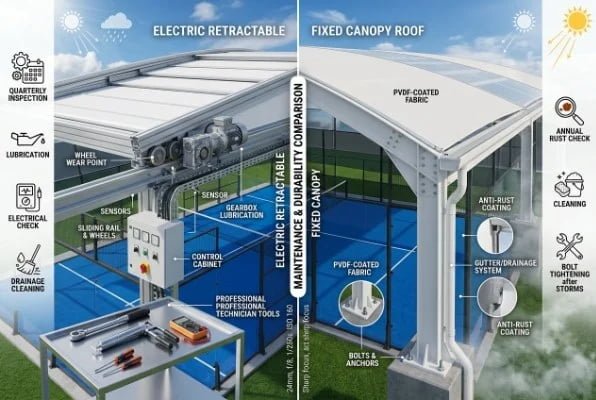
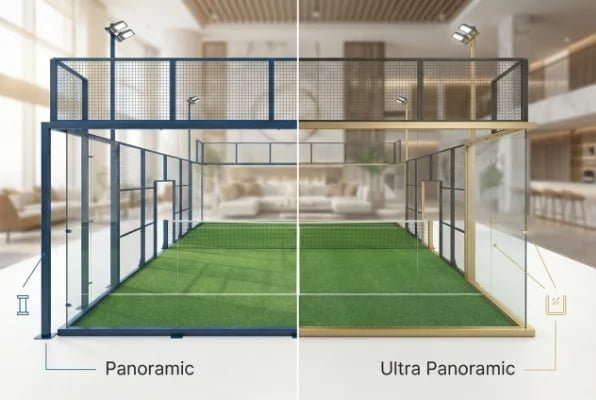
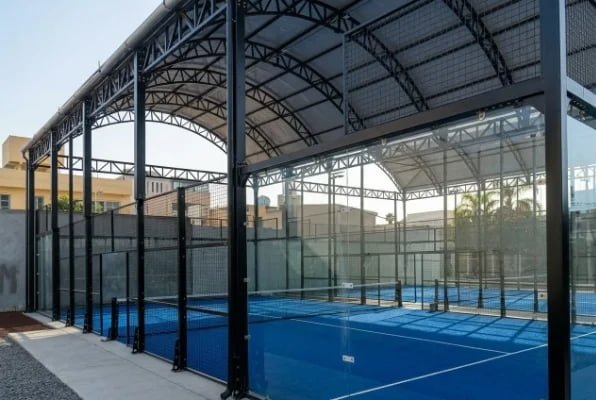
An electric roof padel court can protect playing schedules while preserving the open-air atmosphere that many players prefer. However, buyers can face higher costs, more maintenance, and difficult installation decisions. We help investors compare this flexibility against uncovered and fixed-roof courts so they can select a system that fits their climate and operating model.
An electric retractable roof gives a padel venue adjustable weather protection.1 Operators can open the roof in suitable conditions and close it during rain, excessive sun, or other specified conditions. Its main advantages include scheduling flexibility, an open-air player experience, stronger venue differentiation, and better control over court availability, subject to safe operating limits.
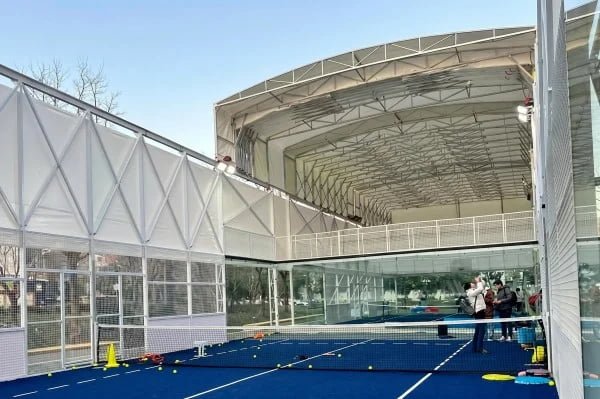
We often find that roof discussions start with design and price. The more useful discussion starts with utilization. A buyer should ask how often the roof will move, what operational problem it solves, and whether the venue can manage its technical and maintenance responsibilities.
What Are the Main Advantages of an Electric Roof Padel Court?
Club operators can lose bookings when outdoor conditions become unsuitable, but a permanently enclosed court can reduce the outdoor character that attracts some players. An electric system provides a middle position. We see its strongest value when a venue genuinely needs both protection and openness at different times.
The main advantages of an electric roof padel court are adjustable enclosure, improved scheduling flexibility, a more open view when the roof is retracted, and greater control over the player environment. The system may also help a venue create a distinctive premium position, although actual commercial results depend on local demand and operating data.
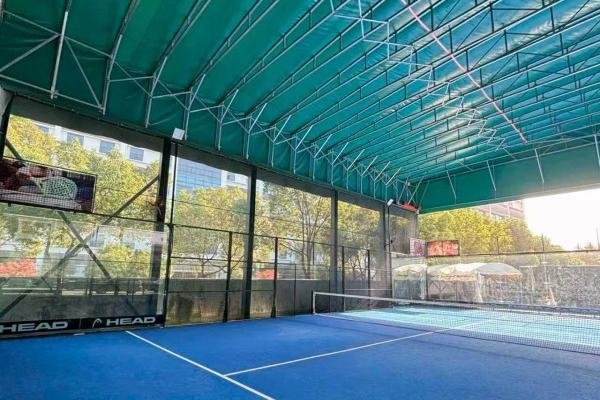
Adjustable Weather Protection
We consider adjustability the defining benefit. A fixed roof remains in place whether the day is clear, cloudy, or wet. An electric retractable roof gives trained venue staff the option to respond to changing conditions within the system’s documented operating limits.
The roof may help operators manage:
- Rain interruptions, when the court, roof geometry, and drainage design support suitable protection
- Strong sunlight, when the roof material and position provide useful shading
- Changing temperatures, when opening the roof can increase natural ventilation
- Variable playing preferences, when customers want either an outdoor or more sheltered experience
- Event schedules, when operators need more control over planned sessions
We do not describe any roofed padel court as automatically usable in every weather condition. Wind, driven rain, lightning, snow, extreme heat, and local safety rules can still require closure.2 A local engineer and relevant authorities should assess these conditions.
A More Open Playing Experience
A fixed roof can create a permanent visual boundary above the court. A retractable padel court roof can offer a clearer top view when it is open. Players may experience more daylight, more natural airflow3, and a stronger connection with the surrounding landscape.
This advantage can matter to:
- Resorts and hotels with attractive views
- Rooftop or waterfront sports venues
- Premium clubs with landscape-focused architecture
- Residential and mixed-use developments
- Seasonal venues that operate differently throughout the year
I have seen buyers focus first on the roof’s appearance in quotation discussions. Their more important question usually appears later: “Will our customers actually prefer the roof open?” We recommend that buyers answer that question through local customer research rather than design assumptions.
Potential Venue Differentiation
An electric roof padel court can become a visible feature in sales presentations and venue tours. However, we treat differentiation as a potential advantage rather than a guaranteed revenue source.
A sophisticated roof does not correct a weak location, poor court installation, insufficient lighting, or an unsuitable booking model. The complete player experience still depends on turf quality, glass alignment, structural stability, lighting, drainage, ventilation, maintenance, and daily operations.
How Does an Electric Roof Padel Court Compare With Open and Fixed-Roof Courts?
Buyers sometimes compare only two quotations: one with a roof and one without it. That approach can hide the most relevant alternative. We usually recommend a three-way comparison because an uncovered court, a fixed-roof court, and an electric retractable system solve different operational problems.
An uncovered court usually offers the lowest complexity and the strongest outdoor feeling. A fixed roof offers continuous overhead coverage with fewer moving components. An electric roof padel court adds adjustable enclosure, but it also introduces motors, controls, electrical work, inspections, maintenance, and higher procurement and installation costs.4
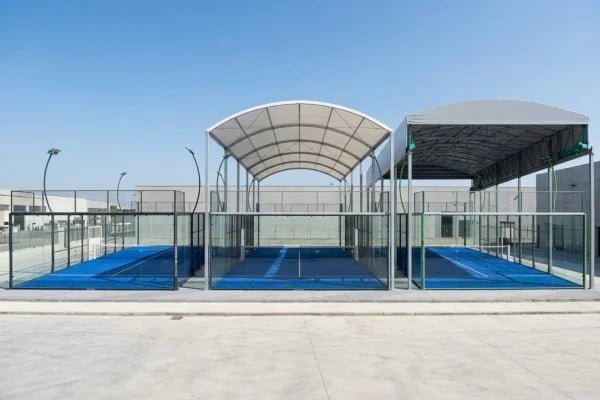
Three Court Configurations at a Glance
| Evaluation factor | Open court | Fixed-roof court | Electric retractable roof |
|---|---|---|---|
| Open-air experience | Strong | Limited by roof design | Strong when retracted |
| Overhead weather protection | None | Continuous | Adjustable |
| Mechanical complexity | Low | Moderate | High |
| Electrical controls | Usually not needed for roof | Usually not needed for roof movement | Required |
| Routine roof maintenance | Low | Moderate | Higher |
| Initial investment | Usually lowest | Middle range | Usually highest |
| Operator training | Basic | Basic to moderate | More detailed |
| Visual differentiation | Depends on court design | Depends on roof architecture | Potentially high |
| Moving-component risk | None for roof | None for roof | Present |
| Best-fit situation | Mild climate or seasonal use | Frequent need for stable coverage | Frequent need for both openness and coverage |
We use this table as a screening tool, not as a final specification. Every project has different wind exposure, rainfall, temperature, foundation conditions, planning requirements, and operating priorities.
When an Open Court May Be Better
We often recommend that buyers keep an open court in the comparison. An uncovered design may make sense when the local climate rarely interrupts play, the project has a limited budget, or the venue lacks the maintenance resources needed for a motorized roof.
An open court can also provide a simple installation process. However, buyers still need to evaluate drainage, corrosion protection, wind exposure, lighting, glass, turf, foundations, and local approvals.
When a Fixed Roof May Be Better
A fixed roof can be the practical choice when the venue expects the roof to remain closed almost all the time. The buyer can avoid paying for movement that the operator rarely uses.
A fixed structure usually has fewer mechanical and electrical components than an electric roof.5 That difference can reduce certain maintenance tasks, although the fixed roof still requires structural inspection, drainage management, cleaning, and fabric or panel maintenance.
When Electric Retraction Has Distinctive Value
The electric system becomes more compelling when both operating modes have measurable value. A venue may want shelter during wet periods and open skies during clear evenings. A hotel may want an unobstructed view during normal play but more protection for scheduled events.
We advise buyers to avoid choosing an electric system only because it appears more premium. The system earns its place when adjustability serves a repeated operational need.
When Can an Electric Roof Padel Court Improve Venue Utilization?
A roof can look impressive in a proposal, but appearance alone does not improve a booking schedule. Buyers need to connect roof movement with specific interruptions and customer preferences. We encourage operators to estimate how many playable hours the roof could realistically protect or improve during a normal year.
An electric roof padel court can improve utilization when changing weather frequently disrupts bookings and when operators will actively use both open and closed modes. Buyers should analyze historical weather, court operating hours, cancellation records, customer preferences, and safe roof operating limits before estimating any utilization or revenue benefit.
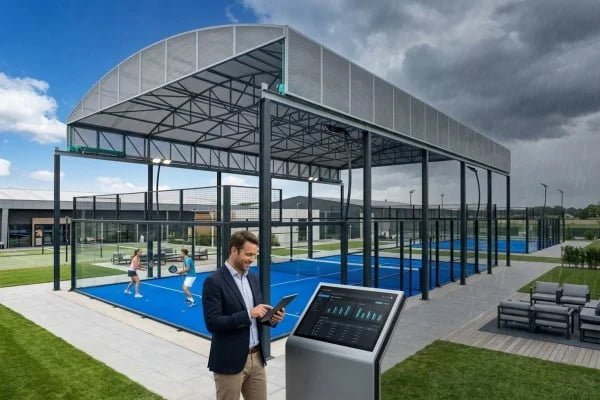
We Start With an Opening-Frequency Estimate
We ask buyers a simple question during roof comparisons:
How many times do you expect your team to open or close the roof during a typical week?
The answer often reveals whether an electric retractable roof is solving a real problem. If the buyer expects the roof to stay closed for months, a fixed roof deserves serious consideration. If the buyer expects daily changes based on weather, events, and customer preferences, electric operation may provide more meaningful value.
We suggest that buyers review at least the following data:
- Hourly rainfall records, rather than annual rainfall totals alone
- Wind speed and direction, including seasonal extremes
- High-temperature periods and direct solar exposure
- Current booking cancellations caused by weather
- Peak booking hours and the value of schedule reliability
- Customer interest in outdoor and sheltered play
- Staff availability to operate and inspect the system
- Local restrictions on operation during adverse conditions
Historical weather data cannot guarantee future performance.6 However, it gives buyers a stronger basis than general claims such as “the area is rainy” or “players prefer outdoor courts.”
We Separate Utilization From Revenue
A venue may protect more booking hours without generating an equal increase in revenue.7 Customer demand, pricing, competition, staffing, coaching programs, and seasonal travel patterns all influence financial performance.
We do not promise a standard payback period for an electric roof padel court. A responsible financial model should include:
- Additional equipment and transport costs
- Foundations and supporting construction
- Electrical installation and control integration
- Local engineering review
- Installation labor and access equipment
- Inspection and commissioning
- Preventive maintenance
- Replacement parts
- Possible downtime during repairs
- Insurance and permit-related expenses
I have found that buyers make better decisions when they model several scenarios. They can create conservative, expected, and high-use cases. They can then test whether the project remains acceptable if the roof moves less often or protects fewer bookings than forecast.
We Consider Venue Positioning
A retractable roof may support a premium venue concept. Hotels, resorts, real estate developments, and flagship clubs may value architecture and customer experience alongside direct court revenue. We still recommend that these buyers document the commercial purpose. A clear purpose makes design choices, budgets, and supplier comparisons easier to defend.
What Costs and Responsibilities Come With an Electric Roof Padel Court?
The roof price does not represent the entire investment. A buyer can receive an attractive equipment quotation and still encounter unplanned expenses during engineering, installation, or operation. We advise buyers to calculate the total lifecycle responsibility before comparing an electric roof with simpler alternatives.
An electric roof padel court generally costs more because it includes moving structures, motors, controls, wiring, sensors or safety devices where specified, and additional installation coordination. Owners must also plan for inspections, cleaning, lubrication where required, electrical servicing, spare parts, staff training, and clearly assigned maintenance responsibility.
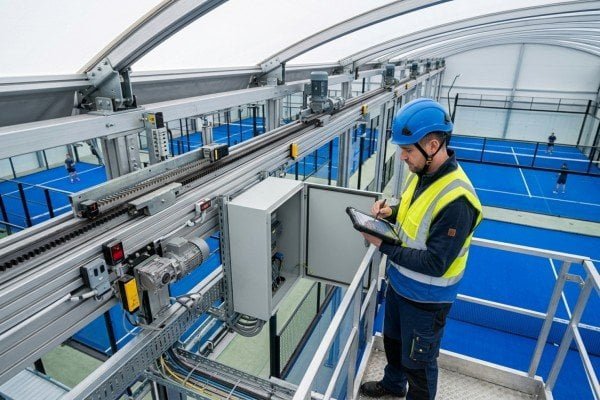
The Cost Premium Has Several Sources
We expect an electric system to involve more components than a conventional fixed roof. The exact bill of materials depends on the design, span, roof membrane or panel system, drive method, control specification, and project location.
A complete cost review may include:
| Cost category | Questions we recommend asking |
|---|---|
| Roof structure | What steel, tracks, supports, and roof materials are included? |
| Drive system | How many motors or actuators does the design use? |
| Controls | What control panel, switches, remotes, and emergency functions are included? |
| Electrical work | Who supplies cabling, protection devices, grounding, and site connections? |
| Installation | Who installs, aligns, tests, and commissions the system? |
| Civil work | Do foundations or support points require special design? |
| Logistics | How are long components, glass, motors, and control equipment packed? |
| Inspection | Which local professionals must inspect the system? |
| Maintenance | What tasks, intervals, and replacement parts does the supplier specify? |
| Warranty | Which party covers components, labor, shipping, and site access? |
We recommend that buyers request a detailed scope-inclusion and scope-exclusion list. That document helps prevent disputes between the court supplier, roof supplier, electrician, civil contractor, and installation team.
Moving Components Create Maintenance Duties
Every moving system experiences wear.8 Tracks can collect debris. Fasteners can loosen. electrical connections can deteriorate. Roof materials can become dirty or damaged. Motors and control components can eventually require repair or replacement.
The supplier should provide a maintenance manual that identifies:
- Inspection points
- Cleaning procedures
- Approved operating sequences
- Lubrication requirements, if applicable
- Fastener checks
- Electrical inspection requirements
- Emergency procedures
- Consumable and spare-part references
- Service intervals
- Conditions that prohibit roof movement
We recommend that qualified technicians perform electrical and structural tasks. Venue staff should only carry out duties for which they have appropriate training and authorization.
Responsibility Must Be Assigned Before Shipment
Export projects involve several parties. The manufacturer may supply the court and roof package, while local contractors complete foundations, power connections, drainage, installation, and approvals. Buyers should assign each duty in writing before production begins.
QHPADEL provides documentation such as installation drawings, foundation drawings, packing lists, and maintenance manuals according to the agreed package. However, buyers should have local qualified professionals review project-specific structural, electrical, drainage, wind, and permitting requirements.
How Should Buyers Evaluate an Electric Roof Padel Court Supplier?
A low quotation can hide missing components, unclear installation duties, or limited technical documentation. A high quotation can also include features that the venue does not need. We recommend that buyers compare suppliers through a controlled specification rather than relying on price or promotional images.
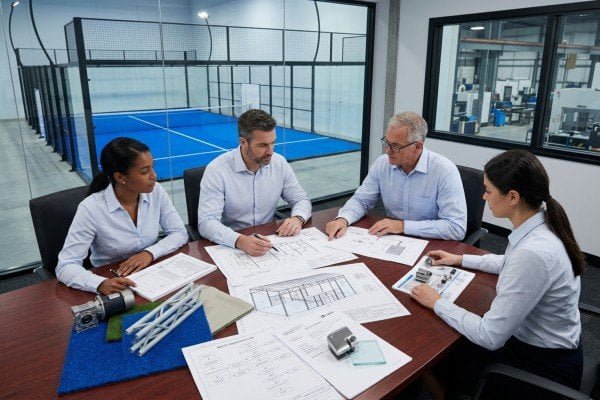
Buyers should evaluate an electric roof padel court supplier by reviewing the complete bill of materials, roof mechanism, control scope, drawings, documentation, packaging, installation support, warranty terms, spare-parts plan, and relevant test or certification records. Local engineers should verify structural, electrical, wind, foundation, drainage, and code suitability.
We Recommend a Technical Request for Quotation
A clear request for quotation helps suppliers price the same scope. Buyers should provide the site location, court quantity, preferred court style, expected roof operation, available power, site dimensions, and known environmental conditions.
The request should ask for:
- A complete bill of materials
- General arrangement and dimensional drawings
- Roof opening and closing description
- Motor and control specifications
- Required site electrical work
- Foundation and support requirements
- Packing and container-loading details
- Installation responsibilities
- Commissioning procedures
- Maintenance instructions
- Recommended spare parts
- Warranty inclusions and exclusions
- Available certificates and test reports
- Lead time and replacement-part process
We also recommend that buyers ask whether the quoted roof is integrated with the padel court frame or supported by a separate structure. That distinction can affect foundations, installation sequencing, structural review, and responsibility allocation.
We Verify Documents Instead of Accepting Logos
A certificate logo on a brochure does not prove that a specific product configuration satisfies a project requirement. Buyers should request full documents and check the product name, model, manufacturer, issuing body, standard, issue date, validity, and scope.
QHPADEL’s stated documentation includes ISO 9001 factory certification and available certification records for specified artificial turf, steel frame structures, tempered glass, LED lighting, screws, and accessories. Buyers should verify that the documents supplied with a quotation apply to the exact products ordered and meet local procurement requirements.
We do not treat component certificates as automatic approval for a complete roofed court. Local authorities may require separate calculations, drawings, inspections, permits, or professional sign-off.9
We Review Production and Export Support
Production capacity matters, but coordination often matters more for an electric roof project. QHPADEL operates 10 production lines and reports monthly capacity above 1.5 million square meters of artificial turf and 150 complete padel court systems. Our standard court lead times generally range from 20 to 30 days depending on quantity, while custom styles can require up to 35 days.
Buyers should confirm the final lead time for the selected roof configuration. They should also review component numbering, packaging protection, loading plans, replacement procedures, and remote installation guidance. A motorized roof requires careful coordination among manufacturing, civil preparation, court assembly, electrical connection, testing, and handover.
Frequently Asked Questions
Is an electric roof padel court suitable for every climate?
No. We recommend project-specific assessment because wind, rainfall, snow, heat, corrosion exposure, drainage, and electrical conditions vary widely. A qualified local engineer should verify structural and foundation requirements. Local electricians and authorities should also confirm power, safety, inspection, and permitting requirements.
Can players use an electric roof padel court in all weather?
No. We avoid making an absolute all-weather claim. A closed roof may reduce certain weather interruptions, but extreme wind, lightning, driven rain, snow, flooding, heat, or other unsafe conditions may still require closure. Operators should follow documented limits and local safety procedures.
Is an electric retractable roof better than a fixed roof?
Not always. We prefer an electric roof when the venue will regularly benefit from both open and sheltered operation. A fixed roof may offer better value when operators expect continuous coverage and do not need frequent roof movement. The final choice should reflect usage, budget, climate, and maintenance capability.
How often does an electric padel court roof need maintenance?
The required interval depends on the system design, components, environment, and supplier instructions. We recommend scheduled inspections of the structure, tracks, roof material, motors, controls, electrical connections, fasteners, and drainage. Qualified technicians should complete tasks involving structural safety or electrical systems.
What documents should I request before ordering?
We recommend requesting the bill of materials, layout drawings, foundation information, installation manual, electrical requirements, packing list, maintenance schedule, warranty, spare-parts list, and relevant certificates or test reports. Local professionals should review these documents against site conditions and applicable regulations before production.
Conclusion
An electric roof padel court offers valuable flexibility when a venue needs both weather protection and an open-air playing experience. Its benefits can include better scheduling control, attractive views, natural ventilation, and stronger venue positioning. However, buyers should weigh those benefits against higher costs, mechanical complexity, maintenance, and local engineering requirements.
We recommend comparing open, fixed-roof, and electric options with real weather and booking data. For a detailed quotation, documentation review, or project comparison, contact Alice Chen at QHPADEL via alice@grass-supplier.com or WhatsApp +86 185 7566 0746.
-
"(PDF) Retractable Roof that Can Withstand All Climate Conditions", https://www.academia.edu/110237185/Retractable_Roof_that_Can_Withstand_All_Climate_Conditions. Retractable roofs are movable roof systems that can be opened or closed to provide either open-air conditions or overhead shelter. Evidence role: definition; source type: encyclopedia. Supports: That retractable roofs are roof structures designed to open and close, allowing a space to alternate between open-air and covered conditions.. ↩
-
"Lightning Safety and Outdoor Sports Activities", https://www.weather.gov/safety/lightning-sports. Weather-safety guidance recognizes that lightning, severe wind, excessive heat, snow, and flooding can create hazards requiring activity suspension or facility-specific safety action. Evidence role: general_support; source type: government. Supports: That lightning, high winds, heat, snow, and other hazardous conditions can require suspension of outdoor or semi-outdoor activities despite available shelter.. Scope note: General weather-safety guidance does not establish the operating limits of a particular retractable-roof design; those limits must come from project engineering and manufacturer documentation. ↩
-
"[PDF] Decision support for the design of a building form coupling daylight …", https://dr.lib.iastate.edu/server/api/core/bitstreams/21919f6f-56ad-49a7-8ae7-fd9019bfa079/content. Building-environment research indicates that operable envelope openings can increase daylight availability and support natural ventilation by permitting direct air exchange with outdoor conditions. Evidence role: mechanism; source type: research. Supports: That opening building envelopes or roof elements can increase exposure to daylight and enable greater natural air exchange.. Scope note: The magnitude of daylight and airflow improvement depends on roof geometry, surrounding obstructions, wind conditions, and the specific court design. ↩
-
"[PDF] Structural Design Of Retractable Roof Structures Advances In …", https://www.clc.fordham.edu/ev232607/21V9E00981035950/PAGE/short/structural__design_of_retractable_roof-structures-advances-in-architecture.pdf. Studies and engineering accounts of retractable roofs describe additional drive, control, inspection, and maintenance requirements associated with movable roof systems, which can increase project and lifecycle complexity relative to fixed structures. Evidence role: general_support; source type: paper. Supports: That retractable roof systems entail specialized moving components, installation coordination, inspection, and maintenance considerations that add lifecycle complexity.. Scope note: This evidence supports the direction of the comparison, not a universal cost premium; actual costs depend on design, site conditions, procurement, and local labor. ↩
-
"[PDF] Structural Design Of Retractable Roof Structures Advances In …", https://www.clc.fordham.edu/ev232607/21V9E00981035950/PAGE/short/structural__design_of_retractable_roof-structures-advances-in-architecture.pdf. Engineering descriptions of retractable roofs identify moving roof elements, drive mechanisms, controls, and monitoring or safety systems as integral parts of their operation, unlike nonmoving fixed roofs. Evidence role: mechanism; source type: paper. Supports: That retractable roof systems require moving structural elements and drive, control, and safety systems that are not required for a nonmoving fixed roof.. Scope note: The number and type of components vary substantially by span, roof form, drive technology, and applicable safety requirements. ↩
-
"Climate change impacts – NOAA", https://www.noaa.gov/education/resource-collections/climate/climate-change-impacts. Climate authorities explain that historical observations and climate normals summarize past conditions but cannot guarantee future weather or climate outcomes, especially where variability and long-term change alter local risk. Evidence role: expert_consensus; source type: institution. Supports: That historical weather observations and climate normals characterize past conditions but are not guarantees of future conditions, particularly where climate variability and change affect risk.. Scope note: Historical data may still be useful for preliminary planning when interpreted alongside projections, extremes, and site-specific risk assessment. ↩
-
"Sports, Jobs, & Taxes: Are New Stadiums Worth the Cost? | Brookings", https://www.brookings.edu/articles/sports-jobs-taxes-are-new-stadiums-worth-the-cost/. Facility-economics research generally finds that additional capacity or availability produces revenue only to the extent that demand, pricing, and operational capability support additional paid use. Evidence role: general_support; source type: research. Supports: That revenue effects from increased facility capacity or availability depend on demand, pricing, competition, and operating conditions rather than capacity alone.. Scope note: This principle is contextual and does not quantify revenue effects for padel venues in a particular market. ↩
-
"[PDF] degradation modeling of a robot arm to support prognostics and …", https://tsapps.nist.gov/publication/get_pdf.cfm?pub_id=935776. Mechanical-engineering literature recognizes wear as a consequence of repeated relative motion, loading, friction, and environmental exposure, making inspection and maintenance relevant to moving assemblies. Evidence role: mechanism; source type: research. Supports: That friction, loading, environmental exposure, and repeated motion contribute to mechanical wear and motivate inspection and preventive maintenance.. Scope note: Wear rates and maintenance intervals are component- and environment-specific and cannot be inferred from this general principle alone. ↩
-
"Building Site Inspection Program", https://www.tdlr.texas.gov/ihb/bldgsite.htm. Building-regulation authorities commonly require permits, plan review, structural documentation, and inspections for regulated construction, and may require licensed professional design or sign-off depending on the project and jurisdiction. Evidence role: general_support; source type: government. Supports: That building-control systems commonly require permits, plans, structural information, and inspections for construction work, with professional design documentation required in specified circumstances.. Scope note: Exact requirements are determined by the applicable local code, authority having jurisdiction, project classification, and site conditions. ↩