You forget your padel balls at home. You only have old tennis balls in your bag. Should you use them? I will show you why you must avoid this mistake.
You can physically hit a tennis ball on a padel court, but you should never do it. Tennis balls have higher internal pressure and bounce much faster. They make the ball impossible to control with a solid padel racket. They also ruin the strategic use of the glass walls.
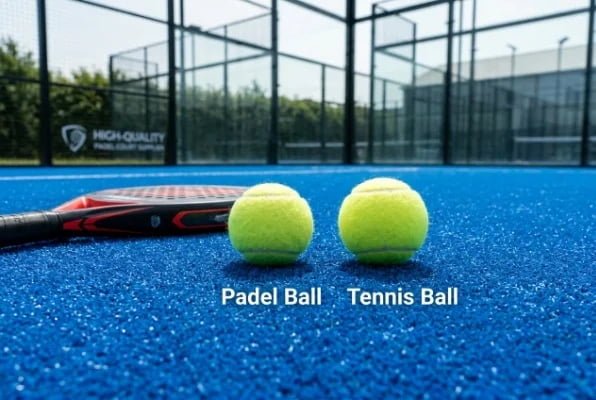
Many beginners ask me this question when they buy new courts from QHPADEL. They want to save money. They want to use their old tennis gear. However, this small choice changes the whole game. I always tell my clients that a padel court needs the right accessories. If you spend money to build a great court, you must use the right ball. Let us look closely at why these two yellow balls are completely different.
What Are the Main Differences Between Padel and Tennis Balls?
You look at both balls. They look exactly the same. You feel confused. How do you tell them apart? The secret hides inside the rubber core.
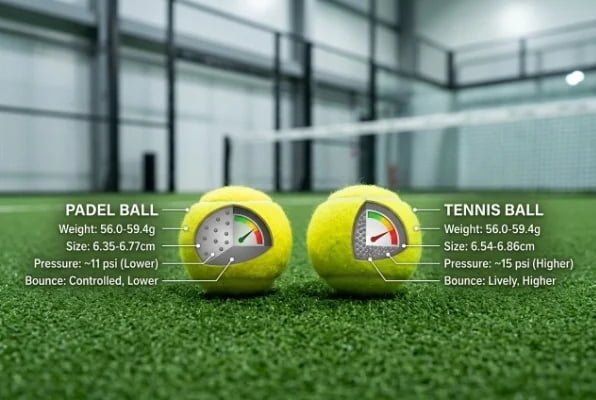
The main difference between a padel ball and a tennis ball is the internal pressure and weight. The official rules state a padel ball must be slightly lighter. Padel balls also have lower internal pressure. This lower pressure creates a slower and lower bounce than tennis balls.
Understanding the Physical Design
When I worked in the artificial turf factory, I learned that small details change everything in sports. We must look at the specific rules to understand these two balls. Both balls are fuzzy. Both balls are yellow. Both balls undergo pressurization in the factory. But the differences in weight, size, and internal pressure1 change how they fly through the air.
Tennis balls need to travel across a large, open court. They need high internal pressure to fly fast. They need to bounce high on hard courts or grass. Padel courts are much smaller. They use soft artificial turf with silica sand. If a padel ball has high internal pressure, it will fly out of the small court very easily.
Let us break down the exact numbers. I made a simple table to show the International Padel Federation (FIP) and International Tennis Federation (ITF) rules.
| Feature | Padel Ball | Tennis Ball |
|---|---|---|
| Weight | 56.0 to 59.4 grams | 56.0 to 59.4 grams |
| Size | 6.35 to 6.77 cm | 6.54 to 6.86 cm |
| Pressure | 10 to 11 psi | Around 14 psi |
| Bounce | 135 to 145 cm | 135 to 147 cm |
The weight numbers look very similar on paper. However, manufacturers always make the padel ball on the lower end of the weight limit. They make the tennis ball on the higher end. The internal pressure difference is the most important factor here. A lower pressure means a softer ball. A softer ball means a slower game. This slower speed matches the small court size. It helps players keep the rally going. The FIP tests every ball carefully to ensure it meets these strict rules. If you buy a certified padel ball, you guarantee a good game.
What Happens If You Use a Tennis Ball on a Padel Court?
You start hitting a tennis ball on your new padel court. The ball flies everywhere. You feel frustrated and want to quit. The high pressure destroys the padel experience.
Using a tennis ball on a padel court makes the game too fast and hard to control. The ball bounces too high off the artificial turf. It rebounds too hard off the glass walls. You cannot use tactics, and rallies end very quickly.

The Impact on Gameplay and Tactics
Padel is a game of careful strategy. It is not just a game of power. The sport uses walls, just like squash. The court is completely enclosed by metal mesh and glass walls. When you play with a real padel ball, the low pressure helps the ball bounce off the glass gently. You have time to move. You have time to think. You have time to hit the ball back over the net.
When you use a tennis ball, the high pressure2 creates a huge problem. The ball hits the glass and shoots out like a rocket. You cannot catch up to it. The delightful, fast-paced rhythm of attack and defense is completely lost. Rallies become very short and boring.
Also, you must think about your racket. A tennis racket has strings. Strings act like a trampoline. They absorb the heavy impact of a hard tennis ball. A padel racket is a solid piece of carbon fiber or fiberglass. It has holes, but it has no strings. Hitting a hard, high-pressure tennis ball with a solid padel racket feels terrible. It transfers a lot of shock to your wrist and elbow. It can even hurt your arm over a long period.
| Game Element | With Padel Ball | With Tennis Ball |
|---|---|---|
| Court Control | Easy to place the ball | Ball flies out of control |
| Glass Walls | Useful for strategic returns | Ball rebounds too fast |
| Rallies | Long and engaging | Short and frustrating |
| Racket Feel | Comfortable impact | Harsh impact, hurts arm |
Padel places a great focus on keeping pace with the speed of the ball. Tennis focuses on clever angles and big volleys. You can physically hit the tennis ball on the padel court. But it ruins the authentic padel experience. The padel ball is engineered perfectly. It gives you the best bounce speed. It gives you the best rhythm on the artificial turf. This design helps new players learn the game easily.
Conclusion
You should never use a tennis ball for padel. The high pressure ruins the bounce, makes wall tactics impossible, and hurts your arm. Always choose the correct padel ball.