
Are you unsure about your padel court base? A wrong base choice ruins the game completely. Here is the truth about using shock pads under your padel grass.
No, you do not need a shock pad under padel court artificial grass. A shock pad makes the surface too soft. Padel requires a solid concrete base. High-density turf filled with silica sand provides all the necessary shock absorption for players while keeping the ball bounce perfect.
Many buyers ask me this question because they want the best for their projects. They worry about player safety. They also worry about court quality. I talk to purchasing staff and company owners every day. They want to avoid mistakes. They need strict quality control. Choosing the wrong base layer is a massive mistake. Let us look at why a shock pad is a bad idea for your next padel club. I will share my engineering experience to help you build the perfect court.
Will a Shock Pad Absorb Too Much Energy from the Padel Ball?
Are players complaining about a dead ball? If the court is too soft, the game is ruined. Let us look at how shock pads kill ball energy.
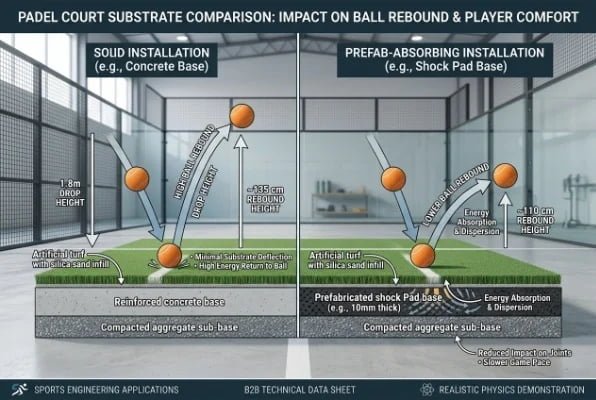
Yes, a shock pad absorbs too much energy from the padel ball. Padel needs a fast and steady ball bounce. A soft pad under the grass eats the energy of the ball. The ball will not bounce high enough. This makes the court useless.
The Physics of Ball Bounce
When a padel ball hits the ground, it needs a hard surface. The hard surface pushes the ball back up. This is basic physics. If the surface is soft, the surface bends. The bending takes the energy away from the ball. The ball stops and stays low. Players cannot hit the ball back. I tested this in our QHPADEL factory last year. We dropped a padel ball on a concrete floor. It bounced very high. Then we put a 10mm shock pad on the concrete. We dropped the ball again. The bounce was less than half the normal height.
Soccer Fields are Different
Many contractors build soccer fields and padel courts. They think both need shock pads. This is wrong. Soccer players run fast and tackle each other. They fall hard. They need shock pads to stop broken bones. Padel players do not tackle. They need the ball to bounce perfectly.
| Sport | Main Player Action | Ground Requirement | Need Shock Pad? |
|---|---|---|---|
| Padel | Hitting a bouncing ball | Hard and firm | No |
| Soccer | Running and tackling | Soft and safe | Yes |
| Rugby | Heavy physical contact | Very soft | Yes |
How Do Padel Courts Get Shock Absorption Without an Underlay?
Knee pain is a big fear for club owners. You want safe courts for your clients. How do we protect players without using soft pads?
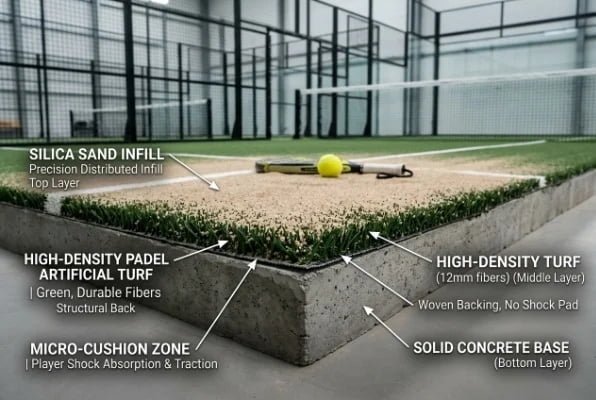
Padel courts get shock absorption from the artificial turf and silica sand. Our high-density turf holds the sand tightly. This sand and grass mix acts as a built-in cushion. It protects player knees. It also keeps the surface hard enough for a perfect ball bounce.
The Power of High-Density Turf
I always tell my clients to check the turf density. At QHPADEL, we make artificial grass with very high density and high dtex. Dtex means the weight of the grass yarn. Thick and heavy yarn stands up straight. When we put silica sand into this grass, the sand fills the spaces. The grass holds the sand in place. This creates a solid but flexible layer.
The Micro-Cushion Effect
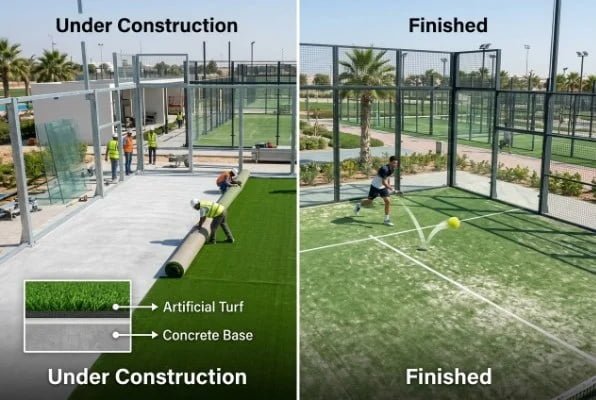
You only need a flat and hard concrete base under the grass. The concrete gives the solid support. The sand inside the grass gives a micro-cushion. When a player steps hard, the sand moves a tiny bit. This small movement takes the stress off the knees. David, a club owner in Canada, bought our turf last year. He was worried about older players getting joint pain. I told him to trust our turf-sand system. Today, his older players love the courts.
| Base Layer | Material | Purpose |
|---|---|---|
| Bottom | Concrete | Firm support for ball bounce |
| Middle | Artificial Turf | Holds sand and provides grip |
| Top | Silica Sand | Protects knees and turf fibers |
What Happens If You Install a Shock Pad by Mistake?
Construction mistakes happen often. A wrong installation wastes a lot of money and time. What exactly happens if your workers put down a shock pad?
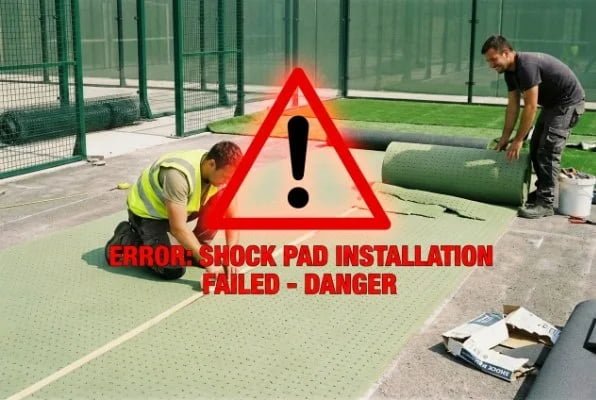
If you install a shock pad by mistake, the court is ruined. The ball will not bounce right. You cannot just pull the pad out easily. You must stop play, tear up the expensive artificial grass, remove the pad, and buy totally new grass.
The Cost of a Wrong Base
If your contractor puts a shock pad under the grass, you have a big problem. You cannot use the court. The players will ask for their money back. To fix this, you must cut the grass open. You cannot save the old grass because it is full of heavy sand. You must throw the old grass away. Then you take out the shock pad. Finally, you must buy new grass and pay workers to install it again. This is a huge loss of money.
Delays in Club Opening
I know a client in Mexico named Carlos. His local contractor tried to use left-over soccer pads for his padel courts. Carlos did not know this was bad. After the installation, the ball did not bounce. They had to stop the project. Carlos missed his club opening date by one month. He lost rental income. He also paid twice for the grass.
| Problem Area | Detail of the Loss |
|---|---|
| Material Cost | Buying new grass and new sand |
| Labor Cost | Paying workers to remove and rebuild |
| Time Delay | Missing the paving completion date |
| Business Loss | No rental income for weeks |
Conclusion
Padel courts do not need shock pads. A solid concrete base with high-density artificial turf and silica sand gives the perfect ball bounce and keeps players safe.