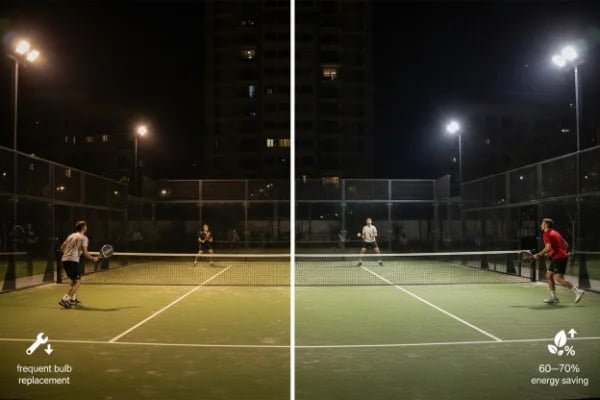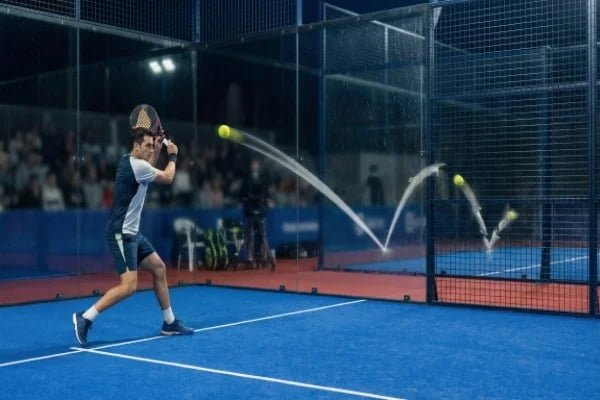
Bad lighting ruins a good game of padel instantly. Players complain about glare, shadows make the ball disappear, and your court bookings drop because nobody enjoys playing in the dark.
The optimal height for padel court light poles is usually 6 meters for standard recreational and club use. For professional competitions requiring television broadcasting, 8-meter poles are recommended. This height ensures uniform light distribution, minimizes glare for players, and maintains the necessary lux levels for high-quality gameplay.
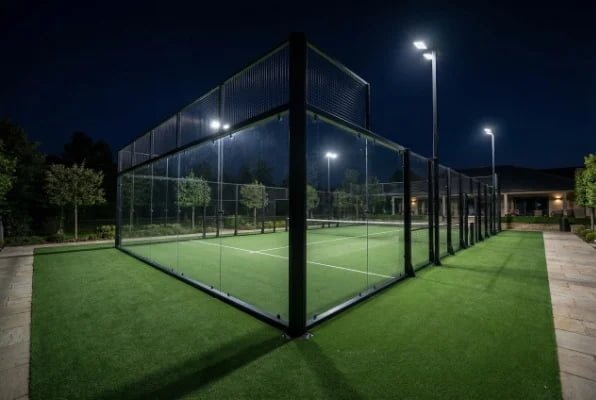
I have seen many court owners ignore this specific detail. They focus on the turf or the glass, but they forget the lights. This mistake costs them money later. You need to know the specific numbers to make the right choice.
Why does the height of the light pole matter for player experience?
Have you ever played on a court where the lights blind you during a smash? It is frustrating and dangerous for players who just want a safe game.
The pole height directly controls where shadows fall and how much glare hits the glass walls. Correct height balances the light so players see the ball clearly without being blinded by direct beams or distracted by strong reflections on the glass.
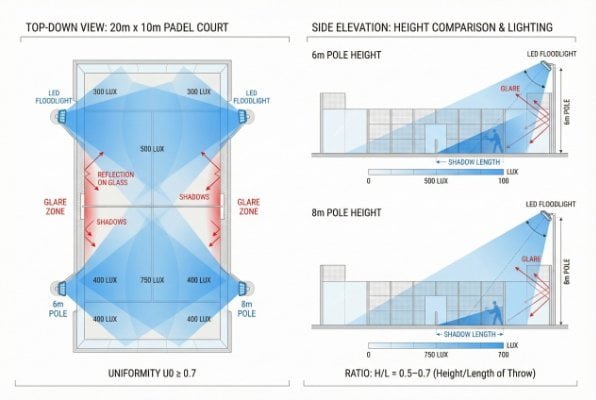
I often tell my clients that lighting is about geometry, not just brightness. If your light poles are too low, the angle is bad. The lights will cast long, noticeable shadows. They also create glare on the glass walls. This affects the players’ vision significantly. However, you cannot just make them extremely high. If the light poles are too high, the light dissipates. It disappears before it reaches the ground. This reduces lighting efficiency and wastes energy.
I rely on data for my advice. Research from the International Commission on Illumination (CIE) gives us a formula. The optimal ratio of light pole height to field length for small enclosed sports fields is roughly 1:0.5 to 0.7. A padel court is 20 meters long. This calculation means we need a height of 6 to 8 meters. This specific height range achieves uniform light distribution. We aim for a uniformity ratio greater than or equal to 0.7. It also maintains horizontal illuminance between 300 and 750 lux.
We must also consider the structure itself. Padel courts have a minimum height of 4 meters for the mesh and glass. A very small group of my clients face strict field limitations. Their buildings are only 4 to 5 meters high. They must modify the light poles to stay within 4 meters. This is rare and not ideal. For the best experience, sticking to the calculated ratio is crucial. I always advise against lowering the poles unless there is absolutely no other choice. Good visibility keeps players coming back.
What are the standard light pole heights according to professional regulations?
Guessing the right specifications for your local safety codes is a recipe for disaster. You might face fines or forced closures if your equipment does not meet the mandatory standards.
Standard regulations distinguish between training courts and professional venues. A 6-meter pole is the industry standard for most clubs, while 8-meter poles are required for televised events to allow for better camera work and higher vertical illumination without blinding the players.
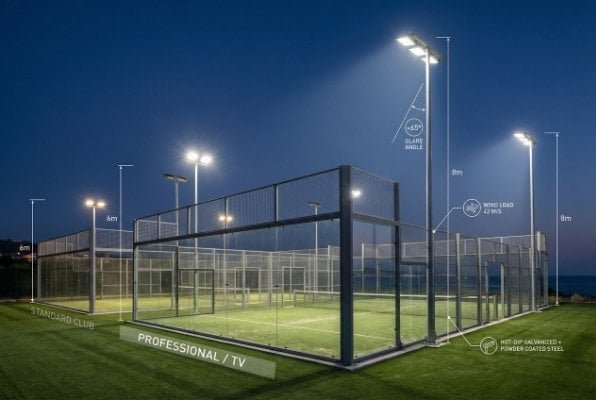
Through my years at QHPADEL, I have standardized our recommendations based on proven results. The most common choice is the standard 6-meter-high light pole. This works perfectly for indoor and outdoor recreational fields. It is also the standard for most commercial clubs. However, some professional events have different needs. They choose 8-meter-high light poles. These usually carry stronger 400W anti-glare LED lights.
We must evaluate three critical factors when designing these systems.
First is Glare Control. The angle between the light source and the horizontal plane should be less than 65 degrees. This reduces direct glare to the players’ eyes.
Second is Wind Load Resistance. This is vital for outdoor courts. Posts up to 6 or 8 meters high must meet EN40-3-1:2013 standards. They must withstand wind speeds up to 42 meters per second. This ensures safety during storms.
Third is Corrosion Resistance. At QHPADEL, we use hot-dip galvanized steel poles. We treat them with electrostatic powder coating for rust prevention. If you build in a coastal area, we add a zinc-rich epoxy primer. This prevents the salty air from eating the metal.
Here is a breakdown of the specific requirements:
| Feature | Standard Requirement |
|---|---|
| Standard Height | 6 Meters |
| Professional Height | 8 Meters |
| Wind Resistance | Up to 42 m/s |
| Glare Angle | < 65 Degrees |
| Material Treatment | Hot-dip Galvanized + Powder Coating |
HOW MANY LIGHTS FOR A PADEL COURT?
Buying too many lights wastes your budget, but buying too few creates dark spots on the court. Finding the exact balance is difficult without technical knowledge of lux levels and positioning.
The standard LED lighting system for a padel court consists of 8 lights in total. We mount 2 lights on each of the 4 light posts. This configuration ensures that every corner of the court receives adequate coverage and maintains the required brightness levels.
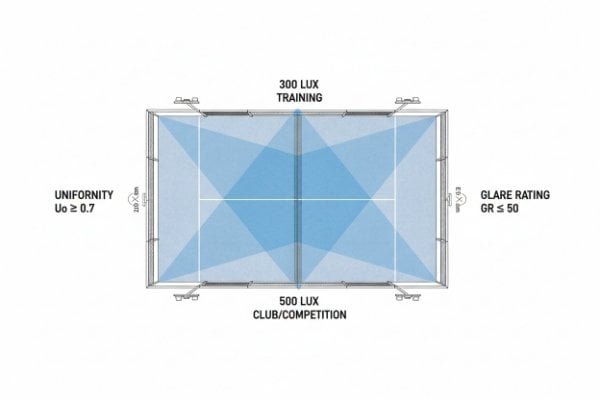
You need to know exactly how the system fits together. The standard setup involves 8 lights. We install 2 lights on each light post. Where do the posts go? Each light post sits on a pillar between the tempered glass and the steel mesh on the side of the court. We position them 6 meters above the ground. This side positioning is deliberate. It prevents lights from hanging directly over the play area where high balls occur.
This specific number of lights is not random. It is calculated to meet lux standards. The recommended minimum sustained illuminance for a field varies by use. For training and recreation, you need 300 lux. For clubs and competitions, you need 500 lux. If you use fewer than 8 lights, you will likely fail to hit these numbers. The court will look dim.
We also look at quality metrics beyond just brightness. We measure Uniformity (Uo). This value must be greater than or equal to 0.7. This means the light is even across the floor. We also measure the Glare Rating (GR). This must be less than or equal to 50.
I advise my clients to check these parameters during the factory inspection. Chinese suppliers can vary in quality. You must ensure the 8 lights provided actually meet these lux and glare standards. At QHPADEL, we test this strictly before shipping. You do not want to install the lights and then find out they are too weak. Replacing them later is expensive and disrupts your business.
Conclusion
Choosing the right height and quantity of lights ensures player satisfaction and safety. Stick to 6-8 meter poles and an 8-light system to guarantee optimal visibility for your padel business.