Padel court lighting can look adequate on a quotation yet perform poorly after installation. Players may encounter glare, dark corners, strong shadows, or difficulty tracking the ball against glass.1 I reduce that risk by treating lighting as a scenario-based system involving visual needs, court geometry, fixture optics, aiming, site conditions, and budget.
Professional padel court lighting should be designed around the court’s operating scenario rather than a fixed wattage, fixture count, or illuminance target.2 A suitable design balances ball visibility, lighting uniformity, glare control, vertical illumination, mounting geometry, environmental conditions, and cost. Project-specific calculations and acceptance criteria should be verified by a qualified lighting professional.
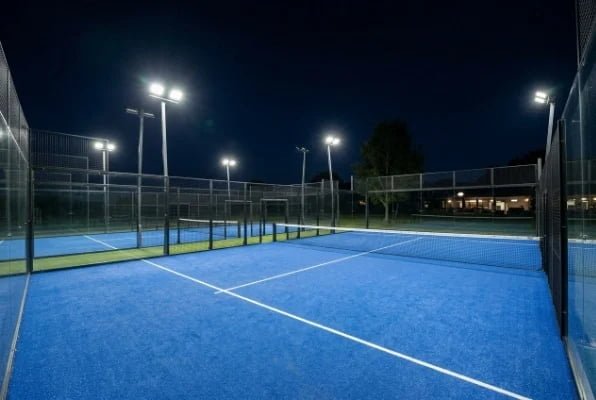
In customer configuration discussions, I start with how the court will actually be used. I then examine the structure, site, and expected visual performance. This process often reveals why two courts of the same size may need different lighting proposals.
How Should I Define the Padel Court Lighting Scenario?
A buyer can select fixtures too early and discover later that the specification does not match the court. Recreational evening play, competitive events, indoor clubs, and outdoor facilities create different visual demands. I therefore define the operating scenario before discussing lamp power, quantity, or price.
I define the lighting scenario by documenting the usage level, indoor or outdoor location, operating hours, surrounding light, court orientation, mounting restrictions, maintenance conditions, and any broadcasting or local compliance requirements. These inputs give the supplier and lighting professional a reliable basis for proposing and verifying an appropriate configuration.
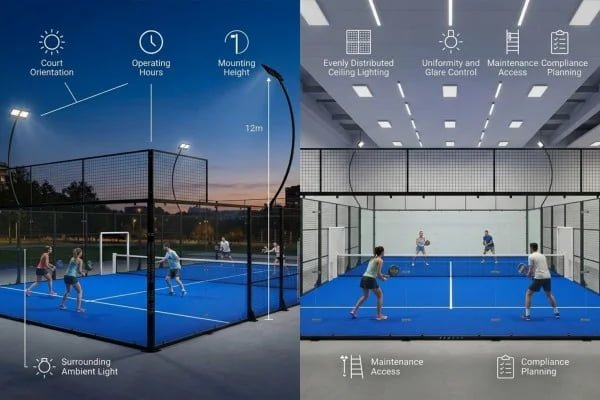
I Start With the Level of Play
A private residential court does not normally have the same performance expectations as a commercial club or tournament venue. However, I do not assume that “recreational” means poor-quality lighting. Club customers still need players to follow fast shots, lobs, and rebounds without discomfort.
I usually ask buyers to classify the intended use:
- Private or occasional recreational play
- Commercial club training and regular matches
- Competitive events
- Institutional use, such as schools or municipal sports centers
- Broadcasting, recording, or live streaming
- Mixed use, such as daily club play with occasional tournaments
This classification does not automatically produce a universal illuminance value. It helps establish the appropriate performance range and documentation requirements. A qualified professional should compare those requirements with applicable federation guidance, tender documents, and local regulations.
I Separate Indoor and Outdoor Conditions
Indoor and outdoor projects create different problems. An indoor building may have roof beams, reflective walls, dark ceilings, limited mounting height, or other sports areas nearby. Those elements can affect shadows, glare, and fixture placement.
An outdoor court introduces other variables:
- Nearby roads, homes, hotels, or offices
- Existing streetlights and architectural lighting
- Court orientation and surrounding darkness
- Wind exposure and vibration
- Rain, dust, salt, humidity, and temperature
- Local restrictions on spill light or operating hours
- Access for maintenance equipment
I once reviewed a customer question that initially focused only on LED wattage. After discussing the site, the more important issue became the neighboring residential area. The proposal needed controlled optics and careful aiming rather than simply stronger fixtures.
I Document the Operating Schedule
Operating hours affect both visual needs and commercial cost. A club running lights for six to ten hours per evening may place greater value on efficiency, dimming, control zones, heat management, and maintenance access than a private court used twice a week.
I recommend that buyers provide at least the following project inputs:
| Project input | Why I request it |
|---|---|
| Court type and quantity | Multiple courts can affect spill light and pole positions |
| Indoor or outdoor setting | The environment changes fixture and layout requirements |
| Intended level of play | Visual performance expectations differ |
| Daily operating hours | Energy and maintenance costs become easier to evaluate |
| Site drawing and orientation | Geometry influences aiming and mounting positions |
| Nearby properties or roads | Glare and spill light may need tighter control |
| Ceiling or pole restrictions | Available mounting points affect the proposal |
| Streaming or broadcasting plans | Cameras can require separate technical evaluation |
| Local standard or tender requirement | The design must respond to project-specific rules |
I avoid approving a lighting package from a product catalog alone. A catalog describes equipment, but it does not prove how that equipment will perform on a particular court.
Why Is Average Illuminance Not Enough for Padel Court Lighting?
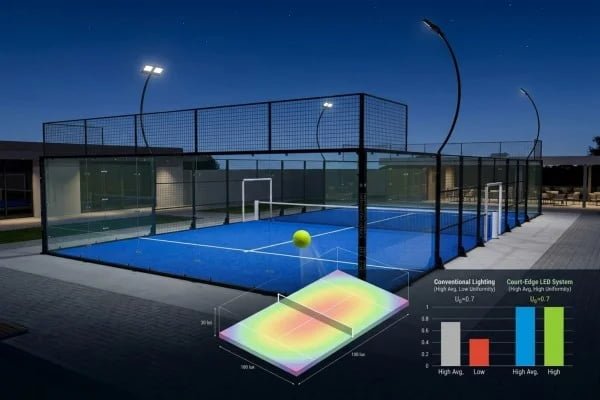
A quotation may advertise a high average illuminance figure, but that number can hide serious visual problems. One bright area can raise the average while corners remain dark. Players may also experience glare or lose sight of high balls even when a meter records substantial light on the playing surface.
I evaluate padel court lighting as a complete visual system. Average horizontal illuminance is only one metric. I also ask about uniformity, minimum values, glare control, vertical illumination, shadows, color quality, surrounding contrast, measurement grids, maintenance assumptions, and whether the calculation covers the full playing area.
I Look at Distribution, Not Just the Average
Averages can be misleading. For example, a calculation may combine very bright zones beneath fixtures with weaker areas near glass corners. The resulting average can appear acceptable even though players experience repeated changes in brightness.
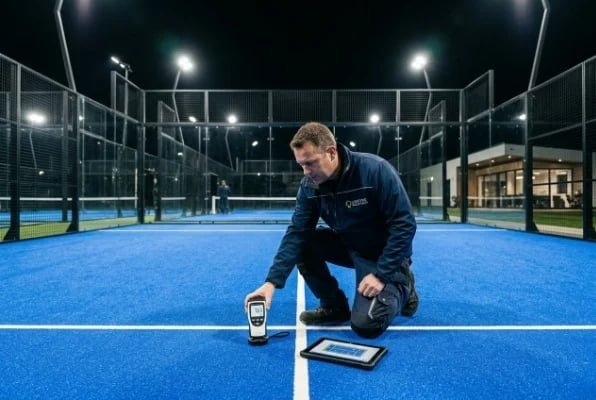
Uniformity provides more context. Project documents may express uniformity as a ratio such as minimum illuminance divided by average illuminance. However, I ask the project lighting professional to confirm the correct formula, measurement plane, grid, and target because standards and tender requirements can define them differently.
I ask suppliers or consultants to show:
- The calculation grid
- Average, minimum, and maximum values
- Uniformity ratios
- Fixture positions and mounting heights
- Aiming directions
- The maintained-light assumption
- Calculation boundaries
- Any excluded areas or obstructions
A single headline number does not provide this information.
I Consider Vertical Ball Visibility
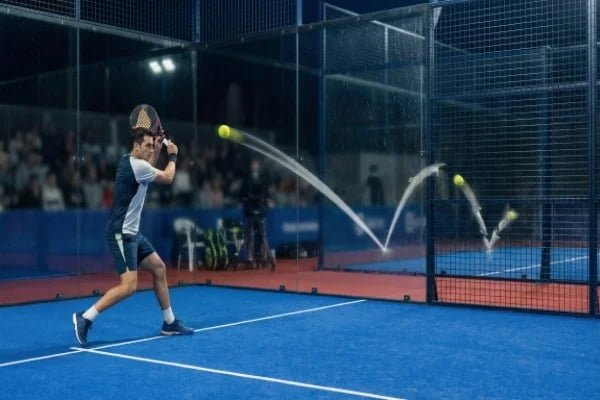
Players do not look only at the floor. They track a moving ball at different heights and directions.3 A lob may rise above the main line of sight, while a fast volley may cross the court near a player’s body. Glass walls and dark or bright backgrounds can further affect visual contrast.
For that reason, I ask whether the proposal considers vertical illumination and the likely viewing directions. This point becomes especially important when a project includes video recording or broadcasting. Cameras and human eyes do not evaluate a scene in exactly the same way4, so a general club-level design may not satisfy camera requirements.
I Treat Glare as a Design Issue
Glare is not solved by reducing or increasing wattage alone. Players may look upward while serving or following a lob. If a bright fixture sits directly in a common sightline, it can cause discomfort or briefly reduce the ball’s visibility.5
In post-installation feedback, I have seen customers describe acceptable overall brightness but request changes to fixture angles because one viewing direction felt uncomfortable. I treat that feedback as practical experience, not laboratory evidence. It shows why on-site aiming should remain part of commissioning.
I Check Color and Flicker Documentation
Color rendering, correlated color temperature, driver quality, and flicker behavior can influence the perceived result.6 They may also matter for camera use. I do not select these characteristics by marketing language such as “daylight white” alone.
Instead, I request technical documents and compare:
- Declared color temperature and tolerance
- Color rendering information
- Driver model and electrical specifications
- Flicker-related data when recording is planned
- Optical distribution files used in calculations
- Lumen maintenance assumptions
- Product and driver certificates required by the project
At QHPADEL, LED lighting documentation can include CE and relevant AS/NZS-related certificates for specified products. I advise buyers to verify certificate numbers, product-model coverage, validity, issuing bodies, and acceptance by local authorities. A certificate is a document to review, not proof that a complete site design will meet every local requirement.
How Do Fixture Optics and Court Geometry Affect Padel Court Lighting?
Buyers sometimes compare lighting packages through watts per fixture and total fixture quantity. That comparison is incomplete. Two fixtures with similar power can distribute light very differently. If optics, aiming, mounting height, or court geometry are unsuitable, adding more power may increase glare without correcting the dark areas.
I coordinate fixture selection with the court structure and site layout. Beam distribution, fixture position, mounting height, tilt angle, setback, glass location, structural posts, and neighboring courts all influence visibility. I prefer to review these factors before production and retain enough adjustment for proper on-site aiming.
I Compare Optics Before Wattage
Wattage describes electrical input. It does not, by itself, describe useful light on the court.7 Luminous output provides more information, but even total lumens cannot show where the light will go.
Fixture optics control distribution. Depending on the layout, a designer may consider narrow, medium, wide, asymmetric, or other specialized beam patterns. The appropriate option depends on actual mounting geometry.
| Specification | What it tells me | What it does not prove |
|---|---|---|
| Wattage | Approximate electrical input | Visibility, uniformity, or glare control |
| Luminous flux | Declared total light output | Distribution across the court |
| Beam distribution | How the fixture directs light | Final site performance without calculation |
| Color temperature | Declared appearance of the light | Color consistency or visual comfort |
| [Ingress protection rating | Resistance to defined environmental exposure](https://en.wikipedia.org/wiki/IP_code)[^8] | Long-term performance in every climate |
| Photometric file | Data for lighting simulation | Accuracy of the whole project model |
| Fixture quantity | Number of installed luminaires | Whether positions and angles are suitable |
I prefer a lower-power configuration with appropriate optics over a higher-power option that sends excessive light outside the useful area. However, I do not treat that preference as a universal rule. A project-specific model should demonstrate the expected result.
I Coordinate Lighting With the Court Structure
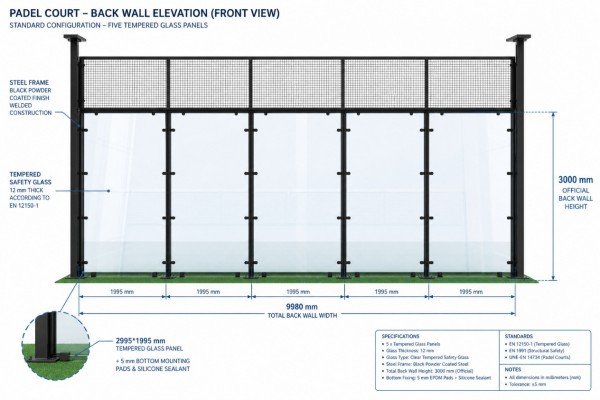
A complete padel court is an integrated assembly. Structural posts, mesh panels, tempered glass, access doors, turf, nets, and lighting supports must work together. Lighting positions should not be decided after the steel structure has already been manufactured unless the system was designed for those positions.
I review questions such as:
- Can the intended post safely support the fixture and bracket?
- Does the mounting position conflict with structural connections?
- Will a fixture or cable interfere with glass installation?
- Can technicians reach the fixture for future maintenance?
- Could the frame or roof create a shadow?
- Does the aiming direction place a fixture in a common player sightline?
- Will neighboring courts affect each other?
- Are conduits, junction boxes, and cable routes coordinated?
- Does the support need evaluation for wind or vibration?
A structural engineer should verify load-bearing questions and local wind requirements. I can coordinate product drawings and component information, but I do not replace a licensed engineer’s project-specific review.
I Preserve On-Site Adjustability
Even a detailed proposal may need adjustment after installation. Actual site conditions can differ from early drawings. A nearby wall may be lighter than expected. An indoor ceiling may create reflections. A mounting bracket may have a slightly different practical range.
I therefore prefer clearly defined aiming references and adjustable mounting hardware where appropriate. The installation team should record final angles and tighten fasteners according to the approved instructions.
When a customer reports shadows or glare, I investigate the pattern before recommending more fixtures. The first checks often include:
- Whether each fixture matches the specified model and optic
- Whether all fixtures are operating correctly
- Whether installers followed the intended positions
- Whether aiming angles changed during installation
- Whether any structure blocks part of the beam
- Whether voltage or driver issues affect output
- Whether site conditions differ from the original proposal
This sequence can prevent unnecessary equipment purchases.
What Should a Professional Padel Court Lighting Proposal Include?
A short quotation with fixture quantity, wattage, and price may seem convenient, but it leaves important assumptions undefined. If the final result is uneven, buyers and suppliers may disagree about responsibility because neither party established performance criteria, installation conditions, or commissioning procedures.
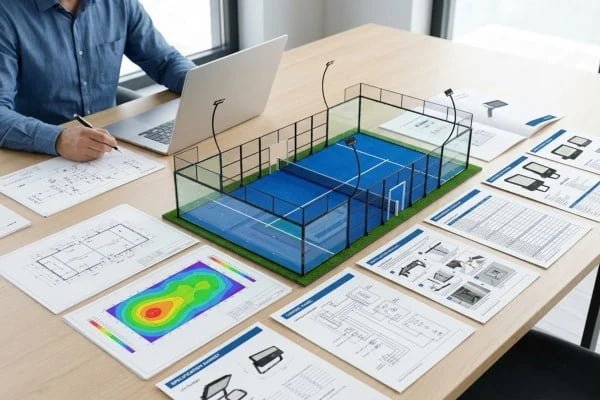
I expect a professional proposal to connect project inputs with equipment selection, layout drawings, photometric information, electrical data, control requirements, installation instructions, and acceptance criteria. The proposal should also identify assumptions, exclusions, and items requiring verification by a qualified lighting designer, electrical professional, structural engineer, or local authority.
I Request a Defined Technical Package
The proposal should provide enough information for procurement comparison and later installation. It does not always need to be a lengthy report, but its assumptions should be traceable.
I recommend requesting:
- Fixture manufacturer and exact model
- Quantity and rated input power
- Optical distribution or beam designation
- Declared lumen output
- Color temperature and color rendering information
- Driver and input-voltage details
- Ingress and impact protection data where relevant
- Mounting height and fixture coordinates
- Aiming angles or aiming points
- Court layout and calculation area
- Photometric calculation output
- Uniformity and minimum-value information
- Maintenance factor or maintained-output assumption
- Control method, such as switching, zoning, or dimming
- Electrical load information
- Installation and adjustment instructions
- Warranty terms and exclusions
- Applicable test reports and certificates
I also ask whether the proposal includes brackets, cables, connectors, control equipment, distribution boards, surge protection, and installation labor. These items can produce hidden costs if the quotation defines only the luminaires.
I Compare Proposals on the Same Basis
Two offers cannot be compared fairly when their assumptions differ. One supplier may quote only fixtures. Another may include supports, cabling, control components, calculations, and commissioning guidance.
I use a comparison table to expose those differences:
| Evaluation point | Proposal A | Proposal B | Buyer action |
|---|---|---|---|
| Usage scenario stated | Yes/No | Yes/No | Confirm the same intended use |
| Exact fixture model | Listed/Unclear | Listed/Unclear | Reject model ambiguity |
| Layout drawing | Included/Excluded | Included/Excluded | Request coordinates and heights |
| Photometric basis | Stated/Unstated | Stated/Unstated | Check files and assumptions |
| Uniformity data | Included/Excluded | Included/Excluded | Compare the same calculation area |
| Glare review | Included/Excluded | Included/Excluded | Request professional assessment |
| Controls | Included/Excluded | Included/Excluded | Calculate operating implications |
| Installation scope | Defined/Unclear | Defined/Unclear | Allocate responsibility |
| Commissioning | Included/Excluded | Included/Excluded | Plan aiming and verification |
| Certificates | Model-specific/General | Model-specific/General | Verify document coverage |
This comparison is more useful than ranking offers by total watts or unit price.
I Define Acceptance Before Ordering
Acceptance criteria should be agreed upon before production and installation. Otherwise, a buyer may expect tournament-level performance while a supplier priced a basic recreational package.
The contract or technical schedule may define:
- Approved fixture models and substitutions
- Installation tolerances
- Intended measurement area
- Measurement method and instrument requirements
- Timing of measurements
- Maintained or initial performance basis
- Aiming and adjustment responsibilities
- Process for correcting nonconformities
- Local electrical and structural approvals
- Documentation required at handover
A qualified lighting professional should define or verify technical thresholds. A licensed electrician should address electrical design and connection requirements. Local engineers and authorities should evaluate structural safety, permits, spill light, and other regulatory matters.
How Can I Select a Reliable Padel Court Lighting Supplier?
A supplier may offer attractive fixture specifications but provide little support when drawings, certificates, replacement parts, or installation questions arise. For club operators and contractors, incomplete coordination can delay the whole court project. I therefore evaluate the supplier’s technical process as carefully as the physical lighting products.
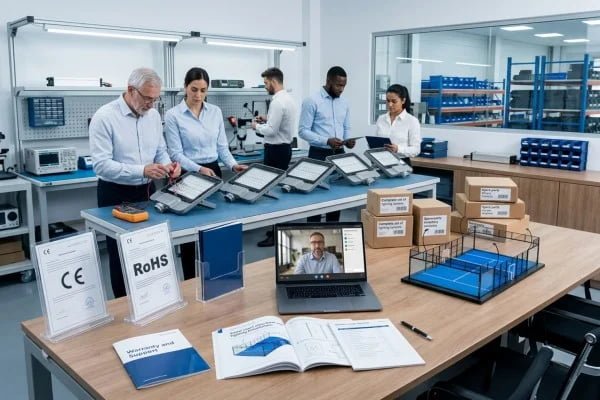
I select a padel court lighting supplier by checking its project-questionnaire process, technical documentation, court-structure coordination, product traceability, certificate coverage, replacement support, warranty terms, and willingness to state limitations. A reliable supplier should request site information and support professional verification rather than promise universal results from a standard package.
I Look for Questions Before Answers
A responsible supplier should ask questions before recommending equipment. I become cautious when a seller immediately prescribes a fixed number of high-power fixtures without requesting the court layout or operating scenario.
Useful supplier questions include:
- What is the court’s intended usage level?
- Is the site indoor or outdoor?
- How many courts will be installed?
- What are the mounting restrictions?
- Are there nearby homes, roads, or other courts?
- Does the project require streaming or broadcasting?
- Which local standards or tender requirements apply?
- Who will complete electrical installation and commissioning?
- Who will verify the design and acceptance criteria?
These questions show that the supplier understands lighting as a system rather than an isolated accessory.
I Verify Quality-Control and Documentation Processes
I ask how the supplier controls incoming components, fixture models, driver specifications, bracket dimensions, labeling, and packing. For a complete court shipment, I also verify that the bill of materials identifies each lighting-related component.
At QHPADEL, our role as a complete court-system supplier lets us coordinate lighting supports with structural posts, frame drawings, packing lists, and installation documentation. Our factory has ten production lines and produces complete court systems as well as artificial turf. I present these capabilities as supplier information that buyers should audit, not as a guarantee of site-specific lighting performance.
Buyers can request:
- Factory quality-management documents, such as ISO 9001 certification
- Product certificates tied to the offered model
- Driver and fixture data sheets
- Photometric files
- Packing lists
- Wiring and installation instructions
- Spare-part identification
- Warranty procedures
- Photos or records from pre-shipment checks
I recommend independently verifying certification status and local acceptance. A general certificate carrying a company name may not cover every fixture variant, wattage, driver, or market.
I Evaluate After-Sales Boundaries
Lighting issues can involve product quality, design assumptions, installation, electrical supply, aiming, or site changes. The supply agreement should distinguish these responsibilities.
For example:
- The supplier may be responsible for a defective driver.
- The installer may be responsible for an incorrect mounting angle.
- The electrical contractor may be responsible for unsuitable wiring.
- The project designer may be responsible for an approved but inadequate layout.
- The owner may be responsible for unapproved site changes.
I value suppliers that provide a diagnostic process rather than immediately assigning blame. Photos, videos, fixture labels, installation measurements, and original drawings can help identify the likely cause.
I have received bounded customer feedback ranging from satisfactory evening visibility to requests for angle adjustments because of glare or unevenness. I do not treat those comments as universal performance data. I use them to improve buyer communication and remind project teams to include commissioning in the plan.
Frequently Asked Questions
What is the correct lux level for padel court lighting?
No single lux target fits every project. Recreational, commercial, competitive, institutional, and broadcast uses may have different requirements. I recommend checking applicable federation guidance, tender specifications, and local standards. A qualified lighting professional should confirm the correct illuminance, uniformity, glare, measurement, and maintenance criteria.
Are higher-wattage LED fixtures better for padel courts?
Higher wattage does not automatically improve visibility. Fixture efficiency, optics, position, aiming, uniformity, and glare control can matter as much as electrical power. A higher-power fixture with unsuitable distribution may create bright spots and discomfort while leaving important areas relatively dark.
Should lighting be ordered with the complete padel court?
Ordering lighting with the court can simplify structural coordination, bill-of-material control, packing, and installation documentation. However, buyers should still verify the lighting proposal separately. The complete package should identify exact fixture models, supports, electrical scope, layout assumptions, certificates, commissioning responsibilities, and local professional approvals.
Conclusion
Professional padel court lighting requires more than choosing a wattage, fixture count, or average illuminance figure. I recommend defining the operating scenario first, then evaluating uniformity, glare, vertical visibility, optics, geometry, controls, documentation, and commissioning. Buyers should verify all project-specific calculations, standards, certificates, and acceptance criteria with qualified professionals.
-
"How LED Sports Lighting Reduces Glare and Shadows", https://shine2sportslighting.com/blog-details/enhancing-safety-on-the-field-how-led-sports-lighting-reduces-glare-and-shadows?srsltid=AU7gw4Uoq2aNKGfwbXoJQDSYlli0XnTnkxb204k_YsvoHjUpUlwG1Lfx. Sports-lighting guidance identifies illuminance uniformity, glare limitation, and the visibility of moving objects as relevant visual-performance considerations for ball-sport facilities. Evidence role: general_support; source type: research. Supports: Sports-lighting guidance and vision research describe glare, non-uniform illumination, and shadows as factors that can impair visual performance in ball sports.. Scope note: The source should be used as general sports-lighting support; it may not test padel courts or glass-walled courts specifically. ↩
-
"DIN EN 12193 · Sports lighting", https://www.bega.com/en/knowledge/lighting-theory/reference-values-for-illumination/dinen12193-sports-lighting/. Sports-lighting standards commonly differentiate performance criteria by sporting use and competition level, so a single wattage or illuminance prescription is not sufficient for all facilities. Evidence role: expert_consensus; source type: institution. Supports: Sports-lighting standards classify facilities and specify lighting criteria according to the type and level of sporting activity rather than a single universal installation recipe.. Scope note: Applicable classes, numerical criteria, and legal obligations depend on the governing standard, jurisdiction, and project brief. ↩
-
"The Core Ignored Index in Professional Sports Lighting Design", https://www.hishine-led.com/info/sports-lighting-vertical-illuminance-guide-103577596.html. Because ball-sport participants track moving objects through three-dimensional space, sports-lighting assessment may consider visual conditions beyond horizontal illuminance at ground level. Evidence role: mechanism; source type: paper. Supports: Research on visual performance in ball sports and sports-lighting guidance recognizes that players visually track elevated moving objects and that relevant light reaches more than the horizontal playing plane.. Scope note: The relative importance and prescribed measurement method for vertical illuminance vary by sport, competition level, and governing standard. ↩
-
"Broadcast Level Sports Lighting for Perfect Clarity – ZC Lighting", https://zcled.com/broadcast-level-sports-lighting-for-perfect-clarity/. Lighting suitable for human visual tasks may require additional evaluation for video capture because cameras respond differently to temporal modulation, spectral characteristics, exposure, and scene contrast. Evidence role: mechanism; source type: institution. Supports: Broadcast and imaging guidance distinguishes camera-related lighting requirements, including exposure, color reproduction, flicker, and vertical illumination, from ordinary human visual assessment.. Scope note: This distinction does not by itself establish that a particular padel installation is suitable for a given camera system. ↩
-
"What to measure and report in studies of discomfort from …", https://www.energy.gov/eere/ssl/articles/what-measure-and-report-studies-discomfort-glare-pedestrian-applications. Bright luminaires within the observer’s field of view can produce discomfort glare and, in some conditions, disability glare that reduces visual performance. Evidence role: mechanism; source type: research. Supports: Glare literature distinguishes discomfort glare from disability glare and explains that bright sources in the field of view can cause discomfort and reduce the ability to see visual detail.. Scope note: The severity of glare depends on luminance, source size, background luminance, viewing direction, adaptation, and exposure duration. ↩
-
"Flicker Research", https://www.energy.gov/cmei/ssl/flicker-research. Color rendering, correlated color temperature, and temporal light modulation are recognized lighting characteristics relevant to perceived appearance and, in some applications, visual comfort or imaging quality. Evidence role: general_support; source type: institution. Supports: Lighting science recognizes color rendering, correlated color temperature, and temporal light modulation as measurable properties that can affect visual appearance, comfort, and camera behavior.. Scope note: Their practical significance depends on the product, application, observer, and camera settings; these properties do not independently predict overall court performance. ↩
-
"[PDF] Understanding LM-79 Reports – Better Buildings Solution Center", https://betterbuildingssolutioncenter.energy.gov/sites/default/files/attachments/understanding_lm79_reports.pdf. Wattage measures electrical input, whereas luminous flux and illuminance describe different aspects of light output and delivery; optical distribution determines where the emitted light reaches. Evidence role: definition; source type: government. Supports: Electrical power is measured in watts, while emitted light and delivered illuminance are separate photometric quantities influenced by efficacy and optical distribution.. ↩