
Are you worried about how to fix an uneven padel court in a newly leased warehouse or an empty outdoor lot? When your existing concrete floor has hidden bumps and dips, laying artificial turf directly over it will ruin the ball bounce and create dangerous tripping hazards. Fortunately, there is a right way and a disastrously wrong way to level your space without re-pouring the entire foundation.
To fix an uneven padel court, you can use self-leveling compound exclusively for the 20×10 meter indoor playing area to ensure a flat turf surface and consistent ball bounce. However, you must never apply self-leveling cement under the structural frame, as it lacks the load-bearing capacity to safely anchor heavy steel posts1.
Deciding whether to patch, pour, or elevate your leased site requires careful planning and strict guidelines. Let us explore the exact boundaries between safe turf preparation and structural engineering so you can avoid costly court collapses.
Can Self-Leveling Compound Fix an Uneven Padel Court?
Budget-conscious club operators often look for cheap shortcuts when retrofitting an old building. Pouring self-leveling cement across the entire room seems like a magic fix for an uneven padel court floor. But is this standard flooring practice actually safe for high-impact sports facility construction?
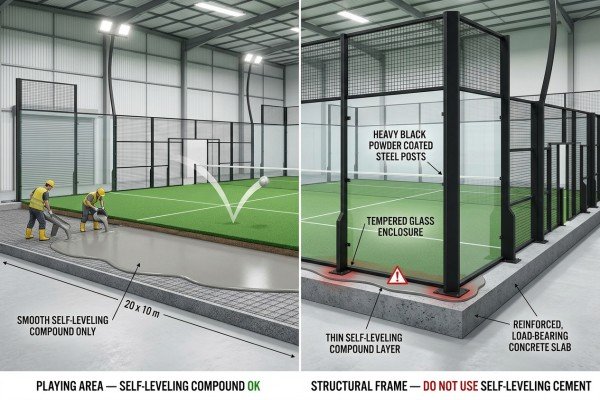
Yes, self-leveling compound can fix an uneven padel court, but only within the 20×10 meter indoor playing zone. It perfectly smooths out minor bumps under the artificial turf to guarantee proper ball bounce. It must never be applied to the outer perimeter where the heavy court frame sits.
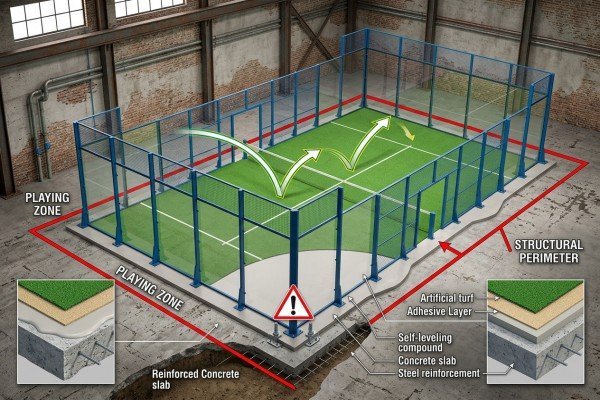
To understand why this boundary is so strict, you must separate a padel court into two distinct engineering zones: the play area and the load-bearing frame area.
Self-leveling cement is fantastic for smoothing out an existing warehouse floor inside the playing lines. Padel requires a highly predictable ball bounce. Even a slight dip under the artificial grass will change the rebound angle, frustrating players and making your club look unprofessional.
I often speak with clients who want to retrofit old industrial spaces to launch their clubs quickly. They frequently ask me if they can just flood the whole floor with self-leveling cement to save money on civil contractors. I always tell them to stop and draw a literal line on the floor. Inside the court lines, self-leveling compound acts as a great base for the artificial turf. It cures flat, eliminates minor depressions, and ensures the turf lays perfectly flat without wrinkles.
However, self-leveling materials are relatively soft, brittle, and designed primarily for pedestrian traffic or aesthetic flooring finishes2. They are absolutely not designed for heavy structural anchoring.
Acceptable Indoor Floor Preparations
If you are managing local civil contractors to prepare a leased indoor space, stick to these safe methods for the play area:
- Mechanical Grinding: Grinding down localized high spots in the concrete is always safer than adding layers.
- Targeted Leveling: Applying self-leveling cement strictly inside the 20x10m play area.
- Epoxy Skim Coats: Using thin epoxy leveling for very minor surface imperfections prior to turf installation.
Why is Self-Leveling Cement Dangerous Under the Padel Court Frame?
You might be tempted to level the entire warehouse floor in one massive pour to save time and labor costs. If you anchor the padel court frame directly into a layer of self-leveling cement, you risk catastrophic structural failure. How bad can it get when heavy equipment meets a soft foundation?
Anchoring a court frame into self-leveling cement causes weak expansion screw grip, leading to structural instability. As the heavy steel and glass compress the soft leveling layer, uneven settling occurs. This causes expensive tempered glass to shatter and creates extreme safety hazards during player impacts.
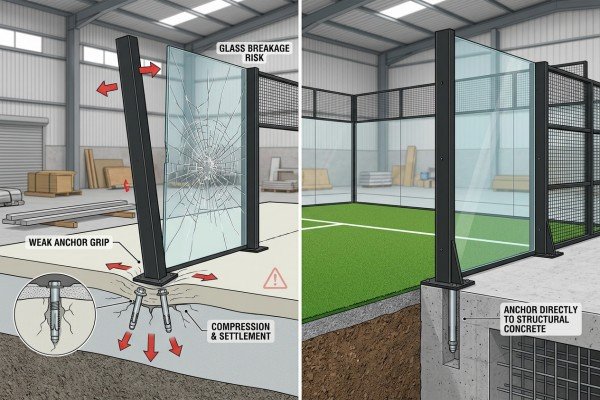
The perimeter of a padel court carries an immense physical load. You have heavy structural steel posts, dense wire mesh fencing, and massive panels of tempered safety glass. At QHPADEL, our structural frames and glass are built and certified to strict CE and AS/NZS standards. They are designed to withstand heavy player impacts and high wind loads, but they require a rock-solid concrete foundation to perform safely.
When you try to fix an uneven padel court by pouring a self-leveling layer under the frame perimeter, you create a fatal flaw in the anchoring system. Expansion bolts must grip deep into solid, high-psi concrete. If the top 10 to 30 millimeters of your floor consists of a brittle self-leveling compound, the bolts will crush the surrounding material the moment they are tightened.
Over a few months of play, the constant vibration of players hitting the glass and the mesh will cause this grip to loosen.
The Domino Effect of Foundation Failure
What happens next is expensive and dangerous. When a player crashes into the glass during a match, the poorly anchored structural posts will shift. The metal frame twists slightly. The tempered glass, which is incredibly strong against flat impacts but highly vulnerable to torsion and corner stress, experiences massive pressure points. It will shatter instantly, dumping hundreds of kilos of glass onto your court.
| Foundation Material | Load-Bearing Capacity | Best Application | Risk for Frame Anchoring |
|---|---|---|---|
| C25/C30 Concrete | Very High | Entire court foundation | None (Golden Standard) |
| Self-Leveling Cement | Low | Indoor 20x10m turf area only | High (Crushing, Bolt Failure) |
| High-Strength Mortar | Medium | Minor localized frame patching | Moderate (Requires precision) |
Do not compromise on the perimeter. If the outer ring where the posts sit is uneven, your contractor must use high-strength, non-shrink structural grout to level the base plates, or they must physically grind the existing concrete to a perfectly flat state.
How Do You Fix an Uneven Padel Court Outdoors?
Outdoor courts face harsh weather, heavy rain, and temperature fluctuations. If you lease an outdoor parking lot or an old tennis court, you cannot just pour indoor leveling compounds and hope for the best. How do you handle outdoor unevenness without causing severe water drainage problems?
To fix an uneven padel court outdoors, you cannot use self-leveling cement because it lacks weather resistance and cannot form a drainage slope. You must either re-pour a fresh concrete foundation, use outdoor high-strength repair mortar, or install a raised metal chassis system.
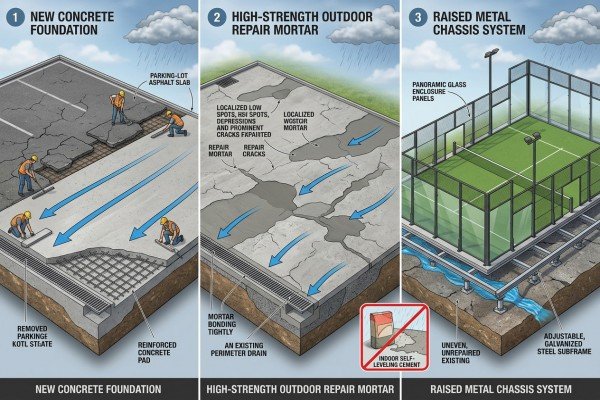
Outdoor environments pose a completely different set of civil engineering challenges compared to indoor warehouses. The biggest factor is water management. An outdoor padel court requires a strict drainage slope—usually between 0.5% and 1%—to prevent rainwater from pooling on the artificial grass and ruining playability.
Self-leveling cement is, by definition, designed to level itself flat. It will actively fight your contractor’s attempts to create a precise drainage slope. Furthermore, standard indoor leveling compounds degrade rapidly when exposed to standing water, intense UV rays, and seasonal freezing temperatures. It will crack and turn to dust under your artificial turf within a year.
If you lease an outdoor lot and need to fix an uneven padel court, you have three realistic, professional options.
1. Re-pouring the Foundation
This is always the safest, most durable method. Pouring a fresh C25 or C30 concrete slab over the existing bad floor guarantees perfect playability and structural safety. Your civil contractor can form the perfect 0.5% slope, ensuring water drains outward while providing a massive anchor point for the steel posts.
2. High-Strength Exterior Repair Mortar
If the existing concrete is mostly structurally sound but has localized dips, civil contractors can use high-strength exterior repair mortar. They must manually trowel this material to ensure the slope continues to push water away from the court center. This takes skilled labor but is cheaper than a full re-pour.
3. The Raised Chassis System
I often recommend this solution for clients dealing with severe drops (ranging from a few centimeters up to 1 meter) on leased land where digging or pouring new concrete is strictly prohibited. A raised metal chassis creates a perfectly flat, elevated platform over the uneven ground. While it costs more upfront in equipment, it completely bypasses the need for heavy wet trades, allows for perfect water drainage underneath, and can be disassembled and moved if you lose your land lease.
What is the Golden Standard to Accept a Repaired Uneven Padel Court?
Managing a local civil engineering crew can be stressful for club operators. If they hand over a poorly leveled site, your equipment installation phase will turn into a nightmare. How do you verify their work and enforce quality control before paying their final invoice?
To confidently fix an uneven padel court and sign off on contractor work, use the manufacturer’s golden standard: the foundation must show less than 3 millimeters of error when measured under a 3-meter straight edge. This strict metric applies to both the turf area and the structural frame perimeter.
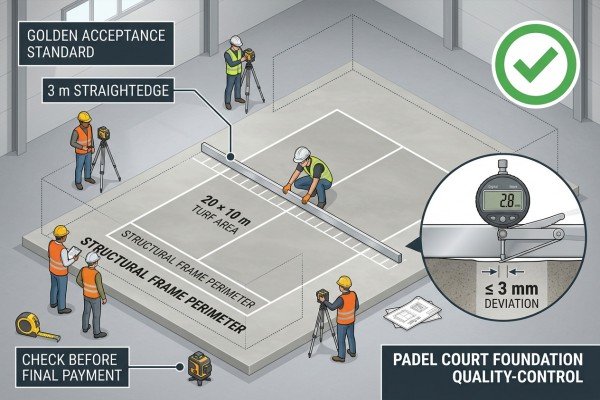
As an equipment manufacturer, QHPADEL supplies B2B buyers with complete, premium padel court packages. We ship everything from the panoramic glass and robust steel posts to the high-density artificial turf and lighting fixtures. But the ultimate success and safety of the installation relies entirely on the quality of your foundation.
We provide our clients with detailed foundation drawings, pre-embedding plans, and comprehensive installation guides. However, we are not on-site civil engineers. It is crucial that you, the buyer, hold your local contractors accountable to strict, measurable metrics.
Do not accept vague promises that the floor is "flat enough." When you hire a crew to fix an uneven padel court, write the acceptance standard directly into their contract. The industry standard dictates that a 3-meter straight edge level, laid anywhere on the court slab, must not reveal a gap larger than 3 millimeters.
Why the 3mm Standard Matters
- Turf Longevity and Playability: Padel turf laid on a floor with less than 3mm of variation prevents the ball from skidding unpredictably. It also prevents premature wear spots on the grass fibers.
- Glass Alignment: Our CE-certified tempered glass panels are designed to meet tightly. A floor variation greater than 3mm causes the steel posts to lean, which in turn causes the glass panels to pinch or gap. This tension is the leading cause of unexplained glass breakage.
- Fast Installation: An accurate foundation means the structural assembly goes exactly as planned. A perfectly flat perimeter allows a standard four-court system to be built rapidly, keeping your project within our standard 20-25 day production and deployment timelines.
Always measure the floor before you start unpacking the steel frames. Fixing the concrete is significantly cheaper and easier before the heavy equipment is unboxed and staged.
Frequently Asked Questions
Can you install artificial grass directly on an uneven padel court?
No. Laying artificial grass directly over bumps causes irregular ball bounces, accelerates turf wear, and creates tripping hazards for players. You must level the floor underneath to ensure competitive play and a safe environment.
Can I use wooden shims to level the padel court frame?
Never. Wooden shims rot rapidly due to moisture and will compress under the heavy impact loads of players hitting the glass. Only use high-strength metal shims or structural non-shrink grout to level the load-bearing frame.
Who is responsible if the glass breaks due to an uneven foundation?
Typically, the local civil contractor or the site owner holds responsibility for foundation-related failures. Equipment warranties usually cover manufacturing defects in materials, but they do not cover damages caused by poor civil engineering and uneven settling.
How long does self-leveling cement take to dry on a padel court?
Depending on the specific product formulation and indoor humidity, it usually takes 24 to 72 hours to fully cure before it is safe to unroll, cut, and glue the artificial turf onto the indoor play area.
Conclusion
Trying to properly fix an uneven padel court foundation requires knowing exactly where to draw the line between civil engineering and equipment installation. While self-leveling compounds are an excellent, budget-friendly solution for smoothing the indoor 20x10m turf area, they pose catastrophic structural risks if placed under load-bearing steel and glass. Always demand the 3mm/3m golden measurement standard from your local contractors before installation begins.
-
"EZ Level® Premium Self-Leveling Underlayment", https://www.tecspecialty.com/products/surface-preparation/ez-level-premium-self-leveling-underlayment/. Studies on cementitious underlayments indicate that while they provide high surface smoothness, their compressive and shear strengths are generally insufficient for anchoring heavy structural steel subjected to dynamic loads. Evidence role: mechanism; source type: research. Supports: the structural limitations of self-leveling underlayments for heavy anchoring. Scope note: The research focuses on general structural anchoring in underlayments rather than padel court posts specifically. ↩
-
"[PDF] Testing of Selected Self-Leveling Compounds for Floors", https://nvlpubs.nist.gov/nistpubs/Legacy/IR/nistir5633.pdf. Construction industry guidelines define self-leveling underlayments as non-structural materials intended to smooth interior floors for pedestrian traffic and subsequent floor covering installations. Evidence role: definition; source type: institution. Supports: the standard industrial applications of self-leveling compounds. Scope note: Guidelines vary slightly by manufacturer and specific polymer-modified formulations. ↩