You see these sports everywhere now, but do you know which one fits your club? Choosing the wrong court type costs time and huge money. Let me clarify the confusion right now.
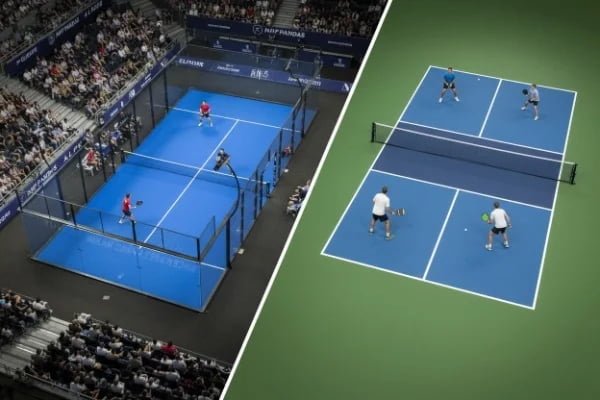
Padel and Pickleball differ mainly in origin and court structure. Padel, derived from tennis, uses enclosed glass walls for gameplay on a 20x10m court. Pickleball, rooted in badminton, uses a smaller open court without walls. Padel offers higher global growth potential, while Pickleball dominates the US market.
Many investors rush into construction without understanding the nuances between these two. They look similar, but the player experience and business models are totally different. Don’t make that mistake. Read on to discover which sport actually drives higher profits and player retention for your business.
Is Padel Easier to Play Than Pickleball?
Beginners fear difficult sports, and if your court is empty, you lose revenue. You need a sport that brings players back immediately. Which sport is friendlier to new players?
The learning curve is short for both sports compared to tennis. Both use short-handled rackets and smaller courts, making them accessible. However, Pickleball is slightly easier for absolute beginners due to the slower plastic ball. Padel requires learning wall rebounds but offers a deeper, more rewarding skill progression.
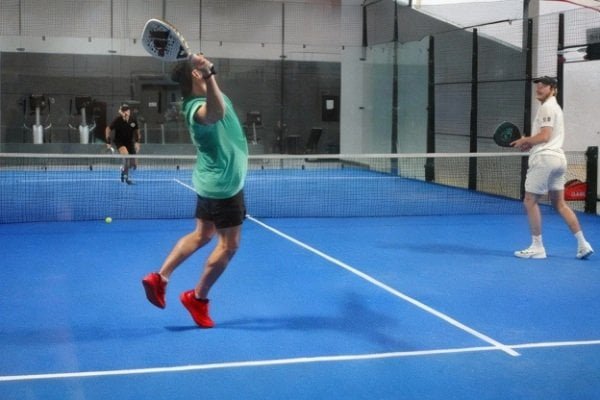
In my experience as an engineer and player, I see distinct origins shaping these sports. Pickleball comes from badminton, while Padel comes from tennis. This ancestry dictates the feel of the game. Both are physically active and highly social, but the equipment makes a big difference.
Pickleball is often compared to standing on a giant ping-pong table. It uses a perforated plastic ball that travels slowly. The rallies are long because the ball moves slowly through the air. Padel, on the other hand, uses a ball very similar to a tennis ball, just with lower pressure. The rallies here are long too, but for a different reason: the surrounding walls keep the ball in play.
Here is a quick breakdown of the equipment feel:
| Feature | Padel | Pickleball |
|---|---|---|
| Racket Face | Solid, perforated, thicker (EVA foam) | Solid, flat, creates a "pop" sound |
| Ball Type | Pressurized rubber (like Tennis) | Hard plastic with holes (Wiffle style) |
| Game Speed | Fast-paced with wall interaction | Slower pace, strategy focused |
| Social Feel | High (always doubles) | High (singles or doubles) |
Both sports are easier to cover than tennis because the courts are smaller. I find that Padel offers a unique challenge: the glass walls. Even if you miss the ball initially, it bounces off the glass, giving you a second chance. This mechanic makes Padel incredibly addictive. As you practice, using the wall becomes a strategic weapon, something a Pickleball court simply cannot provide.
What Are the Key Differences Between Padel and Pickleball Rules and Courts?
Construction mistakes are expensive and hard to fix. Getting dimensions wrong ruins the player experience and safety. Do you know the exact specifications required for each?
Padel courts are 20x10m enclosed spaces using tempered glass walls as part of the game. Pickleball courts1 are 13.41×6.1m open courts with a "no-volley zone2." Padel uses a golden point system, while Pickleball follows specific serving rules where the ball must not bounce before the serve.
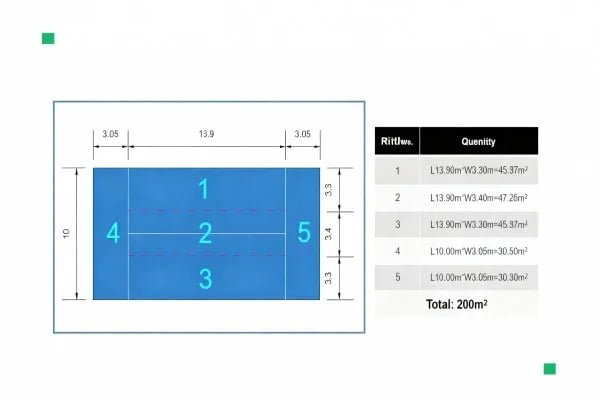
The biggest difference lies in the enclosure. A standard Padel court is nearly enclosed, measuring 10 meters wide and 20 meters long. At QHPADEL, we know that the total footprint, including the structure, is about 21 x 11 meters. The walls are not just fences; they are active parts of the playing field. We use tempered glass that must meet strict impact resistance standards (at least 300kg) to ensure safety.
In contrast, a Pickleball court is open. It measures 13.41 x 6.1 meters. It is essentially the same size as a badminton court. It is about 16.5% smaller than a Padel court.
Here is how the rules dictate the build:
| Rule/Feature | Padel | Pickleball |
|---|---|---|
| Enclosure | Required (Glass + Mesh) | None (Open court) |
| Serve | Underhand, must bounce first | Underhand, no bounce (air) |
| Scoring | Tennis style (15, 30, 40, Deuce/Golden) | Points (Play to 11, win by 2) |
| Net Lines | Service box lines | No-volley zone (Kitchen) |
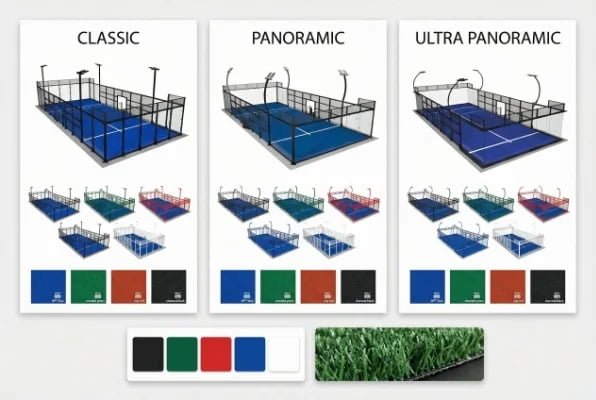
When we export courts, we focus heavily on the Padel structure. The steel columns and glass must withstand wind and impact. For example, our Panoramic courts use minimal steel to give spectators a clear view, while Classic courts use reinforced double columns for areas with strong winds. Pickleball does not require this complex engineering.
Also, the ground surface matters. Padel uses artificial turf, usually 7500 dtex or higher, filled with sand. This allows for the necessary slide and grip. Pickleball is usually played on a hard acrylic surface, similar to a hard tennis court.
Why Are Padel and Pickleball Booming Right Now?
Following a fading trend is risky for your investment portfolio. You need a sport with long-term growth and staying power. Which one is truly taking over the world?
Padel commands higher global search volume and is expanding rapidly worldwide, whereas Pickleball’s growth is heavily concentrated in the United States. Both have surged since 2020, but Padel’s international reach makes it a more versatile option for global investors looking for sustainable market expansion.
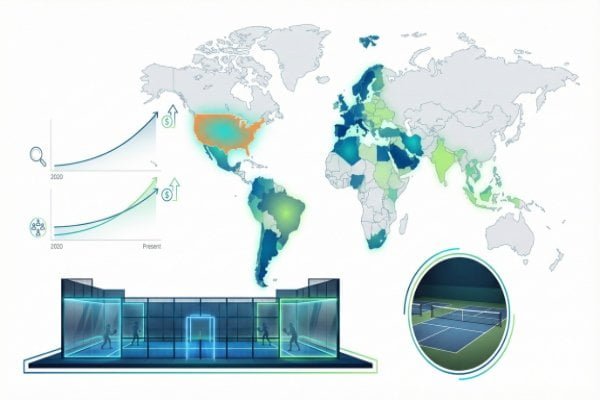
If you look at Google Trends, both sports show a steady increase since 2020. But the geography is different. Pickleball is huge in the US. Padel is a global phenomenon. It is growing fast in Europe, the Middle East, South America, and now Southeast Asia.
I have seen this growth firsthand. In Indonesia alone, over 2,000 new Padel courts have been built recently, with 10,000 planned globally by 2025. This is not just a fad. Established centers see occupancy rates reach 80%.
Why is Padel booming globally?
- Social Stickiness: Padel is almost always played as doubles. It requires four people. This creates a strong community. It is very social.
- Space Efficiency: You can fit more players in a smaller area compared to other sports.
- Professional Appeal: Events like the World Padel Tour3 use "Ultra Panoramic" courts that look amazing on TV, creating an aquarium effect for viewers.
Pickleball is popular because it is accessible and can be played on modified tennis courts easily. However, Padel requires specific construction. This barrier to entry actually helps club owners. Once you build a quality court, you have a captive audience because they cannot just play in their driveway. The demand for high-quality, professional venues is outpacing supply in many developing countries.
Which Sport Offers Better ROI for Club Owners?
Empty courts kill businesses faster than anything else. You need high occupancy and low maintenance to survive. Which sport yields the best financial return per square meter?
Padel courts offer superior ROI due to higher density; you can fit nearly three Padel courts in the space of one tennis court. With 80% occupancy and 4 players per hour, revenue potential is significantly higher. High-quality materials like artificial turf ensure durability and lower maintenance costs.
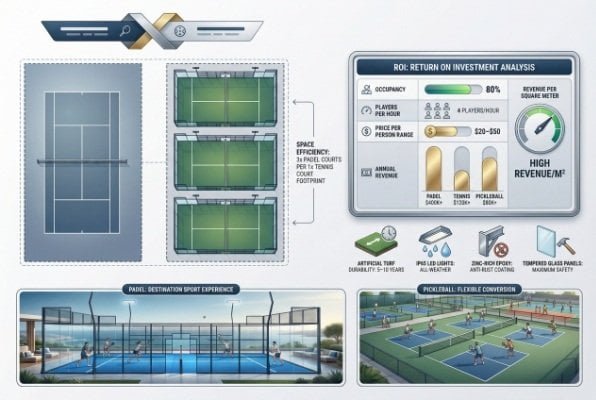
Let’s break down the numbers. I love the math behind court construction. A tennis court requires about 36.6 x 18.3 meters including the buffer zone. In that same space, you can install three Padel courts.
Revenue Calculation:
- One Tennis Court: Max 4 players (usually 2).
- Three Padel Courts: Max 12 players.
- Income Potential: If you charge $5-7 per person per hour, one Padel court can generate $29,200 to $40,880 per year based on 80% occupancy. Multiply that by three for the same land area.
Construction Cost vs. Return:
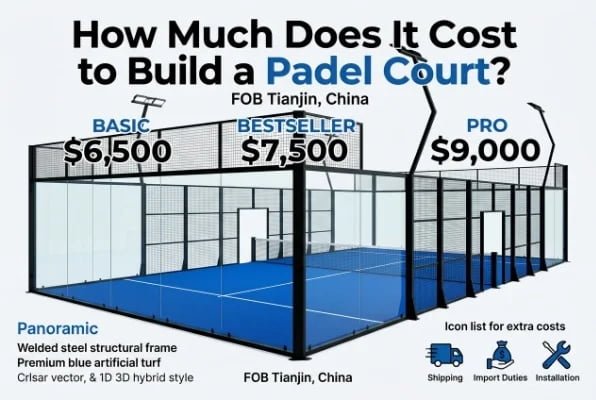
Building a Padel court costs between $15,000 and $50,000 depending on location and civil work. Buying directly from a manufacturer like us (QHPADEL) reduces the material cost to about $6,500 – $9,000 FOB.
Maintenance Factors:
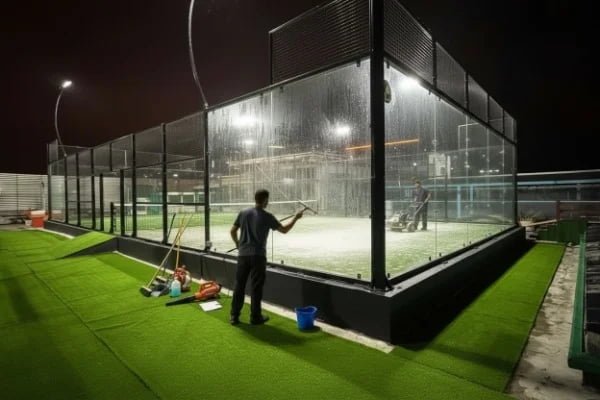
- Turf: Good artificial turf lasts 5-10 years.
- Lights: IP65 LED lights run maintenance-free for years.
- Structure: Zinc-rich epoxy primer prevents rust, even in coastal areas.
Successful clubs do not just rent courts. They add coaching, tournaments, and F&B services. Because Padel is a "destination" sport (you need the specific court), players stay longer and spend more. Pickleball is great, but Padel maximizes the revenue per square meter of your land. For a club owner, Padel is the clear winner for maximizing yield on your real estate assets.
Conclusion
Padel offers higher global growth and better revenue per square meter than Pickleball. For investors, building Padel courts provides a stronger long-term ROI through density and community retention.