Are you planning to build a padel court but feel unsure about the exact space needed? A wrong measurement will ruin your project. I will give you the exact dimensions today.
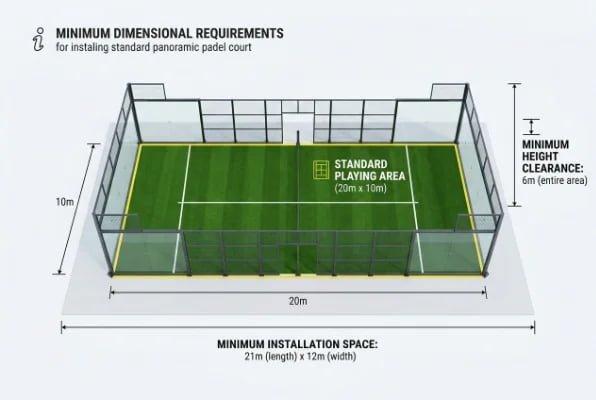
The minimum required space to install a padel court is 21 meters long, 12 meters wide, and 6 meters high. The standard playing surface is 20 by 10 meters, but you need extra space for the structural frame and entry buffer zones to ensure safe play.
Knowing the basic numbers is just the start. You must understand how these measurements affect your building process. Let me break down the details so you can plan your project without making costly mistakes.
What Is the Difference Between the Playing Surface Area and the Total Construction Footprint?
Do you think a 20 by 10 meter space is enough? Building on this exact size will cause big problems. You need extra room for the court frame.
The playing surface area is strictly 20 meters long and 10 meters wide. However, the total construction footprint must be at least 21 meters by 12 meters to fit the glass, steel pillars, and a 0.5-meter safety buffer on the entrance sides.
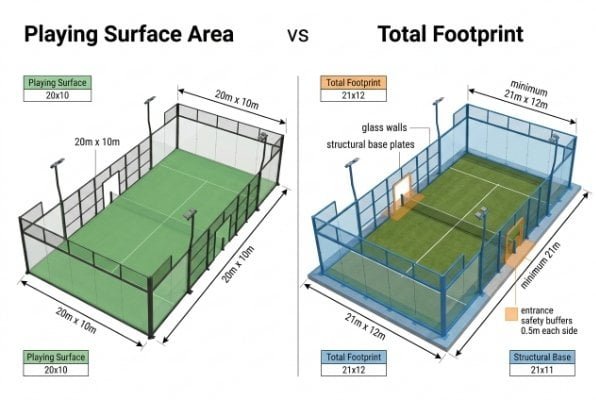
I remember a client from the United States who poured his concrete base exactly 20 meters by 10 meters. When the goods arrived, his installation team had no place to bolt the steel pillars and glass panels. He had to spend extra money and time to pour more concrete around the edges. This is a common mistake. The 20 by 10 meters is an internationally recognized fixed size for the playing game. But the structure itself needs a base. You must calculate at least 0.5 meters around the outside for the structural components. This includes the steel frame, the glass panels, and the base plates.
Also, you must leave room for the entrances. The ends of the court do not require extra buffer zones for players, but the sides where the doors are need space. You need at least 0.5 meters on both sides of the entrances and exits. When we add this up, the length becomes 20 meters plus 0.5 meters on each end. The width becomes 10 meters plus 0.5 meters for the structure and 0.5 meters for the buffer on each side.
Dimension Breakdown
| Measurement Type | Length | Width | Why It Matters |
|---|---|---|---|
| Playing Surface | 20 meters | 10 meters | Official game rules require this size. |
| Structural Base | 21 meters | 11 meters | Gives room to bolt the frame securely to the ground. |
| Total Footprint | 21 meters | 12 meters | Includes the minimum safety buffer for the doors. |
Understanding this difference helps you prepare the site correctly the first time. It saves you from costly delays and makes your one-stop procurement process much easier.
How Does the Minimum Ceiling Height Differ for Indoor Padel Courts Compared to Outdoor Setups?
Are you worried about the roof height for your indoor club? A low ceiling ruins the game because players cannot hit high shots. We must get this right.
For indoor padel courts, the absolute minimum ceiling height is 6 meters across the entire playing area. However, I highly recommend a minimum height of 8 meters. Outdoor setups do not have a ceiling limit, but lighting poles must be at least 6 meters high.
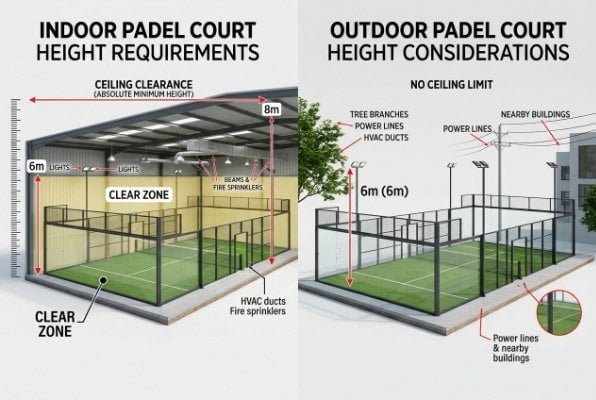
Height is a major factor in padel. Players use the "lob" shot very often. The lob is a high, defensive shot. If your ceiling is too low, the ball will hit the roof, and the players will get angry. A 6-meter ceiling is the basic requirement to meet functional installation rules. You can play a game with a 6-meter height. But professional players and experienced club members prefer more space. This is why I always tell my clients to find a warehouse with at least 8 meters of clearance.
When you look at an indoor building, you must look at the lowest point of the ceiling. You must also check for lights, air conditioning ducts, and fire sprinklers. These objects hang down and take up space. The 6-meter or 8-meter measurement must be completely clear of any obstacles. For outdoor courts, you do not worry about a roof. But the standard lighting poles are 6 meters high. You must ensure no tree branches or power lines block this space.
Indoor vs Outdoor Height Needs
| Setup Type | Minimum Height | Recommended Height | Obstacles to Watch Out For |
|---|---|---|---|
| Indoor Padel | 6 meters | 8 meters | Lights, roof beams, pipes, air ducts. |
| Outdoor Padel | 6 meters (lights) | No limit | Tree branches, power cables, nearby buildings. |
If you want your club to attract good players and generate high profits from venue rentals, you must provide a great playing experience. A high ceiling is one of the best ways to do this.
How Should You Plan the Layout to Ensure Proper Traffic Flow and Safety Zones?
Do players bump into each other near the court doors? Poor planning makes your club unsafe and hard to walk through. A good layout solves this problem.
You must leave a minimum buffer zone of 0.5 meters on both sides of the court entrances and exits. This extra space ensures players can safely enter the court and run out during matches without crashing into walls.
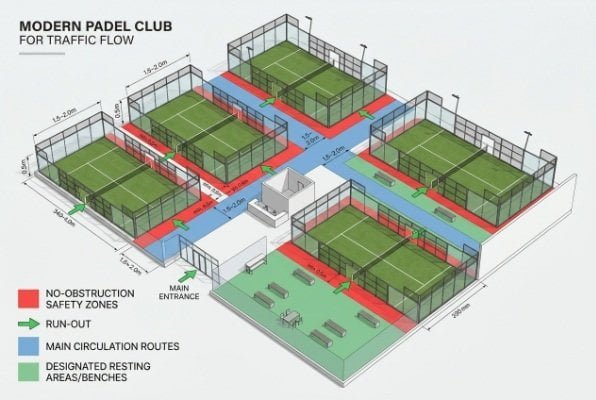
When you plan your club, you are not just placing metal and glass on the ground. You are building an experience for people. Safety and movement are very important. The 0.5-meter buffer zone is the absolute minimum requirement for the door areas. Padel is a fast sport. Sometimes, the ball bounces out of the court through the door. Good players will run out of the door to hit the ball back in. If you put a wall right next to the door, the player will hit the wall and get hurt.
I have visited clubs in the UAE and Mexico where they forgot to leave walkways. The players had to squeeze past each other to get to their courts. This looks unprofessional and lowers the value of the club. You need to think about how people walk from the reception desk to the farthest court. You should keep the main walkways clear. Do not put benches or trash cans in the 0.5-meter buffer zone.
Key Layout Zones
| Zone Name | Minimum Size | Location | Purpose |
|---|---|---|---|
| Entrance Buffer | 0.5 meters | Outside court doors | Allows safe entry and out-of-court play. |
| Main Walkways | 1.5 to 2 meters | Between court blocks | Lets players walk easily to their courts. |
| Resting Area | Varies | Away from doors | Gives players a place to sit without blocking traffic. |
A clear layout makes your customers happy. Happy customers will rent your courts more often. This directly helps you achieve greater profits and success.
How Can You Optimize Your Available Land or Warehouse Space for Maximum Court Capacity?
Do you want to fit as many courts as possible to increase your profits? Wasted space means lost money. You must plan the layout smartly to win.
To maximize court capacity, share walkways between courts and align the courts side by side. By keeping the minimum 21 by 12 meters footprint and grouping entrance buffer zones together, you can fit more courts into your space.
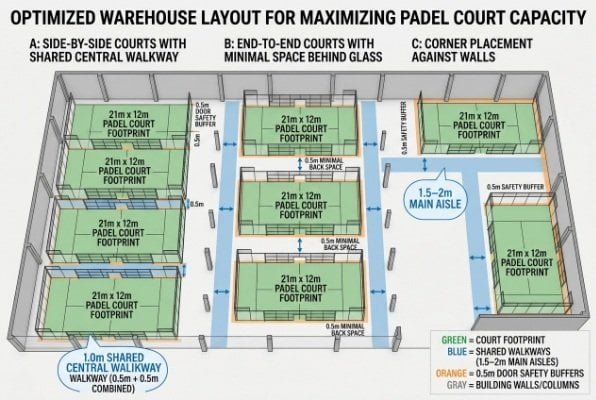
Many investors buy land or rent a warehouse and want to know how many courts they can fit. The answer depends on how you arrange the 21-meter by 12-meter blocks. I always help my clients draw a floor plan before they buy anything. If you put the courts end-to-end (the 10-meter sides facing each other), you do not need buffer zones between the glass backs. You only need the 0.5-meter space for the structural frame.
If you put the courts side-by-side (the 20-meter sides facing each other), you can share the middle walkway. Instead of having two separate 0.5-meter buffers, you can make one 1-meter walkway between the two courts. Both courts will use this walkway for their doors. This trick saves a lot of space in a big warehouse. It allows you to add one or two more courts to your project. More courts mean more hourly rental fees.
Space Saving Ideas
| Layout Strategy | Space Saved | Best Used For | Result |
|---|---|---|---|
| Shared Walkways | High | Side-by-side courts | Uses one path for two court entrances. |
| End-to-End Joining | Medium | Long, narrow buildings | Removes the need for walking space behind the glass. |
| Corner Placement | Low | Square warehouses | Pushes non-door sides close to the building walls. |
When you buy from us, you get a one-stop, worry-free procurement process. We do not just sell you the artificial turf and the steel frame. We help you design the best layout for your specific land so you do not waste any money.
Conclusion
The minimum space for a padel court is 21 meters long, 12 meters wide, and 6 meters high. Proper planning guarantees a safe, successful, and highly profitable padel club.