Padel court repairs kill your profits and frustrate your players. You see rust on the metal structure and worn-out turf much sooner than you expected. Do not let poor durability drain your budget and ruin the player experience.
The lifespan of a Padel court depends on material quality, installation precision, and maintenance habits. High-quality hot-dip galvanized steel and UV-resistant turf last much longer. Generally, courts last 6 to 8 years outdoors and over 10 years indoors if you maintain them correctly and choose the right specifications.
I have seen many investors lose money because they ignored these details during the purchasing phase. They focused only on the lowest price and paid for it later with expensive repairs. I want to share my engineering experience to help you avoid these mistakes. Here is everything you need to know about court longevity.
How Does the Quality of Materials (Turf, Steel, Glass) Impact Durability?
Cheap materials look good on paper but fail quickly in reality. You might save money now, but you will pay double for replacements and lost customers in just a few years.
Material quality is the main factor for durability. You need turf with high Dtex and UV resistance, and steel that is hot-dip galvanized. These specifications prevent fading and rust. Choosing standard or premium materials ensures your court remains safe and playable for a decade.
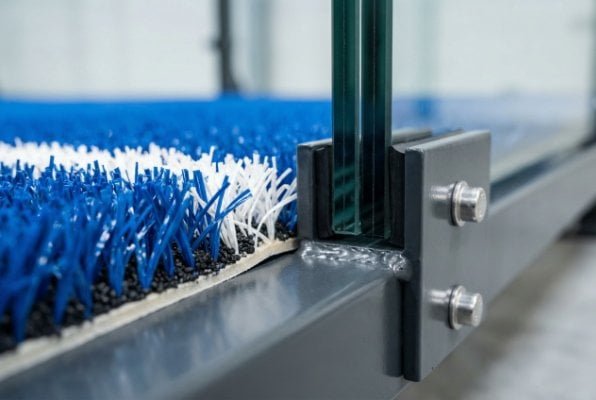
The materials you choose are the foundation of your court’s life. As an engineer, I look at the technical data sheets first. Let me break down what matters for the turf and the steel structure.
First, let’s talk about the artificial turf. The lifespan relies heavily on the "dtex" content of the yarn and the UV-resistant additives. Dtex measures the weight of the fiber. Higher dtex usually means a thicker, more durable fiber.
- High-Quality Standard: A good turf usually has around 13,500 dtex. It should also have at least 7% UV-resistant additives. This prevents the sun from breaking down the plastic fibers.
- Backing: The backing holds the grass together. I always recommend PU (Polyurethane) backing over Latex. PU is stronger, resists water better, and lasts longer. With these specs, turf typically lasts 8 years.
Second, the steel structure is where many suppliers cut corners. The standard for a long life is hot-dip galvanizing followed by electrostatic powder coating. This creates a strong barrier against rust.
- The Problem: To reduce costs, some factories use thinner steel profiles. They also use "cold galvanizing" or electroplated zinc. This looks shiny and new when you receive it, but the protection is very thin. It will rust quickly.
- Coastal Areas: If your club is near the sea, the salty air is aggressive. You need an additional layer of zinc-rich epoxy primer before the powder coating.
Here is a comparison table to help you check your supplier quotes:
| Component | Good Quality (QHPADEL Standard) | Low Quality (Risk of Failure) |
|---|---|---|
| Turf Yarn | 13,500 Dtex | Below 8,000 Dtex |
| Turf UV Protection | 7% Additive | Low or None |
| Turf Backing | PU (Polyurethane) | Latex |
| Steel Treatment | Hot-dip Galvanized | Cold Galvanized (Electroplated) |
| Steel Thickness | Standard Thickness (e.g. 3mm) | Reduced Thickness |
Why Professional Installation and Foundation are Critical for a Long Lifespan?
Even the best materials fail if the installation is bad. A tilted floor or loose bolts can make a premium court dangerous and unusable within months.
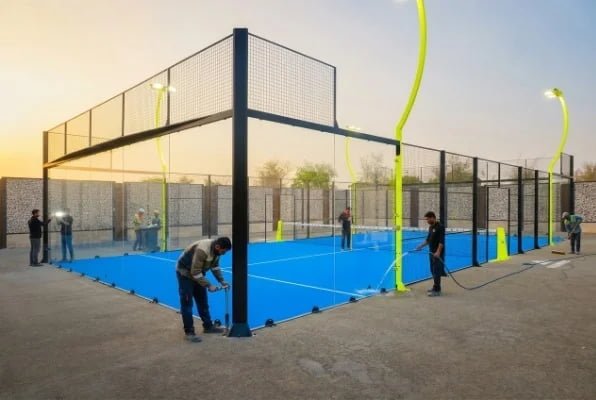
A professional installation ensures the structural integrity of the Padel court. A level concrete foundation prevents glass breakage and frame warping. Skilled installers tighten bolts correctly and lay turf evenly. This precision prevents early wear and ensures the court functions exactly as the manufacturer intended.
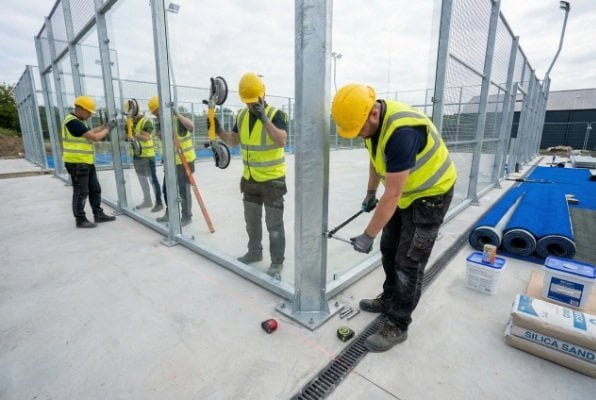
I have visited many sites where the owner blamed the manufacturer for broken glass, but the real problem was the ground. The foundation is the most critical part of the installation process.
If the concrete base is not perfectly level, the steel frame will twist slightly when you bolt it down. This puts uneven pressure on the tempered glass. One day, a player might hit the glass normally, and it could shatter because it was already under stress. A level foundation prevents this expensive and dangerous issue.
The installation of the turf is also very important for longevity.
- Joints: The seams where turf rolls meet must be glued perfectly. If they are loose, players will trip, and the turf will peel up.
- Sand Infill: You must fill the turf with the correct amount of silica sand. The sand protects the grass fibers. If there is too little sand, the fibers stand up alone and get crushed by player shoes. If the sand is uneven, the court wears out in patches.
Common Installation Mistakes to Avoid
- Poor Drainage: If water pools on the concrete, it rots the bottom of the steel posts and degrades the turf backing. You need a slope of about 0.5% to 1% for outdoor courts.
- Loose Bolts: Installers must use torque wrenches to tighten every bolt to the specific standard. Loose bolts cause the cage to rattle, which wears out the metal connection points.
- Cutting Corners on Glue: Using cheap glue for the turf lines leads to separation after a few months of rain or heat.
When I manage a project, I insist on checking the concrete level before we even open the container. It is better to delay installation by two days to fix the floor than to replace the glass two months later.
Indoor vs. Outdoor: How Environmental Factors Affect Padel Court Wear and Tear?
Nature is the biggest enemy of your Padel court. Sun, rain, and wind attack your investment every day, while indoor courts stay safe and protected.
Outdoor courts face UV radiation and moisture, reducing their lifespan to 6-8 years. Indoor courts are protected from weather and can last over 10 years. You must choose specific materials like extra anti-rust coatings for outdoor projects to combat these harsh environmental factors.
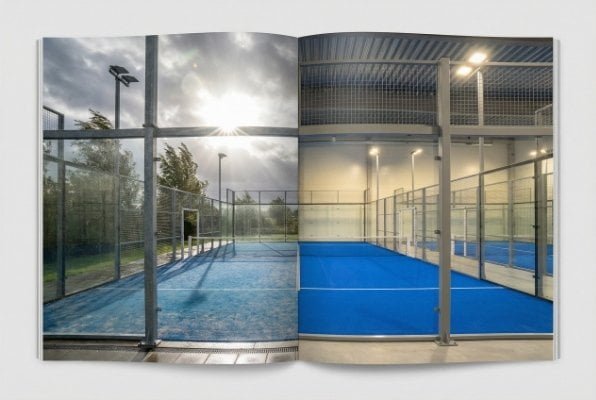
The environment plays a huge role in how long your court lasts. At QHPADEL, we see a clear difference in the lifespan data between indoor and outdoor projects.
Indoor Environments:
Indoor courts exist in a mild, controlled environment. There is no rain, no direct UV sunlight, and the temperature is stable.
- Turf: Without UV exposure, the fibers do not become brittle. The turf stays soft and green for a very long time.
- Structure: There is no rain to cause rust. The bolts stay tight because there is no thermal expansion and contraction from hot days and cold nights.
- Result: A standard quality court can easily last over 10 years indoors.
Outdoor Environments:
Outdoor courts are exposed to the elements 24/7.
- Sun: UV rays are the primary killer of artificial turf. Even with UV stabilizers, the sun eventually breaks down the plastic. The color fades, and the fibers break.
- Rain and Humidity: Water is the enemy of steel. If the galvanized layer is scratched or thin, rust will start immediately. Moisture also helps moss and algae grow in the turf sand, which makes the surface slippery and hardens the ground.
- Wind: Strong winds put physical stress on the glass and the fence. Over time, this vibration loosens bolts and weakens the structure.
- Result: Even with good maintenance, an outdoor court usually lasts 6 to 8 years before it needs major repairs or turf replacement.
Because of this, you cannot simply buy the cheapest court for an outdoor project. You must invest in better protection. As I mentioned earlier, if you are near the ocean, the salt spray accelerates rust by 10 times. In these cases, standard hot-dip galvanizing is not enough. You must ask for the "marine grade" protection with the zinc-rich epoxy primer.
What Daily Maintenance Practices Can Extend the Life of Your Padel Court?
Neglect is a silent killer for sports facilities. If you ignore small problems like loose sand or dirt, they turn into expensive repairs very fast.
Regular maintenance keeps the court in top condition and extends its life. You must brush the turf to redistribute sand, clean the glass, and check bolts. A consistent schedule of daily checks and monthly deep inspections prevents major damage and ensures player safety.
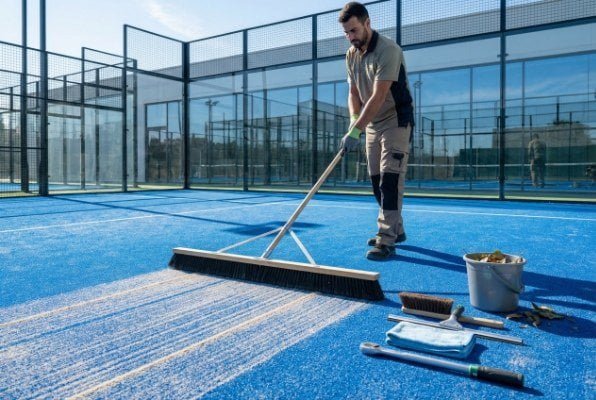
Many club owners think their job is done once the installation is finished. This is wrong. To get the maximum ROI (Return on Investment), you need a strict maintenance plan. Based on my experience helping clients manage their clubs, here is the schedule you should follow.
Daily and Weekly Tasks
- Daily Checks: Walk around the court. Look for debris like leaves, gum, or trash. Remove them immediately. Sharp objects can cut the turf fibers.
- Weekly Cleaning: Clean the glass panels. Dirty glass looks bad and makes it hard for players to see the ball. More importantly, dirt acts like sandpaper and can scratch the glass surface over time.
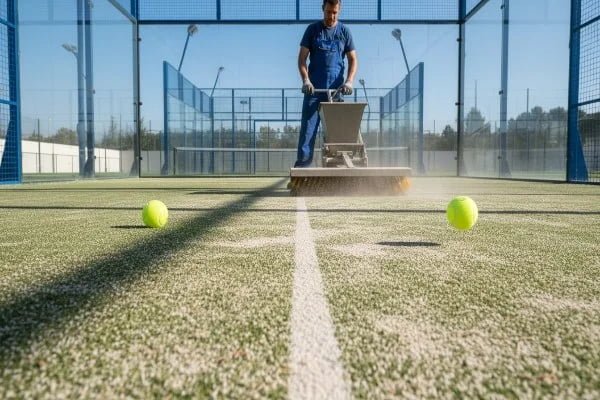
- Weekly Brushing: This is vital. You must brush the artificial turf every few weeks (or weekly if the court is busy). This redistributes the silica sand. The sand supports the grass blades. If the sand moves to the edges, the grass in the middle will flatten and wear out quickly.
Monthly and Long-Term Maintenance
- Monthly Safety Check: Inspect the structural bolts and the wire mesh fencing. Vibrations from play can loosen nuts. Tighten them to ensure the cage is rigid and safe.
- Deep Cleaning (Every 6 Months): You should perform a deep clean. This might involve a specialized machine that lifts the sand, cleans the dust out, and puts the sand back. This prevents the court from becoming hard and slippery.
- Turf Overhaul (Every 5-6 Years): Even with perfect care, the turf will eventually wear down. Plan your budget to overhaul or replace the turf every 5 to 6 years for outdoor courts. This ensures your court maintains optimal performance and keeps players happy.
If you follow this routine, you extend the life of your investment. You also show your customers that you care about quality, which helps you justify your rental prices.
Conclusion
To maximize your Padel court’s lifespan, prioritize high-quality materials like hot-dip galvanized steel and UV-resistant turf, ensure professional installation on a level foundation, and follow a strict maintenance schedule.