Wind ruins outdoor padel games fast. High winds shift the ball and stop good play. I will show you how to build a strong, wind-resistant padel court.
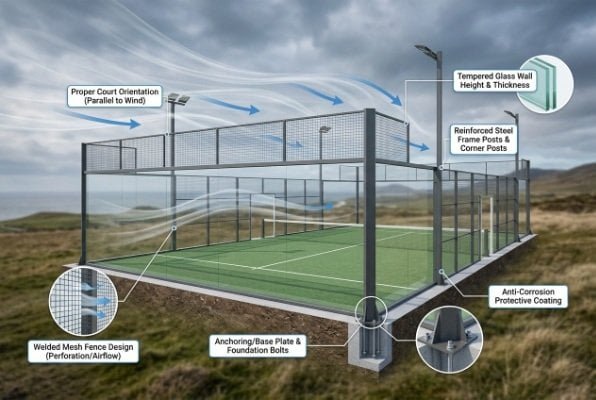
Wind resistance in a padel court depends heavily on court location, proper orientation, glass wall height, and mesh design. You must align the court parallel to the wind and choose the right materials to lower structural stress and stop wind turbulence inside the playing area.
You want your padel court to last for years without wind damage. I talk to many buyers from different countries every day. They all worry about bad quality and wasted money. A broken court ruins your club business and upsets your players. You need to know exactly how to check the wind factors before you order any materials. Let us look closely at how you can make the right choices for your next big project.
How Do Court Location and Orientation Influence the Wind Stability of Padel Courts?
Poor court placement causes daily wind problems. Your players will complain, and your business loses money. You can fix this early by choosing the right spot and direction.
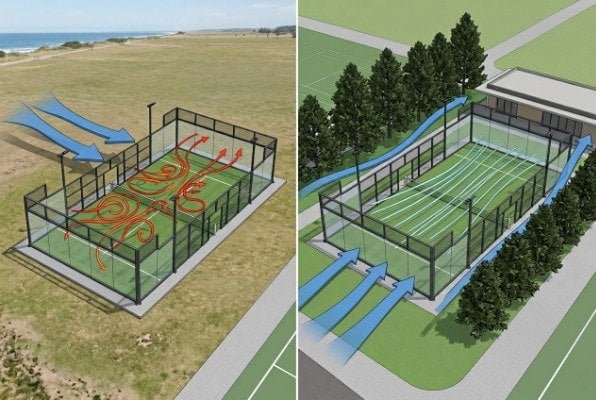
Court location and orientation stop crosswinds. You should build courts near trees or buildings to block the wind naturally. You must also point the long side of the court toward the main wind direction to lower the crosswind impact on the ball.
Let me share a quick story. Last year, I helped a club owner in a coastal area. He wanted to build a large outdoor club. He did not think about the wind direction at first. The wind from the ocean was very strong and never stopped. If he placed the court wrong, the heavy crosswinds would ruin every game. The ball would fly out of the court easily. We checked the site plan together. We changed the design. We pointed the long side of the court straight into the ocean wind. This small change saved his whole project. The players love the court now.
Why Location Matters for Wind
Your court position changes everything about the wind speed. Courts in open areas take the full wind force. This is very bad for the court structure. Trees, hills, and large buildings act as natural walls. They block the wind before it hits your court. If you build the court in a crowded city, the high buildings help you a lot. They slow down the air. If you build in an empty flat field, you face a big challenge. You must plan carefully.
The Golden Rule of Court Orientation
You must find the main wind direction in your city first. You then place the court length parallel to this main wind. Crosswinds push the ball to the sides very hard. Parallel winds have much less impact on the players and the ball path. This simple step costs no money but gives great value.
Location and Orientation Guide
| Factor | Bad Choice | Good Choice | Impact on Wind Control |
|---|---|---|---|
| Court Location | Empty open flat field | Near buildings or large trees | Creates a natural wind block |
| Court Orientation | Perpendicular to main wind | Parallel to the main wind | Greatly reduces heavy crosswinds |
| Coastal Area | Facing sideways to the sea | Long side facing the open sea | Lowers the ball shift in air |
What Role Do Structural Design and Material Selection Play in Withstanding Strong Winds?
Weak materials break in strong storms. A broken court stops your business and costs a lot to fix. Good structural design keeps your padel court safe.
Glass walls block strong winds, while mesh fencing lets air pass to lower structural stress. Taller walls protect the court well, but you must avoid making them too high. This stops a bad downward wind tunnel effect on the court.
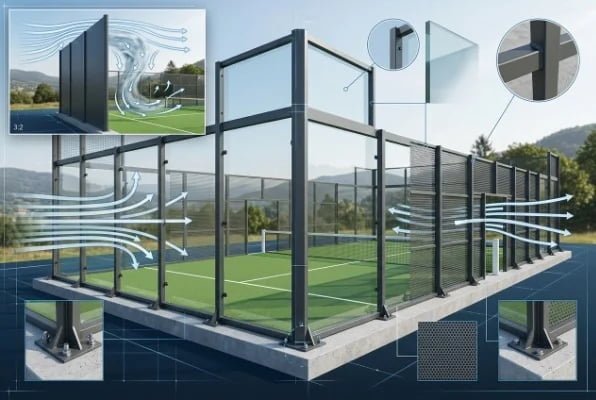
I inspect many factories in China every week. I see good designs and I see many bad designs. You must demand strict quality control for your court parts. Good design balances the wind block and the wind flow perfectly.
Glass Walls and Steel Mesh Fencing
You need thick and strong glass walls to stop the harsh wind. The glass keeps the wind out of the main play area. But you cannot use solid glass everywhere on the court. You must use steel mesh or perforated metal fencing on the side areas. The small holes in the mesh let the strong wind pass through easily. This stops the wind from pushing too hard against the whole court structure. If the wind cannot pass through the sides, the steel frame will bend or break during a big storm. You will lose your money.
The Hidden Danger of Tall Walls
Many buyers think taller walls are always better for wind. This idea is simply not true. Taller walls do block more wind from the outside. But if the wall is too high, the wind hits the top edge and pushes straight down. We call this the wind tunnel effect. The heavy wind pushes the ball down to the grass floor very fast. The players cannot hit the ball back. You must work with a good engineer to find the exact right wall height for your local weather.
Material Selection Guide
| Court Part | Material Action | Wind Benefit for Players | Risk of Bad Choice for Owners |
|---|---|---|---|
| Thick Glass Wall | Blocks heavy wind outside | Keeps play area calm and fair | Glass breaks under high wind pressure |
| Steel Mesh Fence | Lets fast air pass through | Lowers steel frame stress well | Steel frame bends or breaks badly |
| Custom Wall Height | Protects players from side | Stops strong side winds well | Creates a bad downward wind tunnel |
Conclusion
You can protect your outdoor padel court from wind damage easily. Choose the right location, correct orientation, and strong materials to keep your court safe and very profitable.