Are you worried about low-quality materials ruining your padel court investment? Understanding the exact composition of artificial turf is crucial for avoiding costly mistakes and ensuring durability for your business.
Top-quality padel turf consists of polyethylene (PE) fibers blended with UV inhibitors and color masterbatch. These fibers, typically 12mm high with 9000-13500 Dtex, use a KDK crimping process. They are tufted into a double-layer polypropylene backing and secured with high-strength waterproof PU adhesive for maximum longevity.
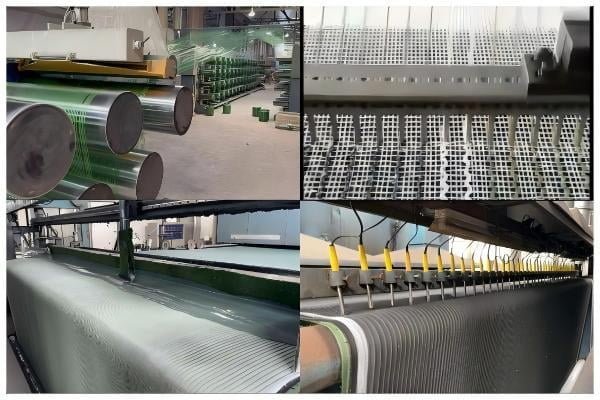
Many suppliers hide the details about their raw materials. This lack of transparency leads to poor purchasing decisions. I want to break down every component for you so you can choose the best product.
What Raw Materials Are Used to Manufacture Padel Grass Fibers?
Many buyers struggle to distinguish between high-end and cheap fibers. This confusion often leads to courts that wear out fast. I will clarify the material differences here to help you.
The best fibers use a blend of Polyethylene (PE)1, UV stabilizers, and color granules. High-quality options feature 9000-13500 Dtex2 for thickness. Cheaper alternatives often use Polypropylene (PP) with low Dtex (3500-6000), leading to faster degradation and poor performance under heavy play.
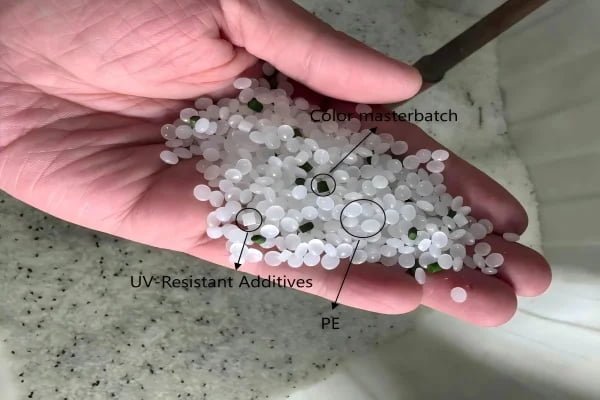
I always tell my clients that the raw material determines the lifespan of the court. High-quality turf starts with the yarn. We use a uniform blend of Polyethylene (PE), UV inhibitors, and color masterbatch granules. This mixture creates strong, straight fibers. Later, we crimp them using the KDK process. The weight of the yarn, or Dtex, is very important. Good turf ranges from 9000 to 13500 Dtex. This makes the grass thick and durable.
However, I see many cheap products on the market. These often use Polypropylene (PP) material. They use a standard crimping process instead of KDK. The Dtex is low, usually only 3500 to 6000 Dtex. This grass is thin and weak.
The backing is also different. Superior turf uses a double-layer PP backing with high-quality waterproof PU adhesive3. Cheap turf uses PP plus Net and SBR latex. SBR is not waterproof. When it rains, the water hurts the glue. The yarn pulls out easily.
Here is a comparison table to help you check specifications:
| Component | High-Quality Turf | Low-Quality Turf |
|---|---|---|
| Fiber Material | Polyethylene (PE) | Polypropylene (PP) |
| Additives | UV Inhibitors + Masterbatch | Minimal Additives |
| Dtex | 9000 – 13500 | 3500 – 6000 |
| Backing Glue | Waterproof PU Adhesive | SBR Latex (Not Waterproof) |
| Durability | High Pull-out Strength | Low Pull-out Strength |
What Are the Different Types of Artificial Turf for Padel Courts?
You might see various grass styles and feel unsure which one fits padel. Choosing the wrong style affects ball bounce and player safety. Let’s look at the options available today.
Padel turf has evolved into three main styles: Slit Film, Monofilament, and KDK Crimped Monofilament4. While Slit Film and straight Monofilament were popular in the past, modern courts almost universally use KDK Crimped Monofilament (12mm) because it holds sand better and provides a consistent playing surface.
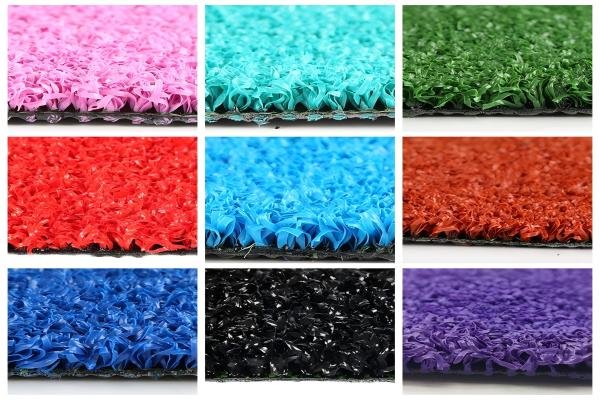
I have watched the industry change over the years. Padel court artificial turf has evolved significantly. Today, we generally see three yarn types. These result in three distinct styles: Slit Film, Monofilament, and KDK process crimped monofilament.
First, there is Slit Film. Manufacturers make this by compressing polypropylene (PP), colorants, and UV-cured granules into thin sheets. Then, they cut the sheets. This forms a mesh structure. Before 2005, technology was not advanced, and this was common for sports. Now, it is mostly for ornamental turf or low-budget projects.
Next is Monofilament artificial turf. We extrude this using specific molds. The fibers have shapes like S-shapes or diamonds. It is made of Polyethylene (PE). This material resists UV rays and abrasion very well. Soccer courts usually use this type with 40-60mm height. Before 2015, some padel courts used 10-20mm straight monofilament. However, this required a large amount of silica sand filling to keep the fibers up.
Finally, we have the modern standard: KDK crimped monofilament. Nowadays, padel courts almost universally use this type. The fibers are woven into crimped yarns. They are typically 12mm long. This texturized design holds the sand in place. You only need a small amount of silica sand filling. This offers the best performance for players.
How Is Synthetic Padel Tennis Grass Produced in the Factory?
Installation delays often happen because of complex seam work. You want a fast and easy installation process. I will explain how modern factory production solves this problem for you.
Modern production weaves white lines directly into the turf rolls, unlike older methods that required cutting and pasting on-site. We typically produce a complete court using just three specific rolls (A, B, and C) with pre-woven lines, which significantly reduces seams and installation time.
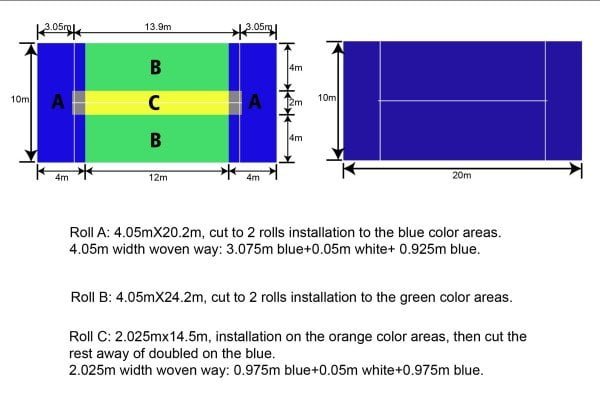
In the past, we produced padel turf separately from the field color and the white yarn. Installers had to cut the green turf and glue in the white lines manually. This took a long time and created weak points. Now, technology allows us to weave the white yarn directly into the roll. This significantly reduces the number of seams during installation. It makes your job much easier.
Typically, we only need 3 rolls of turf per site to build a standard court. I will explain the specific cutting plan we use in the factory.
Roll A: The size is 4.05m x 20.2m. You cut this into 2 rolls. These are installed in the blue (or main color) area. The 4.05m width weave consists of 3.075m blue, 0.05m white, and 0.925m blue.
Roll B: The size is 4.05m x 24.2m. You also cut this into 2 rolls. These are installed in the other green or blue area.
Roll C: The size is 2.025m x 14.5m. This is installed in the center orange or blue area. Then, you cut off the remaining portion. The double-layer weave width is 2.025m. It contains 0.975m blue, 0.05m white, and 0.975m blue.
This precise production method ensures that the lines are straight and strong. It saves you money on installation labor.
Conclusion
Understanding raw materials, KDK technology, and factory production methods ensures you buy durable, high-performance padel turf. Choose quality components to maximize the lifespan and profitability of your courts.
-
Explore the advantages of Polyethylene (PE) in turf for durability and performance. ↩
-
Understanding Dtex is crucial for choosing the right turf; learn how it affects quality. ↩
-
Learn about the importance of waterproof PU adhesive in ensuring turf durability. ↩
-
Explore this link to understand why KDK Crimped Monofilament is the preferred choice for modern padel courts. ↩