
Are you struggling to reconcile official bidding documents with actual manufacturing specifications? When specifying the standard glass height for a padel court, many procurement officials demand mathematically exact measurements on paper. However, demanding a perfect 3000mm glass panel from a factory creates severe installation risks and safety hazards. Here is how professional manufacturers bridge this gap between theory and reality.
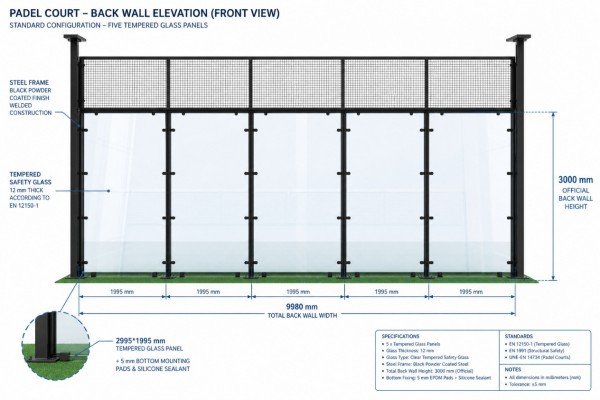
The standard glass height for a padel court officially requires a 3-meter high back wall according to FIP regulations. However, professional manufacturers produce the tempered glass panels at exactly 2995mm. The remaining 5mm accommodates bottom mounting pads and silicone sealant, achieving the strict 3-meter compliance without risking thermal expansion explosions.
Understanding this 5mm engineering tolerance is critical for civil contractors, public sector institutions, and club operators. Let us explore why standard dimensions on tender documents must translate differently on the factory floor.
Why does the standard glass height for a padel court differ from actual blueprints?
Contractors often panic when their commercial packing list shows 2995mm panels instead of the expected 3000mm. This discrepancy causes unnecessary friction during the public bidding process. Understanding the engineering logic eliminates compliance worries and speeds up project approval.
Actual manufacturing blueprints set the standard glass height for a padel court at 2995mm to account for essential installation hardware. The structural glass rests on protective neoprene pads1, which add the necessary height to fulfill the exact 3-meter assembled requirement specified in public tenders.
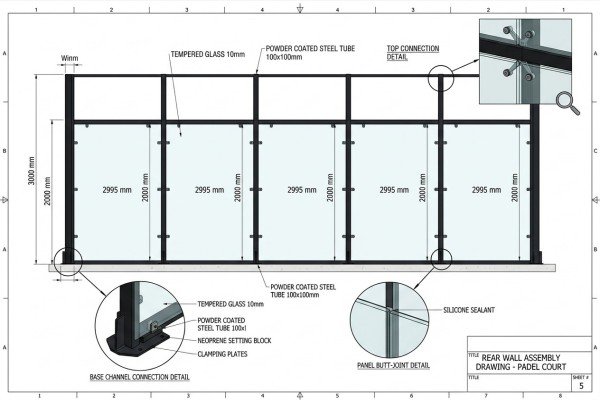
When reading International Padel Federation (FIP) regulations, the language is clear: the back wall must reach exactly 3 meters2. As a manufacturer with 10 years of production experience at QHPADEL, I frequently review municipal tender documents demanding this exact standard.
However, a padel court is not a theoretical diagram. It is a massive outdoor structure subjected to physical laws. If a factory produces a raw glass panel at exactly 3000mm, it fails the real-world engineering test. Professional production drawings always dictate a panel size of 1995mm by 2995mm. The missing 5mm is not a defect, a manufacturing error, or a shortcut to save material. It is an intentional, calculated engineering margin.
When contractors install a panoramic or standard court, they do not place tempered glass directly onto raw concrete or steel frameworks. Doing so would cause immediate damage. Instead, the glass sits on specialized bottom mounting pads. These pads, combined with structural gaps, add precisely 5mm to the total assembly height. Once fully installed and sealed with weather-resistant silicone, the finished wall perfectly achieves the 3-meter standard.
Here is a breakdown of how the final dimension is achieved:
| Component | Dimension Specification | Purpose |
|---|---|---|
| Tempered Glass Panel | 2995mm | The primary structural barrier |
| Mounting Hardware/Pads | 3mm – 5mm | Elevates glass off hard concrete |
| Silicone Sealant | Fills remaining gap | Waterproofs and secures the base |
| Total Assembled Height | 3000mm | Meets strict FIP regulations |
By utilizing this correct mathematical approach, equipment distributors and importers can confidently assure their local buyers that the final assembled product will pass any stringent government or club inspection.
What are the safety risks if the standard glass height for a padel court is exactly 3000mm?
Some buyers insist on absolute millimeter precision, forcing suppliers to theoretically produce exactly 3000mm panels. This demand ignores basic physics. Without proper engineering tolerance, the resulting safety hazards put players at immense risk and guarantee costly post-sale disputes.
Supplying exactly 3000mm panels for the standard glass height for a padel court eliminates the critical 5mm expansion gap. When exposed to outdoor temperature fluctuations, the glass undergoes thermal expansion.3 With nowhere to expand, internal stress builds, causing catastrophic self-explosion of the tempered glass.
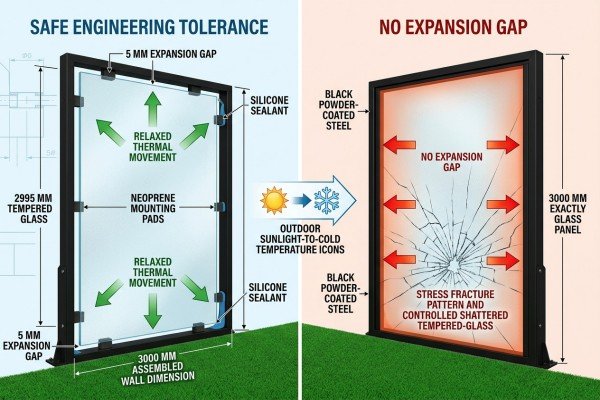
The laws of physics do not care about strict tender documents. Tempered glass expands and contracts based on environmental conditions. In regions like the Middle East or South America—where we export heavily—daily temperature swings are extreme4.
If the glass is cut to an absolute 3000mm height and wedged tightly between a concrete foundation and an upper steel frame, it has zero room to breathe. When the sun heats the court, the panel expands. Without that 5mm tolerance, the glass presses against the rigid metal and concrete. This internal stress builds rapidly until the tempered glass undergoes spontaneous self-explosion5, posing a severe danger to players.
Beyond temperature, zero-tolerance dimensions create nightmares during the site installation process. Civil contractors face inherent variations in concrete leveling. Even a laser-leveled foundation will possess microscopic imperfections or deliberate slight gradients for water drainage6.
The Dangers of Zero-Tolerance Glass Dimensions
If installers attempt to maneuver a mathematically exact 3000mm heavy glass pane into a rigid 3000mm space, severe problems occur:
- Corner Chipping: The moment a glass corner grinds against a steel post or concrete base due to lack of clearance, it chips. Corner impacts are the Achilles’ heel of tempered glass, leading to instant shattering.7
- Inability to Level: Installers cannot insert leveling shims under an exact 3000mm pane, resulting in crooked walls on uneven concrete.
- High Replacement Costs: Breakages during installation force contractors to re-order single glass panels, delaying the project and destroying profit margins.
- Unclear Liability: When a zero-tolerance panel breaks, fierce disputes arise regarding whether the failure was a material defect or an installation error.
How do factory blueprints ensure the standard glass height for a padel court meets compliance?
Passing strict government or university procurement inspections requires airtight documentation. If your blueprints do not clearly explain the structural math, inspectors will reject the installation. Proper factory documentation prevents these costly compliance failures.
Our technical drawings clearly detail how the 2995mm manufacturing specification satisfies the standard glass height for a padel court. By documenting the 5mm structural gaps, mounting pads, and sealant, we provide procurement officials with verifiable proof of FIP and safety compliance.
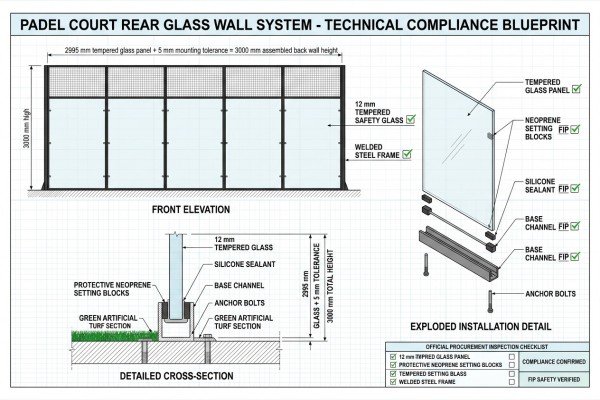
Over the past 9 years of exporting padel systems, I have seen many distributors lose bids simply because they could not explain the discrepancy between their physical product and the tender specifications. Procurement officers compare the packing list to the tender, see 2995mm instead of 3000mm, and immediately flag the shipment as non-compliant.
At QHPADEL, our engineering department removes this ambiguity before production even begins. We provide our B2B clients with comprehensive installation blueprints and foundation drawings. These documents map out every millimeter of the court’s architecture. When an inspector questions why a CE-certified glass panel measures 2995mm, our blueprints provide the exact structural breakdown.
We clearly define the physical boundaries for the buyer. The blueprints show the tempered glass measured at exactly 1995mm x 2995mm. Below the glass, the drawing details the protective neoprene base pads that elevate the panel. Finally, the drawing highlights the weather-grade silicone that fills the engineering gap, ensuring structural stability and waterproofing.
This comprehensive documentation is a critical asset for public sector and institutional buyers. These entities require traceable supply chains and logical, defensible technical responses for bidding. By proactively providing standardized blueprints that map out these tolerances, we empower our distributors to win government tenders. They can clearly demonstrate that they are providing a safely engineered structure, rather than a mathematically blind sheet of glass.
How does the standard glass height for a padel court impact civil contractors?
Local installers bear the brunt of poorly designed courts. When factories fail to calculate correct installation margins, contractors waste days fighting to fit oversized materials. Proper height tolerances dramatically reduce labor costs and eliminate on-site modifications.
For civil contractors, understanding the standard glass height for a padel court means utilizing the 5mm tolerance to absorb foundation imperfections. This gap allows installers to micro-adjust the glass panels, ensure perfectly plumb alignments, and avoid shattering disputes caused by rigid components.
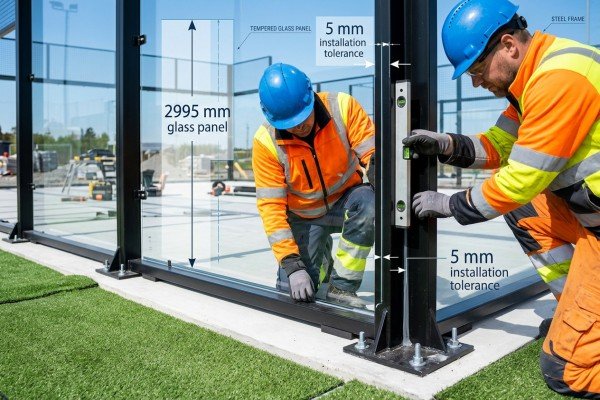
Civil contractors and engineering firms are the backbone of any successful club deployment. They take delivery of our 600+ annual export containers, handle site preparation, pour the concrete, and manage the final handover to the club owner.
From my experience working with contractors globally, the concrete foundation is rarely mathematically perfect. Concrete cures with slight gradients to allow for rainwater drainage. If the glass had no height tolerance, contractors would have to grind down solid concrete or modify the steel frames on site with heavy machinery. This is a massively expensive, time-consuming, and dangerous proposition.
The 2995mm glass height specification provides contractors with the essential breathing room they need to execute a flawless installation. Installers use high-density shims within that 5mm gap to level the panels perfectly, regardless of minor foundation slopes. Once the wall is plumb and leveled, the gap is securely sealed, resulting in a beautiful, standardized finish.
This structural design also clarifies after-sales responsibilities. When a factory supplies a 2995mm panel and provides clear pre-embedding drawings, the installation process is straightforward. If the panel is installed properly with expansion gaps, the risk of a material defect claim drops to near zero. Our structural accuracy ensures that as long as the foundation drawings are followed, the installation will be safe, swift, and entirely compliant, protecting the contractor’s reputation and bottom line.
Frequently Asked Questions
Does a 2995mm panel meet FIP requirements for the standard glass height for a padel court?
Yes. FIP requires the final assembled back wall to measure 3 meters. A 2995mm glass panel, combined with 5mm of structural mounting pads and silicone sealant, achieves the exact 3-meter regulatory requirement upon complete installation.
Will the 5mm gap at the bottom of the glass affect the ball bounce?
No. The 5mm gap is positioned at the very base of the concrete foundation and is entirely filled with industrial-grade silicone sealant. This creates a flush, seamless finish that has absolutely zero impact on gameplay or ball trajectory.
Can I request exactly 3000mm glass for my public bidding documents?
While a factory can theoretically cut glass to any size, we strongly advise against exactly 3000mm panels. Doing so eliminates the critical engineering tolerance needed for thermal expansion, leading to a high probability of spontaneous glass shattering.
Who is responsible if the glass shatters during installation?
Responsibility depends on the installation method. If the contractor fails to utilize the provided 5mm tolerance gap or forces the glass against raw steel/concrete, the liability falls on the installation team. Proper use of our blueprints prevents this entirely.
Conclusion
Navigating procurement specifications requires understanding the crucial difference between theoretical rules and manufacturing reality. The standard glass height for a padel court dictates a 3-meter wall, but safety and physics demand a 2995mm panel paired with a 5mm mounting gap. By respecting thermal expansion and structural tolerances, B2B buyers, contractors, and public institutions guarantee safe, long-lasting, and compliant installations. At QHPADEL, we provide the precise blueprints, CE-certified materials, and technical support you need to win competitive bids and build reliable clubs. For detailed bill of materials and factory-direct pricing, contact Alice Chen at QHPADEL today.
-
"Neoprene Setting Blocks", https://www.crlaurence.com/products/brands/listing/J19B_XX. Architectural glazing guidelines specify the use of elastomeric setting blocks, such as neoprene, to cushion structural glass and prevent direct contact with rigid substrates. Evidence role: general_support; source type: institution. Supports: The industry standard use of neoprene setting blocks to support and protect structural glass edges.. ↩
-
"The padel court, measurements and materials", https://www.bnlitalymajorpremierpadel.com/en/News/Padel-QA/The-padel-court-measurements-and-materials. See the International Padel Federation (FIP) official rules of padel, which define the structural dimensions and mandatory 3-meter height for back walls. Evidence role: definition; source type: institution. Supports: The official FIP dimensional requirements for padel court walls.. ↩
-
"Thermal Expansion Coefficients – HyperPhysics", http://hyperphysics.phy-astr.gsu.edu/hbase/Tables/thexp.html. Materials science studies on architectural glazing detail the thermal expansion coefficient of tempered glass, demonstrating how temperature fluctuations cause measurable dimensional changes. Evidence role: mechanism; source type: paper. Supports: The physical mechanism and rate of thermal expansion in tempered glass.. ↩
-
"Diurnal temperature range: A climatological primer for health …", https://pmc.ncbi.nlm.nih.gov/articles/PMC13340791/. Climatological data highlights that arid and semi-arid regions, such as parts of the Middle East, experience significant diurnal temperature variations, placing high thermal stress on outdoor structures. Evidence role: general_support; source type: research. Supports: The high diurnal temperature variations characteristic of Middle Eastern and certain South American climates.. Scope note: The source provides general meteorological data rather than specific measurements for padel court locations. ↩
-
"1.3 Thermal Expansion – University Physics Volume 2", https://pressbooks.online.ucf.edu/osuniversityphysics2/chapter/thermal-expansion/. Research on glass failure mechanisms indicates that when tempered glass is constrained without expansion joints, thermal stress can exceed the material’s tensile strength, resulting in spontaneous shattering. Evidence role: mechanism; source type: research. Supports: How constrained thermal expansion leads to critical stress and spontaneous shattering in tempered glass.. ↩
-
"Patio Slabs, Porch Slabs, Walkways, and Driveways Slope …", https://basc.pnnl.gov/resource-guides/patio-slabs-porch-slabs-walkways-and-driveways-slope-away-house. The American Concrete Institute (ACI) and similar civil engineering bodies mandate slight surface gradients on outdoor concrete slabs to ensure effective surface water runoff. Evidence role: general_support; source type: institution. Supports: Civil engineering standards requiring deliberate gradients on outdoor concrete surfaces for proper water drainage.. ↩
-
"Which factors could cause the tempered glass broken after …", https://www.hhglass.com/news/Which-factors-could-cause-the-tempered-glass-broken-after-installation.html. Fracture mechanics studies of tempered glass show that the edges and corners contain complex residual stress profiles, making them highly vulnerable to impact-induced catastrophic failure. Evidence role: mechanism; source type: paper. Supports: The stress distribution in tempered glass that makes edges and corners particularly vulnerable to catastrophic failure upon impact.. ↩