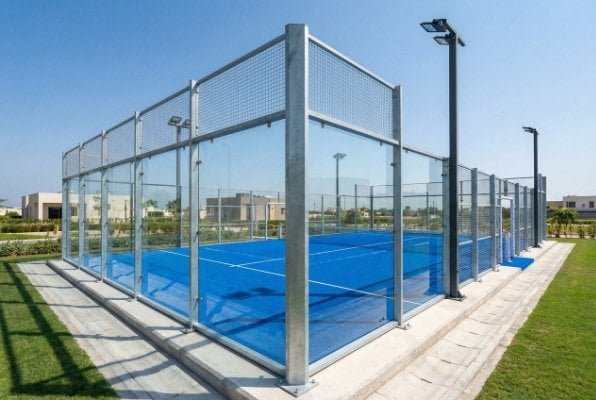
Padel players hate inconsistent bounces and slippery courts. These issues ruin the game and cause injuries. The secret to fixing this lies hidden beneath your feet: silica sand.
Silica sand acts as a stabilizer for artificial turf, ensuring consistent ball bounce and preventing injuries by providing necessary grip. It filters water to stop puddles and creates a protective barrier that extends the turf’s lifespan by minimizing fiber wear and preventing fungal growth.
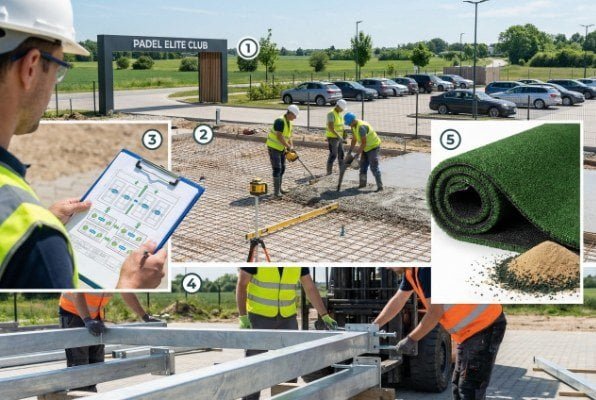
Many club owners overlook this crucial material. They focus on glass and steel but forget the sand. However, choosing the wrong sand affects everything from game quality to maintenance costs. You might think all sand is the same, but that is a costly mistake. Let me explain exactly why this material matters so much for your success and how to handle it correctly.
Why is Sand Infill Critical for Player Safety and Artificial Turf Longevity?
Slips and falls scare every player. Without the right surface friction, a fun match turns into a medical emergency. You must understand how infill prevents these accidents.
The silica sand provides essential grip, allowing players to move quickly and change direction safely. It also protects the turf fibers by holding them upright and acting as a shield against foot traffic, significantly extending the court’s usable life while preventing dangerous organic contamination.
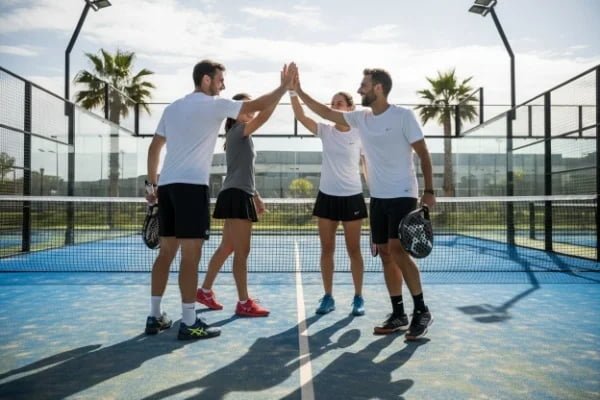
As an engineer who has worked with artificial turf for years, I see many people confuse padel turf with soccer grass. In soccer, we use rubber granules and sand to make the ball bounce fast. But padel is different. We need control. The artificial turf and sand in padel fields are designed to control the ball’s bounce, making it slower and easier to handle.
This is where the type of sand becomes critical. You must use silica sand (SiO2), not beach sand. Here is why this distinction saves your court:
- Drainage: Beach sand absorbs water. It turns into a paste when wet. Silica sand acts as a filter. It lets water pass through, preventing puddles and keeping the field stable.
- Hygiene: Beach sand contains organic matter. This leads to fungi and moss. Silica sand prevents this contamination, inhibiting the growth of microorganisms that damage the turf surface.
- Friction: Padel requires rapid movement and constant changes of direction. Silica sand increases friction with the player’s shoe. This grip significantly reduces the risk of slipping.
Furthermore, the sand acts as a barrier. It sits between the player and the backing of the turf. This reduces wear and tear on the fibers. We know that high-quality artificial turf is the most wear-resistant component, designed to withstand 5-10 years of traffic. However, without sand, those fibers flatten and break much faster. The sand keeps the fibers standing up, which helps with the ball trajectory and bounce angles, adding tactical depth to the game.
What is the Ideal Silica Sand Granulometry and How Much Silica Sand is Required Per Padel Court?
Buying the wrong sand wastes money and ruins turf. Using the incorrect size or amount creates a messy, unplayable surface. You need to know the exact specifications.
The ideal silica sand particle size is between 0.2mm and 0.5mm. This allows it to penetrate turf fibers effectively. Modern textured artificial turf typically requires 6-8 kg/sqm, whereas older monofilament styles need 15-20 kg/sqm. Sourcing locally saves significant shipping costs.
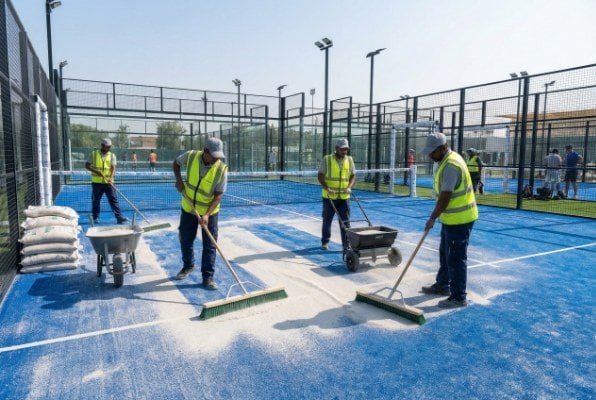
The size of the particle determines the success of your court. If the grains are too big, they sit on top of the grass like gravel. If they are too small, they block drainage. We recommend a particle size of 0.2-0.5mm. This size is small enough to fall between the fibers but large enough to facilitate drainage.
The amount you need depends entirely on the technology of the turf you buy. At QHPADEL, we have seen a shift in the market. We have largely phased out the old monofilament artificial turf. That old style required a lot of sand—about 15-20 kg per square meter.
Now, we commonly use 12mm curled high-dtex artificial turf. The specs look like this:
- Dtex: 7500-13500d
- Density: 42000-63000 turfs/sqm
Because this grass is dense and curled, it holds the sand better. You only need 6-8 kg per square meter. This is a huge saving.
| Feature | Monofilament Turf (Old Style) | Curled High-Dtex Turf (New Style) |
|---|---|---|
| Sand Required | 15-20 kg/sqm | 6-8 kg/sqm |
| Maintenance | High (sand moves easily) | Low (sand is trapped) |
| Visual | Sand is very visible | Sand is hidden |
A final piece of advice on purchasing: Do not import the sand. We recommend purchasing silica sand from your country of origin. It is a cheap material, but it is heavy. Shipping it from China adds unnecessary weight and cost. Buy the turf from us, but get the sand locally.
How to Properly Maintain Padel Artificial Turf and Sand for Longevity?
A neglected court loses players fast. Uneven bounces and hard spots frustrate customers and lower your revenue. Simple, regular checks solve these problems before they start.
Maintenance is simple but consistent. For busy courts, check weekly; for others, check monthly. Look for uneven sand distribution or accumulation at the edges. Redistribution with a brush ensures even ball bounce. Regular maintenance prevents compaction and keeps the playing surface professional and safe.
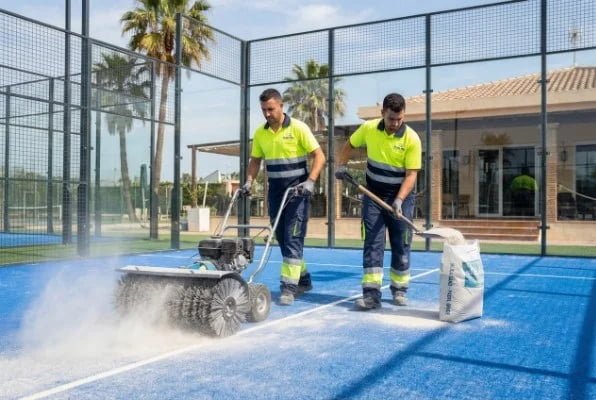
Many of our clients worry that maintenance will be difficult. I always tell them: padel court maintenance is very simple. It does not require expensive machines or a large team. It mostly requires attention.
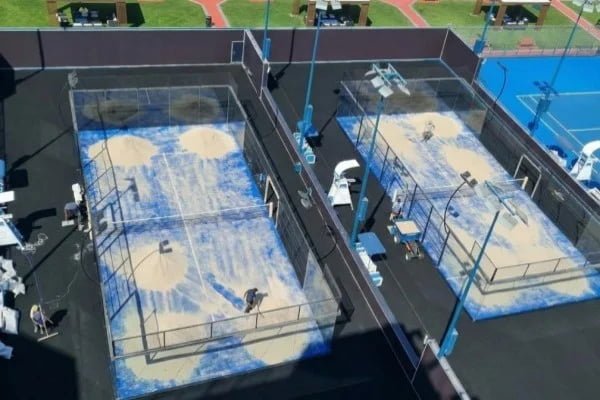
The main issue is sand movement. As players run and slide, they push the sand away from the center and toward the edges or the net. If you leave it, the center becomes slippery, and the edges get deep piles of sand. This makes the ball bounce unevenly.
Here is the schedule I recommend to my clients:
- High Capacity Courts: If your court is fully booked every week, check it once a week.
- Moderate Capacity Courts: If usage is average, check it once a month.
What to do during the check:
- Inspect: Look for bare spots where the green turf is too visible. Look for piles of sand against the glass walls.
- Brush: Use a wide brush. Push the accumulated sand from the edges back into the playing zones.
- Refill: If you see that the level has dropped, add a small amount of silica sand.
The goal is to smooth it with a brush to ensure that the ball bounces evenly everywhere. A well-maintained court not only plays better but also protects your investment. Remember, a good court can generate significant revenue, potentially over $29,000 per year. Don’t let a lack of brushing ruin that income.
Conclusion
Silica sand ensures safety, protects your investment, and guarantees a great game. Choose the right size, use the correct amount, and brush regularly to keep your courts profitable and professional.