You invest heavily in Padel courts, but the turf wears out too fast. Do you assume a higher Dtex number automatically guarantees long-lasting quality for your projects?
Generally, higher Dtex indicates a heavier product, but it does not always mean better performance. The thickness of individual fibers determines true durability. A lower total Dtex with thicker individual strands often outperforms a higher total Dtex made of thin, weak fibers.
Many suppliers push high numbers to impress you. However, understanding the technical truth saves money and headaches. Let me explain how Dtex really works so you make the right choice.
What is the Meaning of Dtex in Padel Tennis Artificial Grass?
Confusing technical specs on quote sheets can lead to bad purchasing decisions. Do you actually know what the Dtex number on your specification sheet represents?
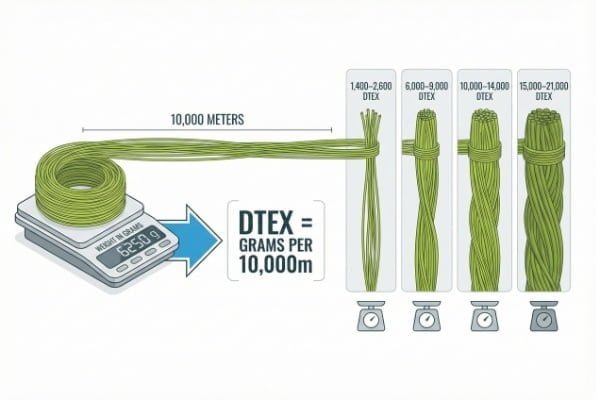
Dtex stands for Decitex. It is the standard unit of measure for fiber density. Specifically, it represents the weight in grams of a single yarn bundle that is 10,000 meters long. It tells you how much material is in the turf.
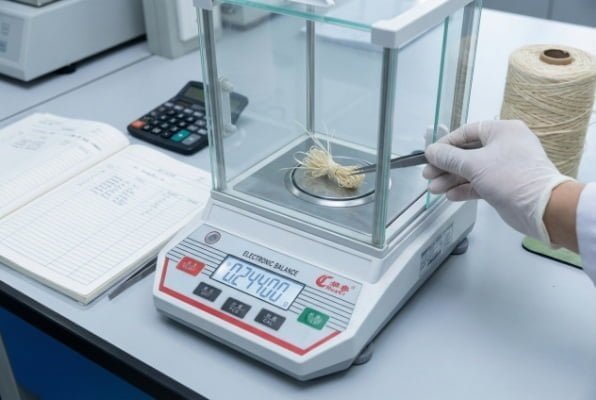
I want to take you inside the logic of the factory lab. When we look at Dtex, we are looking at a measurement of mass and length. It is a very objective number. If I take a spool of yarn that is 10,000 meters long and weigh it, that weight in grams is the Dtex. For example, if the scale shows 8,800 grams, the turf is 8,800 Dtex. This is the standard unit for fiber density across the textile industry.
However, you must be careful. A high Dtex value simply means there is more plastic material in that bundle. It does not tell you the shape or the quality of that plastic. As a buyer, you might see a quote for 12,000 Dtex and think it is superior to 10,000 Dtex. But you need to look closer. The Dtex value is a sum of all the filaments in one stitch.
To help you understand this better, let’s break down the relationship between weight and material quantity.
Understanding the Numbers
| Measurement Unit | Definition | What it Indicates |
|---|---|---|
| Dtex (Decitex) | Weight in grams of 10,000 meters of yarn. | Total material density per yarn bundle. |
| Denier | Weight in grams of 9,000 meters of yarn. | An older unit, less common in Padel turf now. |
| Pile Weight | Weight of the grass per square meter. | Overall heaviness of the finished carpet. |
When I worked in the technical department, we often saw competitors use "filler" content to increase weight. But true Dtex refers to the yarn itself. Understanding this definition is the first step. It protects you from suppliers who use big numbers to hide poor quality.
How Does Fiber Thickness (Dtex) Impact the Playing Experience and Safety?
Players complain about uneven bounces and slippery courts after just a few months. Is the fiber thickness of your current turf too thin to hold its shape?
Thicker individual fibers provide superior resilience and stay upright longer. This ensures a consistent ball bounce and better traction for players. Thin fibers split easily, leading to flat courts that look bad and increase the risk of injury during intense matches.
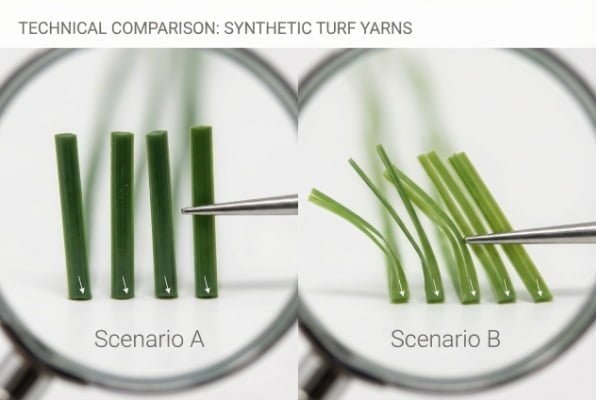
This is the most critical insight I can share with you today. Please pay close attention to the math here. A higher total Dtex value usually means more material. But the thickness of individual fibers has the greatest impact on abrasion resistance. Even if two bundles of yarn have a similar total weight, a thicker individual yarn is more resistant to splitting. It holds its shape better than a thinner one.
Let’s look at a concrete example. Consider two products. Product A is 10,000 Dtex. Product B is 12,000 Dtex. On paper, Product B looks stronger. But you must ask the supplier: "How many filaments are in the bundle?"
Product A (10,000d) consists of a bundle of 4 monofilaments.
Product B (12,000d) consists of a bundle of 6 monofilaments.
Now, let’s do the math to find the thickness of a single blade of grass.
The Calculation of Strength
| Product | Total Dtex | Filament Count | Individual Yarn Dtex | Result |
|---|---|---|---|---|
| Product A | 10,000 | 4 | 2,500 | Thicker, Stronger |
| Product B | 12,000 | 6 | 2,000 | Thinner, Weaker |
While 12,000d seems larger than 10,000d, the truth is that the 10,000d product is composed of four very thick 2,500d yarns. The 12,000d product is composed of six thinner 2,000d yarns. Ultimately, the 10,000d yarn is stronger and more durable. Thicker yarns resist the friction of sand and shoes. Thinner yarns split and lay flat quickly. When the grass lays flat, the ball rolls too fast, and players lose grip. Safety is compromised. Therefore, do not just look at the total number. Look at the structure of the yarn.
How Do I Select the Correct Dtex for Commercial vs. Residential Padel Courts?
Using the wrong turf specification can destroy your profit margins or ruin a home game. Are you overspending on residential courts or under-speccing busy commercial clubs?
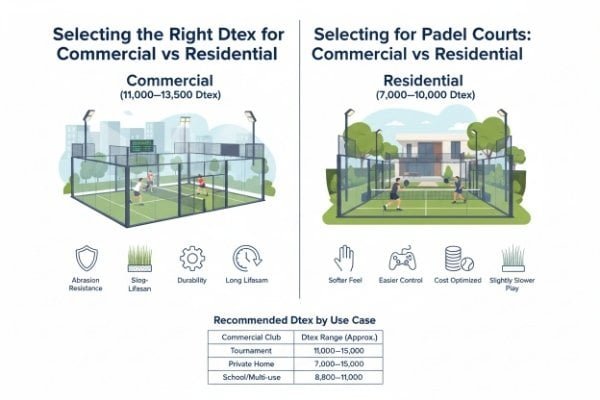
Commercial venues with high traffic need 11,000-13,500 Dtex for maximum abrasion resistance. Conversely, residential or private courts work best with 7,000-10,000 Dtex. This lower range offers a softer feel and easier ball control for casual players who do not play every day.
Selecting the right turf is about balancing performance with cost. You do not need a tank to drive to the grocery store, and you should not use a sedan to carry heavy construction loads. The logic for Padel courts is the same. I have helped many club owners in Brazil and Mexico who wanted to save money by buying lighter turf. They ended up replacing it two years later. That is a massive loss of profit.
For high-traffic commercial venues, I strongly recommend a range of 11,000 to 13,500 Dtex. These courts are used 8 to 12 hours a day. The friction is constant. You need heavy, thick fibers (as we discussed above) to withstand this wear. It improves wear resistance and durability significantly.
On the other hand, for residential areas with lower usage, such as a private court in a villa, 7,000 to 10,000 Dtex is suitable. Why? Because these courts are not played on every hour. Also, lower Dtex turf often has lower resilience, which makes the game slightly slower. This allows for easier control during games for families or amateur players. It is also softer to the touch.
Selection Guide by Application
| Usage Scenario | Recommended Dtex | Key Benefit | Fiber Focus |
|---|---|---|---|
| Commercial Club | 11,000 – 13,500 | High Durability | Thick Monofilament |
| Tournament Court | 12,000 – 15,000 | Professional Speed | High Density / Texturized |
| Private/Residential | 7,000 – 10,000 | Comfort & Cost | Softer Feel |
| School/Multi-use | 8,800 – 11,000 | Versatility | Balanced Thickness |
By matching the Dtex to your actual needs, you optimize your investment. You get the best performance for your specific situation without wasting budget.
Why Choose QHPADEL for Customized Dtex and High-Performance Turf Solutions?
Finding a factory that accepts specific technical adjustments is frustrating and time-consuming. Do you struggle to find a supplier who will manufacture turf exactly to your market’s requirements?
QHPADEL provides flexible customization for orders of just six courts or more. We adjust Dtex, stitch density, color, and backing to fit your needs. This allows you to offer a unique product that stands out against competitors using standard, off-the-shelf specifications.
At QHPADEL, we understand that one size does not fit all. Many importers in the US and Europe struggle because big factories ignore small customization requests. They only want to sell what they have in stock. My background as an engineer taught me that small tweaks in production make a big difference in the final product.
We offer custom-made artificial turf for at least six fields. This is roughly 1,200 square meters (200 sqm per court * 6). This Minimum Order Quantity (MOQ) is very friendly for growing businesses. You do not need to order a whole container of just one type.
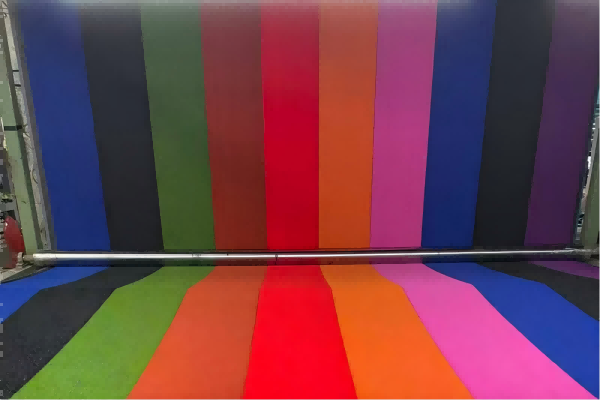
We can adjust several parameters for you. The Dtex value can be increased for durability. The density can be changed to alter the ball speed. We can even customize the turf color (blue, terracotta, black) and the underlayment backing. This allows you to meet specific customer needs and market demands for personalized customization.
QHPADEL Customization Capabilities
| Feature | Standard Option | Custom Option (QHPADEL) | Benefit |
|---|---|---|---|
| Dtex | Fixed (e.g., 8800) | Adjustable (7000-15000) | Perfect durability match. |
| Color | Blue / Green | Custom Colors | Matches club branding. |
| Backing | Latex | PU / Double PP | Better drainage/strength. |
| MOQ | High (3000sqm+) | Low (1200sqm / 6 courts) | Lower risk for you. |
Our mission is to make your procurement worry-free. We handle the strict quality control and certifications, so you can focus on selling and building.
Conclusion
Total Dtex measures weight, but individual fiber thickness defines durability. Choose 11,000+ for commercial clubs and lower Dtex for homes. QHPADEL customizes these specs to guarantee your project’s success.