Padel turf Dtex often attracts attention when buyers compare quotations, but a larger number can create a false sense of certainty. If buyers select turf from one figure alone, they may pay for an unsuitable specification or overlook important construction details. I recommend evaluating Dtex alongside filament structure, density, traffic, lifespan goals, and budget.
Higher Dtex does not automatically mean better padel turf. Dtex measures yarn linear mass, but it does not independently show filament strength, tuft density, material quality, wear resistance, or playing performance. Buyers should compare the complete turf system and confirm that its specification matches expected court traffic, target service life, maintenance plan, and available budget.
I configure turf specifications for club operators, contractors, distributors, and importers. In those conversations, I often see two quotations with different Dtex figures presented as if the larger figure settles the decision. A closer breakdown usually reveals a more useful commercial question: What does each specification deliver for this project?
What Does Padel Turf Dtex Actually Measure?
Buyers often see numbers such as 8,800, 10,000, or 12,000 Dtex without a clear explanation. That uncertainty makes the largest number look safer. I reduce this confusion by separating what Dtex measures from the broader quality characteristics that it cannot measure by itself.
Dtex is a unit of linear mass. One Dtex represents one gram per 10,000 meters of yarn.1 A higher total figure generally indicates more yarn mass for the measured yarn bundle2, but it does not reveal the full construction or performance of padel turf. Buyers must also examine filament count, individual filament size, material, profile, and tufting.
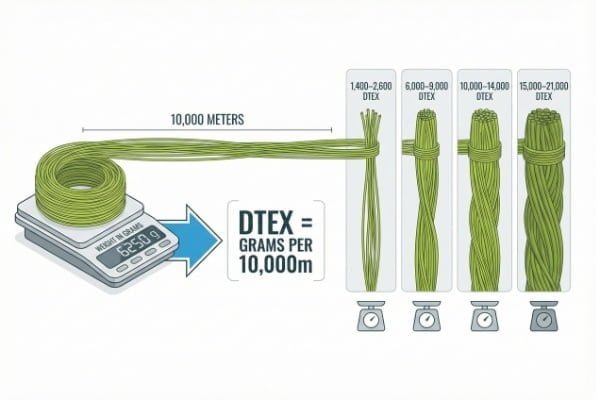
Dtex is a measurement, not a quality grade
I treat Dtex as a technical descriptor rather than a score. A 12,000 Dtex yarn bundle is not automatically “better” than a 10,000 Dtex bundle, just as a heavier piece of steel is not automatically more suitable for every structure.
The figure tells me about linear mass under the supplier’s stated construction. It does not directly tell me:
- How many individual filaments form the yarn bundle
- How thick each filament is
- Whether the yarn uses polyethylene, polypropylene, or another formulation
- Whether the yarn is monofilament, fibrillated, textured, or a mixed construction
- How tightly the backing holds each tuft
- How many stitches or tufts appear per square meter
- How much total yarn the finished turf contains
- How the product responds to abrasion, UV exposure, heat, or repeated maintenance
- How the complete surface affects ball response and player movement
I always ask suppliers to define the notation behind the headline number. Different quotations may describe yarn construction in different ways. If one document says “12,000 Dtex” without stating the filament configuration or test basis, buyers cannot make a reliable like-for-like comparison.
Total Dtex can hide different constructions
I often use the following simplified example when I speak with buyers:
| Example construction | Calculation | Total Dtex | Initial observation |
|---|---|---|---|
| 6 × 2,000d | 6 × 2,000 | 12,000 | Fewer, heavier yarn elements |
| 8 × 1,500d | 8 × 1,500 | 12,000 | More, lighter yarn elements |
Both configurations total 12,000 Dtex, yet their construction is not identical. Under matched materials and manufacturing conditions, the 6 × 2,000d option may use stronger individual elements. However, I would not present that possibility as a universal durability rule. Material formulation, yarn geometry, extrusion quality, tuft design, and testing conditions can change the result.
I recommend asking the supplier what each number in its yarn notation represents. Buyers should not assume that every manufacturer uses identical terminology.
A complete comparison should include product data sheets, physical samples, and relevant test reports. Buyers should also confirm the methods and conditions behind laboratory claims instead of comparing isolated results from different test procedures.
Why Does Higher Dtex Not Always Mean Better Padel Turf?
A high Dtex figure sounds reassuring, especially when a buyer wants a long-lasting commercial court. However, the number can become misleading when other variables remain hidden. I have seen buyers focus on yarn mass while giving too little attention to turf density, backing, filament shape, and intended use.
Higher Dtex does not always mean better padel turf because performance comes from the interaction of several components. A heavy yarn bundle can still be paired with low tuft density, an unsuitable filament profile, or inconsistent manufacturing. A lower-Dtex option may offer better value when its complete construction fits the court’s traffic and commercial position.
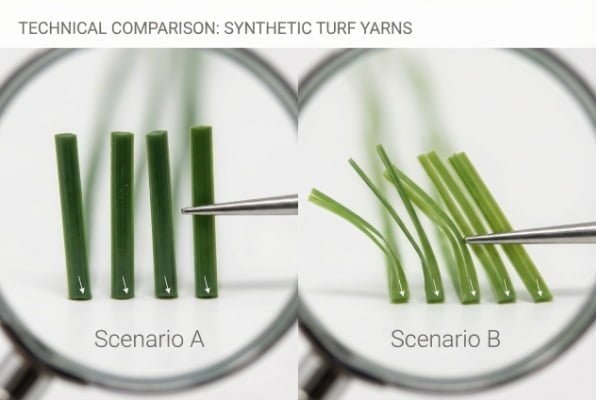
Turf functions as a system
I evaluate artificial grass by looking at how the yarn, tufting, backing, infill, and installation work together. A single specification rarely predicts the performance of the installed surface.
The following factors deserve attention:
- Filament material: The polymer formulation affects flexibility, recovery, and environmental resistance. Buyers should request declared material information and supporting test documents where applicable.
- Filament profile: Flat, ribbed, reinforced, curled, or textured profiles can behave differently under traffic.
- Yarn construction: Monofilament and fibrillated yarns have different structures.3 Buyers should judge each option against the intended court design rather than ranking one type universally.
- Tuft density: A high yarn Dtex does not compensate automatically for a low number of tufts.
- Pile height: The pile specification affects the complete system, including infill requirements and surface behavior.
- Gauge and stitch rate: These figures help buyers understand how yarn is distributed across the backing.
- Total yarn content: Yarn weight per square meter can provide a broader view than bundle Dtex, although buyers should still confirm how the supplier calculates it.
- Primary and secondary backing: Backing construction and tuft bind influence product integrity.4
- Installation quality: Seams, adhesive selection, base flatness, drainage, infill distribution, and brushing can affect the final result.
A larger number can create unnecessary cost
A premium specification has value when it answers a real operating need. However, an investor building a lightly used private or hotel court may not need the same configuration as a busy club running bookings throughout the day.
I once discussed a project where the buyer initially requested the highest available Dtex because a competing quotation described it as a premium grade. After we reviewed expected bookings and the project’s budget, the buyer shifted attention to a balanced system with appropriate density and documentation. That field experience does not prove a universal performance rule, but it shows why procurement context matters.
I recommend that buyers ask a simple question for every upgrade:
Which measurable requirement does this higher specification address?
If the answer only says “higher is better,” I would request more detail. A credible quotation should explain the construction difference, intended application, price impact, and available test evidence.
How Should Buyers Compare Padel Turf Specifications?
Turf quotations often use different formats, which makes direct comparison difficult. One supplier may highlight Dtex, while another emphasizes density or yarn weight. I solve this problem by placing every offer into one comparison sheet and marking any missing, undefined, or unsupported values.
Buyers should compare padel turf specifications through a standardized technical schedule. The schedule should cover total Dtex, filament configuration, yarn type, pile height, gauge, stitch rate, tuft density, yarn weight, backing, roll dimensions, certificates, test methods, warranty terms, and price. Buyers should request clarification whenever suppliers calculate values differently.
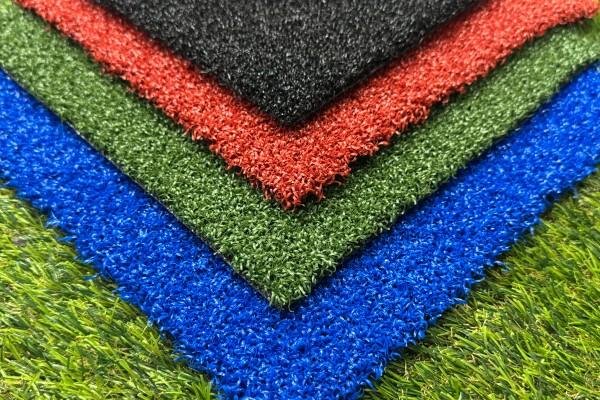
Build a like-for-like comparison table
I recommend using a table similar to the following one:
| Comparison item | Supplier A | Supplier B | What I would verify |
|---|---|---|---|
| Total Dtex | 12,000 | 10,000 | Yarn bundle definition and method |
| Yarn configuration | 6 × 2,000d | Not stated | Number and size of yarn elements |
| Yarn type | Monofilament | Fibrillated | Product structure and intended use |
| Material | PE declared | PE declared | Material data and supporting documents |
| Pile height | 12 mm | 12 mm | Measurement tolerance |
| Gauge | 3/16 inch | 3/16 inch | Actual production specification |
| Stitch rate | Supplier value | Supplier value | Unit and test method |
| Tuft density | Supplier value | Supplier value | Calculation per square meter |
| Yarn weight | Supplier value | Not stated | Net yarn content and calculation |
| Backing | PP plus coating | PP plus coating | Layers, coating, drainage, tuft bind |
| Roll width and length | Stated | Stated | Court layout and seam plan |
| Test documents | Listed | Partial | Issuer, model, scope, and validity |
| Warranty | Stated terms | General claim | Exclusions and claim procedure |
Buyers should avoid comparing values when the units differ. A stitch rate listed per 10 centimeters cannot be compared directly with a value listed per meter until someone converts it. The same care applies to density, yarn weight, roll dimensions, and tolerances.
Request physical and documentary evidence
I encourage importers and contractors to examine a production sample before confirming a large order. A small sample cannot reproduce years of court use, but it can reveal differences in color, texture, backing, yarn configuration, and workmanship.
Buyers should request:
- A complete technical data sheet
- A sample linked to the quoted model
- Batch or model identification
- Turf layout and cutting plan
- Installation and maintenance instructions
- Packing details
- Warranty terms and exclusions
- Relevant certificates and test reports
- The test method used for performance claims
QHPADEL can provide turf documented as CE and RoHS certified, while the factory maintains ISO 9001 certification.5 I advise every buyer to verify the certificate issuer, covered product, report number, scope, and validity. Certifications remain procurement documents that require review; they do not replace project-specific professional evaluation.
Which Padel Turf Dtex Suits Different Court Traffic Levels?
Buyers sometimes request a universal Dtex recommendation before they describe the project. That order creates a risk because court use varies widely. I begin with expected bookings, user profile, maintenance capacity, climate, commercial positioning, replacement plan, and the operator’s tolerance for downtime.
The suitable padel turf Dtex depends on the complete court requirement rather than one fixed benchmark. A busy commercial club may justify a more robust yarn and dense construction, while a lightly used private court may prioritize value. Buyers should match the full turf system to realistic traffic and verify performance claims under comparable conditions.
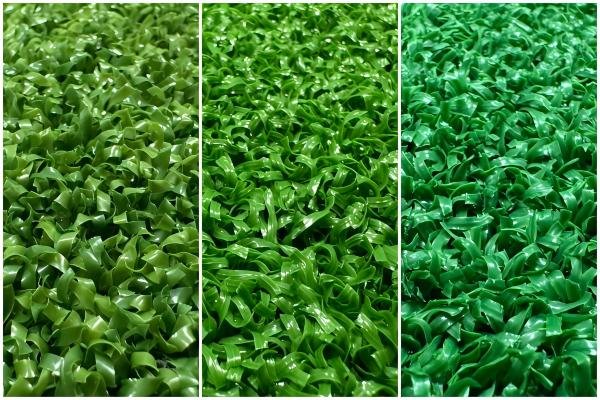
Start with operating conditions
I ask buyers to describe the court before I discuss the yarn specification. The following questions usually reveal more than a request for “the best Dtex”:
- How many playing hours does the operator expect each day?
- Will the court serve a private property, hotel, school, public facility, or commercial club?
- Will beginners, recreational players, or competitive players use it?
- How often can staff brush, redistribute infill, and inspect seams?
- Will the court be indoors, outdoors, roofed, or exposed to severe weather?
- What service-life target does the financial plan assume?
- How easily can the operator source replacement turf?
- Does the project target an economy, standard, or premium market position?
I treat the answers as procurement inputs rather than performance guarantees. Even two clubs with similar booking levels may experience different wear because maintenance, footwear, environment, installation, and player behavior differ.
Use traffic categories as a discussion framework
The following framework helps buyers organize requirements, but it does not prescribe a universal Dtex:
| Project profile | Typical procurement priority | Recommended evaluation focus |
|---|---|---|
| Private or low-traffic court | Controlled cost and suitable playability | Balanced specification, maintenance needs, warranty |
| Hotel or residential amenity | Appearance and occasional use | Color stability documents, surface consistency, upkeep |
| School or institution | Safety, documentation, durability | Tender compliance, traceability, maintenance planning |
| Commercial club | Frequent use and low downtime | Yarn construction, density, backing, spare stock, support |
| Premium chain | Standardization across sites | Repeatable SKU, batch control, long-term supply |
| Distributor inventory | Broad market suitability | Resaleable specification, documentation, stable production |
A higher specification may be justified when heavy traffic creates a genuine durability requirement or when a distributor needs a premium product tier. However, the supplier should explain the upgrade using more than a Dtex number. The supplier should identify changes in filament structure, density, yarn content, backing, and evidence.
I also recommend that project owners involve qualified installers and appropriate local professionals. The turf must work with the base, drainage, infill, court enclosure, and local conditions. A remote product recommendation cannot replace an application-specific site assessment.
How Can Buyers Evaluate a Padel Turf Supplier?
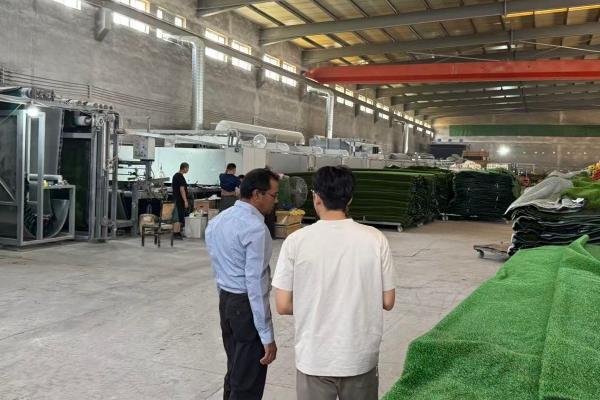
A suitable product can still cause delays when the supplier provides incomplete documentation, inconsistent production, or unclear packing. Buyers often concentrate on sample appearance and unit price. I widen the evaluation to include manufacturing control, specification traceability, lead time, replacement procedures, export experience, and technical support.
Buyers should evaluate a padel turf supplier through documented capability, not sales claims alone. I recommend verifying the factory, quality procedures, production capacity, product certificates, batch consistency, packing lists, installation documents, lead times, warranty process, and export records. Buyers should also confirm that the delivered turf matches the approved sample and purchase specification.
Review production and quality controls
I advise buyers to ask how the factory controls raw materials and finished products. Useful questions include:
- How does the factory identify each yarn and turf batch?
- Which specifications does the production team check during tufting?
- How does the factory control pile height, roll length, width, and color?
- How does the team handle material substitutions?
- Can the supplier connect a shipment to its approved sample?
- Which inspection records accompany the order?
- How does the supplier manage nonconforming products?
- What happens when a buyer reports a shortage or manufacturing defect?
QHPADEL operates 10 production lines and reports monthly artificial grass output above 1.5 million square meters. Our factory has more than 10 years of production experience and 9 years of export experience. These details show capability, but I still encourage buyers to conduct their own supplier audit or use an independent inspection company when order value or project risk justifies it.
Evaluate the complete court package
Many padel projects require more than turf. A complete package may include structural posts, welded frame netting, tempered glass, LED lights, nets, screws, and accessories. Buyers should verify each component separately because one certificate does not cover every product.
At QHPADEL, we provide complete court packages and documentation such as:
- Installation drawings
- Foundation drawings
- Packing lists
- Maintenance manuals
- Component identification
- Available test and certification documents
Our standard production schedule depends on order size. We typically produce two courts in about 20 days, four courts in 20–25 days, and larger standard orders in no more than 30 days. Custom styles may require up to 35 days. Buyers should confirm the current schedule, drawing approval date, payment milestone, and shipping plan before placing an order.
For customized turf specifications, our usual turf MOQ is six courts, or approximately 1,254 square meters based on 209 square meters per court. Buyers can discuss yarn Dtex, density, and color, but I recommend changing specifications only when the project requirement supports the added cost and production complexity.
Frequently Asked Questions
Is 12,000 Dtex always better than 10,000 Dtex for padel turf?
No. A 12,000 Dtex yarn has greater stated linear mass than a 10,000 Dtex yarn under comparable definitions, but it is not automatically better. I would also compare filament configuration, material, tuft density, total yarn content, backing, manufacturing consistency, test methods, traffic, and budget.
Does higher Dtex make padel turf last longer?
Higher Dtex may contribute to a more robust construction in some matched comparisons, but it cannot guarantee a longer lifespan. I consider yarn structure, polymer quality, density, backing, installation, traffic, climate, infill management, and maintenance. Buyers should verify durability claims and the conditions behind any supporting tests.
What information should a padel turf quotation include?
I recommend requesting total Dtex, yarn configuration, yarn material and type, pile height, gauge, stitch rate, tuft density, yarn weight per square meter, backing construction, roll dimensions, color, warranty, packing, lead time, certificates, and test reports. The quotation should define units and calculation methods.
Can I compare Dtex values from different suppliers directly?
You can compare them only after you confirm that both suppliers define and measure the yarn in a comparable way. I would request the filament or yarn-element breakdown, material, structure, and test basis. A headline Dtex number without construction details does not support a reliable comparison.
When is a higher-Dtex padel turf specification justified?
A higher-Dtex option may be justified for heavy commercial traffic, premium positioning, or a specification that requires more substantial yarn construction. I would approve the upgrade only after the supplier explains its complete construction, supporting evidence, cost difference, and relevance to the court’s operating plan.
Conclusion
Higher padel turf Dtex does not automatically mean higher quality. I treat Dtex as one useful measurement within a wider evaluation of filament construction, material, density, yarn content, backing, traffic, maintenance, lifespan goals, and budget. Buyers should standardize quotation comparisons, verify technical documents, and seek qualified project-specific advice before ordering.
If you need a complete padel court quotation or a tailored turf comparison, contact Alice Chen at QHPADEL via alice@grass-supplier.com or WhatsApp +86 185 7566 0746. We can review your traffic requirements, target market, court quantity, and specification options.
-
"Textile", https://en.wikipedia.org/wiki/Textile. Decitex (dtex) is a standardized linear-density unit expressing the mass in grams of 10,000 metres of textile material. Evidence role: definition; source type: institution. Supports: the standardized definition of decitex as a linear density unit equal to one gram per 10,000 metres of textile material. ↩
-
"Units of textile measurement", https://en.wikipedia.org/wiki/Units_of_textile_measurement. Because dtex measures mass per unit length, a higher dtex value denotes greater linear mass only when the compared yarns are specified on the same construction and measurement basis. Evidence role: mechanism; source type: education. Supports: that dtex expresses mass per unit length, so a larger value corresponds to greater linear mass when like-for-like yarn definitions are used. Scope note: The unit alone does not establish the mass, construction, or performance of an installed turf product per square metre. ↩
-
"Structure and Long Term Properties of Polyethylene …", https://www.academia.edu/15142008/Structure_and_Long_Term_Properties_of_Polyethylene_Monofilaments_for_Artificial_Turf_Applications. Synthetic-turf literature distinguishes monofilament yarns, formed as individual filaments, from fibrillated tape yarns, whose slit film structure opens into a network during use. Evidence role: definition; source type: paper. Supports: the structural distinction between monofilament yarns and fibrillated tape yarns used in synthetic turf. Scope note: Construction category alone does not determine which yarn is preferable for a particular court application. ↩
-
"From the Field: Getting to Know Today’s Synthetic Turf", https://plantscience.psu.edu/research/centers/ssrc/documents/ftfgettingtoknowsyn-1.pdf/@@download/file/FTFgettingtoknowsyn.pdf. Artificial-turf testing standards treat tuft bind—the force resisting withdrawal of pile yarn from the backing—as a relevant measure of pile-to-backing integrity. Evidence role: mechanism; source type: institution. Supports: that tuft bind is a recognized property used to assess resistance to pile-yarn withdrawal from artificial-turf backing. Scope note: A tuft-bind result is only one integrity measure and does not by itself predict all in-service failures or surface performance. ↩
-
"Compliance FAQs: CE Marking", https://www.nist.gov/standardsgov/compliance-faqs-ce-marking. European Commission guidance explains that CE marking is supported by conformity assessment and technical documentation where applicable, while RoHS compliance concerns restrictions on specified hazardous substances in covered electrical and electronic equipment. Evidence role: definition; source type: government. Supports: the documentary meaning and verification context of CE marking and RoHS compliance claims. Scope note: General regulatory guidance does not verify QHPADEL’s specific documents, product coverage, certificate validity, or applicability of CE or RoHS requirements to a given turf product. ↩