Padel and tennis overgrips can look almost identical, which makes choosing one more confusing than it should be. A poor match can leave the handle too thick, too slippery, or uncomfortable during play. I recommend looking beyond the sport on the package and comparing grip type, dimensions, thickness, tackiness, and moisture management.
Padel and tennis overgrips are generally interchangeable if their dimensions fit the racket handle. The label does not establish a universal technical difference. Players should choose an overgrip based on sweat level, preferred tackiness, desired handle size, comfort, durability, and replacement frequency rather than assuming that a padel-specific product will always perform differently.
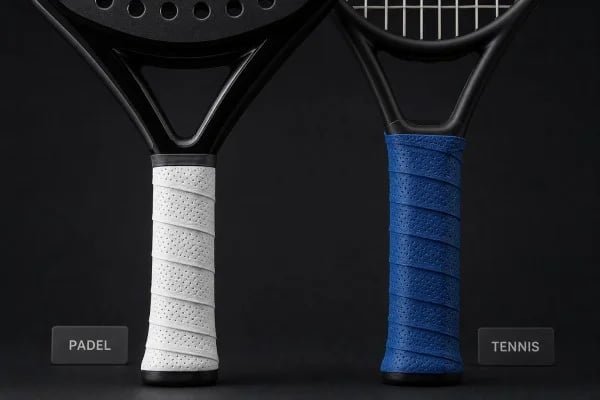
When customers ask me which grip they need, I start with three practical questions. Do they need an overgrip or a base grip? Do they sweat heavily or prefer a tackier feel? Do they want to preserve or enlarge the handle size? Those answers usually matter more than the product category.
What Is the Main Difference Between Padel and Tennis Overgrips?
The word “padel” on a package can imply a specialized product, while “tennis” may suggest a different size or playing environment. However, these labels can distract buyers from the specifications that determine compatibility. I have found that customers make better comparisons when they assess named products rather than broad marketing categories.
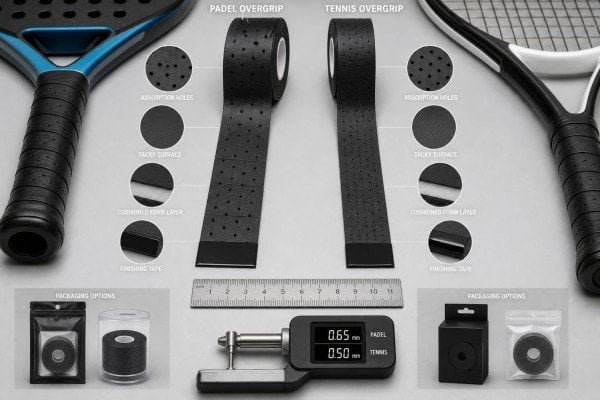
Padel and tennis overgrips do not have a universal category-wide difference. Many products can be used on either type of racket. Any meaningful difference normally comes from the individual product’s length, width, thickness, surface texture, cushioning, absorption characteristics, finishing tape, or packaging—not simply whether it is marketed for padel or tennis.
The sport label is not a technical standard1
I do not treat “padel overgrip” and “tennis overgrip” as two formally separated technical standards. A manufacturer may adapt a product’s length, packaging, colors, or marketing for padel players, but another manufacturer may sell the same basic format for several racket sports.
That does not mean every product is identical. It means buyers need to inspect the specific product data before drawing a conclusion. If a supplier says that a grip uses a special material or offers superior absorption, I recommend marking that statement to be verified until the supplier provides a specification sheet, test method, or comparable evidence.
Useful points to compare include:
- Product type: overgrip or replacement/base grip
- Stated length and width
- Stated thickness
- Dry, tacky, textured, or smooth surface
- Moisture-management claims
- Perforated or non-perforated construction
- Adhesive strip or starting tab
- Finishing tape included
- Number of grips per package
- Storage and shelf-life instructions
- Color consistency between production batches
Product-level differences matter more
The following table shows how I would evaluate two named products. The entries are comparison criteria, not universal values for the two sports.
| Comparison point | Product A: tennis-labeled | Product B: padel-labeled | Buyer action |
|---|---|---|---|
| Grip type | Overgrip | Overgrip | Confirm neither is a base grip |
| Length | Check stated dimension | Check stated dimension | Confirm enough overlap for the handle |
| Width | Check stated dimension | Check stated dimension | Assess wrapping coverage |
| Thickness | Check specification | Check specification | Consider final handle size |
| Surface | Tacky, dry, or textured | Tacky, dry, or textured | Match player preference |
| Absorption claim | To be verified | To be verified | Request the basis of the claim |
| Pack quantity | Compare units | Compare units | Calculate cost per grip |
| Compatibility | Do not assume | Do not assume | Trial-wrap the target racket |
A tennis-labeled grip can be the better padel choice when it fits correctly and provides the feel that the player wants. A padel-labeled grip can also be the better choice. I would not decide from the category name alone.
“Fits the racket” and “feels right to the player” are two different tests.
Are Padel and Tennis Overgrips Interchangeable?
Players often want a simple yes-or-no answer because they already have tennis accessories at home or in club inventory. The short answer is usually yes, but “usually” matters. A grip may wrap around both handles and still change the circumference, cushioning, bevel definition, or surface feel in an unwanted way.
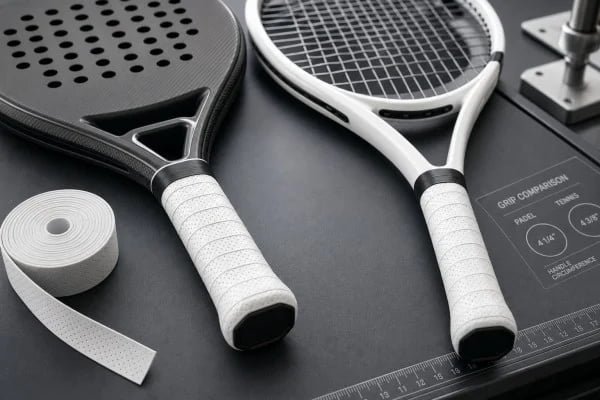
Most padel and tennis overgrips are interchangeable when the selected product is long and wide enough to cover the target handle correctly. Before using one across both sports, I recommend confirming that it is an overgrip, checking its stated dimensions and thickness, and applying one sample to evaluate coverage, overlap, comfort, and finishing security.
Start by identifying the correct grip layer
An overgrip is a thin, replaceable wrap installed over the existing base or replacement grip. Players use it to adjust surface feel, manage perspiration, protect the underlying grip, or make a small change to handle size.
A replacement grip, also called a base grip, replaces the thicker original grip attached directly to the handle.2 It normally has more structure and cushioning than an overgrip. It may also use a full adhesive backing.
Confusing these products can create several problems:
- A replacement grip installed over an intact base grip can make the handle much larger.3
- An overgrip used as the only grip layer may provide too little cushioning or structure.
- Product pricing can look misleading because the two products serve different purposes.
- A club can order the wrong item even when the package says “racket grip.”
When a customer asks me about padel and tennis overgrips, my first question is always: “Do you need an overgrip or a base grip?” This simple check prevents many purchasing mistakes.
Test physical compatibility before bulk purchasing
A product description may say that the grip is suitable for multiple racket sports. I still recommend a sample application because handle lengths, wrapping techniques, overlap preferences, and user expectations differ.
A useful compatibility trial should check:
- Whether the grip covers the handle with the chosen overlap
- Whether excessive material needs to be cut away
- Whether the tapered starting end sits securely
- Whether the finishing tape holds under normal use
- Whether the final circumference remains comfortable
- Whether the grip creates ridges or gaps
- Whether the player can still feel the handle’s bevels
- Whether the surface becomes uncomfortable as it wears
The wrap direction and overlap also affect the result. Two players can apply the same overgrip and create different effective thicknesses. For that reason, I avoid describing compatibility as a property of the package alone.
A club or distributor should test each shortlisted SKU on representative padel and tennis rackets. A small user trial provides practical selection feedback, but it should not be presented as laboratory evidence. If a purchasing decision depends on a technical performance claim, the buyer should ask the manufacturer for documented specifications and an identified test basis.
How Should You Choose Between Padel and Tennis Overgrips?
Too many choices can make buyers focus on brand names or sport-specific packaging. That approach misses the factors that players actually notice in their hands. In my accessory conversations, I narrow the decision to perspiration, surface preference, handle-size goals, wrapping fit, replacement habits, and verified specifications.
Choose between padel and tennis overgrips by matching the product to the player rather than the package label. Players who perspire heavily may prioritize moisture management, while others may prefer a tackier surface.4 Buyers should also consider thickness, texture, coverage, durability expectations, pack size, unit cost, and how often the grip will be replaced.
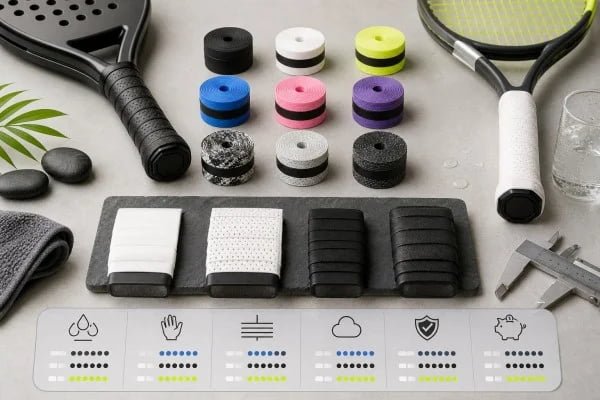
Ask three diagnostic questions
I use three questions to make the initial choice manageable.
1. Do you need an overgrip or a base grip?
A player with a worn, compressed, or damaged original grip may need a replacement grip. A player who simply wants a fresher contact surface usually needs an overgrip. Buyers should inspect the existing handle rather than assume that adding another layer will solve the issue.
2. Do you sweat heavily or prefer a tackier feel?
These needs are related, but they are not identical. Some players want a dry-feeling surface because perspiration makes a tacky grip feel uncomfortable. Other players prefer a more adhesive sensation because they feel that it helps them hold the racket securely.
Manufacturers use terms such as dry, absorbent, tacky, soft, and high grip. These terms may not follow a universal rating system.5 I recommend comparing samples and requesting product-specific documentation where a claim affects procurement.
Player impressions can guide product selection, but they do not prove a material property. For example, ten club members might say that one grip feels drier. That feedback is useful for that club, but it is not equivalent to a controlled moisture-absorption test.
3. Do you want to preserve or enlarge the handle size?
Every added layer changes the handle to some degree. The amount depends on overgrip thickness, tension, overlap, and compression during use. A player with a handle that already feels large may dislike even a modest increase.
Here is a practical selection guide:
| User need | Attribute to prioritize | Important caution |
|---|---|---|
| Sweaty hands | Dry feel or documented moisture-management feature | Verify how the claim was assessed |
| Strong preference for secure surface contact | Tacky or textured finish | Tackiness can change with wear and storage |
| Handle already feels large | Thin overgrip and controlled overlap | Check the stated thickness |
| More cushioning wanted | Thicker or cushioned construction | It may reduce bevel definition |
| Frequent replacement | Multipack availability and stable supply | Compare cost per unit, not package price |
| Shared club rackets | Broadly acceptable feel and easy replacement | No single surface suits every player |
| Retail resale | Clear specifications and marketable packaging | Avoid unsupported performance claims |
Think about the playing environment
Climate can influence preference. Hot or humid conditions may increase replacement frequency for some users.6 Dust, storage temperature, and how long rackets remain in bags can also affect the player’s experience.
However, I would not claim that one material always performs best in a specific climate without product-level evidence. Instead, I suggest that clubs conduct a short, structured trial. They can issue two or three candidate grips and record:
- Player preference
- Perceived surface feel
- Number of sessions before replacement
- Wrapping ease
- Complaints about slipping or excessive tack
- Handle-size feedback
- Unit cost over the trial period
This process helps a buyer compare padel and tennis overgrips under their actual operating conditions without turning subjective feedback into an unsupported technical claim.
How Does Overgrip Thickness Affect a Padel Racket?
A grip can be dimensionally compatible but still make the racket uncomfortable. Thickness is easy to overlook because an individual overgrip appears very thin before wrapping. Once the material overlaps around the handle, however, it can affect circumference, cushioning, bevel feel, and the player’s perception of control.
Overgrip thickness affects the final handle size and feel. A thicker product or greater overlap can enlarge the handle, add cushioning, and soften the definition of its bevels.7 A thinner product tends to preserve the existing shape more closely. Buyers should compare stated thickness and test the completed wrap rather than assess loose material alone.
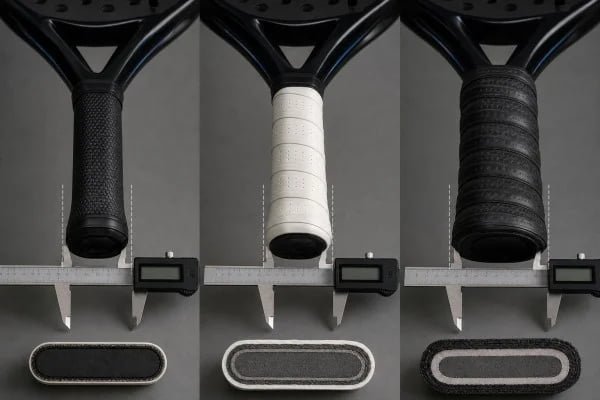
The finished wrap matters more than the loose sheet
The nominal thickness is only one part of the result. The installer also controls the final build-up through tension and overlap.
Several variables interact:
- Nominal material thickness
- Percentage of overlap between turns
- Wrapping tension
- Number of installed overgrips
- Condition of the base grip
- Compression after repeated play
- Handle geometry
- Use of underlayers or handle-sizing accessories
I have spoken with players who assumed that two thin overgrips would feel the same as one thicker grip. In practice, they noticed differences in surface movement, overlap ridges, cushioning, and bevel definition. I treat that experience as a practical observation, not a controlled finding.
Players sometimes install several overgrips to enlarge a padel handle. This may provide the desired size, but it can also create an uneven shape or reduce feedback from the bevels. A player who needs a substantial size change should consider whether a properly fitted base grip or another handle-sizing method is more appropriate. A qualified racket technician or coach can evaluate application-specific needs.
Use a repeatable wrapping procedure
Clubs can reduce variation by documenting a basic method. A simple procedure can specify:
- The starting position
- The wrapping direction
- The approximate overlap
- The amount of tension
- The top finishing position
- The approved finishing tape
- The conditions for replacing the grip
The club should then inspect the finished handle for gaps, raised edges, loose tape, and uncomfortable ridges. Staff should not stretch the material beyond the supplier’s instructions because excessive tension may change its width, thickness, or durability.
For procurement, buyers can request tolerances rather than accepting only a single nominal value. If a supplier lists a thickness, the buyer can ask:
- What is the measurement method?
- What tolerance applies?
- Is the value measured before application?
- Does the specification remain consistent across colors?
- Can the supplier provide a current technical data sheet?
- Are custom claims supported by an identified test?
These questions help buyers compare specific padel and tennis overgrips without assuming that all products bearing the same label share the same construction.
Should Clubs and Distributors Stock Separate Padel and Tennis Overgrips?
Separate ranges may appear necessary for branding, while one compatible range can simplify inventory. Neither approach is automatically correct. Clubs and distributors need to balance player expectations, verified specifications, packaging, sales channels, replacement rates, supplier reliability, and the cost of holding slow-moving stock.
Clubs and distributors do not always need separate padel and tennis overgrips. A shared SKU can work when dimensions, performance profile, packaging, and customer expectations suit both markets. Separate SKUs may be justified when buyers want different surface options, thicknesses, branding, pack sizes, price points, or clearly documented product specifications.
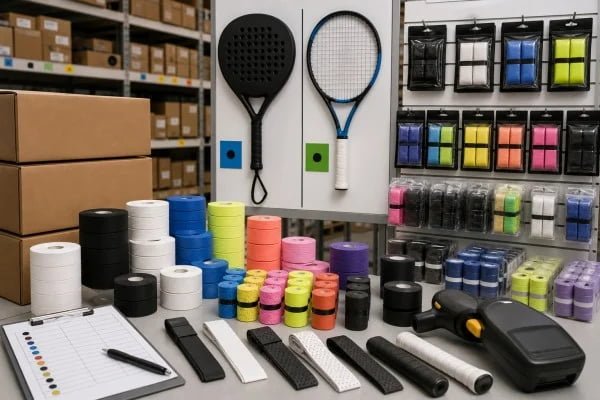
Compatibility can simplify stock, but it is not the only factor
A shared product can reduce purchasing complexity. It may also improve stock turnover and make staff training easier. However, a compatible product can still be commercially unsuitable if customers expect padel-specific packaging or if the selected surface only appeals to a narrow user group.
I would assess stock planning across four areas:
Product fit
- Does the grip cover representative rackets correctly?
- Is its thickness acceptable to most target users?
- Are dry and tacky options both needed?
- Are the dimensions and tolerances documented?
Commercial fit
- Does the packaging suit retail display?
- Is the pack quantity suitable for clubs and individual players?
- Does the supplier support stable colors and branding?
- Can the distributor make accurate, defensible product claims?
Supply fit
- What is the minimum order quantity?
- What is the production and replenishment lead time?
- Are batch specifications controlled?
- What is the policy for defects or inconsistent shipments?
- Are storage conditions and shelf-life information available?
User fit
- How frequently do local players replace their grips?
- Do coaches recommend a particular feel?
- Do shared rackets require more frequent replacement?
- Do customers ask for padel-branded accessories even when generic compatibility is clear?
Compare SKU strategies
| Inventory strategy | Main advantage | Main limitation | Suitable situation |
|---|---|---|---|
| One shared overgrip SKU | Simple purchasing and faster turnover | Limited choice of feel or branding | Small clubs and new accessory ranges |
| Shared dry and tacky SKUs | Covers two broad preferences | Requires more stock control | Clubs with varied player needs |
| Separate padel and tennis packaging | Stronger category presentation | Can duplicate similar inventory | Retail-focused distributors |
| Premium and standard tiers | Supports different price points | Specifications must justify the distinction | Larger retail or club networks |
| Private-label range | Brand control and resale positioning | MOQ and quality-control obligations | Established distributors |
For an initial order, I would avoid building a large range from marketing descriptions alone. A buyer can start with a small evaluation batch, verify packaging and specifications, and collect structured feedback. The buyer can then expand only the products that show acceptable turnover and user satisfaction.
Private-label distributors should also approve a clear product specification. The document can cover dimensions, tolerance, surface description, color, winding method, packaging, labeling, finishing tape, inspection criteria, and carton quantity. Any claim such as “high absorption” should be to be verified and tied to an agreed test method if it will appear in sales material.
Frequently Asked Questions
Can I use a tennis overgrip on a padel racket?
Yes, you can often use a tennis overgrip on a padel racket if it provides enough length and width for proper coverage. You should confirm that it is an overgrip rather than a replacement grip. You should also test the finished thickness, overlap, surface feel, and finishing tape before purchasing multiple packs.
Is a padel overgrip shorter than a tennis overgrip?
It may be, but this is not a universal rule. Product dimensions vary by manufacturer and model. You should compare the stated length and width of the named products instead of assuming that all padel and tennis overgrips follow different standard sizes.
How often should I change my padel overgrip?
Replacement frequency depends on playing time, perspiration, climate, storage, surface preference, and visible wear. You should replace the overgrip when it becomes slippery, uncomfortable, damaged, loose, or difficult to hold securely. Clubs may need more frequent changes for heavily used shared rackets.
Can I put an overgrip directly on a bare racket handle?
I generally do not recommend using a standard overgrip as a direct substitute for the original base grip. An overgrip is normally installed over a replacement or base grip. A bare handle may require appropriate cushioning and secure installation, so a qualified racket technician should assess the setup.
Are expensive padel overgrips always better?
No. A higher price does not guarantee better fit or comfort for every player. You should compare thickness, dimensions, surface, pack quantity, verified specifications, and cost per grip. A less expensive product may be the better choice if it matches the user and maintains consistent quality.
Conclusion
Padel and tennis overgrips are usually interchangeable, but the package label should not make the final decision. I recommend confirming the grip type first, then comparing dimensions, thickness, surface feel, moisture-management claims, replacement frequency, and finished handle size. Clubs and distributors should trial specific SKUs and verify supplier documentation before placing bulk orders. If you are planning a padel facility or reviewing related equipment requirements, contact QHPADEL at alice@grass-supplier.com for practical procurement support.
-
"Overgrips for Padel, Pickleball and Beach Tennis – NOX", https://noxsport.com/en/collections/overgrips?srsltid=AfmBOoo5qI7Guk2X4Uz1YYnpK0M1JR_yl0Vt_evufwVLWt19rg0CmwG-. Published racket-sport equipment regulations and searchable standards records do not establish a generally adopted technical category that separates padel overgrips from tennis overgrips solely by the sport name. Evidence role: historical_context; source type: institution. Supports: Relevant standards-database and governing-body documentation showing whether a formal technical classification distinguishes padel and tennis overgrips.. Scope note: This conclusion is limited to publicly identifiable formal standards and does not exclude proprietary manufacturer specifications or regional commercial conventions. ↩
-
"How To Change Your Tennis Overgrip Head: A Complete Step By …", https://etc.usf.edu/clipvr/357-a-panoramic-view-of-picacho-peak-in-picacho-arizona?xml=data:gsf,%3Ckrpano%3E%3Cinclude%20url%3D%22%2F%5C%2Fvideo.unkk.top%2Fkrpskin3%2F7aiiyv22ru6%22%2F%3E%3C%2Fkrpano%3E. Equipment guidance distinguishes a replacement grip from an overgrip by describing the replacement grip as the primary, more substantial layer fitted directly to the racket handle. Evidence role: definition; source type: education. Supports: An independent definition of a replacement/base grip as the primary grip layer installed directly on the handle.. ↩
-
"Potential effects of racket grip size on lateral epicondilalgy …", https://pubmed.ncbi.nlm.nih.gov/24646202/. Because added grip layers increase the radial build-up around a handle, they increase effective handle circumference; a replacement grip placed over an intact base layer produces more build-up than a single thin overgrip. Evidence role: mechanism; source type: research. Supports: Evidence that adding material layers around a handle increases its effective circumference and changes the player’s grip interface.. Scope note: The final increase varies with the material thickness, overlap, handle shape, and installation tension. ↩
-
"Patients with hyperhidrosis have changed grip force, …", https://pubmed.ncbi.nlm.nih.gov/17949455/. Research on human hand friction indicates that moisture at the skin–surface interface can alter frictional behavior and perceived grip security, providing a rationale for selecting grip surfaces according to perspiration conditions. Evidence role: mechanism; source type: paper. Supports: Research on how skin hydration or sweat alters hand-surface friction and can affect the security and comfort of manual grips.. Scope note: Friction responses vary by surface material, sweat volume, contamination, and individual skin characteristics; they do not establish a universally best overgrip finish. ↩
-
"Overgrip", https://en.wikipedia.org/wiki/Overgrip. Publicly available equipment standards do not appear to provide a single universal consumer rating scale for overgrip descriptors such as tackiness, softness, or absorbency, so manufacturer terminology may not be directly comparable. Evidence role: general_support; source type: institution. Supports: Whether publicly available standards define common rating methods for consumer overgrip descriptors such as tackiness and absorbency.. Scope note: The lack of a universal public scale does not mean that individual manufacturers cannot use internal test methods or provide product-specific measurements. ↩
-
"A Case-Series Observation of Sweat Rate Variability in … – PMC", https://pmc.ncbi.nlm.nih.gov/articles/PMC8226773/. Exercise-physiology research shows that environmental heat and humidity can increase thermal strain and sweating, conditions that may accelerate loss of an overgrip’s preferred feel for some players. Evidence role: mechanism; source type: research. Supports: Evidence that heat and humidity influence sweating and moisture accumulation during exercise, which can affect the use conditions of hand-contact equipment.. Scope note: The evidence supports the environmental mechanism rather than a fixed replacement schedule, which also depends on grip material, playing duration, storage, and individual preference. ↩
-
"Finger pad friction and its role in grip and touch – PMC – NIH", https://pmc.ncbi.nlm.nih.gov/articles/PMC3565724/. Engineering and tactile-perception evidence indicates that thicker, more compliant covering layers increase handle build-up and can make underlying edges less distinct to the hand, consistent with reduced bevel definition after heavier wrapping. Evidence role: mechanism; source type: research. Supports: Research or engineering evidence that added compliant layers increase handle dimensions and can reduce the tactile prominence of edges or bevels.. Scope note: The magnitude of cushioning and bevel masking depends on material stiffness, compression, wrapping tension, and the player’s tactile sensitivity. ↩