
Are you planning to build a club but feel unsure about the exact space you need? Getting these measurements wrong can ruin your installation timeline and waste your budget.
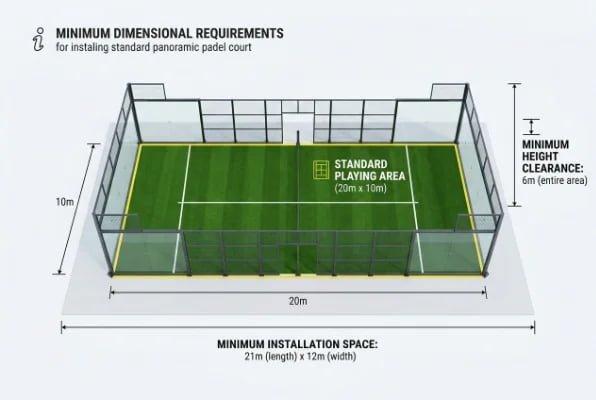
A standard padel tennis court measures exactly 20 meters in length and 10 meters in width. However, during actual construction, you must reserve an additional 1 to 2 meters around the perimeter for lighting, walkways, and drainage, making the total required area approximately 22 by 12 meters.
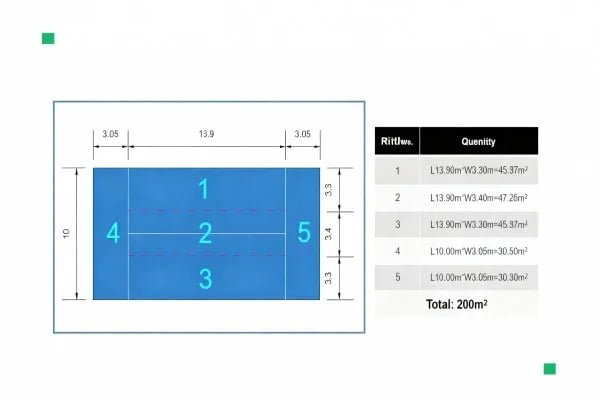
Knowing the basic numbers is just the start. Let me explain why specific measurements matter for your budget and construction success, so you do not make mistakes.
What are the dimensions of a padel tennis court?
You need precise details to ensure your ground work is ready for the steel structure. Any error here means the glass and frames will not fit together correctly.
The internal playing area is strictly 20 meters long and 10 meters wide. The walls are usually 3 meters high on the sides and 4 meters high at the back, combining glass and steel mesh panels.
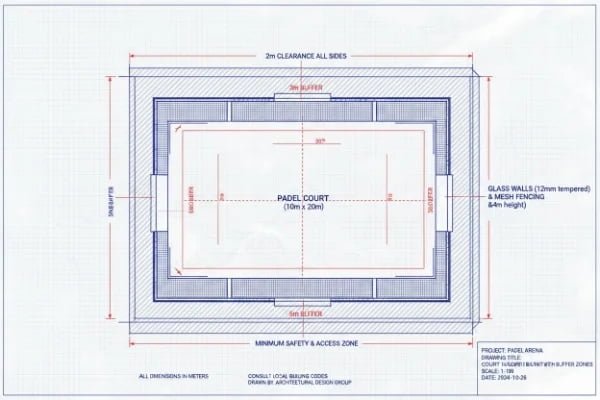
I have worked as an engineer for many years, and I see a common mistake. Clients often prepare a foundation that is exactly 20 meters by 10 meters. This is wrong. You must think about the "out of court" space.
While the court dimensions are 20 meters by 10 meters, I strongly recommend you reserve at least 1 to 2 meters of buffer space1 around the perimeter during actual construction. This space is necessary for the installation of lighting systems, walkways for players, seating areas, and proper drainage systems. Without this buffer, you cannot perform maintenance or clean the glass safely.
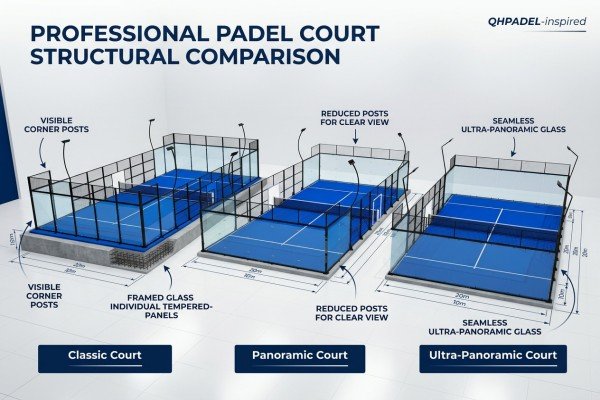
Also, the type of court affects the structure. For example, a Panoramic Padel Court uses steel columns only at the corners to give a clear view. This structure still needs a solid base. The glass itself is usually 12mm tempered glass. When we design the layout, we also consider the steel columns. A zinc-rich epoxy primer protects these columns from rust.
Here is a simple breakdown of the dimensions you need to know:
| Feature | Dimension (Metric) | Note |
|---|---|---|
| Length | 20 Meters | Internal play area |
| Width | 10 Meters | Internal play area |
| Buffer Zone | 1-2 Meters | Required on all sides |
| Wall Height | 3 to 4 Meters | Back walls are higher |
| Glass Thickness | 12 mm | Standard for safety |
If you plan to install indoors, you also need to check your ceiling height. You need at least 6 to 8 meters of clear height so the ball does not hit the roof during a lob.
How much smaller is a padel court to a tennis court?
Many of my clients want to convert old tennis courts into padel clubs. They always ask about the space efficiency and how many courts they can fit in the same area.
A padel court is roughly one-third the size of a standard tennis court. This means you can fit two to three padel courts in the space of a single tennis court, which increases your revenue potential.
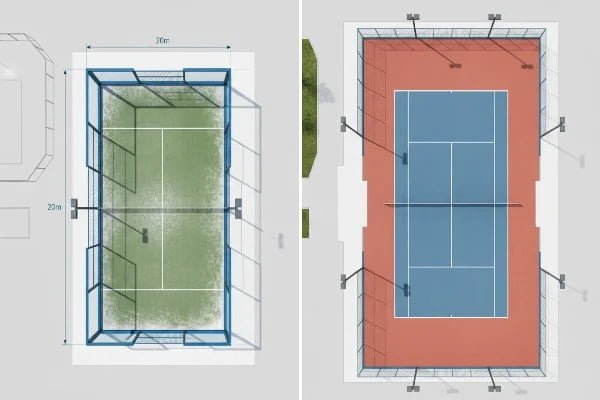
Let us look at the numbers. A tennis court has dimensions of 23.77 by 10.97 meters. However, tennis is not enclosed. You need a huge run-off area for players to chase the ball. Because of this, the overall area required for a tennis court is 2 to 3 times larger than that of a padel court.
Padel is different. It is an enclosed game. The ball bounces off the tempered glass walls, which must meet impact resistance standards. This means the "run-off" area is very small. You only need the 1 to 2 meters buffer I mentioned earlier.
From a business perspective, this is great news. If you own a sports club, replacing one tennis court with three padel courts triples your capacity. Instead of 2 or 4 players paying for one hour, you can have 12 players paying for that same hour.
Here is why the size difference matters for your profit:
- Land Use: Padel uses land much more efficiently.
- Infrastructure: The steel structure and glass create a contained environment, unlike open tennis courts.
- Capacity: You serve more customers per square meter.
Also, consider the wind. A tennis court is open, but a padel court has walls. If you build outdoors in a windy area, like a coastal city, you might need a Classic Court structure which is very strong against wind. The smaller footprint and sturdy structure make padel easier to fit into difficult land shapes than tennis.
How much does it take to set up a padel court?
Price is the first question every purchasing manager asks me. You need to know the total cost to get the materials from my factory in China to your location.
The cost involves the court price, shipping, and installation. A typical court costs between $6,500 and $9,000 FOB, plus shipping, which can bring the landed cost to around $9,000 to $11,000 per court depending on your location.
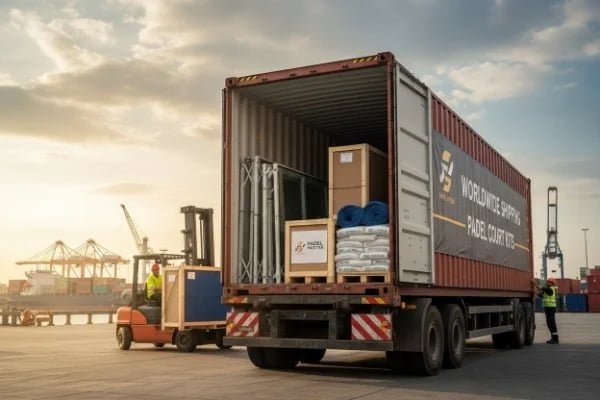
I want to give you a real-world example to help you budget. Let’s take the example of loading two courts into a 20GP container. This is a common order size for new clubs.
Suppose the FOB (Free on Board) price is US$8,000 per court. This price usually includes high-quality artificial turf (7500 dtex or higher) and LED lighting. If the estimated sea freight to a destination like Jakarta, Indonesia is US$2,000, the math looks like this:
- Court Cost: $8,000 x 2 = $16,000
- Freight: $2,000
- Total: $18,000
This means the cost to the port is approximately US$9,000 per court. Of course, this is just the start. You will have additional costs for:
- Customs Clearance: Taxes and duties in your country.
- Trucking: Moving the container from the port to your site.
- Installation: Hiring a team to set up the steel and glass.
The price of a QHPADEL court typically ranges from FOB $6,500 to $9,000 per court. This variation depends on the model you choose. For example, a Panoramic court looks better and costs more than a Classic court. Custom colors or logos on the glass also add to the price.
At QHPADEL, we try to make this easy. If you require DDP (Delivered Duty Paid) service, we can accurately calculate the costs based on your specific needs. This means we handle the shipping and taxes for you.
When you buy, do not just look at the cheapest price. Quality matters. For example, the artificial turf needs to withstand 5-10 years of traffic. If you buy a cheap court, you will spend more money fixing it later.
Conclusion
A padel court is 20×10 meters, requires a small buffer, and costs about $9,000 to get to your port; contact us for a precise quote today.
-
Exploring the importance of buffer space can help you avoid costly mistakes during construction and maintenance. ↩