
Building a padel court on water sounds like the ultimate visual centerpiece for a luxury resort or high-end sporting event. But the reality is far more complicated. Many buyers mistakenly assume they can simply bolt standard padel equipment onto a floating barge, which quickly leads to shattered glass and twisted metal.
A padel court on water is a highly customized, marine-grade sports structure installed over a floating pontoon or barge. Unlike standard land-based courts, it requires specialized engineering to withstand dynamic water sway, intense open-water wind loads, and severe salt corrosion, demanding strict coordination between a marine contractor and the court manufacturer.
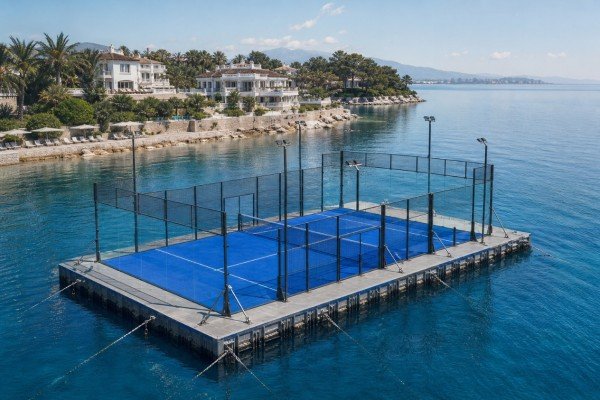
Understanding the hidden costs and structural risks is critical before making this investment. Let’s break down exactly what makes these floating sports platforms so complex and how professional manufacturers adapt upper-structure specifications for challenging marine environments.
Why does a standard structure fail for a padel court on water?
You might think a reinforced concrete foundation and a floating pontoon behave similarly. They do not. When waves and wind hit a floating platform, the continuous micro-movements will quickly tear apart a standard rigid padel structure.1
Standard padel courts fail on water because they cannot absorb dynamic loads. A proper padel court on water requires reinforced structural chassis, laminated explosion-proof tempered glass, and flexible connection gaskets. These specialized upgrades allow the court to flex safely with the pontoon’s movement without shattering or bending.
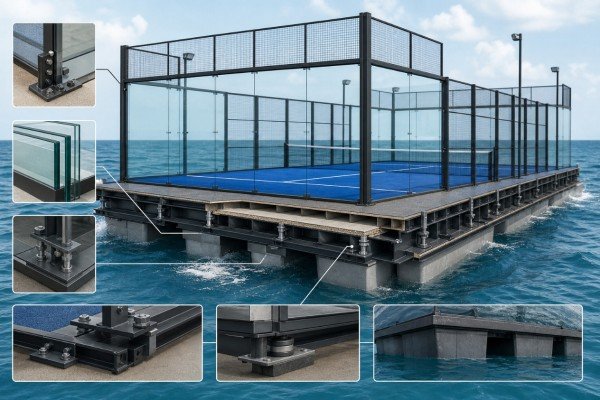
When I evaluate custom inquiries for floating installations, the first engineering hurdle we address is the difference between static and dynamic loads. On a traditional land-based site, the foundation remains perfectly still. Standard 10mm or 12mm tempered glass is highly rigid, which works perfectly on solid ground. However, on water, the pontoon constantly sways. If a rigid steel frame twists even slightly due to a wave, standard glass will shatter instantly.
To solve this, we engineer a marine-specific upper structure. Here are the core structural upgrades required:
- Laminated Explosion-Proof Tempered Glass: We upgrade the glass panels to laminated safety glass (complying with AS/NZS 2208:1996 and AS/NZS 4666:2012 standards). If the glass experiences extreme stress from pontoon torsion, the lamination holds the panel together rather than letting it shatter onto the court.
- Flexible Connection Gaskets: The structural posts and welded frame netting cannot be bolted rigidly against the glass without a buffer. We introduce specialized flexible gaskets and dampening fasteners at critical connection points. These absorb the kinetic energy transferred from the water to the deck.
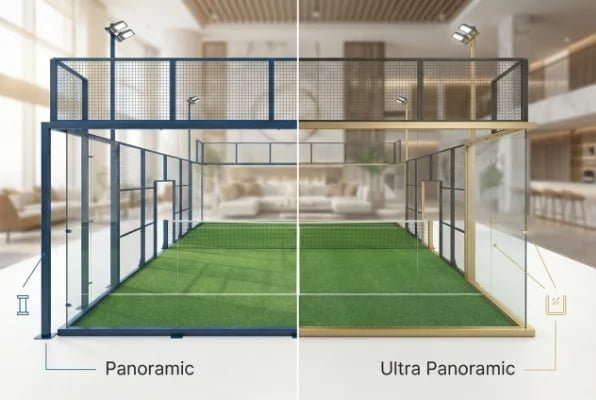
- Reinforced Structural Columns: Open water environments experience significantly higher wind speeds than urban land sites. While the Ultra Panoramic Court is visually stunning, its structural frame must be upgraded. We thicken the steel profiles and reinforce the base plates to manage the intense open-water wind shear.
Engineering contractors must understand that these are not minor adjustments. Failing to upgrade the structural chassis for dynamic loads transforms a high-end sports facility into a severe safety hazard.
How do we manage rust on a padel court on water?
Coastal salt spray and high humidity are aggressive enemies of structural steel. If you use standard land-based rust-proofing, your high-end floating padel investment will start showing red rust streaks within weeks of installation.
To prevent rapid corrosion, a padel court on water requires marine-grade structural upgrades. Manufacturers must abandon standard zinc plating and instead use heavy-duty hot-dip galvanized steel. This is then finished with a C4 or C5 marine-grade powder coating to withstand extreme salt, humidity, and UV exposure.
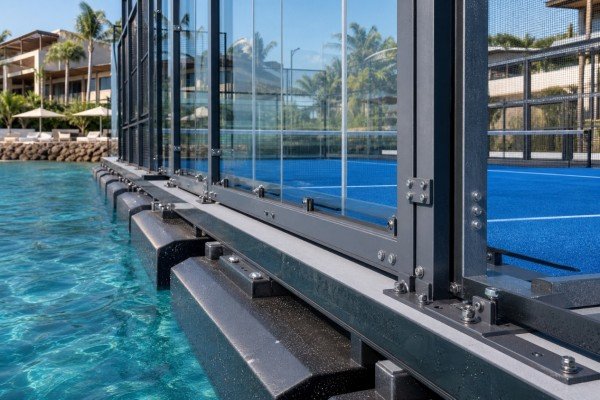
Corrosion is the silent killer of outdoor sports equipment. In the B2B manufacturing world, we classify environmental corrosion environments on a scale from C1 (very low) to C5 (very high marine environment).2 A standard indoor club court requires C2 protection. A standard outdoor court requires C3. A floating pontoon sits squarely in the C4 or C5 category.
Buyers often fall into the trap of accepting vague marketing claims like "100% rust-proof." As a professional manufacturer, I always advise buyers to look at the actual chemical and mechanical processes used in the factory.
Here is how a marine-grade structural frame differs from a standard frame:
| Specification | Standard Land Court | Padel Court on Water |
|---|---|---|
| Steel Treatment | Electro-galvanized or standard primer | Hot-dip galvanized steel |
| Coating Level | C2 / C3 standard powder coating | C4 / C5 marine-grade powder coating |
| Fasteners | Standard galvanized screws | 316 Stainless Steel (AD 2000 WO certified) |
| Lifespan in Salt Air | 1 to 2 years before rusting | 5 to 10+ years with proper maintenance |
The hot-dip galvanizing process is non-negotiable for water installations. We submerge the raw steel profiles into molten zinc, creating a metallurgical bond that protects the steel3 even if the outer powder coating gets scratched by a racket. Furthermore, every single screw, washer, and lighting bracket must be upgraded to marine-grade stainless steel. If a supplier cuts corners on the fasteners, rust will bleed from the screw holes and stain the entire frame.
Who builds the floating foundation for a padel court on water?
The biggest misconception in floating sports projects is assuming the court supplier handles the entire package. If a padel manufacturer claims they will build your underwater foundation, you should immediately question their engineering boundaries.
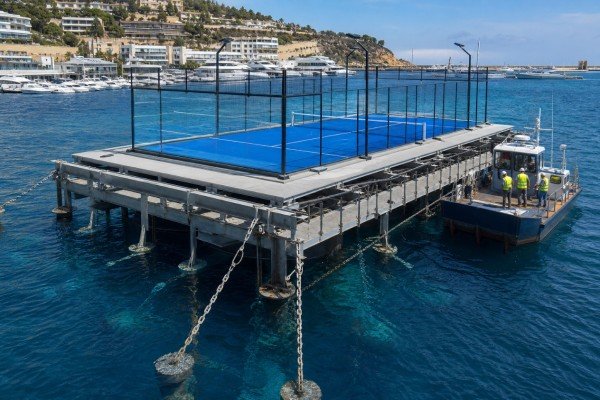
A padel court on water requires a strict division of labor. The padel manufacturer engineers and supplies the marine-grade upper structure and artificial turf, while a localized marine civil contractor must design, build, and anchor the floating pontoon foundation according to local waterway regulations.
At QHPADEL, we manufacture B2B padel court systems. We do not build floating foundations, and we do not provide marine engineering services. I firmly establish this professional boundary with every client because honesty prevents catastrophic project failures.
The floating foundation (the pontoon or barge) is almost always the most expensive and complex part of the project. A club operator or resort developer must hire a local marine contractor. This contractor manages crucial local factors that a factory in China simply cannot oversee:
- Buoyancy and Displacement: The marine contractor calculates exactly how large the pontoon must be to support the weight of the court, the players, and the wind loads.4
- Anchoring Systems: The pontoon must be securely tethered to the seabed or riverbank. This requires localized geological surveys and underwater civil engineering.
- Local Maritime Compliance: Navigable waterways have strict environmental and safety regulations. Your local contractor secures these permits.
Our job as the manufacturer is to support your marine contractor. We provide them with a complete Bill of Materials (BOM). We hand over the exact weights of the tempered glass, the steel frame, the artificial turf, and the silica sand infill. We provide the precise base plate dimensions and foundation drawings. The marine contractor uses our technical data to engineer a pontoon that can safely carry our equipment. This clear division of labor guarantees both structural safety and a smooth installation.
What technical data is required before manufacturing a padel court on water?
You cannot simply order a floating court from a catalog and hope it fits your barge. Skipping the pre-production alignment phase will result in equipment that either cannot be installed or creates severe safety hazards.
Before manufacturing a padel court on water, suppliers require exact technical data from the buyer. This includes local extreme weather data, specific wave height limits, pontoon payload capacities, and clear confirmation on whether the pontoon deck allows for deep drilling or pre-embedded anchoring systems.
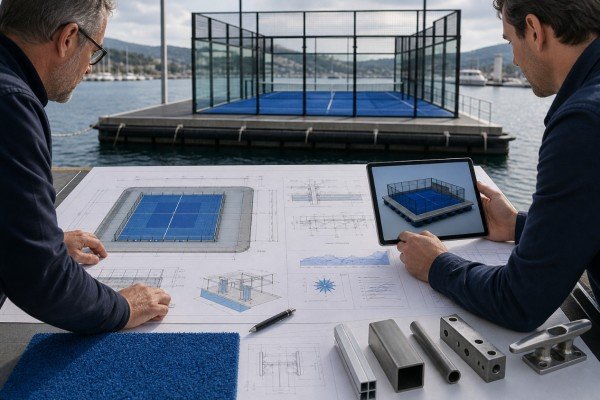
When civil contractors or equipment distributors approach me for a water project, I require them to complete a strict technical alignment checklist before we accept the order. A padel court on water is not a plug-and-play product; it is a highly engineered integration.
Here are the critical data points we must evaluate together:
- Deck Anchoring Compatibility: This is usually the biggest roadblock. On land, installers drill deep into concrete to set expansion bolts. On a floating pontoon, drilling deep holes might puncture the buoyancy chambers and sink the platform. We must know exactly what material the deck is made of. If drilling is prohibited, we must engineer a custom base frame that can be welded or clamped to the pontoon’s structural edges.
- Drainage Strategy: Artificial turf requires proper drainage. On land, a slight concrete slope directs rainwater away. On a flat pontoon deck, water can pool beneath the turf. We need to coordinate with your deck builder to ensure the pontoon features adequate runoff grading or a raised sub-floor system.
- Tolerance for Foundation Settlement: Pontoons can sit unevenly in the water if the payload is unbalanced. We clearly define our after-sales responsibility during this phase. If a glass panel breaks because our material was defective, we replace it. If a glass panel breaks because the pontoon severely tilted or sagged, that is a foundation failure. Defining these warranty boundaries protects both the buyer and the supplier.
- Extreme Weather Load Limits: We need the marine contractor to provide the maximum anticipated wind speeds and wave heights. If the location expects hurricane-force winds, we will mandate a Hurricane Resistant Court structural upgrade.
By gathering this data upfront, we ensure the equipment arrives ready for a precise, safe installation.
Frequently Asked Questions
Can standard artificial turf be used on a floating court?
Standard CE-certified artificial turf works perfectly, but the installation method changes. Because floating courts experience higher wind and wave vibrations, the silica sand infill can shift more easily. We recommend a high-density, texturized turf specification to lock the sand securely in place.
Is the lighting different for a padel court on water?
Yes. Standard LED fixtures will corrode rapidly over water. We upgrade the lighting systems to feature higher waterproof IP ratings5 and specialized anti-corrosion brackets. The fixtures also use AS 61347.2.13:2018 certified components to ensure electrical safety in high-humidity environments.
How long does it take to manufacture a marine-grade padel court?
While our standard factory lead time is 20-30 days for typical courts, a marine-grade system is a custom-made style. The specialized C4/C5 powder coating, hot-dip galvanizing, and dynamic load structural modifications require no more than 35 days for complete production.
How much does a floating padel court weigh?
The upper structure of a complete padel court typically weighs between 5,500 kg and 7,500 kg, depending on the glass thickness and steel profile upgrades. We provide exact packing lists and weight metrics so your marine contractor can accurately calculate the required pontoon displacement.
Conclusion
Building a padel court on water is a brilliant way to create a landmark sports destination, but it requires serious engineering respect. It is not a standard installation. Success depends entirely on upgrading the structural steel for dynamic loads, applying strict marine-grade anti-corrosion treatments, and maintaining clear boundaries between the court manufacturer and your local marine foundation contractor. By understanding these technical realities, buyers can avoid expensive failures and deliver a truly spectacular player experience.
-
"Design and structural analysis of a pontoon vessel – ADS", http://ui.adsabs.harvard.edu/abs/2018AIPC.1980c0006K/abstract. Research on marine structural engineering demonstrates that continuous wave-induced micro-movements create dynamic stress cycles, leading to accelerated fatigue failure in rigid frames not designed for flexibility. Evidence role: mechanism; source type: research. Supports: the mechanism by which continuous dynamic wave loads induce fatigue and structural failure in rigid frames. Scope note: Studies typically focus on large-scale offshore structures rather than recreational sports courts, though the underlying physics of dynamic load fatigue remain identical. ↩
-
"Corrosion class C1, C2, C3, C4 and C5", https://en.nordicsteel.no/fagartikler/korrosjonsklasse-c1-c2-c3-c4-c5. The International Organization for Standardization (ISO) 12944-2 defines atmospheric corrosivity categories from C1 (very low) to C5 (very high), specifically designating C5 for coastal and marine environments with high salinity. Evidence role: definition; source type: institution. Supports: the ISO 12944 standard classification of atmospheric corrosivity. ↩
-
"How Zinc Metal Coatings, Including Hot-Dip Galvanizing …", https://www.waru.edu/sites/default/files/Migrated/CopDocuments/How%20Zinc%20Metal%20Coatings%2C%20Including%20Hot-Dip%20Galvanizing%20Can%20Protect%20and%20Extend%20the%20Life%20and%20Durability%20of%20Steel.pdf. During hot-dip galvanizing, molten zinc reacts with the iron in the steel to form a series of tightly bonded zinc-iron alloy layers, providing both barrier and cathodic protection against corrosion. Evidence role: mechanism; source type: paper. Supports: the formation of a zinc-iron metallurgical bond during the hot-dip galvanizing process. ↩
-
"H-35 POWERING AND LOAD CAPACITY OF PONTOON …", https://people.cs.uchicago.edu/~luitien/h-35.html. According to Archimedes’ principle, a floating structure must displace a volume of water equal to its total mass; engineers must also calculate the metacentric height to ensure stability against overturning moments caused by wind and live loads. Evidence role: mechanism; source type: education. Supports: the naval architecture principles used to calculate pontoon displacement and stability under load. ↩
-
"Ingress Protection (IP) ratings – IEC", https://iec.ch/ip-ratings. The IEC 60529 standard defines Ingress Protection (IP) ratings, where higher second digits (e.g., IP66 or IP67) indicate rigorous protection against powerful water jets and temporary immersion, essential for marine environments. Evidence role: definition; source type: institution. Supports: the definition and application of IP ratings for electrical enclosures in wet environments. ↩