Are you worried about investing huge sums into a Padel club only to see it fail? Many owners struggle with poor construction choices that ruin their reputation and profits.
To build a successful club, you must prioritize five quality checks: strategic location selection with adequate parking, a reinforced concrete foundation to prevent sinking, optimized court positioning for revenue, hot-dip galvanized steel structures for longevity, and high-dtex artificial turf with PU backing for player safety.
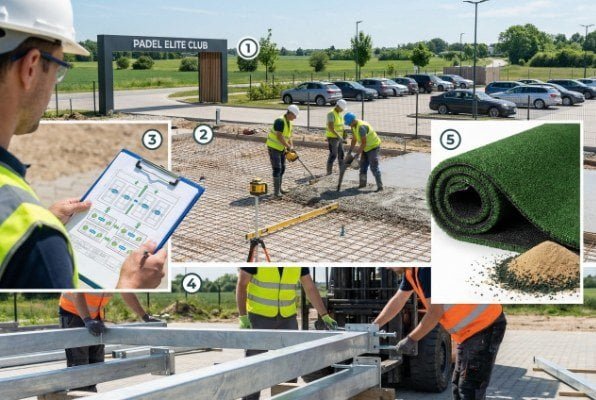
Choosing the right materials and location determines your profit margin. If you ignore these details, you might face expensive repairs or lose customers to competitors. I will walk you through these specific checks to ensure your investment brings long-term success.
How Does Choosing the Right Location Impact Your Padel Club’s Marketing and Traffic?
Finding a location is easy, but finding one that guarantees profit is hard. Do you know why customers often abandon a club before even entering the court?
A good location requires high foot traffic, but accessible parking is even more critical. If players cannot park easily, they arrive late and unhappy. You need to calculate parking capacity based on peak turnover times to ensure a smooth customer experience.
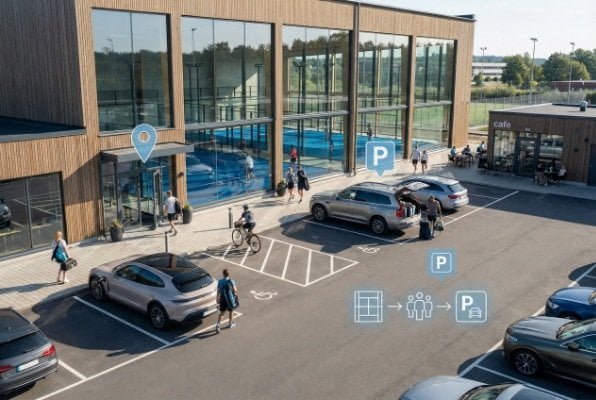
For players who treat padel as more than just a quick hobby, the venue experience is crucial. I have seen many clubs fail not because the courts were bad, but because the logistics were a nightmare. The biggest frustration for a player is driving to a club and struggling to find a parking spot. This leads to late arrivals, shortened game times, and angry customers.
You must calculate your parking needs scientifically. It is not a guessing game. Padel is a doubles game, which means four people play on one court. However, during the transition time between bookings, the next group arrives before the first group leaves. This effectively doubles the number of people at your club.
Here is the formula I use:
- Take the number of courts you have.
- Multiply by 8 (4 current players + 4 incoming players).
- Multiply that total by 0.8 (since most players drive their own cars).
For example, if you have 4 courts, you might have up to 32 people on-site during shift changes. You need approximately 25 parking spaces. If your location is in a busy city center with high foot traffic, this is great. But if you choose a remote area to save on rent, you must use Online to Offline (O2O) marketing1 strategies to bring people in. If the location is hard to find and hard to park at, your business will suffer.
Why Is a High-Quality Foundation Critical to Preventing Structural Sagging?
Imagine your expensive glass walls shattering because the ground moved slightly. This nightmare scenario happens frequently when builders cut corners on the initial groundwork.
A high-quality foundation prevents structural sagging and ensures safety. You need concrete at least 10cm thick, though 18-20cm is ideal. Proper preparation avoids settlement risks from rain, which leads to steel deformation and dangerous glass breakage.
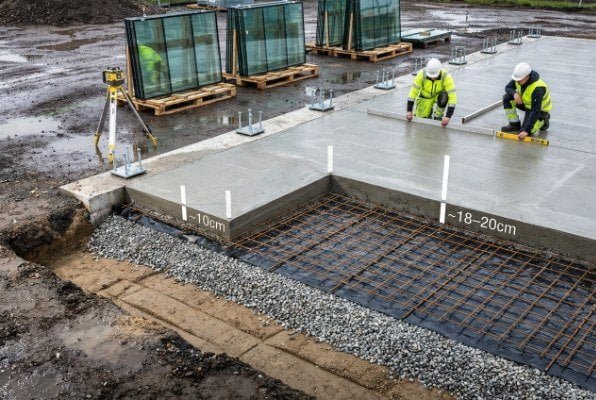
The foundation is the most critical part of a stable installation. I cannot stress this enough: do not build an outdoor padel court without professional help. The ground is alive. It moves, especially during winter rains or seasonal changes. If you do not prepare the terrain correctly, the ground will settle unevenly.
When the ground settles, the steel structure sitting on top of it will deform. Steel is strong, but glass is brittle. The glass walls of a padel court rely on the steel frame for support. If the frame twists due to a bad foundation, the stress on the glass becomes uneven. Eventually, the glass will break. This is a huge safety risk and a massive replacement cost.
Here are the specific parameters you should demand from your construction team:
- Minimum Concrete Thickness: 10cm ( This is the absolute limit).
- Ideal Concrete Thickness: 18cm to 20cm.
- Process: You must proceed in stages to ensure the soil is compacted before pouring concrete.
I have helped clients who tried to save money on the foundation. They ended up spending double the money to fix the sunken courts a year later. A solid foundation is your insurance policy against future disasters.
How Should You Position Your Padel Courts to Optimize Entry and Aesthetics?
Your courts look great, but are they actually making you money? Many owners ignore the front desk layout and lose significant extra revenue every single day.
You should position courts to funnel traffic through a well-stocked reception area. This setup maximizes first impressions and boosts ancillary sales of rackets, balls, and drinks, creating a stable revenue stream that complements your hourly court rental income.
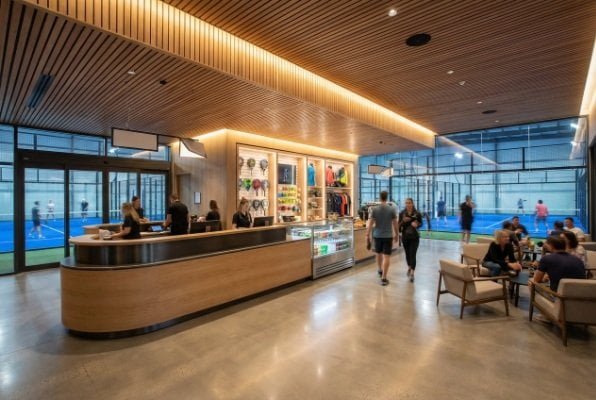
When a new customer walks into your club, their first impression defines their experience. If they walk straight onto a court without seeing your staff or your products, you are leaving money on the table. The layout of your club is a marketing tool.
I recommend designing the entry so that every player must pass the front desk. This is not just for checking in; it is for sales. While court rentals pay the rent, ancillary sales provide your profit margin.
Consider these revenue streams you can capture at the front desk:
- Accessories: Padel balls wear out fast. Grips need changing. Players often forget these items.
- Equipment: Selling high-end rackets and sportswear adds a professional touch.
- Food & Beverage: Energy drinks, water, and snacks are essential after an intense match.
- Services: Sign-ups for training courses or leagues.
If you position the courts well, players will naturally linger in this area before and after matches. This creates a social atmosphere. A club that feels social and lively retains members longer. Do not treat the front desk as just a checkpoint; treat it as a retail store that supports your business stability.
What Makes the Quality of the Steel Structure Vital for a Sustainable Investment?
Rust is the silent killer of outdoor padel courts. Are you tempted by cheaper steel quotes that might destroy your entire facility’s value within two years?
The quality of steel determines if your investment lasts. You must use hot-dip galvanized steel with a coating over 40μm for outdoor use. Cheaper electro-galvanized options save money initially but rust quickly in humidity, ruining your club’s image and safety.
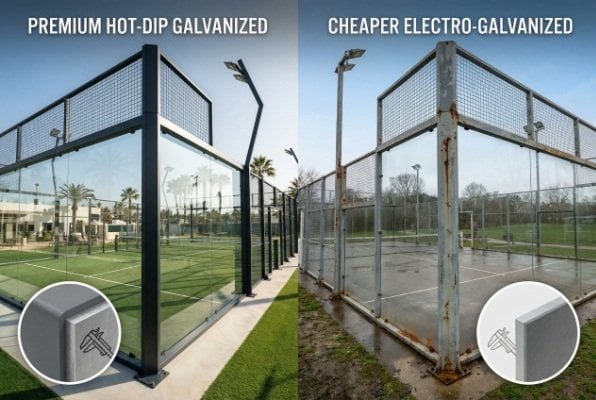
New buyers often underestimate the importance of steel profiles. I have seen quotation sheets where the price difference is only $300 to $800 per court. The client chooses the cheaper option, thinking steel is just steel. This is a fatal mistake.
Inferior steel cannot handle high temperatures or humidity changes. At QHPADEL, we prioritize hot-dip galvanized steel2. This process creates a thick protective coating, typically greater than 40μm. This offers exceptional corrosion resistance for outdoor environments.
Some competitors offer "electro-galvanized" or "cold-galvanized" steel to lower the bid. The coating on this steel is very thin, usually only 3μm to 15μm. This is fine for a dry, indoor warehouse, but outdoors, it will rust very quickly.
| Feature | Hot-Dip Galvanized | Electro-Galvanized |
|---|---|---|
| Coating Thickness | > 40μm | 3μm – 15μm |
| Best Use | Outdoor / Humid | Indoor / Dry Only |
| Cost | Standard | Save $300-$800 |
| Durability | High (Long-term) | Low (Rusts quickly) |
If you choose the cheaper option for an outdoor court, the paint will bubble and rust will streak down the glass within months. Customers engage with the structure; they touch the mesh. If it is rusty, they will think your club is unsafe or dirty. They will leave for a newer club. Do not let a small initial saving cost you your long-term reputation.
How Does Padel Artificial Grass Quality Affect Player Experience and Maintenance Costs?
Players hate slipping on worn-out turf, and you will hate constant repair bills. Low-quality grass looks fine on day one but fails when it rains.
High-quality grass affects player safety and your long-term costs. You should choose turf with at least 7000 dtex and a PU backing. PU adhesive remains strong in rain, whereas SBR latex loses grip strength when wet, risking turf detachment.
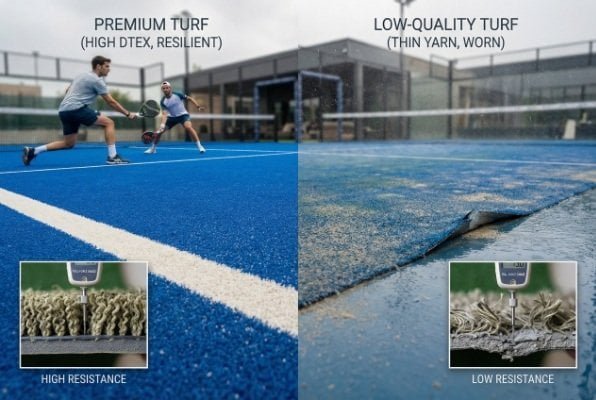
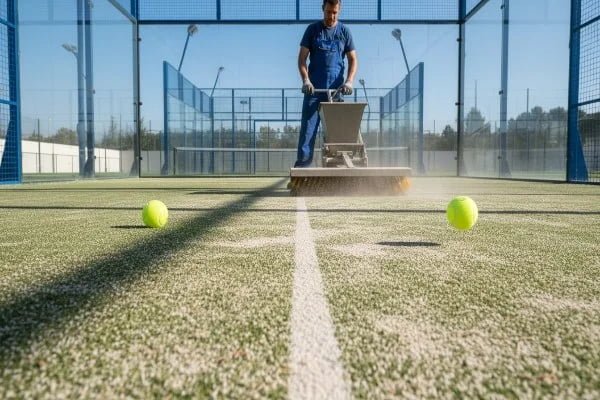
The artificial turf is the only part of the court the players are constantly in contact with. Its quality defines the game. Low-quality turf wears out fast, becomes slippery, and increases the risk of player injury. If a player gets hurt at your club due to bad turf, your reputation is finished.
You need to look at two main specs: Dtex and Backing.
1. Dtex (Density/Thickness of yarn):
The minimum standard is 7000 dtex. However, higher is better for durability.
- 9000 dtex: This is a solid option, costing around $1200 per court.
- 13500 dtex: This is the premium option, costing around $1700 per court. It lasts longer and feels better.
2. Backing (The glue holding the grass):
This is where many suppliers hide cost cuts. The backing holds the grass fibers in place.
- PU (Polyurethane) Backing3: This is what we recommend. The pull-out force (how hard you pull to rip the grass out) is usually above 55N. Importantly, PU is not affected by water.
- SBR Latex Backing4: This is cheaper. It might have a decent pull-out force of 40N when dry. But, during the rainy season, SBR softens. The pull-out force can drop to 25N or 30N.
If you use SBR backing outdoors, the rain will weaken the glue, and the grass fibers will start coming loose. This increases maintenance costs significantly. Always check these specs before you buy.
Conclusion
Building a successful padel club requires strict attention to location, foundation, layout, steel, and grass. Focusing on quality ensures player satisfaction and long-term business success.
-
Discover O2O marketing strategies that can help attract customers to your padel club, even in less accessible locations. ↩
-
Explore the advantages of hot-dip galvanized steel to ensure your outdoor investment is durable and rust-resistant. ↩
-
Explore this resource to understand how PU backing enhances durability and player safety, ensuring a better playing experience. ↩
-
Explore this resource to understand the risks and maintenance costs associated with SBR latex backing, ensuring informed turf choices. ↩