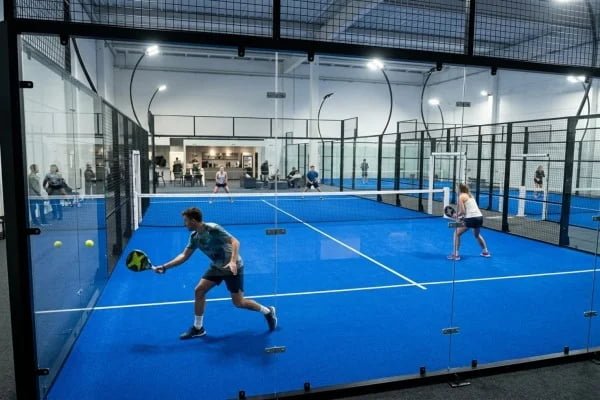
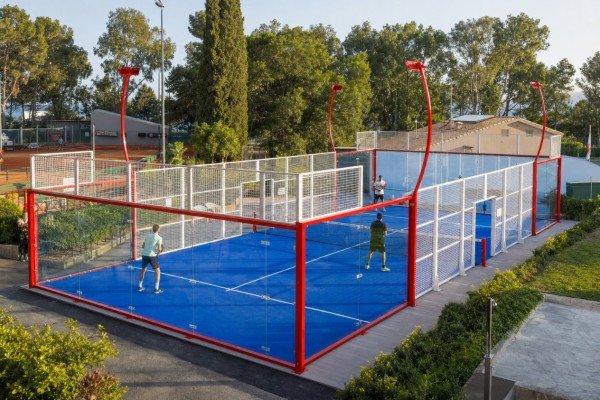
A complete padel court solution can remove many procurement problems that appear when steel, glass, turf, lighting, and accessories come from different suppliers. If buyers compare only unit prices, they may overlook interface errors, split freight, missing parts, installation delays, and disputed responsibility. I recommend comparing the entire project-delivery process instead.
A complete padel court solution is often preferable because one supplier coordinates the court configuration, bill of materials, component interfaces, export packing, drawings, documentation, and replacement support1. This approach can reduce handoff risk and clarify accountability. However, separate sourcing may work when an experienced local contractor accepts responsibility for integrating every component.
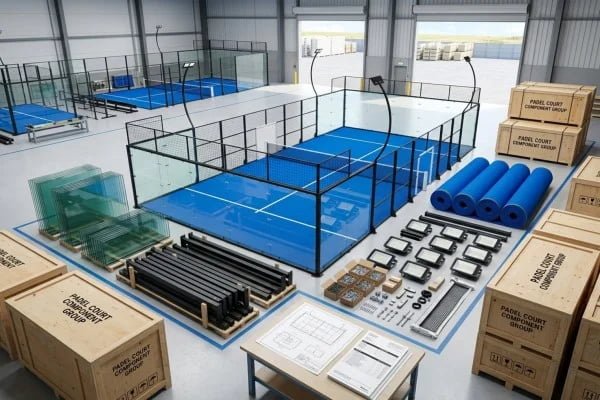
In my pre-sales discussions, buyers often begin by asking which sourcing option has the lower price. I usually redirect the conversation toward a more useful question: Who will control the integration risk from design confirmation through installation? That answer often determines the most suitable procurement route.
How Does a Complete Padel Court Solution Reduce Integration Risk?
Buyers can purchase several well-made components and still receive a court that is difficult to assemble. The problem usually lies at the interfaces rather than within an individual product.2 A coordinated package addresses this risk by aligning dimensions, tolerances, drawings, fastener locations, numbering, and installation sequences before shipment.
A complete padel court solution reduces integration risk by treating the court as one connected system rather than a collection of independent products. The supplier coordinates the steel structure, tempered glass, artificial turf, lighting, netting, fasteners, and technical documents against a shared configuration and bill of materials.
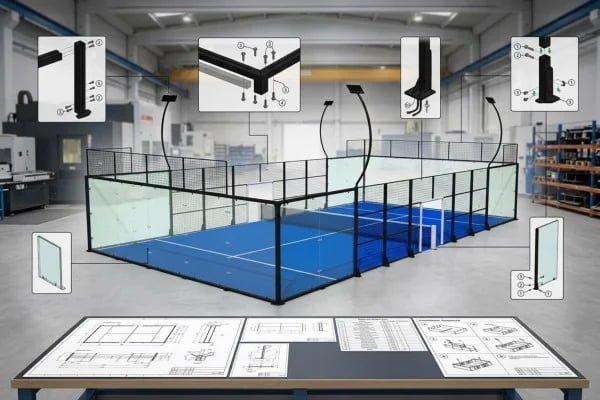
Component quality does not guarantee system compatibility
I regularly speak with buyers who compare local glass, imported steel, locally sourced lighting, and turf from another manufacturer. Each quotation can look reasonable on its own. However, each component must fit the agreed court design and installation method.
For example, a buyer should confirm the following interfaces:
- Steel and glass: Glass dimensions, hole positions, edge clearances, gasket details, and fastening methods must match the frame.
- Steel and foundation: Base plates, anchors, post spacing, and pre-embedded components must align with the approved foundation design.
- Turf and court dimensions: Roll widths, cutting plans, line locations, seam layouts, and infill requirements must suit the finished playing area.
- Lighting and structure: Brackets, cable routes, fixture weights, mounting heights, and electrical specifications require coordination.
- Net and posts: Post locations, tensioning hardware, net dimensions, and center height must follow the selected configuration.
- Fasteners and installation sequence: Bolt grades, quantities, labels, and assembly order must correspond with the packing list and drawings.
A certificate for one part does not prove that all parts form a structurally compliant court.3 Buyers should treat CE documents, test reports, and quality certificates as materials for review rather than automatic whole-court approval. A qualified local structural engineer, electrical professional, or building authority should verify application-specific requirements.4
Shared configuration control matters
I prefer to establish a written configuration before final pricing. The document should state the court type, frame finish, glass specification, turf specification, light configuration, accessories, and documentation scope. It should also identify exclusions.
At QHPADEL, our complete packages can include artificial turf, welded frame netting, structural posts, tempered glass, lighting fixtures, nets, and related accessories. We can also provide installation drawings, foundation drawings, packing lists, and maintenance manuals. Buyers should still check every document against their contract and local regulations.
A useful interface matrix can make the review more disciplined:
| Interface | What buyers should verify | Main risk if misaligned |
|---|---|---|
| Frame to foundation | Base-plate dimensions, anchor positions, levels, tolerances | Posts cannot be installed accurately |
| Glass to frame | Panel size, hole pattern, protective fittings | Rework or replacement may be required |
| Lighting to posts | Bracket type, voltage, cable route, fixture load | Delayed electrical installation |
| Turf to slab | Finished dimensions, drainage, flatness, seam plan | Poor fit or uneven playing surface |
| Fasteners to assemblies | Type, grade, quantity, labeling | Interrupted installation |
| Documents to delivered goods | Part numbers, drawings, packing list | Confusion during unloading and assembly |
The central benefit is not that one supplier makes every decision for the buyer. The benefit is that one party coordinates the defined interfaces and provides a clearer point for technical clarification.
What Costs Should You Compare Beyond Component Quotations?
A low component quotation can be attractive, especially during early budgeting. However, incomplete cost comparisons can create false confidence. If buyers exclude split shipments, internal coordination, replacement freight, site waiting time, and rework, they may select an option without understanding its total project exposure.
I recommend comparing total landed and installed project exposure, not only the sum of steel, glass, turf, and lighting prices. Buyers should align the bill of materials, Incoterms, freight batches, documentation, installation support, spare parts, replacement procedures, and responsibility boundaries before deciding which sourcing model offers better value.
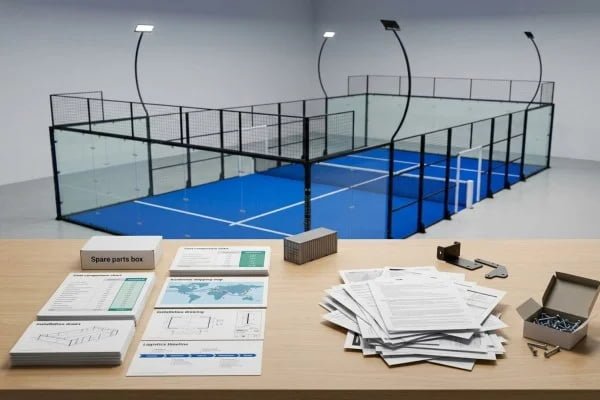
Build a like-for-like cost model
I have seen many inquiry comparisons where one quotation includes a complete set while another excludes freight-sensitive or installation-critical items. The headline totals cannot be compared until the scopes are aligned.
Buyers can use the following cost structure:
-
Equipment price
- Structural steel
- Tempered glass
- Turf and line materials
- Lighting
- Nets, fasteners, gaskets, and accessories
-
Logistics cost
- Inland transport
- Export packing
- Port charges
- Ocean or land freight
- Customs clearance
- Local delivery
- Multiple-shipment handling
-
Integration cost
- Drawing review
- Contractor coordination
- Measurement verification
- Component adaptation
- Technical communication
- Project management time
-
Installation exposure
- Crew waiting time
- Equipment rental extensions
- Missing-part replacement
- Site modifications
- Repeat mobilization
- Schedule disruption
-
After-sales exposure
- Responsibility for defects
- Replacement approval process
- Replacement production time
- Courier or freight responsibility
- Availability of compatible spare parts
A complete package is not automatically cheaper. A local glass source, for instance, may reduce overseas freight and simplify replacement. A local electrician may also be better positioned to select compliant electrical components. However, those savings are meaningful only if the local components are fully compatible and someone accepts integration responsibility.
Compare commercial terms in one table
| Cost or risk item | Complete package | Separate sourcing |
|---|---|---|
| Supplier quotations | Usually fewer | Usually several |
| Freight batches | May be consolidated | May require multiple deliveries |
| Interface coordination | Primarily centralized | Managed by buyer or contractor |
| Local adaptation | May still be required | Can offer greater local flexibility |
| Missing-part responsibility | Often easier to trace within agreed scope | Can involve supplier disputes |
| Replacement speed | Depends on stock and export distance | Local supply may be faster |
| Documentation consistency | Can follow one configuration | Must be assembled across suppliers |
| Overall integration owner | Supplier and buyer define boundaries | Buyer should appoint a capable integrator |
I recommend assigning a monetary allowance to uncertain items rather than treating them as zero. Even when buyers cannot calculate an exact figure, they can grade each exposure as low, medium, or high. This method produces a more realistic procurement comparison.
How Does a Complete Padel Court Solution Improve Logistics and Documentation?
An export project can stall even when every major component has been manufactured. Poor labels, unclear packing lists, mixed fasteners, or documents that do not match the delivered configuration can slow customs review and installation. Coordinated logistics reduce this gap between factory completion and usable delivery.
A complete padel court solution can improve logistics by linking the approved configuration to the bill of materials, package labels, loading plan, packing list, and installation documents. Buyers gain better shipment visibility, while installers can identify components more easily and report shortages against a shared reference.
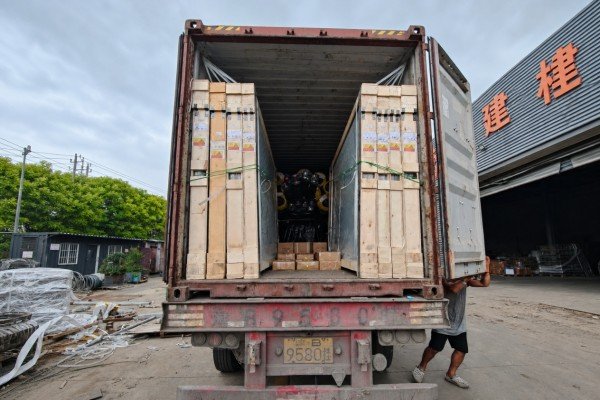
The packing list should function as a control document
I advise buyers not to treat the packing list as an administrative formality. It should help the importer, warehouse team, and installer understand what has arrived.
A practical packing workflow includes:
- A final approved bill of materials
- Component numbers that match the drawings
- Package or crate identification
- Quantities by court and package
- Gross and net weights where applicable
- Loading photographs or records
- A shortage-reporting procedure
- A defined contact for technical questions
- A list of recommended spare or wear items
For multi-court projects, buyers should also ask whether parts are packed by individual court, by component category, or by installation sequence. Each method affects site handling. A contractor installing courts one at a time may prefer court-by-court identification. A warehouse distributor may prefer standardized component groups.
QHPADEL reports annual exports of more than 600 containers and manufactures complete court systems for several overseas regions. I mention this business context because repeat export handling can support packaging discipline. However, buyers should still inspect the proposed packing method, request sample packing lists, and confirm liability terms in writing.
Documentation must match the purchased configuration
Supplier documents often fall into several categories:
| Document | Procurement purpose | Buyer verification |
|---|---|---|
| Configuration sheet | Defines the ordered court | Confirm every option and exclusion |
| Bill of materials | Controls component quantities | Match it to the quotation and contract |
| Foundation drawing | Supports site planning | Obtain local engineering approval |
| Installation drawing | Guides assembly | Check revisions and component numbers |
| Packing list | Controls shipment contents | Match packages to the BOM |
| Certificates and reports | Supports compliance review | Verify issuer, scope, model, and validity |
| Maintenance manual | Supports post-installation care | Confirm procedures and spare parts |
QHPADEL states that its factory holds ISO 9001 certification and that various components have supporting certificates or test documents. These include CE and RoHS documentation for artificial turf, CE documentation for the steel frame, and several standards-related documents for glass, lights, screws, and accessories.
I recommend that buyers request current copies and verify that each document covers the actual model and specification being purchased. Component certificates should not be presented as whole-court structural approval. Local authorities and qualified professionals must determine whether the final design satisfies building, wind, electrical, fire, and safety requirements.
When Does Separate Component Sourcing Make Sense?
A complete package can reduce coordination work, but it is not the only rational procurement model. Separate sourcing can offer local availability, familiar materials, or faster replacement. The risk increases when no party checks interfaces or accepts overall responsibility for the combined result.
Separate component sourcing can make sense when an experienced local contractor controls measurements, drawings, tolerances, procurement, installation, and local compliance.5 The contractor should have the authority and technical ability to approve interfaces, reject unsuitable components, manage schedule dependencies, and accept responsibility for integrating the complete court.
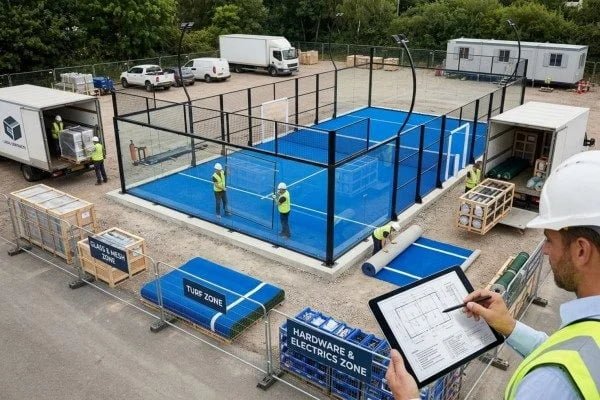
Strong local integration can change the decision
I often ask buyers whether they already have a contractor who has installed the proposed court type. A general builder may be capable, but padel court integration involves specialized details. Buyers should evaluate relevant experience rather than relying on a broad construction title.
Separate sourcing may be appropriate when:
- A qualified local contractor has completed comparable installations.
- Local glass is easier or legally preferable to procure.
- Electrical fixtures must follow specific local requirements.
- The buyer has an established turf supplier with compatible specifications.
- Import duties strongly favor local production of certain components.
- Replacement parts must be available within a short local lead time.
- The contractor can produce or approve coordinated shop drawings.
- One party accepts overall integration and handover responsibility.
The model becomes more difficult when the buyer personally acts as the coordinator without technical support. The buyer may receive conflicting answers because each supplier can reasonably state that its own product meets the submitted specification. The unresolved issue is whether the submitted specifications were compatible in the first place.
Use a sourcing decision matrix
| Buyer condition | Complete solution may suit | Separate sourcing may suit |
|---|---|---|
| Limited padel installation experience | High | Low |
| Strong local specialist contractor | Medium | High |
| Tight need for one coordinated BOM | High | Medium |
| Local glass or electrical requirements | Medium | High |
| Limited internal project-management time | High | Low |
| Need for flexible local replacement | Medium | High |
| Several courts using one standard design | High | Medium |
| Complex site-specific engineering | Depends on professional review | Depends on professional review |
I would not decide solely from this matrix. I would use it to identify where responsibility sits. Buyers should document who approves foundation interfaces, structural assumptions, electrical specifications, glass selection, turf preparation, and final installation.
The best sourcing model is usually the one in which integration responsibility is explicit, technically competent, and contractually visible.
How Should You Evaluate a Complete Padel Court Solution Supplier?
A complete-package label does not guarantee a complete service. Some quotations may omit installation-critical accessories, documentation, or replacement terms. Buyers should challenge vague scope descriptions before paying a deposit because later clarification can affect cost, production, shipping, and the construction schedule.
Buyers should evaluate a complete padel court solution supplier through its configuration process, BOM detail, drawing control, manufacturing quality procedures, packing method, documentation, lead-time basis, and after-sales responsibility. Buyers should also verify certificates and appoint qualified local professionals to review structural and regulatory requirements.
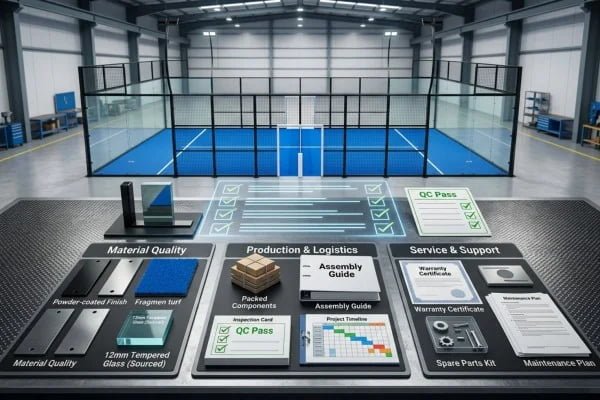
Ask questions that expose delivery capability
In my inquiry work, I find that strong procurement questions reveal more than a general request for “best price.” I recommend asking each shortlisted supplier the same questions:
- What exactly is included in one court?
- Which components or services are excluded?
- Does the BOM identify quantities and specifications?
- Do component numbers match the installation drawings?
- Which foundation information will the supplier provide?
- Which assumptions require local engineering approval?
- How will glass and frames be protected during shipping?
- How are fasteners labeled and counted?
- What evidence supports the quoted production lead time?
- What happens if a part is missing, damaged, or incorrect?
- Who pays for replacement production and freight under each scenario?
- Which certificates apply to the exact supplied models?
Buyers should also compare production capacity with realistic order scheduling. QHPADEL operates 10 production lines and reports monthly capacity exceeding 1.5 million square metres of artificial turf and 150 complete court systems. Its standard guidance states that two courts can be produced in about 20 days, four courts in 20–25 days, and larger standard orders in no more than 30 days. Custom designs can require up to 35 days.
These figures should be treated as supplier-stated production guidance, not a guaranteed project completion date. Buyers should obtain a written schedule for their order. The schedule should distinguish drawing approval, deposit receipt, production, inspection, packing, vessel booking, transit, customs clearance, and installation.
Match the supplier to the buyer profile
Different buyers should emphasize different evidence:
- Club operators should focus on complete scope, budget visibility, spare parts, appearance, warranty terms, and installation support.
- Contractors should focus on foundation drawings, tolerances, hole positions, labels, fastener completeness, and responsibility boundaries.
- Distributors should focus on standardized SKUs, OEM options, repeat-order consistency, marketing files, and delivery planning.
- Institutions should focus on traceable documentation, bidding requirements, safety specifications, and independent compliance review.
I also recommend a pre-shipment inspection for significant orders. The inspection scope can include quantities, visible finish, dimensions, package labels, document revisions, and loading readiness. A qualified third party should perform any specialized testing that falls outside the buyer’s or supplier’s competence.
Frequently Asked Questions
Is a complete padel court solution always cheaper?
No. A complete padel court solution may reduce coordination, split freight, and interface exposure, but local sourcing can lower costs for specific components. Buyers should compare aligned BOMs, landed costs, installation implications, replacement terms, documentation, and project-management requirements rather than relying on headline prices.
What should a complete padel court package include?
A package commonly includes the structural frame, welded mesh, tempered glass, artificial turf, lighting, nets, fasteners, and installation-related accessories. Buyers should request an itemized BOM because package definitions vary. Foundation construction, electrical work, installation labor, lifting equipment, and local approvals may be excluded.
Can I source the glass or lighting locally?
Yes. Local sourcing can simplify compliance, freight, and replacement, especially for glass and electrical items. However, buyers must confirm dimensions, hole positions, loads, brackets, voltage, protection ratings, and other interfaces. A competent contractor or engineer should approve the combined configuration.
Do component certificates prove that the complete court meets local codes?
No. Component certificates and test reports only apply within their stated scope. They do not automatically certify the assembled court or its foundation for a specific site. Buyers should have qualified local professionals review structural loads, wind conditions, electrical rules, drainage, accessibility, and permitting requirements.
What should I send when requesting a comparable quotation?
Buyers should provide the court quantity, preferred model, installation country, site location, frame color, turf preferences, lighting requirements, intended use, desired delivery date, and any local code conditions. Buyers should ask every supplier to identify inclusions, exclusions, Incoterms, lead times, documentation, packing, warranties, and replacement terms.
Conclusion
A complete padel court solution should be evaluated as a project-delivery model, not simply as a bundle of products. I recommend comparing compatibility, BOM control, freight, documentation, installation support, replacement procedures, and accountability alongside price. Separate sourcing can still be effective when a qualified local contractor controls integration and accepts responsibility.
-
"Coordination mechanism of construction industry supply chain …", https://pmc.ncbi.nlm.nih.gov/articles/PMC12091833/. Construction-management research identifies fragmented supply chains and poorly managed interfaces as sources of coordination risk; integrated procurement can centralize information flows and responsibility, although the result depends on the contractual scope and competence of the coordinating party. Evidence role: general_support; source type: research. Supports: Research on integrated procurement or supply-chain coordination showing that centralized coordination can reduce information and interface-management burdens.. Scope note: The evidence concerns construction and project supply chains generally, not padel courts specifically. ↩
-
"Developing an Interface Management (IM) Model for Construction …", https://www.academia.edu/117173442/Developing_an_Interface_Management_IM_Model_for_Construction_Projects. Studies of construction interface management describe interfaces among disciplines, organizations, and physical systems as recurrent sources of design inconsistency, rework, and schedule disruption when coordination is inadequate. Evidence role: mechanism; source type: paper. Supports: Studies of construction interface management explaining how mismatches in information, responsibilities, and physical connections can generate rework and delay.. Scope note: Such studies establish a general project-delivery mechanism and do not quantify the frequency of interface failures for padel courts. ↩
-
"Building Codes, Standards, and Regulations: Frequently Asked …", https://www.congress.gov/crs-product/R47665. Conformity documentation for a product concerns the product and the scope stated by its issuer; it does not, by itself, demonstrate that a complete installed structure satisfies site-specific structural, installation, or building-regulation requirements. Evidence role: definition; source type: government. Supports: Official conformity-assessment guidance distinguishing product documentation from verification of the final works, installation, and site-specific regulatory compliance.. Scope note: Applicable legal duties and approval procedures vary by jurisdiction and product category. ↩
-
"[PDF] Wind Loading Codes: International Usersˇ Perspectives", https://engineering.purdue.edu/~frosch/ftp/Talbott/11%20-%20References/files/ASCE%20Structures%20Congress%202004/PDFs/st04-5243.pdf. Building-regulation guidance generally bases structural and electrical approval on applicable local codes and site conditions, including design loads and installation details; review by authorized professionals or authorities may therefore be required. Evidence role: expert_consensus; source type: government. Supports: Building-regulation guidance showing that structural and electrical compliance depends on local codes, site conditions, and professional review where required.. Scope note: The required reviewer, approval process, and governing code differ across countries and municipalities. ↩
-
"Project Management for Construction: The Owners’ Perspective", https://www.cmu.edu/cee/projects/PMbook/01_The_Owners’_Perspective.html. Construction-management literature indicates that projects using multiple specialized suppliers require explicit allocation of interface-management duties, including design coordination, sequencing, and responsibility for incompatibilities. Evidence role: general_support; source type: paper. Supports: Construction-management literature showing that fragmented supply arrangements require clear interface-management responsibility and capable coordination.. Scope note: The literature supports the governance principle but cannot establish that any specific contractor has the necessary padel-court expertise. ↩