Padel is often described as a type of tennis, but that shortcut can create costly misunderstandings. Players may expect the same equipment, while investors may assume that a smaller tennis surface is enough. I find that the clearest solution is to treat it as a tennis-related racket sport with distinct rules and facility requirements.
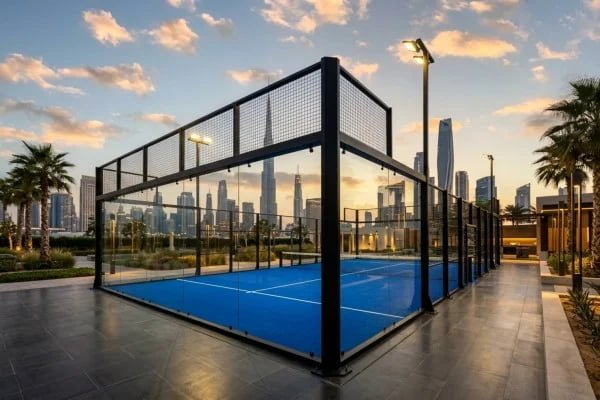
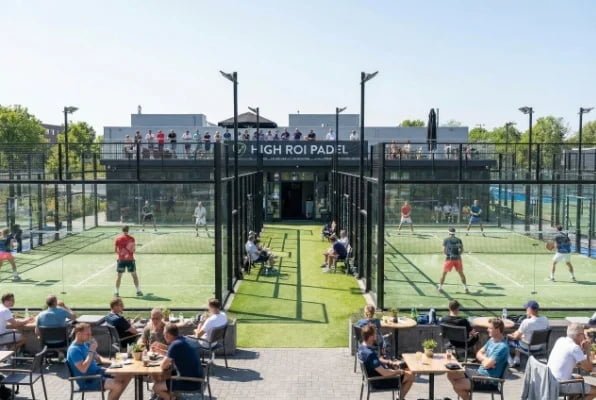
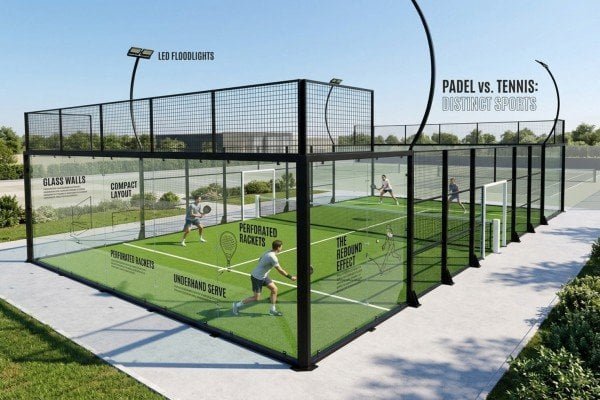
Padel is related to tennis, but it is a separate racket sport rather than tennis played on a smaller court.1 It uses an enclosed court, playable walls, solid perforated rackets, underarm serves, and predominantly doubles play.2 These differences also make a padel facility a dedicated court system, not simply a resized tennis court.
That distinction matters beyond sports terminology. In our project discussions, buyers often ask whether they can reuse tennis equipment or convert an existing court. The answer depends on how the sport works and how its structural, surface, lighting, foundation, and installation components fit together.
Is Padel a Type of Tennis or a Separate Sport?
The phrase “a type of tennis” is convenient, but it can hide important differences. If a buyer treats padel as mini tennis, the buyer may choose unsuitable equipment or underestimate the construction scope. I prefer a more precise description that recognizes both the shared heritage and the separate identity.
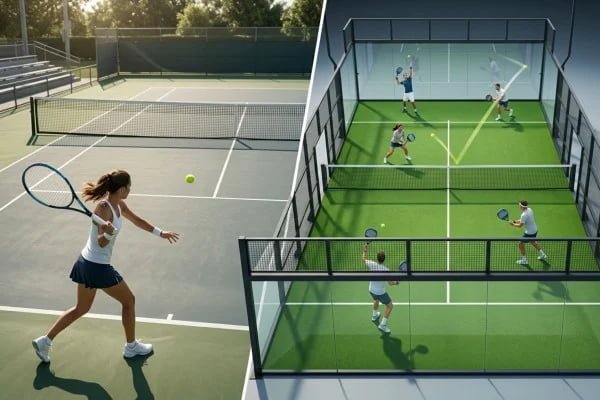
Padel belongs to the broader family of racket sports and has strong similarities to tennis, including a net, scoring system, balls, and opposing sides. However, it is a separate sport because its enclosed court, wall rebounds, serving method, racket design, and standard doubles format produce different rules, tactics, equipment needs, and facility requirements.
Why the Tennis Comparison Is Still Useful
The comparison helps new players understand the basic idea. Two sides hit a ball over a net, rallies determine points, and the familiar tennis scoring sequence of 15, 30, and 40 generally applies3. Those similarities make the sport easier to explain to investors, institutional buyers, and people considering their first game.
However, the comparison becomes less useful when it suggests that the sports are interchangeable. The International Padel Federation maintains dedicated rules for padel, while the International Tennis Federation publishes separate rules for tennis. I recommend checking the latest official documents when specifications, tournaments, or public tenders depend on exact requirements.
The most practical description is:
Padel is a tennis-related racket sport with its own rules, equipment, court design, and governing framework.
Where the “Mini Tennis” Description Breaks Down
Several differences immediately affect the playing experience:
- The surrounding walls form part of play. A ball can remain playable after bouncing on the court and then rebounding from an allowed wall surface.4
- Players use solid rackets. A padel racket does not have the open string bed found on a tennis racket.
- The serve starts underarm. The server bounces the ball before striking it at or below the permitted height under the official rules.
- Doubles is the standard format. The regular court is designed around four players.
- The enclosure affects tactics. Players must judge rebounds, positioning, and movement near glass and fencing.
I have received inquiries asking whether ordinary tennis rackets and nets can be included with a court order. That question is understandable, but the answer illustrates the distinction: tennis equipment should not automatically be specified for a padel project.
For casual conversation, calling the sport “similar to tennis” is reasonable. For coaching, procurement, design, bidding, or construction, buyers should use the sport’s correct name and its dedicated technical requirements.
How Is Padel Different From Tennis During Play?
New players can recognize many tennis-like features, but a rally quickly exposes the differences. If players expect tennis behavior from every bounce, they can struggle with the enclosure and serve. A short review of the main rule differences provides a better picture without turning the discussion into a full coaching manual.
Padel differs from tennis because players can use permitted wall rebounds after the ball bounces, serve underarm after bouncing the ball, and play with solid perforated rackets. Standard matches usually use doubles on an enclosed 10-by-20-metre court. These features create longer rebound sequences and different positioning from conventional tennis.
Walls Are Active Parts of the Game
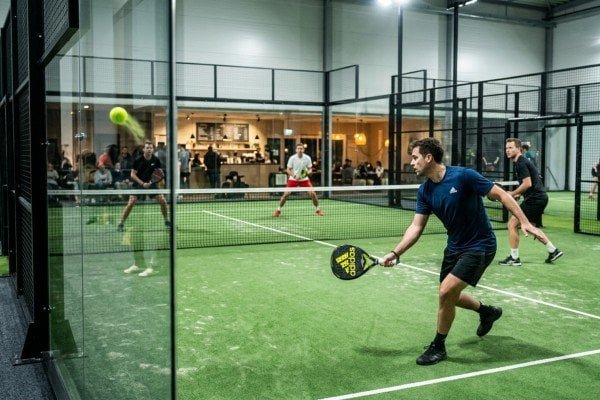
The enclosure is the most visible difference. In tennis, a perimeter fence normally stops an out-of-play ball and keeps it within the facility. In padel, specified glass or solid wall areas contribute directly to rallies.
A player may return a ball after it:
- Crosses the net.
- Lands correctly on the player’s side.
- Rebounds from an allowed wall.
- Is struck before a second ground bounce.
This sequence changes how players judge depth and pace. A deep shot that would pass a tennis player may rebound from the rear glass and offer another opportunity to return it. However, the exact legality of a shot depends on the sequence of contact and the official rules. Players should consult a qualified coach or referee for application-specific rule interpretation.
The Racket and Serve Are Different
A tennis racket uses strings under tension. A padel racket has a solid striking surface with perforations and includes a safety cord.5 Buyers planning rental fleets should therefore budget for dedicated rackets rather than assume that equipment from a tennis program can be transferred.
The serve also has a different motion. The player first bounces the ball and then hits it underarm within the conditions defined by the rules. This method can feel more accessible to beginners, but it does not make the entire sport identical or automatically easier.
Court Dimensions Affect Movement
The official playing area is 10 metres wide and 20 metres long, divided by a net.6 By comparison, the ITF specifies a tennis court length of 23.77 metres, with widths of 8.23 metres for singles and 10.97 metres for doubles.7
| Feature | Padel | Tennis | Practical effect |
|---|---|---|---|
| Standard playing area | 10 m × 20 m | 23.77 m long; width varies | Padel uses a more compact footprint |
| Court boundary | Enclosed with glass/walls and mesh | Open playing area with external fencing | Padel boundaries influence rallies |
| Typical format | Doubles | Singles or doubles | A standard padel court usually serves four players |
| Racket | Solid and perforated | Strung | Equipment is not interchangeable |
| Serve | Underarm after a bounce | Overarm or underarm permitted by tennis rules | Technique and receiving position differ |
| Wall rebounds | Part of play under defined conditions | Not part of conventional play | Tactics and court construction change |
These measurements should be treated as the starting point, not the entire facility footprint. A project also requires circulation, access, drainage, structural interfaces, and safe clearances based on the site and applicable local requirements.
Why Is a Padel Court More Than a Smaller Tennis Court?
A smaller playing area can make a project look simple on a plan. However, the enclosure must support glass, fencing, doors, lights, and repeated sporting use. If buyers focus only on turf dimensions, they can miss the interfaces that determine whether the delivered system can be installed accurately and safely.
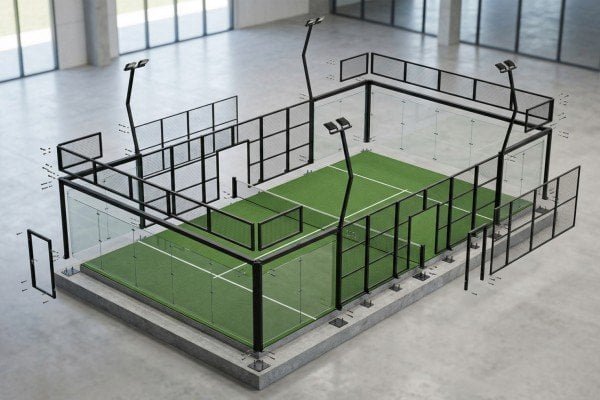
A padel court is an integrated facility system that normally combines a steel frame, tempered glass, welded mesh or fencing, artificial turf, lighting, net equipment, fasteners, foundations, and installation interfaces.8 Each component must match the drawings and local project conditions, so buyers should evaluate the complete bill of materials rather than compare surface prices alone.
The Main System Components
In our manufacturing and export work, a complete package can include several connected product groups:
- Structural posts and frames
- Tempered glass panels
- Welded frame netting or mesh sections
- Artificial turf and infill requirements
- LED lighting fixtures and support posts
- Court net, posts, and tensioning hardware
- Anchors, screws, plates, and other fasteners
- Doors and access hardware
- Protective packaging and component labels
- Foundation, pre-embedding, and installation drawings
A missing fastener may look minor at the purchasing stage, but it can interrupt installation on site. Likewise, unclear hole positions or incomplete component labels can increase labor time. Club operators and contractors should therefore compare complete scopes rather than rely on a single headline price.
Interfaces Matter as Much as Individual Components
Every major component connects to something else. The steel frame connects to the foundation. Glass connects to the support structure. Turf performance depends on the prepared base, drainage, seams, infill, and installation. Lighting depends on fixture positioning, electrical design, local rules, and the intended level of play.
I often encourage buyers to ask interface questions such as:
- Who designs and approves the foundation?
- What tolerances must the civil contractor achieve?
- Which anchors or embedded parts are included?
- How are frame sections numbered for installation?
- How are glass panels protected during transport?
- What electrical items are inside and outside the supplier’s scope?
- Which spare parts are recommended for the project?
- Who is responsible if site conditions differ from the approved drawings?
These questions help separate a component quotation from a properly coordinated court package.
Documents Should Support Delivery and Installation
A commercial court order should be accompanied by documents appropriate to its scope. Buyers may need:
- A detailed bill of materials
- Foundation and pre-embedding drawings
- Assembly or installation drawings
- Packing lists
- Component identification records
- Maintenance manuals
- Warranty terms and exclusions
- Product certificates and test reports
- Replacement-part procedures
QHPADEL provides documents such as installation drawings, foundation drawings, packing lists, and maintenance manuals according to the order. However, buyers should still verify that every document matches the quoted model, destination, tender, and local requirements.
Certificates should also be treated as documents to inspect, not as blanket proof that a complete site is approved. Buyers should verify the certificate holder, product description, standard, report number, issuing body, validity, and relationship to the supplied batch or model. A qualified local engineer or approval authority should evaluate structural and application-specific compliance.
Can an Existing Tennis Court Be Converted Into a Padel Court?
An unused tennis area can appear to offer an easy conversion opportunity. Yet usable surface area does not confirm that the existing base, drainage, access, or approvals will support a new enclosure. I have seen this become one of the first questions from investors, and it requires more than a yes-or-no response.
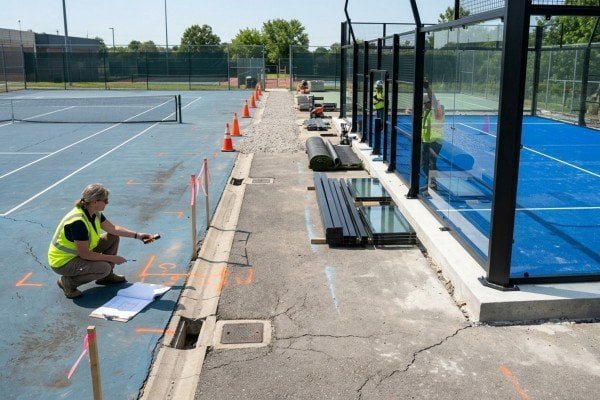
An existing tennis court may provide enough space for one or more padel courts, but conversion feasibility depends on measured dimensions, foundation capacity, drainage, structural loads, access, utilities, local approvals, and installation clearances. A qualified site assessment is necessary before a buyer selects a court layout or commits to equipment.
Space Is Only the First Test
Because a tennis playing area is longer than a standard 20-metre padel enclosure, investors sometimes assume that conversion is automatic. However, the painted playing dimensions do not show the complete usable site.
The assessment should account for:
- Existing fences and their foundations
- Run-off and circulation zones
- Entry routes and emergency access
- Columns, walls, trees, or nearby buildings
- Drainage direction and low points
- Lighting poles and underground services
- Construction equipment access
- Space for unloading glass and steel components
- Local boundary, noise, and planning restrictions
A layout that fits on paper may still create difficult door access or leave insufficient working room for installation.
The Existing Slab May Not Be Suitable
A tennis surface was not necessarily designed to receive the anchors and concentrated forces associated with an enclosed court structure. Cracks, unknown slab thickness, poor level tolerances, or concealed drainage can also affect the proposal.
A court supplier can provide product loads, anchor information, and interface drawings. However, a supplier should not replace the role of a qualified local structural or civil professional. The responsible professional should review the existing condition, wind requirements, soil or slab information, drainage, foundation design, and applicable building rules.
Key information for a feasibility review may include:
| Information needed | Why it matters |
|---|---|
| Verified site survey | Confirms actual space and levels |
| Existing foundation or slab records | Helps assess capacity and anchor conditions |
| Local wind and weather criteria | Influences structural evaluation |
| Drainage plan | Reduces water accumulation and surface problems |
| Utility locations | Prevents conflicts with anchors and excavations |
| Access dimensions | Confirms that long frames and glass can reach the site |
| Local permit requirements | Identifies approvals before procurement |
| Intended use level | Helps define lighting, durability, and operating needs |
Conversion Can Mean Several Different Things
A “conversion” might involve installing a system over an accepted base, modifying the base, removing the old surface, or rebuilding the area more extensively. Buyers should define which work belongs to the court supplier, civil contractor, electrical contractor, installer, and project owner.
I recommend completing the following steps before ordering:
- Obtain an accurate site survey.
- Select a preliminary court layout.
- Review access and unloading conditions.
- Gather available slab and foundation records.
- Confirm local planning and building requirements.
- Ask qualified professionals to review structural and civil conditions.
- Coordinate foundations with the selected court model.
- Approve final drawings before production.
This process does not guarantee that every site can be converted. It helps investors determine what is feasible without relying on the dimensions alone.
How Should Buyers Evaluate a Padel Court Supplier?
Once buyers recognize that the project is not mini tennis, supplier evaluation becomes more focused. A low court price may exclude essential materials, drawings, packaging, or support. I advise buyers to compare scope, manufacturing control, documentation, and delivery capability before comparing the final totals.
Buyers should evaluate a padel court supplier by checking the complete bill of materials, model-specific drawings, structural and product documentation, material specifications, quality-control records, packaging plan, lead time, warranty terms, and replacement process. They should also verify certificates independently and confirm which installation, foundation, electrical, and local approval tasks are excluded.

Compare Like With Like
Two quotations may use the same product name while covering different scopes. One package may include turf, lights, glass, netting, and fasteners. Another may omit electrical components, anchors, infill, spare parts, or installation support.
A useful comparison sheet should include:
| Evaluation area | Questions to ask |
|---|---|
| Court model | Is the design classic, panoramic, ultra panoramic, roofed, or customized? |
| Steel system | What grades, dimensions, coatings, and fabrication controls are specified? |
| Glass | What thickness, processing, edge treatment, markings, and test documents apply? |
| Turf | What pile, Dtex, density, backing, color, roll plan, and infill are offered? |
| Lighting | How many fixtures are supplied, and what electrical specifications apply? |
| Hardware | Are anchors, screws, brackets, net posts, and doors included? |
| Documentation | Are foundation, installation, packing, and maintenance documents provided? |
| Packaging | How are glass, steel, turf, and accessories separated and labeled? |
| Warranty | What is covered, for how long, and under which conditions? |
| After-sales support | How are missing or damaged components documented and replaced? |
Review Manufacturing and Quality-Control Evidence
Buyers can request evidence related to incoming material checks, welding, hole positioning, coating, trial assembly, glass identification, turf inspection, packing, and container loading. The evidence should be relevant to the actual order rather than limited to general marketing photographs.
At QHPADEL, our stated manufacturing capacity includes 10 production lines, monthly artificial turf output above 1.5 million square metres, and capacity for 150 complete court systems per month. Our standard stated production schedules range from about 20 days for two courts to no more than 30 days for orders above four standard courts, while custom styles can require up to 35 days. Buyers should confirm the current schedule in the sales contract because capacity does not by itself guarantee a specific dispatch date.
Verify Certificates Carefully
Our supplied business context lists ISO 9001 factory certification and product-related documents for turf, steel structures, glass, lights, screws, and accessories. These include CE and several Australian/New Zealand standards among the available documentation.
However, I recommend that procurement teams verify:
- The legal name of the certificate holder
- The issuing or testing organization
- The referenced standard and edition
- The exact product or model covered
- Report dates and validity
- Whether the document is a certificate, declaration, or test report
- Whether destination-country requirements differ
- Whether a local authority requires further calculations or approval
No individual product certificate should be interpreted as automatic approval of the complete facility.9 Structural safety, electrical work, foundations, fire rules, accessibility, and planning conditions remain project-specific matters.
Frequently Asked Questions
Is padel easier than tennis?
Many beginners find the underarm serve and compact court approachable. However, wall rebounds, close positioning, and fast exchanges introduce different challenges. I would not describe it as universally easier. The experience depends on a player’s background, mobility, coordination, and familiarity with rebound play.
Can I use a tennis racket to play padel?
No. Players use a dedicated solid, perforated racket with a safety cord rather than a strung tennis racket. Clubs should purchase purpose-made rackets and verify that rental equipment is in good condition. Players should also follow the current official rules and local facility requirements.
Is a padel ball the same as a tennis ball?
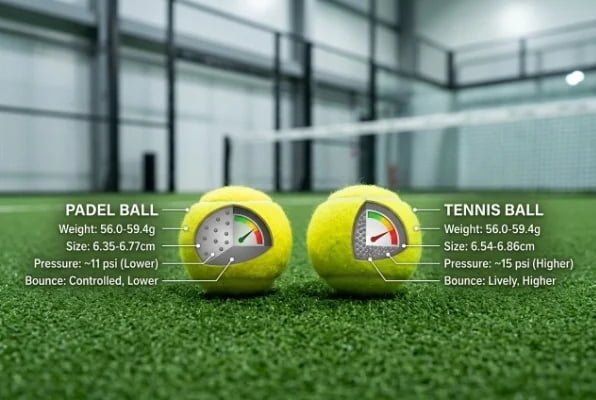
The balls look similar, but buyers should not assume that they are identical. Official specifications can differ, including permitted pressure and rebound ranges.10 Clubs and tournament organizers should source balls marked for the intended sport and check the latest federation rules when formal compliance matters.
How much space does a padel court need?
The official playing enclosure is generally 10 by 20 metres, but a real project needs additional room for access, circulation, installation, maintenance, and any local safety requirements. I recommend using a measured site plan rather than estimating feasibility from the playing dimensions alone.
Can two padel courts fit on one tennis court?
Some sites may have enough overall area, but the answer is project-specific. Existing boundaries, access routes, foundations, drainage, lighting, working clearances, and local regulations can change the layout. A site survey and professional civil and structural review should come before equipment procurement.
Conclusion
Padel is tennis-related, but it is not simply tennis on a reduced surface. Its walls, solid rackets, underarm serve, doubles format, and enclosed playing area create a separate sport and a distinct facility project. Buyers should evaluate the complete court system, verify supplier documents, and obtain qualified local advice for foundations, structures, electrical work, and approvals.
If you are assessing a new facility or tennis-court conversion, contact Alice Chen at QHPADEL via alice@grass-supplier.com or WhatsApp +86 185 7566 0746 to discuss the court package, drawings, documentation, and procurement scope.
-
"Padel", https://en.wikipedia.org/wiki/Padel. The International Padel Federation’s rules define padel through sport-specific court, equipment, service, and gameplay provisions, supporting its treatment as a distinct racket sport rather than merely a reduced tennis format. Evidence role: definition; source type: institution. Supports: Official padel rules and governing-body materials identify padel as a sport with its own regulated playing conditions, equipment, and court.. ↩
-
"[PDF] RULES OF PADEL INTERNATIONAL PADEL FEDERATION", https://www.padelfip.com/wp-content/uploads/2025/12/FIP_Rules-of-Padel.pdf. The FIP Rules of Padel specify an enclosed court, rackets with a solid perforated hitting surface and retention cord, a bounced underhand service, and standard doubles court arrangements. Evidence role: general_support; source type: institution. Supports: The official rules describe the padel court enclosure, permitted racket construction, service procedure, and match formats.. ↩
-
"[PDF] RULES OF PADEL INTERNATIONAL PADEL FEDERATION", https://www.padelfip.com/wp-content/uploads/2025/12/FIP_Rules-of-Padel.pdf. The FIP Rules of Padel describe conventional game scoring using 15, 30, and 40, while also addressing authorized alternative formats in applicable competitions. Evidence role: definition; source type: institution. Supports: The official padel rules set out the conventional point-scoring sequence and any approved alternative scoring arrangements.. Scope note: Tournament regulations may adopt an approved deciding-point or alternative scoring procedure. ↩
-
"[PDF] RULES OF PADEL INTERNATIONAL PADEL FEDERATION", https://www.padelfip.com/wp-content/uploads/2025/12/FIP_Rules-of-Padel.pdf. The FIP Rules of Padel permit a return after the ball has first made a valid bounce on the receiving side and subsequently rebounds from an authorized part of the court enclosure, subject to the rule-defined contact sequence. Evidence role: mechanism; source type: institution. Supports: Official rules explain when a ball that has bounced on a player’s side and contacted part of the enclosure remains in play.. Scope note: Legality varies with the order of contacts, whether the ball struck a permitted court surface, and other circumstances defined in the rules. ↩
-
"[PDF] RULES OF PADEL INTERNATIONAL PADEL FEDERATION", https://www.padelfip.com/wp-content/uploads/2025/12/FIP_Rules-of-Padel.pdf. The FIP Rules of Padel require a non-stringed racket with a perforated hitting area and a cord or strap for attachment to the player’s wrist. Evidence role: definition; source type: institution. Supports: The official rules prescribe the relevant physical characteristics and retention-cord requirement for padel rackets.. Scope note: Detailed dimensional, material, and hole-distribution requirements should be checked in the current full rule text. ↩
-
"[PDF] RULES OF PADEL INTERNATIONAL PADEL FEDERATION", https://www.padelfip.com/wp-content/uploads/2025/12/FIP_Rules-of-Padel.pdf. The FIP Rules of Padel define the standard court as a 20-metre-long, 10-metre-wide rectangle divided across its centre by a net. Evidence role: definition; source type: institution. Supports: The official rules specify the standard dimensions and net division of a padel court.. Scope note: This describes the playing court; required external circulation, construction, and regulatory clearances are site-specific. ↩
-
"[PDF] Court Size | ITF", https://www.itftennis.com/media/9026/court-size-org-requirements.pdf. The ITF Rules of Tennis specify a court length of 23.77 metres, a singles width of 8.23 metres, and a doubles width of 10.97 metres. Evidence role: definition; source type: institution. Supports: The ITF Rules of Tennis provide the standard length and singles and doubles widths of a tennis court.. Scope note: The figures describe the marked court and do not establish the overall facility footprint or run-back space. ↩
-
"[PDF] RULES OF PADEL INTERNATIONAL PADEL FEDERATION", https://www.padelfip.com/wp-content/uploads/2025/12/FIP_Rules-of-Padel.pdf. Padel court technical specifications describe a coordinated installation consisting of a playing surface, net, enclosure walls and mesh, structural supports, access openings, and, where provided, lighting and anchorage systems. Evidence role: general_support; source type: institution. Supports: Technical court specifications identify the principal structural, enclosure, surface, net, and lighting elements used in a padel installation.. Scope note: Specific materials, foundation designs, lighting layouts, and component scopes vary by court model, site conditions, and local regulation. ↩
-
"Building Codes, Standards, and Regulations: Frequently …", https://www.congress.gov/crs-product/R47665. Building-regulatory and conformity-assessment guidance distinguishes certification or testing of a product from approval of a completed work, which remains dependent on the applicable design, installation, jurisdictional requirements, and competent-authority review. Evidence role: expert_consensus; source type: government. Supports: Building-regulatory guidance distinguishes evidence of product conformity from project-level approval and site-specific code compliance.. Scope note: The legal effect of a certificate and the approvals required vary by country and local authority. ↩
-
"[PDF] RULES OF PADEL INTERNATIONAL PADEL FEDERATION", https://www.padelfip.com/wp-content/uploads/2025/12/FIP_Rules-of-Padel.pdf. The FIP Rules of Padel and ITF Rules of Tennis provide sport-specific ball specifications, including prescribed rebound and internal-pressure parameters, which are not identical across all approved ball categories. Evidence role: definition; source type: institution. Supports: FIP and ITF equipment rules state the approved physical ranges for balls used in their respective sports.. Scope note: Some approved tennis-ball categories and altitude provisions may overlap with or differ from standard padel values; current rule editions should be consulted. ↩