Investors are rushing to build sports facilities across Dubai and Abu Dhabi to capture the booming local demand. But many rush blindly, assuming any cheap court will survive the harsh Middle Eastern environment, leading to disastrous structural failures and wasted capital. To understand why is padel so popular in the UAE, you must look closely at the lucrative commercial real estate ROI and the strict equipment standards required to succeed here.
Padel is so popular in the UAE because it offers exceptionally high return on investment (ROI) for commercial real estate developers and club operators.1 The sport perfectly aligns with the premium lifestyle of local communities, driving massive demand for luxury, climate-resilient panoramic padel courts across Dubai and Abu Dhabi.
I speak with investors every week who want to capitalize on this booming trend. But turning player enthusiasm into a profitable, long-term business means navigating severe climate risks and avoiding unreliable suppliers. Let’s break down what actually drives this market from a procurement and operational perspective.
What drives the commercial ROI of padel in the UAE?
Investors see packed sports clubs and want a piece of the action. However, building facilities without understanding the underlying business model risks low utilization and poor space management. The real money lies in maximizing footprint efficiency.
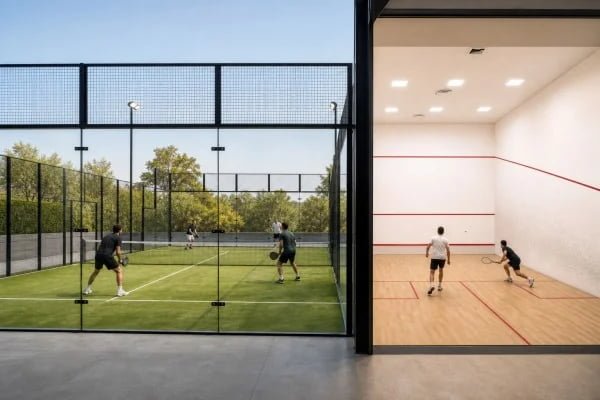
The commercial ROI of padel in the UAE is driven by high player density per square meter. A single tennis court space can accommodate three padel courts, effectively tripling potential hourly rental revenue for club operators, luxury hotels, and premium residential developers.
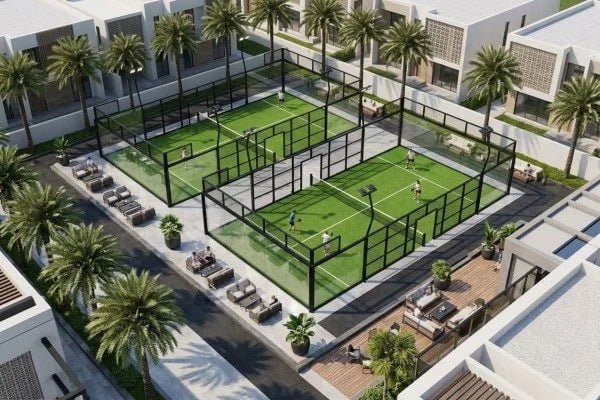
When reviewing project inquiries from UAE buyers, I frequently see developers integrating padel courts into luxury hotel rooftops, high-end residential complexes, and dedicated commercial sports hubs. Real estate in the UAE is expensive. Operators need to generate maximum yield per square meter, and padel achieves this flawlessly. A standard tennis court requires roughly 600 to 800 square meters of space and usually hosts just two players. In contrast, a standard padel court only requires 200 square meters (10x20m play area) and always hosts four players.
This spatial efficiency is a massive driver for commercial adoption. But the financial model goes beyond just the physical footprint. The sport has a very fast learning curve compared to tennis or golf. Beginners can enjoy a rally within their first hour of play. This high accessibility keeps booking rates consistently high, driving steady cash flow for club operators.
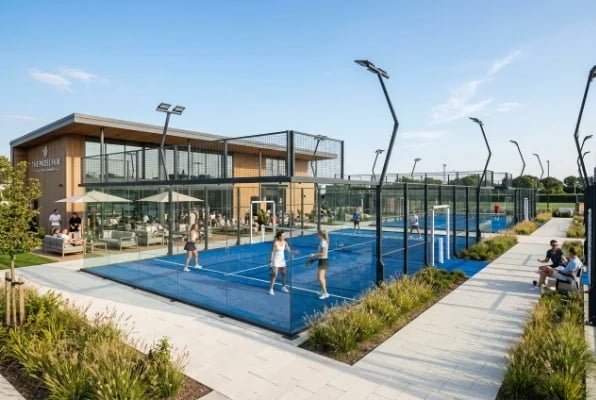
Furthermore, the social aspect of padel matches the premium, community-driven lifestyle expected in the UAE. Players view padel clubs not just as fitness centers, but as high-end social hubs. Club owners capitalize on this by wrapping the courts in premium amenities like specialty coffee shops, luxury locker rooms, and pro shops. Consequently, the core equipment—the court itself—must reflect this luxury expectation, which directly influences the specific types of courts procured for this region.
How does the UAE climate destroy standard padel courts?
Many buyers try to cut costs by importing standard European-spec courts. The harsh reality hits when the artificial grass melts or the steel framework rusts within six months of installation. The UAE’s extreme environment requires industrial-grade resilience.
The UAE climate destroys standard padel courts through intense UV radiation, 50°C+ summer heat, and high coastal humidity. Standard artificial turf degrades rapidly, while non-galvanized steel structures quickly rust, making specialized UV-resistant materials and heavy-duty hot-dip galvanized steel mandatory for survival.
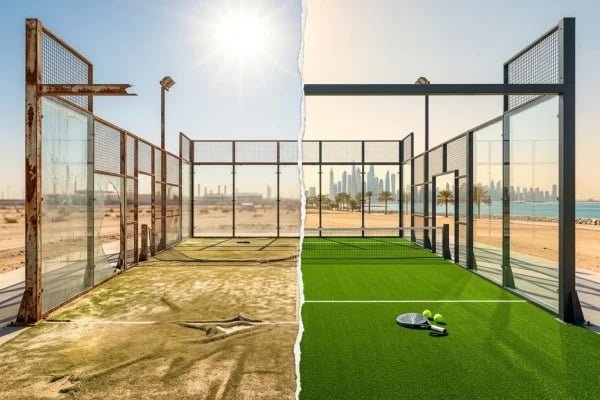
The environment in the Middle East is fundamentally different from indoor arenas in Europe. When evaluating quotes for UAE projects, I often see buyers overlook the hidden costs of climate degradation. You cannot simply drop a standard court into Dubai and expect it to last.
First, consider the artificial grass. Summer temperatures regularly exceed 50°C2, combined with punishing UV rays. Standard artificial turf will rapidly lose its color, become brittle, and eventually melt or flatten.3 For the UAE market, operators must source high-density artificial turf with maximum UV stabilization. Ensuring the turf holds CE and RoHS certifications guarantees that the materials are safe and tested for chemical stability under heat.
Second, the structural frame faces extreme coastal humidity, especially in areas like the Dubai Marina or Abu Dhabi corniche. Standard powder-coated steel will rust almost immediately in these salty, humid conditions.4 Padel courts in this region require heavily galvanized steel profiles.
Here is a quick comparison of how material specifications must adapt for the UAE market:
| Component | Standard European Spec | Required UAE Spec |
|---|---|---|
| Steel Frame | Standard powder coating | Hot-dip galvanized steel with marine-grade outdoor powder coating |
| Artificial Grass | Standard PE, basic UV | High Dtex, heavy UV-stabilized, CE/RoHS certified |
| Glass Fasteners | Standard bolts | PED 2014/68/EU quality system approved fasteners |
| LED Lighting | Standard indoor 200W | IP65+ rated, heat-dissipating aluminum housings, AS 61347 certified |
Ignoring these environmental factors turns a profitable asset into a constant maintenance liability. Professional evaluation of material specs is critical before issuing a purchase order.
Why are panoramic padel courts the standard in Dubai and Abu Dhabi?
Club operators want their facilities to look spectacular on social media to attract high-end clientele. But prioritizing aesthetics over engineering leads to dangerous structural compromises, especially in open, wind-swept areas. You must balance luxury with safety.
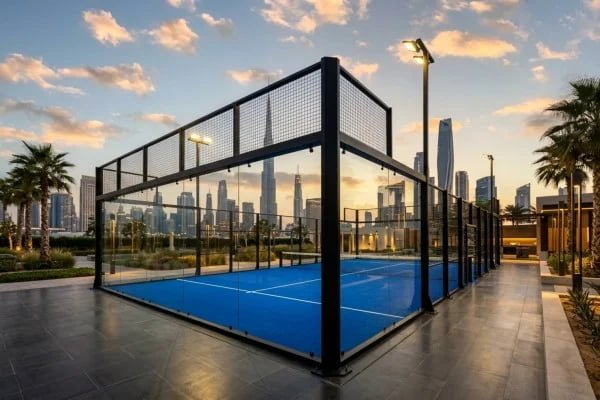
Panoramic padel courts are the standard in Dubai and Abu Dhabi because local players demand premium, unobstructed viewing experiences that align with luxury lifestyles. These pillarless glass designs offer superior aesthetics for broadcasting and social media, driving higher booking rates for club operators.5
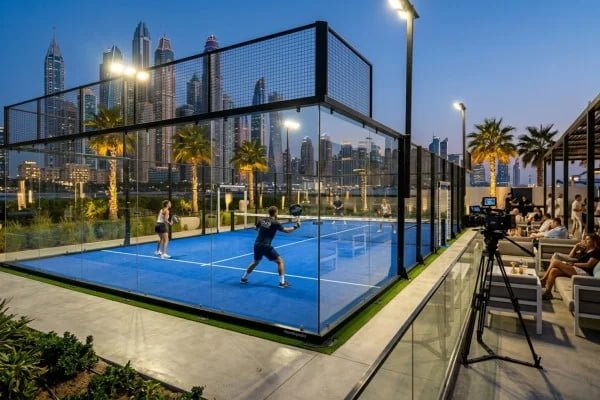
Based on the procurement data I handle daily, Panoramic and Ultra-Panoramic courts completely dominate the UAE market. In fact, for our factory, Panoramic courts make up 50% of our sales, and Ultra-Panoramic models account for another 40%. The classic court design, which features numerous steel pillars breaking up the glass walls, only accounts for about 5% of our overall production.
UAE club investors know that visual appeal drives bookings. Ultra-panoramic designs remove the rear structural pillars entirely, using thick, seamless structural glass to create a perfect viewing angle. However, this aesthetic requirement introduces significant engineering challenges.
Without rear steel pillars to absorb physical impact and wind loads, the tempered glass takes the brunt of the force. The UAE experiences strong coastal winds and occasional sandstorms.6 If you install an ultra-panoramic court outdoors without proper structural integrity, the glass can vibrate dangerously or shatter.
Therefore, the glass cannot just be standard architectural glass. Buyers must verify that the tempered glass is strictly certified to international safety standards, specifically AS/NZS 4666:2012 and AS/NZS 2208:1996. Additionally, the acrylic gaskets and stainless steel screws holding the glass must be precision-engineered to allow for thermal expansion during the day and contraction at night. A premium aesthetic is useless if the court poses a safety hazard to players.
How should UAE buyers evaluate padel court suppliers?
The padel gold rush has flooded the market with inexperienced suppliers offering impossibly cheap prices. Choosing the wrong manufacturer leaves you with missing parts on installation day and zero after-sales support. Procurement demands a rigorous evaluation process.
UAE buyers should evaluate padel court suppliers by demanding a complete Bill of Materials (BOM), verifying international safety certifications like CE and AS/NZS, and confirming exact material specifications. A reliable supplier provides transparent pricing, comprehensive installation drawings, and traceable quality control.
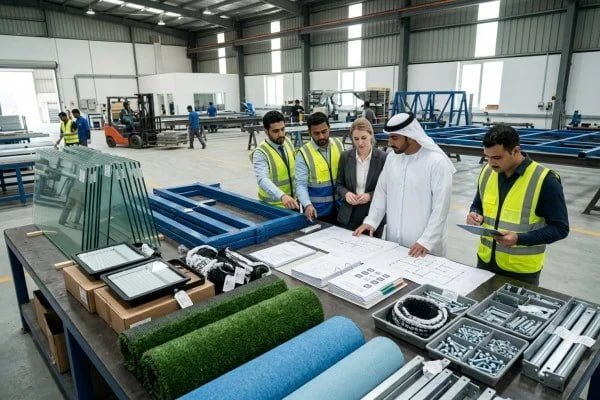
Because the market is hot, many engineering and civil contractors in the UAE fall into the trap of believing "a padel court is just a padel court." They choose the lowest bidder, only to realize on site that the supplier shipped an incomplete system.
When evaluating quotes, always ask for a detailed Bill of Materials (BOM). A complete BOM guarantees zero missing parts. If a supplier fails to include the correct number of structural bolts, expansion screws, or neoprene pads, the local civil contractor cannot finish the installation, causing expensive project delays.
Furthermore, do not just accept a generic CE logo pasted on a PDF. Treat certifications as official documents that must be verified. You need to check the ISO9001 certification of the factory itself, ensuring they have standardized quality management. Look for specific certifications for individual components:
- CE certification for the steel frame structure.
- AS 61347.2.13:2018 for the LED lighting fixtures.
- AD 2000 WO and PED 2014/68/EU approvals for screws and accessories.
Finally, evaluate the supplier’s technical support capabilities. Local sports contractors responsible for site preparation need clear foundation drawings, pre-embedding schematics, and strict tolerance requirements. A qualified supplier will provide comprehensive installation drawings and maintenance manuals alongside the physical product. Define after-sales responsibility early—ensure the supplier has a clear mechanism for replacing wear-and-tear items or glass damaged by severe weather.
Frequently Asked Questions
How much space is required for a padel court in the UAE?
A standard padel court requires a 10×20 meter playing area (200 square meters). However, you must also account for the structural footprint, concrete foundation borders, and adequate safe run-out zones for out-of-court play, bringing the total recommended area to roughly 230 square meters per court.
What type of artificial grass is best for the Middle East?
The best artificial grass for the Middle East features a high Dtex rating, high density, and heavy UV-stabilization. This specific combination prevents the turf fibers from melting, fading, or losing their structural bounce when exposed to the UAE’s intense 50°C summer heat and direct sunlight.
Can standard tempered glass withstand UAE summer heat?
Standard tempered glass can survive the heat only if it is structurally certified (such as AS/NZS 2208:1996) and properly installed. It requires specialized thermal-expansion-accommodating gaskets and precision fasteners to ensure the glass has room to expand safely during peak daytime temperatures without cracking.
How long does it take to import padel courts from China to the UAE?
For standard models, a factory like QHPADEL can produce two complete courts in 20 days, and up to four courts in 20-25 days. Once production is complete, ocean freight from Tianjin Port to major UAE ports like Jebel Ali typically takes an additional 25 to 35 days.
Conclusion
Understanding why is padel so popular in the UAE requires looking beyond the hype and focusing on the underlying commercial real estate ROI. While player demand drives the boom, long-term profitability depends entirely on your procurement strategy. By selecting climate-resilient materials like galvanized steel and UV-stabilized turf, and by demanding strict certifications for panoramic glass structures, you protect your investment from extreme weather and lower your maintenance costs.
If you are a club operator, civil contractor, or equipment distributor looking for reliable, fully-certified court systems, we can help. Contact Alice Chen at QHPADEL (alice@grass-supplier.com or WhatsApp +86 185 7566 0746) to request a detailed Bill of Materials and explore our premium panoramic court packages today.
-
"Motivational Determinants of Recreational Padel Participation", https://pmc.ncbi.nlm.nih.gov/articles/PMC12656352/. Market research or official sector data should document the growth of padel participation and facilities in the UAE; such evidence may indicate commercial opportunity but does not by itself establish ROI for every individual development. Evidence role: statistic; source type: research. Supports: Market data on padel participation, court openings, investment activity, and, where available, facility economics in the UAE.. Scope note: Market-level growth and investment data cannot prove that all padel facilities achieve high returns. ↩
-
"United Arab Emirates – Climatology (CRU)", https://climateknowledgeportal.worldbank.org/country/united-arab-emirates/climate-data-historical. Official meteorological records can establish the frequency, location, and measurement basis of UAE air temperatures at or above 50°C, distinguishing recorded ambient conditions from hotter exposed surface temperatures. Evidence role: statistic; source type: government. Supports: Official meteorological records for UAE summer maximum air temperatures and geographic variation.. Scope note: National or station records may not represent conditions at every court site, particularly shaded, coastal, or urban locations. ↩
-
"Effects of UV radiation on natural and synthetic materials – PMC – NIH", https://pmc.ncbi.nlm.nih.gov/articles/PMC10088630/. Polymer-weathering studies show that ultraviolet exposure and elevated temperatures can alter polyethylene-based synthetic-turf fibres, including colour retention and mechanical properties; the magnitude and rate of deterioration depend on formulation, stabilisers, use, and maintenance. Evidence role: mechanism; source type: paper. Supports: Experimental evidence on ultraviolet radiation, heat, and weathering effects on polyethylene artificial-turf fibres.. Scope note: Laboratory weathering results do not demonstrate that every unspecified ‘standard’ turf will melt or fail rapidly in UAE service. ↩
-
"Corrosion behaviour of cast iron exposed to Arabian Gulf …", https://www.academia.edu/24881122/Corrosion_behaviour_of_cast_iron_exposed_to_Arabian_Gulf_environment. Corrosion-control standards and atmospheric-corrosion research identify coastal salt and persistent humidity as conditions that increase corrosion risk for coated steel, with performance depending on coating design, surface preparation, damage, and maintenance. Evidence role: mechanism; source type: institution. Supports: How salt deposition, humidity, coating defects, and corrosivity categories affect coated-steel corrosion in marine atmospheres.. Scope note: Such sources support elevated risk rather than the assertion that all powder-coated steel will rust ‘almost immediately.’ ↩
-
"assessing the influence of sport facility design on customer …", https://www.academia.edu/9521981/ASSESSING_THE_INFLUENCE_OF_SPORT_FACILITY_DESIGN_ON_CUSTOMER_SATISFACTION_A_STUDY_ON_PARTICIPANTS_OF_A_FITNESS_FACILITY. Consumer-behaviour research may show that venue aesthetics and visibility affect perceived experience and engagement; direct booking records are required to demonstrate that panoramic padel courts produce higher booking rates. Evidence role: general_support; source type: paper. Supports: Research linking sports-facility visual design or spectator visibility to consumer preference, engagement, or booking behaviour.. Scope note: Evidence of aesthetic preference or social-media engagement does not alone prove a causal increase in bookings. ↩
-
"Sand and dust storms", https://wmo.int/themes/sand-and-dust-storms. Official UAE climatological information can document the occurrence and seasonal distribution of high winds, blowing dust, and sandstorms relevant to outdoor structures. Evidence role: historical_context; source type: government. Supports: Official climatological information on wind conditions, dust events, and sandstorms in the UAE.. Scope note: National climate summaries do not substitute for site-specific wind loading and exposure assessment. ↩