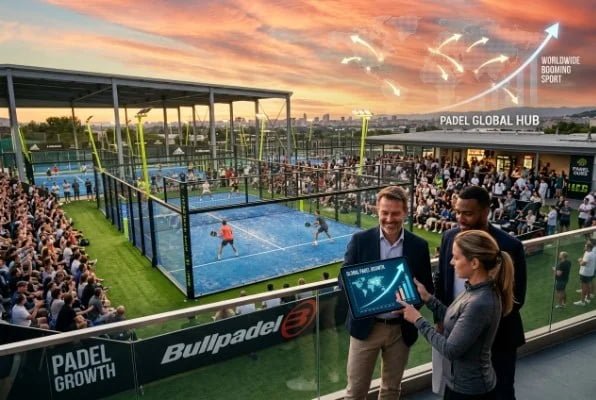
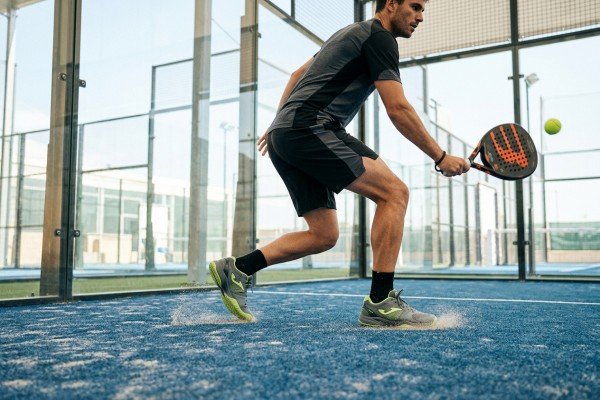
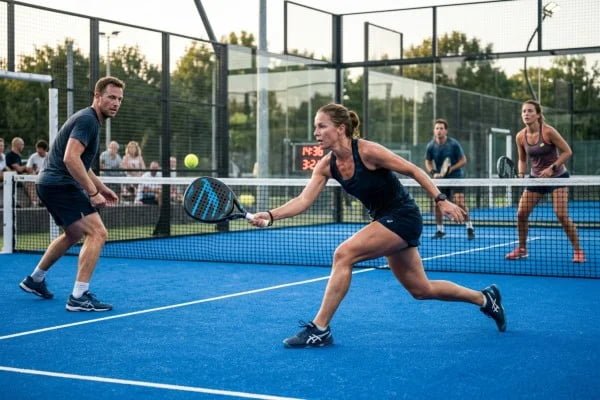
Padel in France has moved from a niche racket sport to a visible part of the country’s leisure and sports market. However, national growth can hide weak local demand, unsuitable sites, or excessive competition. I recommend that investors combine reliable participation data with a city-level feasibility study before ordering courts or signing a lease.
Yes, padel is popular in France and continues to grow. The French Tennis Federation reported around 850,000 practitioners, approximately 3,500 courts, and about 1,000 locations in its June 2025 national development-plan announcement. Still, these national figures do not prove that every French city can support a profitable padel facility.1
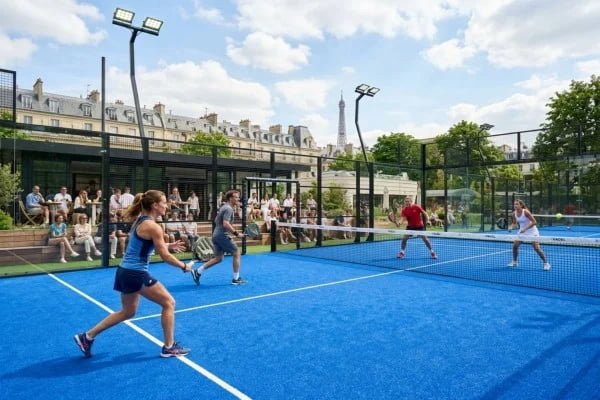
I see the strongest investment decisions when buyers look beyond headline growth. A realistic assessment should examine local player habits, competing facilities, booking prices, property costs, planning constraints, and complete project costs. Court popularity creates an opportunity, but project execution determines whether that opportunity becomes commercially sustainable.
How Popular Is Padel in France According to Available Data?
Padel can look popular on social media without creating reliable court bookings. That gap can cause investors to overestimate demand and commit to an expensive site too early. I therefore start with dated, clearly defined indicators rather than promotional forecasts or unsourced market-size claims.
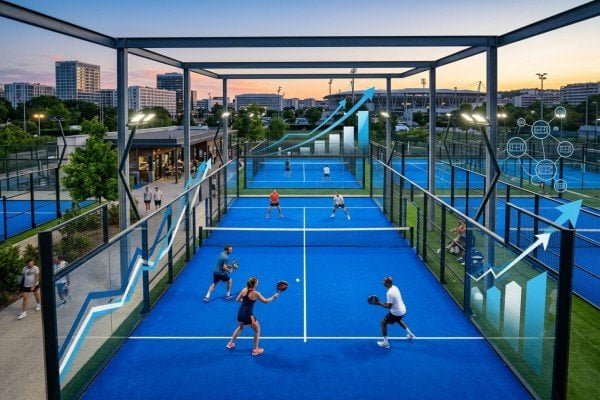
France shows meaningful padel participation through practitioner estimates, federation activity, court expansion, organized competition, and major events. The FFT’s June 2025 announcement cited approximately 850,000 practitioners and 3,500 courts. These figures indicate substantial national reach, although “practitioners” should not be interpreted as paying weekly players.1
What do the headline figures actually mean?
I encourage buyers to separate four measurements that are often presented as though they were interchangeable:
- Practitioners may include occasional and regular players.
- Padel-specific licence holders represent a more formal relationship with the sport, but they still do not measure booking frequency.
- Ranked or competitive players represent a narrower group participating in recognized competitions.
- Court and venue counts measure supply, not utilization or profitability.
The French Tennis Federation, commonly known as the FFT, announced its national Plan Padel in June 2025. The announcement described a market with around 850,000 practitioners, approximately 3,500 courts, and about 1,000 clubs or facilities.1 The FFT also announced a plan involving €40 million and 500 additional courts, which demonstrates institutional support for further development.
Those figures give me confidence that padel in France has progressed beyond a temporary novelty. However, I would not use them alone in an investment model. A practitioner who plays twice per year has a very different commercial value from a player who books twice per week.
Which indicators deserve the most attention?
I use a simple evidence hierarchy when reviewing a location:
| Indicator | What it can show | What it cannot prove |
|---|---|---|
| Federation practitioner estimate | National awareness and participation scale | Local booking demand |
| Padel-specific licences | Formal engagement with the sport | Frequency of commercial court use |
| Court count | Existing supply and market development | Court occupancy or operator profit |
| Tournament entries | Competitive participation | Mainstream leisure demand |
| Search and social-media interest | Awareness and curiosity | Repeat bookings |
| Local booking data | Actual paid demand | Future demand without further analysis |
| Competitor occupancy | Local utilization patterns | Performance at a different site |
Major events add another useful signal. Paris has hosted a Premier Padel Major at Roland-Garros since 2022. The 2024 edition attracted around 64,000 spectators across the tournament week, according to figures published by organizers and the FFT.2 I view that attendance as evidence of audience interest and high-profile visibility.
However, event attendance does not automatically translate into commercial club utilization. Spectators may already play elsewhere, visit only for the event, or live outside the proposed club’s catchment area. I treat event data as supporting evidence rather than a revenue forecast.
I regard national participation, federation investment, and major events as proof of a developed market. I still require local booking evidence before I regard a specific project as feasible.
Why Is Padel in France Continuing to Grow?
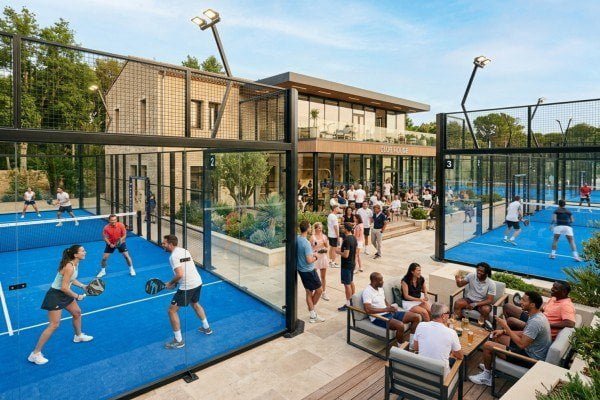
A growing sport can still lose momentum if it becomes difficult to access or too expensive to play. Padel has avoided some of those barriers because it is social, relatively easy for beginners to start, and suitable for compact multi-court venues.1 These features support broader participation.
I believe padel is growing in France because it combines accessible gameplay, a strong social element, organized federation support, and increasing court availability. Tennis clubs, private operators, hotels, leisure centers, municipalities, and property developers can also add courts to different types of sports and hospitality projects.
The sport has a low initial participation barrier
Padel uses an enclosed court and is usually played in doubles. Beginners can often maintain a rally sooner than they can in some other racket sports.2 The smaller playing area also makes social interaction a visible part of the experience.
This accessibility does not mean that every new venue will attract beginners automatically. Operators still need introductory sessions, suitable rackets, coaching, community events, and a simple booking process. I have seen buyers focus heavily on court appearance while giving too little attention to player acquisition.
A successful beginner pathway may include:
- Low-cost trial sessions
- Equipment rental
- Beginner group coaching
- Level-based social games
- Corporate or hotel packages
- Junior and school programs
- Internal leagues that encourage repeat bookings
Different property types can accommodate padel
The French market includes both private and federation-affiliated facilities. Investors may consider indoor warehouses, outdoor sports sites, tennis clubs, hotels, resorts, retail-adjacent leisure developments, or municipal facilities.
Each property type creates different opportunities and constraints:
| Site type | Potential advantage | Common feasibility issue |
|---|---|---|
| Converted warehouse | Weather protection and longer operating hours | Clear height, fire rules, acoustics, and change-of-use approval |
| Existing tennis club | Established racket-sports audience | Member acceptance, land allocation, and access policy |
| Outdoor commercial site | Lower building-envelope cost | Weather exposure, lighting, noise, and drainage |
| Hotel or resort | Added guest experience | Seasonal utilization and limited local membership |
| Municipal facility | Community access and institutional support | Tendering, budgets, documentation, and public approvals |
| Urban leisure complex | Dense catchment area | Rent, parking, neighbor impact, and restricted hours |
Indoor development can be particularly attractive where rain, wind, or winter conditions reduce outdoor usability.3 However, indoor projects usually involve more than court equipment.4 A buyer may need to account for building rent or purchase, floor preparation, fire safety, emergency access, acoustic treatment, ventilation, lighting, and local authorization.
Federation support reduces uncertainty but not risk
The FFT’s involvement gives padel an organized competition structure and greater institutional credibility. The federation’s national plan also signals that court development remains a policy priority.
I still caution private investors against treating announced court construction as purely positive. More courts improve access and awareness, but they also increase competition.5 A new public or club-based project near a proposed commercial venue can change the local supply picture before the venue opens.
Where Is Padel in France Most Commercially Promising?
National maps can make demand appear evenly distributed, but French cities differ substantially. Population alone does not guarantee court use. A project needs reachable customers, appropriate pricing, suitable opening hours, and enough unmet demand within a realistic travel area.
Padel is most commercially promising where population density, purchasing power, convenient access, limited court availability, and proven racket-sport participation overlap.6 Southern regions and large urban areas have established visibility, but less-supplied secondary cities may also offer opportunities if local research confirms sufficient repeat demand.
I recommend defining a realistic catchment area
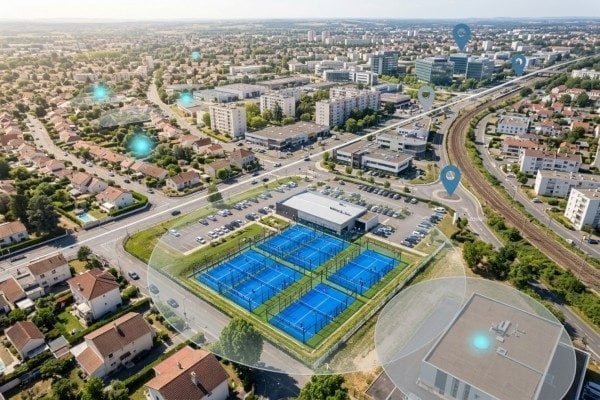
A national participation rate has little value if customers cannot reach the site conveniently. I would begin with drive-time zones rather than administrative boundaries.7 A practical study might compare 10-, 20-, and 30-minute travel areas, although the correct limit depends on density, traffic, public transport, and competing facilities.
The local review should record:
- Population and age profile within each travel zone
- Household income and leisure spending indicators
- Nearby tennis, squash, badminton, and fitness participation
- Existing padel venues and planned developments
- Number of indoor and outdoor courts
- Peak and off-peak prices
- Booking availability by day and time
- Parking and public-transport access
- Corporate, university, school, and tourism demand
- Seasonal weather conditions
- Local noise sensitivity and neighboring land use
I recommend checking competitors’ public booking calendars for several weeks. One fully booked Saturday evening does not prove a supply shortage. A stronger pattern includes repeated peak-time scarcity, acceptable weekday occupancy, waiting lists, or player complaints about limited access.
I would interview local users before finalizing a project
Short interviews can reveal details that market reports miss. Prospective operators can speak with local coaches, tennis clubs, sports associations, hotels, employers, universities, and players.
Useful questions include:
- How often do local players currently play?
- How far do they travel?
- Which hours do they prefer?
- What price do they consider acceptable?
- Do they prefer indoor or outdoor courts?
- Do they struggle to find peak-time bookings?
- Would they join a membership program?
- Do local companies organize team activities?
- Are coaches available to support beginner development?
A waiting list or pre-opening registration campaign provides stronger evidence than a social-media poll.8 Deposits, trial memberships, or corporate letters of interest can provide even better evidence, provided that local consumer and contractual rules are respected.
I compare supply with realistic capacity
A court does not produce revenue every hour that a venue is open.9 Maintenance, cleaning, coaching blocks, tournaments, cancellations, and off-peak periods all reduce sellable or paid hours.
For example, an operator might model:
- 4 courts
- 14 opening hours per day
- 360 operating days
- 20,160 theoretical court-hours per year
If the operator assumes 60% average paid utilization, the model produces 12,096 paid court-hours. That assumption needs local support. A venue may reach high occupancy on weekday evenings while remaining quiet on weekday mornings.
I test several scenarios instead of relying on one optimistic forecast:
| Scenario | Average utilization | Average realized court price | Purpose |
|---|---|---|---|
| Conservative | 30% | €24 per hour | Tests downside resilience |
| Base case | 45% | €30 per hour | Represents supported local assumptions |
| Strong demand | 60% | €34 per hour | Tests upside without treating it as guaranteed |
These figures are only illustrative. Actual French prices, taxes, membership structures, and occupancy differ by city and venue. A qualified local accountant should review the financial model.
Does Popularity Make a Padel Project in France Profitable?
Investors sometimes move directly from “the sport is growing” to “the club will make money.” That shortcut ignores rent, financing, construction, staffing, energy, taxes, maintenance, and customer acquisition. A popular sport can still produce an unprofitable venue.
No, popularity alone does not make a padel project profitable. Commercial performance depends on utilization, realized booking prices, site costs, court count, operating hours, ancillary revenue, financing, and competition. Investors should build conservative cash-flow scenarios and test whether the project survives slower growth or delayed opening.
I separate equipment cost from total project cost
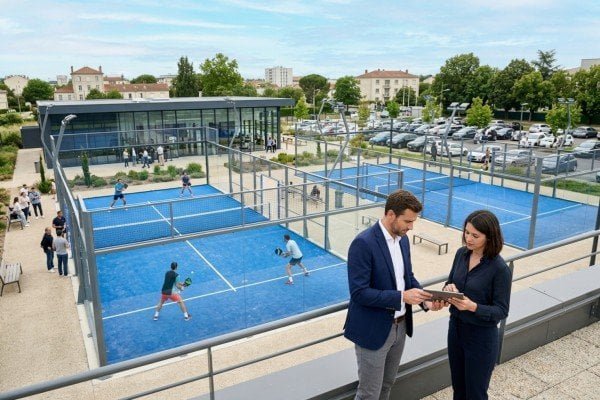
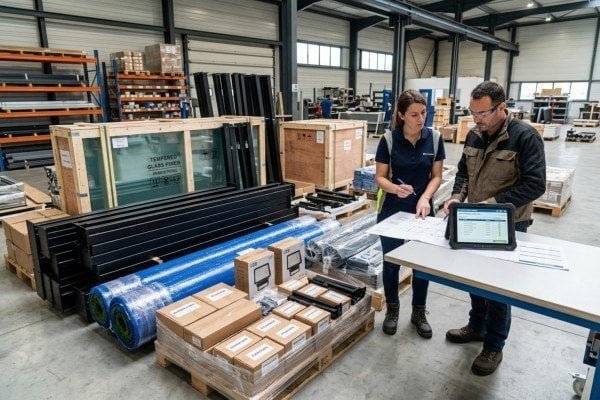
A complete court package can include the steel structure, welded mesh, structural posts, tempered glass, artificial turf, lighting fixtures, net, fasteners, and selected accessories. However, the equipment quotation does not represent the complete opening budget.
A French project may also require expenditure for:
- Land or building acquisition
- Rent deposits and professional fees
- Ground investigation
- Structural and civil engineering
- Foundations or concrete slabs
- Drainage and waterproofing
- Electrical supply and distribution
- Installation labor and lifting equipment
- Freight, insurance, customs, and inland transport
- Planning, building, fire, accessibility, and environmental procedures
- Reception, changing rooms, showers, and furniture
- Heating, ventilation, or acoustic treatment
- Booking software and payment systems
- Initial marketing and working capital
- Spare glass, lighting parts, turf materials, and fasteners
I often receive French inquiries that begin with a request for “the price of one court.” Once the discussion becomes serious, the questions shift toward foundation drawings, container loading, installation responsibility, glass documentation, lighting, and delivery scope. That pattern does not prove French demand or sales. It simply shows that procurement feasibility becomes more complex than the initial equipment price.
Court count can change the business model
A single court can suit a hotel, private property, school, or supplementary sports facility. A dedicated commercial club usually needs enough courts to handle leagues, coaching, social play, events, and peak-time demand.10
A multi-court venue can spread staffing and reception costs across more bookings. However, more courts also increase the initial capital requirement and the risk of underutilization.
I would evaluate at least three options:
- Minimum viable development: Lower capital cost but limited event capacity.
- Phased development: Initial courts plus space and infrastructure for expansion.
- Full development: More revenue capacity but higher demand and financing risk.
A phased plan can reduce risk, but the site layout must preserve future expansion. Foundations, circulation routes, electrical capacity, drainage, and emergency access should support the planned later phase.
Ancillary revenue requires separate evidence
Food and beverage sales, coaching, equipment rental, retail, sponsorship, memberships, and corporate events can improve revenue. However, I never use uncertain secondary income to rescue a weak court-booking model.
The base case should remain credible without aggressive assumptions. An experienced French accountant or feasibility consultant should review tax, payroll, depreciation, and financing assumptions before the buyer commits capital.
How Should Buyers Procure Courts for Padel in France?
Strong local demand can still be damaged by incomplete equipment, unsuitable foundations, shipment delays, or documentation gaps. Buyers need a procurement process that connects the selected court design with the site, installation method, local requirements, and long-term operating plan.
Buyers should procure padel courts through a documented specification, complete bill of materials, verified supplier capability, coordinated foundation design, and clear installation responsibilities. They should also verify certificates, test reports, warranties, packaging plans, and French approval requirements with qualified local engineers and authorities before manufacturing begins.
I define the package before comparing prices
Two quotations can appear similar while covering different scopes. One supplier may include turf, lights, shipping frames, fasteners, and installation documents. Another quotation may exclude several of those items.
I recommend requesting a line-by-line bill of materials covering:
- Steel frames and structural posts
- Welded mesh panels
- Tempered-glass panels and glass hardware
- Artificial turf specifications
- Infill recommendations
- Court net and posts
- LED fixtures, drivers, poles, and cables within the package
- Bolts, anchors, screws, and assembly accessories
- Component labels and installation sequence
- Spare-parts allowance
- Packing method and container plan
- Foundation and installation drawings
- Maintenance documentation
- Warranty scope and exclusions
At QHPADEL, our complete packages can include these core court components. We also provide installation drawings, foundation drawings, packing lists, and maintenance manuals. Buyers still need local professionals to review the documents for the actual site.
I match the court configuration to the use case
A panoramic court often suits commercial clubs that value spectator visibility and a modern appearance. An ultra-panoramic design reduces visual obstruction further. Classic configurations may fit projects that prioritize a conventional structural arrangement or different budget targets.
The buyer should not choose on appearance alone. The decision should consider:
- Indoor or outdoor placement
- Wind and weather exposure
- Spectator layout
- Tournament ambitions
- Maintenance access
- Lighting requirements
- Local engineering review
- Replacement-part availability
- Budget and target customer positioning
Outdoor and wind-exposed projects deserve particular care. A product name such as “hurricane resistant” does not replace site-specific structural calculations. A qualified local structural engineer should assess wind actions, terrain category, foundations, connections, and applicable standards.
Certifications are documents to verify
QHPADEL’s factory holds ISO 9001 certification, while various components have supporting documents that include CE-related documentation and other test certificates. Our listed documents include CE and RoHS records for artificial turf, CE documentation for steel structures, and CE and AS/NZS-related records for tempered glass and lighting.
I advise buyers to verify:
- The certificate issuer
- The named manufacturer and product
- The applicable standard or directive
- The report or certificate number
- The issue and expiry dates
- The scope and tested configuration
- Whether local authorities accept the evidence
- Whether additional French or project-specific evaluation is required
A certificate logo on a brochure is not enough. The buyer should request the underlying report and confirm that it applies to the ordered configuration.
Production and delivery need realistic coordination
Our standard production guidance is approximately 20 days for two courts, 20–25 days for four courts, and no more than 30 days for larger standard orders. Custom designs may require up to 35 days. These periods describe production rather than the complete project schedule.
The total schedule should also include:
- Technical confirmation
- Drawing approval
- Deposit and material planning
- Quality inspection
- Container booking
- Export transport
- Sea freight
- Customs clearance
- Inland delivery
- Site readiness
- Installation and commissioning
I recommend completing foundations only after the local engineer and court supplier have coordinated dimensions, levels, drainage, anchor details, and tolerances. A small mismatch in hole positions or slab levels can create costly delays during installation.
Frequently Asked Questions
Is padel more popular in southern France?
Southern France has strong racket-sport traditions, favorable outdoor conditions, and established padel activity. However, I would not assume that every southern city offers better investment potential. Existing competition may also be stronger. Buyers should compare local court supply, booking availability, property costs, and year-round utilization.
How many padel courts are there in France?
The FFT’s June 2025 Plan Padel announcement referred to approximately 3,500 courts and about 1,000 clubs or facilities. Buyers should treat that figure as a dated national snapshot. Court totals change quickly, and databases may count private, public, indoor, outdoor, or temporarily unavailable courts differently.
Are indoor padel courts better for the French market?
Indoor courts can support more consistent operations during rain, winter, or windy weather. However, indoor facilities can involve higher property, ventilation, fire-safety, acoustic, and energy costs. I recommend comparing expected additional bookings with the full cost of the building rather than evaluating the court structure alone.
How many courts should a new French padel club install?
The correct number depends on demand, site size, financing, and the operating model. A small multi-sport facility may add one or two courts, while a dedicated club may need several. I recommend testing multiple court-count scenarios and preserving space for expansion where possible.
What documents should a French buyer request from a court supplier?
A buyer should request a complete bill of materials, technical drawings, foundation guidance, installation instructions, packing lists, warranties, material specifications, and relevant certificates or test reports. Local engineers, approval bodies, and legal advisers should verify whether those documents satisfy the project’s French requirements.
Conclusion
Padel in France is clearly established and supported by participation, court growth, federation investment, and major events. However, I do not treat national popularity as proof that a particular club will achieve profitable utilization. Buyers should validate city-level demand, model conservative occupancy, calculate the complete project cost, and coordinate procurement with qualified local professionals. If you are evaluating a French padel project, contact Alice Chen at QHPADEL via alice@grass-supplier.com or WhatsApp +86 185 7566 0746 to discuss court configurations, package scope, drawings, production, and export delivery.
-
"Motivational Determinants of Recreational Padel Participation", https://pmc.ncbi.nlm.nih.gov/articles/PMC12656352/. Studies of padel participation describe the sport as predominantly doubles-based and identify social interaction and perceived accessibility as common motives for participation. Evidence role: general_support; source type: paper. Supports: Research describing padel’s doubles format, court characteristics, and reported accessibility or social motivations among participants.. Scope note: Motivational findings may come from particular participant samples and do not by themselves establish that these factors caused national market growth. ↩ ↩ ↩ ↩
-
"Performance Analysis in Padel: A Systematic Review – PMC", https://pmc.ncbi.nlm.nih.gov/articles/PMC10694705/. Technical descriptions of padel note court walls, underhand serving, and doubles play as features that can facilitate early rally exchanges for novice participants. Evidence role: general_support; source type: paper. Supports: Comparative research or coaching literature on early skill acquisition and rally continuity in padel and tennis.. Scope note: Such descriptions provide contextual support and may not constitute controlled evidence that every beginner learns padel faster than other racket sports. ↩ ↩
-
"Climate of France", https://en.wikipedia.org/wiki/Climate_of_France. Research on outdoor physical activity finds that precipitation and adverse weather can reduce participation, providing a rationale for considering weather protection in facility planning. Evidence role: mechanism; source type: research. Supports: Evidence that adverse weather affects participation in outdoor physical activity or outdoor court-sport use, together with relevant French climate data.. Scope note: General outdoor-activity evidence does not quantify the booking premium or profitability of an indoor padel venue at a specific French site. ↩
-
"A review on indoor environmental quality in sports facilities", https://pmc.ncbi.nlm.nih.gov/articles/PMC9790860/. French official guidance explains that works and changes of use may require planning authorization and that establishments open to the public are subject to accessibility and fire-safety rules. Evidence role: general_support; source type: government. Supports: Official French guidance on planning permissions, change of use, accessibility, and fire-safety obligations for buildings open to the public.. Scope note: The applicable procedure depends on the building, municipality, works proposed, and facility classification. ↩
-
"Contradiction between Supply and Demand of Public Sports …", https://pmc.ncbi.nlm.nih.gov/articles/PMC9467751/. Facility-market research indicates that new providers can increase consumer access while also redistributing demand and competitive pressure among existing local operators. Evidence role: mechanism; source type: paper. Supports: Economic evidence that new recreational facilities can expand access while redistributing demand among nearby providers.. Scope note: The magnitude and direction of the effect depend on local unmet demand, differentiation, prices, and travel patterns. ↩
-
"A research on spatial configuration characteristics and social …", https://pmc.ncbi.nlm.nih.gov/articles/PMC12068736/. Studies of recreational-sport participation and facility access commonly identify population characteristics, socioeconomic conditions, travel accessibility, and nearby supply as relevant determinants of demand. Evidence role: general_support; source type: paper. Supports: Research linking sports-facility participation or demand to population characteristics, income, accessibility, and competing supply.. Scope note: These determinants are not a validated profitability formula for an individual padel project. ↩
-
"Mapping and quantifying travel time to define health facility …", https://pmc.ncbi.nlm.nih.gov/articles/PMC12159157/. Spatial-access studies commonly use travel time or travel distance to define service catchments because administrative boundaries do not necessarily reflect users’ actual ability to reach a facility. Evidence role: mechanism; source type: research. Supports: Spatial-access research showing that travel time is a meaningful measure of access to services and recreational facilities.. Scope note: The appropriate travel-time threshold varies by transport options, congestion, urban density, and the type of activity. ↩
-
"Using social media data in demand forecasting: the case of …", https://commons.stmarytx.edu/theses/6/. Consumer-research literature distinguishes stated preferences from behavioral measures, with registrations and financial commitments generally providing more direct evidence of purchase intention than uncommitted survey responses. Evidence role: mechanism; source type: paper. Supports: Research distinguishing stated preferences in surveys from behavioral indicators involving registration, commitment, or payment.. Scope note: Registrations or waiting lists can still overstate eventual paid use when they are free, refundable, or generated by promotions. ↩
-
"Hourly electricity consumption varies throughout the day …", https://www.eia.gov/todayinenergy/detail.php?id=42915. Capacity-management research distinguishes nominal opening capacity from realized sales because downtime, operational scheduling, cancellations, and time-varying demand limit revenue-producing use. Evidence role: mechanism; source type: paper. Supports: Operations research showing that usable capacity and paid demand vary over time and are reduced by downtime, scheduling constraints, and demand peaks.. Scope note: This principle does not establish an expected occupancy rate for any particular padel club. ↩
-
"Business Plan", https://www.brownsvilletx.gov/DocumentCenter/View/2751/Brownsville_SportsPark_BusinessPlan. Sports-facility planning literature notes that multiple activity spaces enable concurrent programming and can improve the capacity to accommodate peak demand, coaching, and events. Evidence role: general_support; source type: research. Supports: Facility-planning evidence that multiple activity spaces increase the ability to schedule concurrent programming, events, and peak-period demand.. Scope note: The required number of courts depends on the local demand profile, operating model, site constraints, and financial structure. ↩