A padel workout can make exercise more enjoyable, but playing occasionally may not produce the weight change that you expect. One exhausting match can create false confidence, while an unsustainable routine quickly loses its value. The practical solution is to judge padel by your weekly activity, eating habits, recovery, and long-term consistency.
Yes, padel can be a good workout to support weight loss because it combines repeated movement, short bursts of effort, and social play. However, weight loss requires a consistent calorie deficit over time. Results depend on playing frequency, active time, intensity, diet, sleep, and whether you can maintain the routine.

I manufacture padel courts rather than provide medical or exercise-science advice. However, my conversations with club operators, beginners, and coaches have shown me one important pattern: repeat participation matters more than one impressive session. The following framework can help you decide whether padel realistically fits your weight-loss plan.
Can a Padel Workout Help You Lose Weight?
Many beginners ask whether a padel workout burns enough energy to make a visible difference. The question sounds simple, but generic calorie estimates can be misleading. If a player ignores food intake, rest periods, and weekly frequency, even demanding matches may fail to produce the desired result.
A padel workout can contribute to weight loss by increasing total physical activity and weekly energy expenditure.1 It does not guarantee fat loss by itself. A player still needs a sustainable calorie deficit, adequate recovery, and enough regular activity to support progress without causing excessive fatigue or injury.

Weight Loss Depends on the Overall Energy Balance
The body loses stored mass over time when energy expenditure consistently exceeds energy intake.2 The Centers for Disease Control and Prevention explains that gradual weight loss generally involves both regular physical activity and changes to eating habits.
Padel can support the expenditure side of that equation. A typical game may involve:
- Repeated short runs
- Side-to-side movement
- Forward and backward movement
- Changes of direction
- Squatting or lowering the body for low shots
- Rotational movements during strokes
- Periods of recovery between points
- Longer pauses between games or sets
However, a padel session does not consist of continuous movement. Players stop between rallies, retrieve balls, change ends, and wait while others serve. Doubles players also cover less space individually than singles players in many racket sports. Therefore, total booking time and active playing time are not the same measurement3.
Why I Avoid Promising a Fixed Calorie Number
Online calorie calculators often provide a single number for an hour of padel. I would not use that number as a weight-loss promise. Energy use changes according to body size, age, playing level, rally duration, court conditions, and individual effort. Consumer watches also estimate rather than directly measure calorie expenditure.4
Two players can spend 90 minutes on the same court and complete very different workouts. One beginner may walk between short rallies and rest frequently. Another player may sustain long points, attack the net, recover quickly, and play with little inactive time.
A more reliable question is:
Can I play often enough, actively enough, and for long enough to increase my weekly movement without compensating by eating more?
Fat Loss Is Not the Same as Water Loss
A hard match can reduce body weight temporarily because a player loses fluid through sweat.5 That lower post-match scale reading does not prove an equivalent reduction in body fat. Rehydration may restore much of the lost weight.
Players should replace fluids appropriately and assess trends over several weeks. Anyone with a medical condition, a history of disordered eating, or concerns about exercise intensity should consult a qualified healthcare or exercise professional before starting a new program.
What Determines the Intensity of a Padel Workout?
Some players finish a match breathing heavily, while others can hold a relaxed conversation throughout. This difference can make generic descriptions of padel intensity unreliable. Without considering match format and actual movement, a player may overestimate or underestimate how much exercise the session provides.
The intensity of a padel workout depends on rally length, playing standard, movement speed, rest time, match competitiveness, and total active minutes. Longer rallies and faster recovery generally raise the physical demand, while frequent stoppages, uneven teams, and short points can reduce it.

Playing Level Changes the Workload
Beginners sometimes assume that advanced players always work harder. That assumption is not universally true.
An experienced player may move efficiently and anticipate the ball early. A beginner may make extra steps, arrive late, and use more effort for each shot. However, beginner rallies often end quickly, which creates more recovery time. Advanced rallies may involve more controlled placement, repeated transitions, and sustained exchanges.
In my conversations with recreational players and club operators, I often hear that participation becomes more consistent when players find partners at a similar level. This observation is not clinical evidence, but it makes practical sense. Balanced matches can produce longer rallies, better enjoyment, and fewer periods in which one team feels excluded.
Use the Talk Test to Judge Effort
A simple way to estimate intensity is the “talk test.” The CDC’s guidance on measuring physical activity intensity explains that a person performing moderate activity can usually talk but not sing. During vigorous activity, a person generally cannot say more than a few words without pausing for breath.
You can apply that method during a padel workout:
| Effort level | Practical sign | Typical session pattern |
|---|---|---|
| Light | You can talk and sing comfortably | Short rallies, long pauses, gentle movement |
| Moderate | You can talk but not sing easily | Regular movement with manageable recovery |
| Vigorous | You can only say a few words | Fast rallies, repeated sprints, limited recovery |
These categories are guides rather than diagnoses. Heat, humidity, medication, illness, and fitness level can all change breathing and perceived effort.
Match Format Also Matters
The following factors can alter how demanding the session feels:
- Total court time: A longer booking can create more exercise, but only if much of it remains active.
- Number of players: Standard doubles padel divides the court between four people.
- Skill balance: Uneven games can produce short points and less movement.
- Training format: Structured drills may reduce waiting time compared with casual matches.
- Ball supply: Multiple balls can keep a coaching drill moving instead of stopping after every error.
- Environmental conditions: Outdoor heat can increase strain without necessarily improving the training benefit.
- Court maintenance: Poor turf condition, uneven infill, or contaminated surfaces may affect footing and safe movement.
Sweating heavily does not automatically mean that a player has completed a superior fat-loss workout. Sweat primarily helps regulate body temperature.6 A player can sweat because of heat and humidity even when the movement intensity is relatively modest.
How Often Should You Do a Padel Workout for Weight Loss?
A common failure pattern starts with one very hard match followed by several inactive days. The session may feel productive, but the weekly activity total remains low. A better plan balances enough frequency to support progress with enough recovery to keep the routine comfortable and repeatable.
Players should schedule a padel workout according to their current fitness, recovery, and broader activity plan. Rather than chasing a perfect number of matches, beginners can build toward recognized weekly exercise guidelines and spread activity across several days. Gradual progression usually makes the routine easier to maintain.

Start With Established Activity Guidelines
The World Health Organization’s physical activity guidelines recommend that adults complete at least 150–300 minutes of moderate-intensity aerobic activity per week, or 75–150 minutes of vigorous-intensity activity, or an equivalent combination. The WHO also recommends muscle-strengthening activities involving major muscle groups on two or more days per week.
These figures describe total weekly activity. They do not mean that every minute booked on a padel court qualifies as moderate or vigorous exercise. Players need to consider active time and effort.
For example, a recreational routine might combine:
- One or two padel sessions
- Regular walking
- Two appropriately designed strength sessions
- Mobility or balance work
- At least one easier recovery day
This example is not a personalized prescription. A qualified coach, physiotherapist, or other relevant professional should evaluate application-specific needs, particularly when a player has pain, limited mobility, cardiovascular concerns, or a long period of inactivity.
Increase Frequency Gradually
A beginner does not need to jump immediately from no exercise to several competitive matches each week. Sudden increases in court time can produce excessive soreness and may discourage another booking.7
A more conservative approach includes:
- Establish a baseline. Record current weekly activity before adding padel.
- Begin with manageable sessions. Stop before fatigue causes movement quality to deteriorate badly.
- Review recovery. Notice persistent soreness, sleep disruption, unusual fatigue, or joint discomfort.
- Add time or frequency progressively. Avoid increasing every variable at once.
- Keep alternative activities available. Walking or strength training can maintain activity when court access is limited.
I have heard club operators say that social bookings often improve repeat attendance. Friends expect one another to arrive, and scheduled matches reduce the need to make a fresh exercise decision each day. I treat this as an industry observation, not proof that padel works better than individual exercise.
Consistency Is the Main Test
The ideal exercise routine is not simply the activity with the highest estimated calorie use per hour. It is an activity that a person can perform safely and consistently.8
A padel workout may suit someone who:
- Enjoys games more than repetitive cardio
- Likes exercising with other people
- Has convenient access to a court
- Can find players with compatible schedules and ability
- Enjoys learning technical skills
- Recovers well between matches
It may be less practical for someone who faces high booking costs, long travel times, unreliable partners, or recurring discomfort during rapid changes of direction. In that case, another form of exercise may be easier to sustain.
How Can You Tell Whether a Padel Workout Is Working?
A sweaty shirt and a tired body can feel like proof of progress. However, those signs cannot show whether the overall plan is producing long-term fat loss. Without consistent tracking, normal daily weight fluctuations may cause unnecessary excitement or frustration.
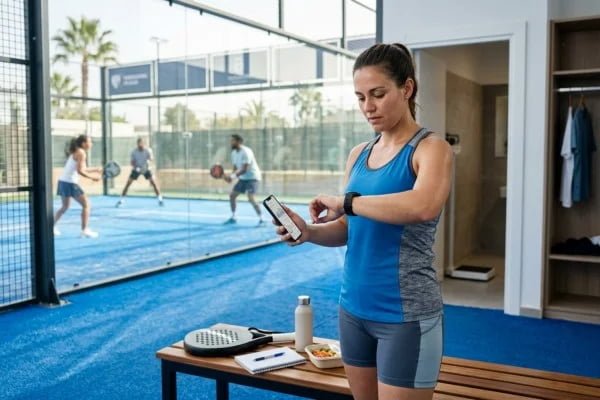
You can evaluate a padel workout by tracking weekly playing frequency, active minutes, perceived effort, food intake, recovery, and longer-term body-weight trends. Use comparable measurements over several weeks instead of judging a single session or a single scale reading.
Track Inputs Before Judging Results
I suggest using a simple log instead of relying on an estimated calorie total. The log can include the variables that you can observe directly.
| Metric | What to record | Why it matters |
|---|---|---|
| Frequency | Sessions per week | Shows whether participation is consistent |
| Duration | Start and finish time | Measures total session exposure |
| Active time | Approximate minutes spent playing | Separates movement from waiting |
| Effort | Easy, moderate, or hard | Adds context to session length |
| Recovery | Soreness, sleep, and fatigue | Helps identify an unsustainable workload |
| Food habits | Meals, snacks, and drinks | Reveals possible energy compensation |
| Weight trend | Comparable measurements over time | Reduces emphasis on daily fluctuations |
| Enjoyment | Simple score from 1 to 10 | Helps predict whether you will continue |
Wearable devices can add information about heart rate and movement, but players should treat consumer calorie estimates cautiously. Device fit, algorithms, activity type, and individual physiology can affect the result.
Use Comparable Weight Measurements
Body weight can change from day to day because of hydration, food volume, sodium intake, glycogen storage, and other factors.9 A single reading after a match tells you very little.
A more useful process includes:
- Measuring under similar conditions
- Using the same scale
- Avoiding conclusions from one unusually high or low reading
- Looking at multi-week trends
- Considering waist measurements or clothing fit where appropriate
- Reviewing both exercise and food patterns
Weight is also not the only useful outcome. A regular padel workout may improve playing confidence, movement tolerance, social engagement, or general fitness even when scale change is slow. Those benefits do not cancel the need for a calorie deficit when fat loss remains the specific goal, but they can help sustain the behavior that supports it.
Watch for Compensation
Exercise sometimes changes behavior outside the court.10 A person may feel hungrier after a match, choose a high-energy post-game meal, or become less active for the rest of the day because of fatigue. These responses can reduce the expected energy deficit.
This issue does not make padel ineffective. It shows why the player should evaluate the complete week rather than one session. If progress stalls, the player can review:
- Whether court attendance has become irregular
- Whether active playing time is lower than expected
- Whether serving breaks and conversations occupy much of the booking
- Whether portions or liquid calories increased
- Whether poor recovery reduced movement on non-padel days
- Whether the tracking period has been long enough
A registered dietitian can help with nutrition planning. A qualified exercise professional can help with training load and conditioning. These professionals can give individual guidance that a manufacturer or general article cannot provide.
Is a Padel Workout Better Than Running or the Gym?
People often search for the single best weight-loss exercise. This comparison can create another barrier because each option has different costs, skills, physical demands, and social features. The hardest workout on paper provides little value if the participant dislikes it and repeatedly skips it.
A padel workout is not universally better than running, cycling, swimming, or gym training. The better option is the safe activity that fits your health, budget, schedule, preferences, and recovery while helping you meet weekly activity goals and maintain an appropriate calorie deficit.

Compare Sustainability, Not Just Intensity
Each exercise option has practical strengths and limitations.
| Activity | Potential advantage | Possible barrier |
|---|---|---|
| Padel | Social, skill-based, and enjoyable | Requires a court and playing partners |
| Running | Accessible and time-efficient | Repetitive impact may not suit everyone |
| Gym training | Easy to structure and progress | Some beginners find it intimidating |
| Cycling | Lower-impact aerobic option | Equipment, traffic, or weather can limit access |
| Swimming | Full-body activity with low joint impact | Pool access and swimming ability are required |
| Walking | Simple and widely accessible | May require more time to reach higher activity volumes |
A person does not need to choose only one. Padel can form the enjoyable center of a mixed routine, while strength work supports general physical capacity and walking adds low-intensity activity.
Consider the Demands of Padel
Padel involves acceleration, braking, reaching, turning, and changing direction.11 Those actions can challenge players who are unprepared for court movement. Proper footwear, a suitable warm-up, progressive exposure, and a maintained playing surface all deserve attention.
Court quality also affects the playing experience. Buyers and club operators should assess:
- Turf fiber specifications and infill requirements
- Surface drainage and maintenance
- Seam quality
- Glass condition
- Fence alignment
- Court lighting
- Foundation tolerances
- Clear space around entrances
- Local structural and safety requirements
As a padel-court manufacturer, I see these points from a facility perspective. They do not replace an inspection by qualified local engineers, installers, safety specialists, or sports professionals. Buyers should also verify certificates and test reports rather than treating a supplier’s marketing statement as proof of compliance.
The practical conclusion is simple: padel competes well when enjoyment and social commitment lead to repeat play. Running or gym training may be better when access, flexibility, measurable progression, or solo participation matters more.
Frequently Asked Questions
How long should a padel workout last for weight loss?
No single session length guarantees weight loss. You should consider active playing time, intensity, weekly frequency, food intake, and recovery. You can compare your total activity with recognized weekly guidelines, then increase your workload gradually if your health and recovery allow it.
Does playing padel burn belly fat?
Padel can increase energy expenditure, but it cannot selectively remove fat from the abdomen12. Overall fat loss depends on a sustained calorie deficit and individual factors. A qualified healthcare or nutrition professional can provide personal advice if abdominal fat or weight creates a health concern.
Is playing padel once a week enough?
One weekly match is better than no activity, but it may not satisfy the recommended total for weekly aerobic and strength activity. Its value depends on session intensity and your movement during the rest of the week. Walking, strength training, cycling, or other exercise can supplement padel.
Can a beginner use padel as a workout?
Yes. Beginners can use padel as part of an active routine, but they should progress gradually. Balanced partners, basic coaching, suitable footwear, and manageable sessions can improve the experience. A player with existing pain, medical concerns, or a long period of inactivity should seek professional guidance first.
Why am I not losing weight after starting padel?
Your overall energy deficit may be too small or inconsistent. You may also be playing less often than expected, resting for much of each session, eating more after matches, or judging progress over too short a period. Track several weeks of activity, food habits, recovery, and comparable weight measurements.
Conclusion
A padel workout can support weight loss when it helps you move regularly and maintain a calorie deficit, but no match guarantees a fixed result. I recommend judging padel by frequency, active time, effort, recovery, diet, and multi-week trends rather than sweat or generic calorie claims. The best routine is one that remains safe, enjoyable, and repeatable.
If you operate a club or plan a new padel facility, contact Alice Chen at QHPADEL via alice@grass-supplier.com or WhatsApp +86 185 7566 0746 to discuss complete court packages, technical documents, customization, and procurement requirements.
-
"Performance Outcome Measures in Padel: A Scoping Review", https://pmc.ncbi.nlm.nih.gov/articles/PMC8998912/. Research on physical activity and weight management supports that exercise-related energy expenditure can contribute to weight loss when it is sustained and accompanied by an appropriate energy deficit. Evidence role: general_support; source type: paper. Supports: Evidence that racket-sport participation can produce meaningful physical activity and energy expenditure, which can contribute to weight management when combined with an energy deficit.. Scope note: Energy expenditure and weight-loss effects vary by participant characteristics, exercise dose, diet, and the specific format of play. ↩
-
"Energy balance and its components: implications for body …", https://pmc.ncbi.nlm.nih.gov/articles/PMC3302369/. Energy-balance guidance explains that body-weight change is influenced by the relationship between energy consumed and energy expended over time. Evidence role: mechanism; source type: government. Supports: Authoritative explanation of energy balance and its relationship to changes in body weight over time.. Scope note: Human body-weight responses are dynamically regulated and are not fully predicted by a simple fixed-calorie rule. ↩
-
"Padel Match Analysis: Notational and Time-Motion … – PMC", https://pmc.ncbi.nlm.nih.gov/articles/PMC9324445/. Time-motion studies of padel describe an intermittent activity pattern in which effective playing time is interspersed with pauses between points, games, and other match events. Evidence role: mechanism; source type: paper. Supports: Time-motion analysis showing that padel consists of intermittent rallies separated by recovery and non-playing intervals.. Scope note: Work-to-rest patterns differ by playing standard, match format, rules, and measurement method. ↩
-
"Keeping Pace with Wearables: A Living Umbrella Review of …", https://pmc.ncbi.nlm.nih.gov/articles/PMC11560992/. Validation studies indicate that consumer wearables estimate energy expenditure algorithmically and may differ materially from laboratory reference measurements. Evidence role: general_support; source type: research. Supports: Validation evidence that consumer wearables derive energy-expenditure values from sensor data and algorithms and can show substantial error against reference measurements.. Scope note: Accuracy varies across devices, activities, wear locations, algorithms, and individual users. ↩
-
"American College of Sports Medicine position stand. …", https://pubmed.ncbi.nlm.nih.gov/17277604/. Exercise-hydration guidance notes that sweat loss during physical activity can acutely reduce body mass through fluid loss, with body mass increasing again after rehydration. Evidence role: mechanism; source type: institution. Supports: Sports-medicine guidance explaining that exercise sweat loss produces acute fluid deficits and short-term reductions in body mass.. Scope note: The amount of sweat loss depends on environmental conditions, exercise intensity, clothing, and individual physiology. ↩
-
"Sweat evaporation in humans: A molecular and … – PMC – NIH", https://pmc.ncbi.nlm.nih.gov/articles/PMC12949171/. Human thermoregulation references describe sweating and the evaporation of sweat from the skin as an important mechanism for dissipating heat and regulating body temperature. Evidence role: mechanism; source type: education. Supports: Physiological evidence that sweat evaporation is a principal mechanism for dissipating heat during exercise.. Scope note: Sweat rate alone does not measure exercise intensity because heat, humidity, clothing, and acclimatization also affect sweating. ↩
-
"Training Load and Fatigue Marker Associations with Injury …", https://pmc.ncbi.nlm.nih.gov/articles/PMC5394138/. Training-load research suggests that rapid increases in exercise exposure can be associated with greater musculoskeletal strain and may hinder continued participation when symptoms or fatigue are excessive. Evidence role: general_support; source type: paper. Supports: Evidence that abrupt increases in activity load can increase musculoskeletal symptoms or injury risk and may impair exercise continuation.. Scope note: Most load-injury evidence is observational and may not directly quantify risk for recreational padel players. ↩
-
"Determinants of weight loss maintenance: a systematic review", https://pmc.ncbi.nlm.nih.gov/articles/PMC7416131/. Reviews of weight-management interventions identify sustained adherence to physical activity and dietary changes as important for maintaining longer-term outcomes. Evidence role: expert_consensus; source type: paper. Supports: Evidence and professional consensus that sustained physical-activity participation is important for long-term weight management and health benefits.. Scope note: No single activity is inherently sustainable for every person; access, health status, preferences, and social context affect adherence. ↩
-
"Composition of two‐week change in body weight under … – PMC", https://pmc.ncbi.nlm.nih.gov/articles/PMC5506524/. Clinical and physiological references note that short-term scale-weight fluctuations can reflect fluid balance, dietary intake, gastrointestinal contents, and glycogen-associated water. Evidence role: mechanism; source type: education. Supports: Evidence that short-term body-weight variation commonly reflects changes in body water, gastrointestinal contents, and glycogen-associated water rather than changes in fat mass alone.. Scope note: Repeated large or unexplained weight changes may require clinical assessment rather than interpretation as ordinary day-to-day variation. ↩
-
"The Impact of Physical Activity on Food Reward – PMC – NIH", https://pmc.ncbi.nlm.nih.gov/articles/PMC7261263/. Research on exercise interventions reports that some individuals partially compensate for exercise-related energy expenditure through increased energy intake, reduced non-exercise activity, or both. Evidence role: mechanism; source type: paper. Supports: Research examining compensatory eating and changes in non-exercise activity following exercise interventions.. Scope note: Compensation is variable and does not occur uniformly across individuals or exercise programs. ↩
-
"Does movement efficiency differentiate performance … – PMC", https://pmc.ncbi.nlm.nih.gov/articles/PMC13504952/. Biomechanical and match-analysis studies describe padel as an intermittent racket sport involving repeated multidirectional movement, including accelerations, decelerations, turns, and reaching actions. Evidence role: mechanism; source type: paper. Supports: Match-analysis or biomechanics evidence describing multidirectional movement demands in padel.. Scope note: The frequency and intensity of these movements vary with playing level, tactics, match duration, and whether play is recreational or competitive. ↩
-
"Abdominal aerobic endurance exercise reveals spot reduction …", https://pmc.ncbi.nlm.nih.gov/articles/PMC10680576/. Exercise-physiology research does not support the claim that exercising a specific body area reliably causes preferential loss of subcutaneous fat from that area. Evidence role: general_support; source type: paper. Supports: Evidence that training a particular body region does not reliably produce preferential fat loss from that region.. Scope note: Exercise can improve local muscular strength and endurance, while overall fat distribution changes vary among individuals. ↩