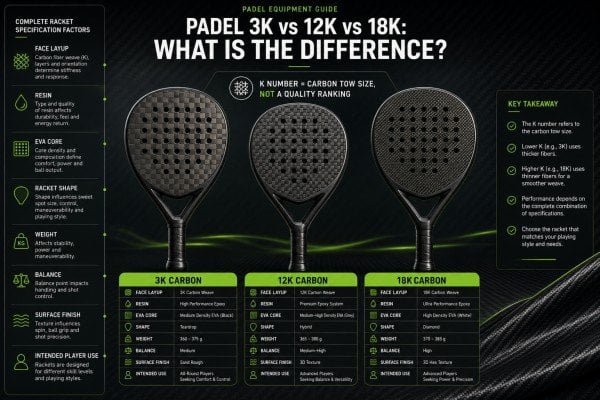
Padel 3K vs 12K vs 18K comparisons often make one number look more advanced than another. That simple ranking can lead players and buyers toward an unsuitable racket. I recommend assessing the K label alongside the face layup, resin, core, shape, weight, balance, finish, and intended use.
Padel 3K vs 12K vs 18K refers to different carbon-fiber tow sizes commonly used or advertised in racket face construction. The number does not independently determine quality, stiffness, power, control, comfort, durability, or player level. I choose between them only after reviewing the complete racket specification and the target user.
I have sourced, sold, and tested samples carrying all three labels. Those comparisons taught me that the printed K number provides only one piece of procurement information. A useful evaluation begins when I look beyond the face description and compare complete, documented configurations.
What Does Padel 3K vs 12K vs 18K Actually Mean?
The K terminology sounds precise, but product listings often provide too little context. That gap makes it easy to assume that a larger number means a better racket. I treat the label as a starting point and ask the supplier what the term describes in that specific model.
I understand 3K, 12K, and 18K as carbon tow designations, in which K generally represents thousands of filaments in a tow1. However, I do not assume that this label describes the full racket layup. I verify whether it refers to the visible face layer, multiple structural layers, or primarily a marketing description.
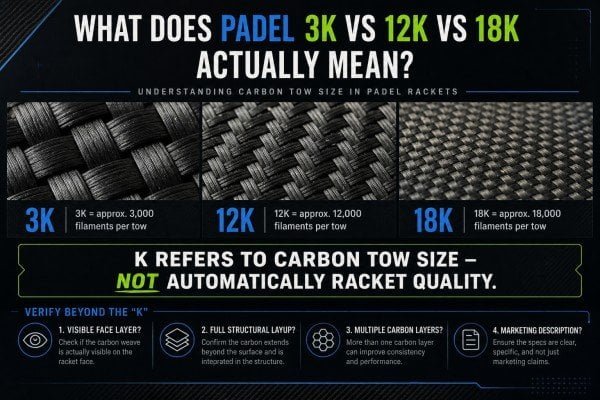
What does the K number describe?
In common carbon-fiber terminology, the figures generally indicate approximate filament counts:
- 3K: about 3,000 filaments per tow
- 12K: about 12,000 filaments per tow
- 18K: about 18,000 filaments per tow
I use the word “generally” deliberately. A racket supplier may describe a product as 12K because the visible outer fabric uses a 12K weave. Another supplier may use similar language for a cosmetic layer while relying on different materials underneath. I therefore request a layer description rather than relying on a catalog title.
I usually ask these questions:
- Which layer uses the stated carbon fabric?
- Does the specification apply to both faces?
- How many carbon, fiberglass, or hybrid layers are used?
- What resin system and curing process does the factory use?
- Is the face specification supported by a material data sheet?
- Can the supplier provide a sectional sample or manufacturing explanation?
Why does a higher K count not prove higher quality?
The tow size can influence how a fabric is woven, handled, and incorporated into a laminate.2 However, I cannot use that number alone to predict how a finished racket will play. The laminate design, fiber orientation, resin ratio, curing consistency, core, frame, and geometry can all change the result.3
| Specification | What I verify | Why it matters |
|---|---|---|
| Carbon designation | Layer location and material documentation | The visible weave may not describe the entire structure |
| Layup | Layer count, orientation, and material mix | The layup affects the behavior of the complete face |
| Core | Material type and density | The core contributes to response, feel, and deformation |
| Shape | Round, teardrop, or diamond geometry | Shape affects the playing area and weight distribution |
| Weight | Target range and production tolerance | Actual weight can influence handling and user suitability |
| Balance | Measurement method and target range | Balance affects maneuverability and perceived head weight |
| Resin and curing | Supplier process controls | Production consistency can affect finished-product quality |
| Surface finish | Smooth, textured, matte, or glossy | The finish affects appearance and may influence ball interaction |
When I compare Padel 3K vs 12K vs 18K samples, I separate supplier-provided claims from my own observations. I am a supplier and procurement adviser, not a materials laboratory. Buyers who need validated mechanical properties should request test reports or arrange independent laboratory evaluation.
Can Padel 3K vs 12K vs 18K Predict Racket Performance?
Players often ask me which K count offers the most power or control. The question is understandable, but it isolates one variable from a complex product. If I answer from the label alone, I risk recommending a racket that does not match the player’s technique, comfort needs, or preferred balance.
I do not use Padel 3K vs 12K vs 18K as a fixed performance scale. A particular sample may feel firmer, softer, faster, or more forgiving, but I cannot attribute that difference solely to its K count unless the other construction variables remain controlled and documented.
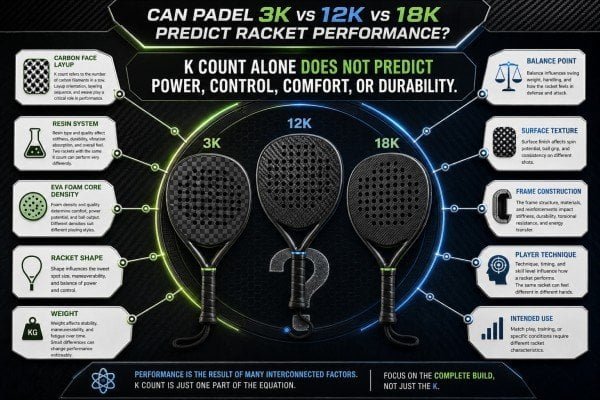
What else changes how a racket feels?
I focus on the interaction between several design choices:
- Face layup: Carbon, fiberglass, and hybrid layers can be combined in different orientations.
- Core construction: Core material and density can influence deformation and perceived response.4
- Racket shape: Shape can affect the location and size of the effective hitting area.5
- Static weight: Two rackets with the same carbon label may have different total weights.
- Balance point: A head-heavy model can feel very different from an evenly balanced model.
- Frame design: Frame geometry and reinforcement can change torsional behavior.
- Hole pattern: Hole size, quantity, and location can influence aerodynamics and structural behavior.6
- Surface finish: Texture and coating can affect feel, wear, and visual quality.
- Manufacturing tolerance: Variations between units can be as important as the nominal model specification.
What did I observe from actual samples?
I once compared three supplier samples labeled 3K, 12K, and 18K. One felt easier to maneuver. Another produced a firmer impact sensation. The third had a visibly different weave and surface coating. At first glance, the K labels appeared to explain the differences.
However, the specification sheets revealed different cores, shapes, balance targets, face layups, and finished weights. The test could therefore show how those three complete rackets differed, but it could not establish a universal rule about 3K, 12K, or 18K carbon.
That distinction matters in both personal buying and commercial sourcing. A buyer may test one firm-feeling 18K sample and conclude that every 18K racket will feel firm. Another factory may produce an 18K-labeled racket with a different core, resin system, layup, and balance. The second product may feel noticeably different.
I treat sample testing as evidence about the tested sample, not proof about every racket carrying the same K label.
How do I make a fair comparison?
I compare products only when suppliers align the main specifications. I request the same or closely matched:
- Shape and mold
- Finished weight range
- Balance-point target
- Core material and density
- Face-layer composition
- Frame construction
- Surface finish
- Hole pattern
- Grip and protector configuration
- Packaging and included accessories
I also recommend blind or semi-blind player testing when practical. A coach can record feedback without emphasizing the carbon label. This method can reduce expectations created by a larger number or a more premium-looking weave.7 For performance-sensitive purchasing, I recommend input from a qualified coach and technical verification from an appropriate materials or testing professional.
Which Padel 3K vs 12K vs 18K Racket Fits the Intended User?
A buyer can select an impressive specification and still choose the wrong product. The risk increases when a reseller purchases inventory before defining the target player. I first identify who will use the racket, how it will be used, and which playing characteristics matter to that group.
I reframe “Which K is best?” into four questions: Who will use the racket? What playing feel does that person require? What is the complete construction? Is the racket intended for personal play, coaching, club rental, testing, or resale? Those answers guide the specification more reliably than the K label.
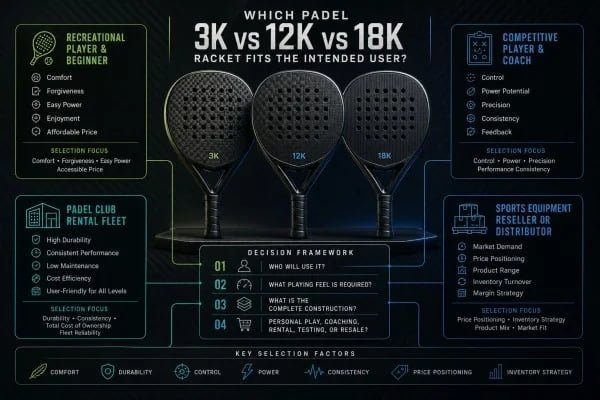
Questions for individual players
When a player asks me for a recommendation, I start with practical information:
- How often does the player play?
- Has the player experienced elbow, wrist, or shoulder discomfort?
- Does the player prioritize maneuverability, a broad effective hitting area, or a specific impact feel?
- What racket shape and balance has the player used before?
- Does the player play mainly at the net, from the back court, or in a mixed style?
- Has a qualified coach observed the player’s technique?
- Can the player test a sample before buying?
I do not automatically assign 3K to beginners, 12K to intermediate players, or 18K to advanced players. That hierarchy may look convenient in a product catalog, but it ignores the rest of the construction and the individual user.
Questions for clubs and coaches
Club rental and training rackets face different demands from personal rackets. A club may value predictable handling, broad user suitability, replaceable accessories, and consistent replenishment more than a specific carbon label.
I advise a club to evaluate:
| Club requirement | Procurement question |
|---|---|
| Mixed player ability | Can a wide range of players use the configuration comfortably? |
| Frequent use | How does the supplier control batch consistency and visible defects? |
| Rental management | Can the club identify models by color, code, or serial number? |
| Coach demonstrations | Can the supplier provide clearly differentiated test models? |
| Replacement planning | Will the same mold and specification remain available? |
| Damage handling | What does the warranty cover, and what evidence is required? |
| Budget control | Does the quote include protectors, straps, bags, and packaging? |
A coach may prefer two or three clearly differentiated complete configurations rather than three rackets differentiated mainly by weave labels. For example, a round, moderate-weight training option and a more specialized higher-balance option can serve distinct purposes. I would still verify each complete specification rather than attach fixed performance claims to its K count.
Questions for resellers
A reseller needs enough product variation to cover target users without creating slow-moving stock. I qualify a distributor by asking about sales channel, customer experience level, target retail position, expected annual volume, and acceptable number of SKUs.
I have seen buyers request one 3K, one 12K, and one 18K model simply because competitors display those categories. That assortment may work as a marketing structure, but the models also need meaningful differences that buyers can understand and sales staff can explain honestly.
I prefer a product matrix based on user need first and material label second. That structure limits unsuitable inventory and reduces the risk of presenting a larger K number as automatic proof of better performance.
How Should Buyers Source Padel 3K vs 12K vs 18K Rackets?
Commercial sourcing adds costs and risks that a single-racket buyer does not face. A low unit quote may hide a different core, simpler layup, wider tolerance, cheaper finish, or missing accessories. I standardize the requested specification before I compare suppliers, samples, or private-label terms.
I source Padel 3K vs 12K vs 18K rackets by issuing one comparable specification sheet, ordering samples, documenting differences, and confirming production terms in writing. I also check target users, logo method, packaging, inspection criteria, sample charges, minimum order quantity, lead time, and the remedy for nonconforming goods.
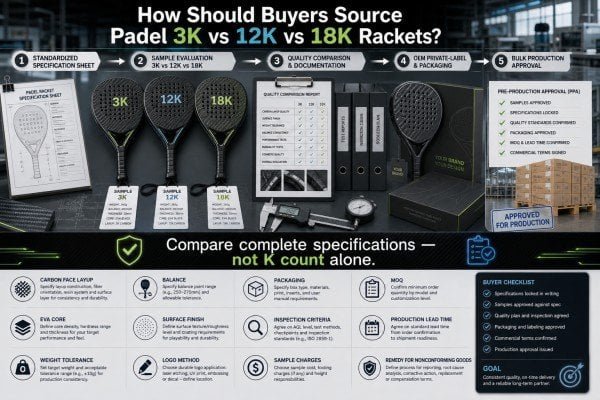
How do I compare quotations?
I never compare prices from descriptions that only say “3K carbon racket” or “18K professional racket.” Those phrases do not define enough of the product.
I ask each supplier to quote against the same purchasing specification:
- Model shape and mold reference
- Nominal dimensions
- Target weight and permitted tolerance
- Balance target and measurement method
- Core description and density
- Face material and complete layup
- Frame material and reinforcement
- Surface texture and coating
- Hole pattern
- Grip, strap, and protector
- Logo application method
- Individual packaging
- Accessories and racket bag
- Carton quantity and dimensions
- Inspection standard
- Sample and production lead time
- MOQ by model, color, and logo
- Warranty conditions
- Payment and shipping terms
This process prevents a buyer from comparing products that look similar in a spreadsheet but differ materially in construction or commercial scope.
How should private-label buyers manage sampling and MOQ?
In my sourcing experience, custom-logo production commonly begins at around 100 rackets for certain supplier programs. I do not treat that figure as an industry-wide rule. The actual MOQ can change with the factory, mold, material, logo method, packaging, color, and number of models.
A single fully customized sample can also cost disproportionately more than the later production unit. The supplier may need to prepare artwork, logo films, decals, printing screens, custom paint, or one-off packaging. Express freight can then exceed the sample’s manufacturing cost.
I manage that risk through a staged process:
- I review an existing unbranded or supplier-branded sample.
- I confirm the core, shape, weight, balance, and face construction.
- I test the sample with representative users.
- I approve the physical specification before adding custom graphics.
- I request a digital artwork proof or pre-production sample.
- I confirm the production MOQ and tolerance in writing.
- I arrange pre-shipment inspection against the approved sample.
How should distributors plan SKUs?
A distributor does not always need separate 3K, 12K, and 18K products. I start with customer segments and build the smallest product mix that covers them.
| Proposed SKU role | Main variables to define |
|---|---|
| Accessible all-round model | Shape, manageable weight, balance, broad user suitability |
| Comfort-focused model | Complete layup, core, weight, and player test feedback |
| Performance-oriented model | Precise target user, balance, shape, layup, and testing |
| Club or rental model | Batch consistency, replacement availability, finish, and budget |
| Premium visual model | Weave appearance, coating, graphics, packaging, and specification |
I then decide whether a 3K, 12K, or 18K face description supports each SKU. I do not build the range around the number alone.
Before a large order, I recommend qualified technical review where performance or safety claims matter. I also ask buyers to verify supplier documents, test reports, factory quality controls, and material declarations. A polished catalog cannot replace traceable specifications and physical inspection.
Frequently Asked Questions
Is 18K carbon always better than 12K or 3K?
No. I do not treat 18K as an automatic quality upgrade. The K label describes only part of the stated face material. The racket’s layup, core, resin, shape, frame, weight, balance, manufacturing consistency, and intended user determine whether the complete configuration is suitable.
Is a 3K padel racket only for beginners?
No. I avoid linking 3K to a fixed player level. A 3K-labeled racket can have many different cores, shapes, weights, balances, and layups. I assess the complete design and recommend that players test the racket or consult a qualified coach.
Can I compare racket prices by carbon K count?
I would not compare prices by K count alone. I first align the core, layup, frame, shape, weight, balance, finish, accessories, packaging, inspection terms, MOQ, and warranty. Without those details, a lower quote may describe a substantially different product.
How many samples should a distributor test?
I usually suggest testing enough samples to represent the planned user segments rather than every available carbon label. A small distributor might begin with two or three complete configurations. I then collect structured feedback on handling, comfort, response, finish, and user suitability before finalizing the range.
What is the MOQ for a custom-logo padel racket?
In my experience, some custom-logo programs begin at around 100 rackets, but that quantity is not universal. The supplier may set separate minimums for each mold, face material, color, logo method, or package. I always confirm current MOQ, sampling costs, and artwork terms before ordering.
Conclusion
Padel 3K vs 12K vs 18K is not a good-better-best ranking. I use the K designation as one line in a much larger product specification. Players should consider their technique, comfort, shape, weight, and balance. Clubs and distributors should also review user coverage, SKU risk, sampling, MOQ, quality control, and comparable quotation terms.
If you need help evaluating padel products or planning a complete padel facility purchase, contact Alice Chen at QHPADEL via alice@grass-supplier.com or WhatsApp +86 185 7566 0746 to discuss your procurement requirements.
-
"Chapter: 1 High-Performance Fiber Technology", https://www.nap.edu/read/11268/page/3. Carbon-fiber textile terminology commonly uses “K” to denote the approximate number of filaments, in thousands, contained in a tow; thus 3K and 12K correspond nominally to about 3,000 and 12,000 filaments, respectively. Evidence role: definition; source type: education. Supports: Carbon-fiber tow labels such as 3K and 12K conventionally indicate approximate filament counts in thousands.. ↩
-
"Novel Method to Manufacture Carbon Fiber Reinforced Polymer …", https://utrf.tennessee.edu/technologies/20138/. Studies of textile composites report that carbon-fiber tow size and fabric architecture affect handling, impregnation, packing, and processing characteristics during laminate manufacture. Evidence role: mechanism; source type: paper. Supports: Tow size affects aspects of carbon-fiber fabric architecture and composite-manufacturing processing.. Scope note: Such findings concern composite processing generally and do not by themselves predict the play characteristics of a particular padel racket. ↩
-
"[PDF] A Study of Void Effects on the Interlaminar Shear Strength of …", https://ntrs.nasa.gov/api/citations/19910002721/downloads/19910002721.pdf. Composite-mechanics research shows that structural stiffness, strength, and failure behavior depend on fiber orientation, stacking sequence, fiber-volume or resin content, curing quality, and component geometry, rather than on tow designation alone. Evidence role: mechanism; source type: research. Supports: Mechanical behavior of fiber-reinforced composite structures is governed by interacting material, layup, processing, and geometric variables.. Scope note: The evidence establishes a general composite-material principle; direct racket performance also depends on sport-specific design and testing. ↩
-
"Effectiveness of core strength training for racket sport athletes’ performance", https://pmc.ncbi.nlm.nih.gov/articles/PMC12953710/. Research on cellular and foam-core structures finds that core density and material formulation influence stiffness, deformation, and energy-absorption behavior under load. Evidence role: mechanism; source type: paper. Supports: Foam or cellular-core material and density influence deformation and mechanical response under loading.. Scope note: This evidence addresses core mechanics generally and does not directly measure subjective feel in padel rackets. ↩
-
"Identifying the Sweet Spot of Padel Rackets with a Robot – PMC", https://pmc.ncbi.nlm.nih.gov/articles/PMC10747547/. Sports-engineering studies of rackets indicate that head geometry and mass distribution affect impact dynamics, vibration nodes, and the location or extent of an effective hitting region. Evidence role: mechanism; source type: paper. Supports: Racket geometry and mass distribution affect impact response and the effective hitting region.. Scope note: Most published work concerns racket sports generally; the exact effect for a given padel-racket mold requires model-specific testing. ↩
-
"Identifying the Inertial Properties of a Padel Racket – PMC", https://pmc.ncbi.nlm.nih.gov/articles/PMC9741144/. Analyses of perforated sporting implements and structures show that hole geometry and placement can affect aerodynamic flow and local structural stress or stiffness distribution. Evidence role: mechanism; source type: paper. Supports: Perforation pattern can modify airflow and local stress or stiffness distribution in a perforated sporting structure.. Scope note: The magnitude and direction of the effect depend on the specific racket geometry, materials, and test conditions. ↩
-
"Experiments – Understanding Psychological Disorders", https://openbooks.library.baylor.edu/understandingpsychdisorders/chapter/reading-conducting-experiments/. Experimental and sensory-evaluation research shows that labels, branding, and visual cues can alter subjective judgments; masking such cues is used to reduce expectation-related bias. Evidence role: mechanism; source type: research. Supports: Blinding or masking product-identifying cues can reduce expectancy-related bias in subjective evaluations.. Scope note: Blinding reduces, but does not eliminate, variation arising from player skill, prior experience, and testing conditions. ↩