You want to invest in a racket sport business. But the names and rules confuse you. You need to know which sport brings the best profit.
Padel uses glass walls and artificial turf on a 20x10m court. Pickleball uses a hard court and plastic balls on a smaller badminton-sized area. Tennis requires a large space and focuses on power. Paddle Tennis is just mini-tennis without walls.
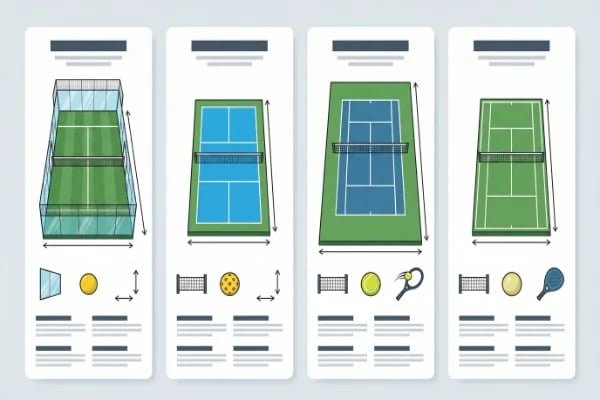
Many people mix up these sports. I will explain the differences clearly.
What is Padel?
You see glass courts popping up everywhere. This sport is taking over the world. You must understand why it grows so fast.
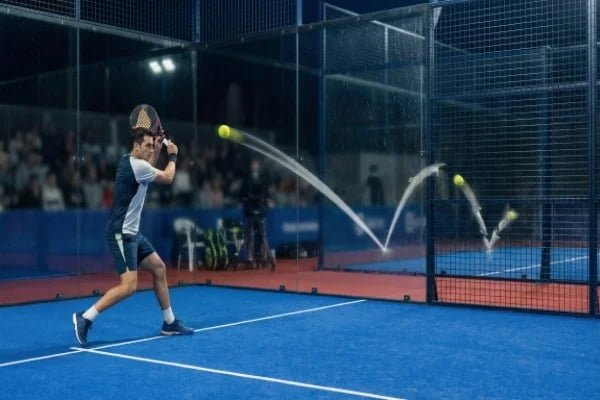
Padel is a mix of tennis and squash. We play it on a 20×10 meter court enclosed by glass walls. You use the walls to bounce the ball. It is social and fun.
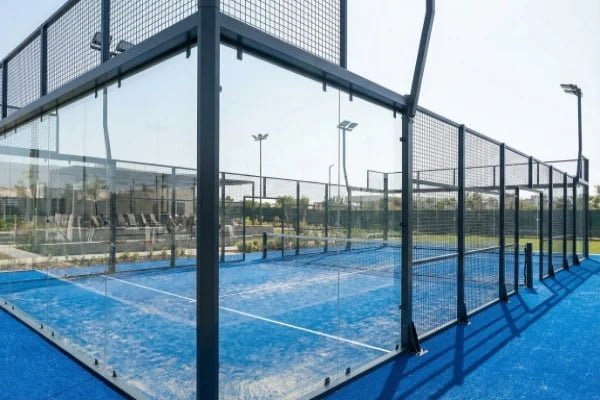
I have worked as an artificial turf engineer for years. I see that Padel is unique because of the walls. A Mexican man named Enrique Corcuera invented it in 1969. He put walls around his court to stop losing balls. Now, we use tempered glass and steel mesh. The court is 20 meters long and 10 meters wide.
In Padel, the service must be underhand. You hit the ball below your waist. The scoring is the same as tennis, including the "deuce," but we often use a "golden point" to save time. The rackets are solid foam with holes. They are short and easy to control. The balls look like tennis balls but have less pressure. This makes them bounce lower.
The best part for investors is the space. You can fit three Padel courts in the space of one tennis court. This triples your potential income. I help clients build Panoramic Padel Courts. These have no steel columns in the corners. It gives a perfect view for spectators.
| Feature | Description |
|---|---|
| Court Size | 20m x 10m (Enclosed) |
| Walls | Glass and Mesh (Part of the game) |
| Racket | Solid foam with holes |
| Scoring | Tennis scoring (Golden point) |
| Surface | Artificial Turf (Sand-filled) |
What is Pickleball?
Your American friends talk about it constantly. It is exploding in the United States. Is it the right investment for you?
Pickleball is like ping-pong on a badminton court. The court is 13.41×6.1 meters. It uses a perforated plastic ball and solid paddles. There are no walls.
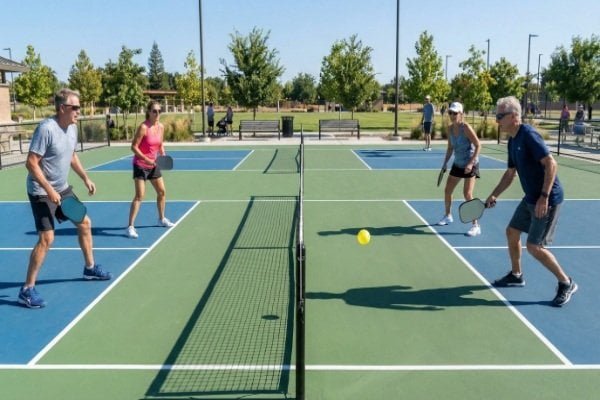
Pickleball is very different from Padel. It started from badminton, not tennis. The court is much smaller. It measures 13.41 by 6.1 meters. It does not use a cage or walls. You play on a hard surface, just like a badminton court. The net sits low.
The rules are specific. There is a "kitchen" or non-volley zone near the net. You cannot smash the ball from inside this zone. This stops players from just standing at the net and hitting down. The ball is hard plastic with holes. It flies slowly. This makes rallies last a long time. You serve underhand, just like in Padel. But in Pickleball, you only get one chance to serve.
I noticed Pickleball is huge in the USA. Google Trends shows high searches there. However, Padel is growing faster globally. Pickleball is cheaper to build because you do not need steel structures or glass. But the gameplay is less dynamic without the wall rebounds.
| Feature | Description |
|---|---|
| Court Size | 13.41m x 6.1m (No walls) |
| Zone | Non-volley zone (Kitchen) |
| Ball | Hard plastic with holes |
| Serve | Underhand, 1 attempt |
| Growth | Mainly USA |
What is Tennis?
Everyone knows this classic sport. But it requires a lot of land. Is it still the best option for club owners?
Tennis uses a large 23.77×10.97 meter court. Players use strung rackets and felt balls. It focuses on power, running ability, and overhand serving.
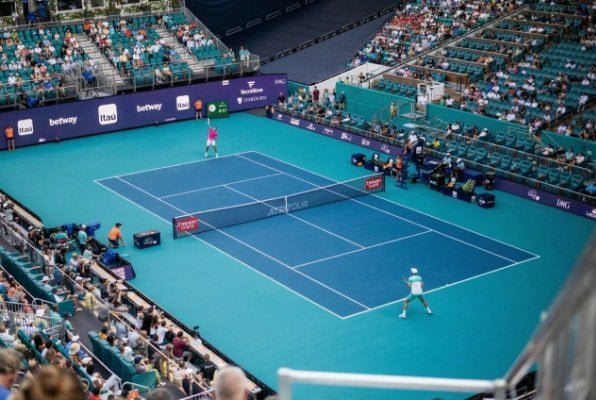
Tennis is the father of these sports. But it is much harder to play. The court is huge. The effective play area is 23.77 meters long. You need a lot of buffer space, making the total area about 36.6 by 18.3 meters. This takes up a lot of valuable land.
In tennis, you run a lot. You need good technique to keep the ball in play. The rackets have strings and generate a lot of power. The serve is overhand and very fast. If the ball passes you, the point is over. In Padel, the wall gives you a second chance. This makes Tennis more physical and less forgiving for beginners.
I often see club owners converting tennis courts into Padel courts. You can build padel courts on top of the old hard tennis surface. We offer portable options that do not damage the ground. This is a smart way to increase your revenue per square meter.
| Feature | Description |
|---|---|
| Court Size | 23.77m x 10.97m (Huge buffer) |
| Racket | Strung racket |
| Difficulty | High (Hard to master) |
| Serve | Overhand |
| Density | Low revenue per sqm |
What is Paddle Tennis?
You might think this is Padel. The spelling is almost the same. But the game and history are totally different.
Paddle Tennis is tennis on a smaller court. It does not have walls. It started in New York a long time ago. It is not Padel.
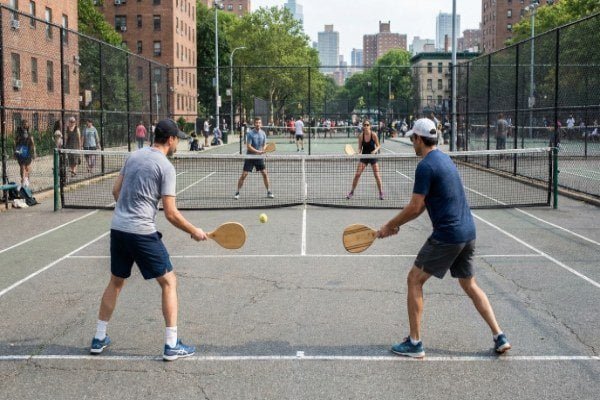
This name causes the most confusion. Padel (with one ‘d’) is the sport with glass walls. Paddle Tennis (with two ‘d’s) is just a mini version of tennis. Franck Beal1 invented it in the early 1900s. He wanted kids to play tennis, so he cut the court size in half.
Paddle Tennis uses a court that looks like a tennis court, just smaller. There are no walls surrounding it. If you hit the ball out, it is out. You play with a solid paddle and a depressurized ball. The game feels like tennis but with less running. It focuses on net play and baseline shots.
Padel is a mix of sports, but Paddle Tennis is a scaled-down tennis game. I see many people incorrectly refer to Padel as "paddle tennis." This is wrong. Padel has the walls and the "cage." Paddle Tennis is open. Do not confuse them when you order equipment or plan your club.
| Feature | Description |
|---|---|
| Walls | No walls (Open court) |
| Origin | USA (Franck Beal) |
| Style | Scaled-down Tennis |
| Racket | Solid paddle |
| Status | Less popular than Padel |
Conclusion
Padel has glass walls and is growing globally. Pickleball has a plastic ball and is big in the USA. Tennis is the traditional, large-court sport. Paddle Tennis is mini-tennis without walls.
-
Learn about Franck Beal’s innovative contributions to Paddle Tennis and how he shaped the game for future generations. ↩