Are you worried that your sports club isn’t generating enough revenue per square meter? Choosing the wrong court size and sport can limit your growth and profits significantly, leaving valuable land underutilized.
A standard padel court measures 10 meters wide by 20 meters long, requiring a total footprint of roughly 21 x 11 meters. In contrast, a tennis court requires 36.6 x 18.3 meters. You can fit nearly three padel courts into the space of a single tennis court.
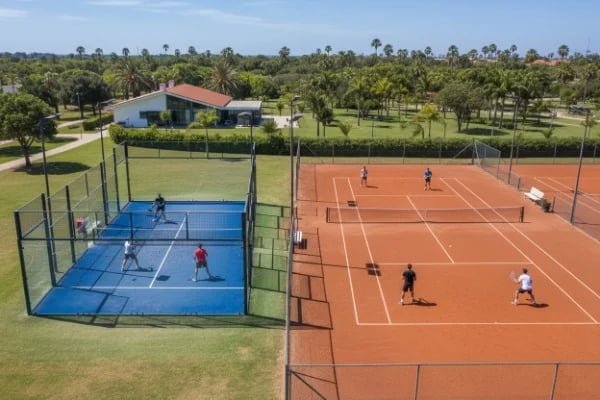
I remember when a client named David from Mexico asked me about maximizing his club’s space. He was shocked to learn how much land he was wasting with his old layout. Let me explain exactly why these dimensions matter for your business.
What are the advantages of having a padel court instead of any other sports facility?
Traditional sports require huge stadiums and massive investments to get started. It is frustrating to see empty fields that cost a fortune to maintain while bringing in very little money relative to their size.
Padel is highly social, accommodating four players in a compact space. It is easier to learn than tennis, suitable for all ages, and requires significantly less land than football or basketball facilities, making it a smarter investment for limited spaces.
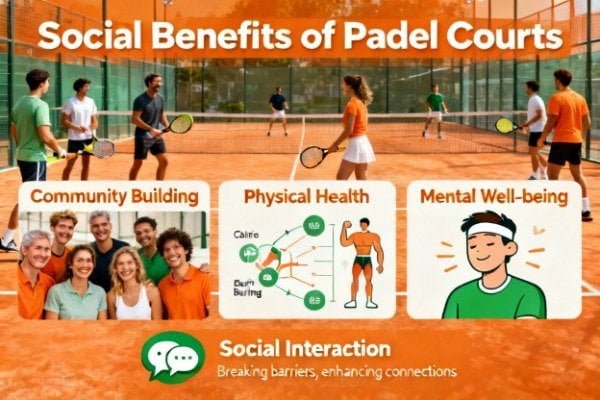
When I look at sports facilities from an engineering perspective, efficiency is everything. Padel offers an incredible advantage because it is almost always played as doubles. This means you have four active customers on a court that is only 200 square meters. If you compare this to other sports, the difference is clear. A singles tennis match uses huge amounts of space for just two people. Football fields are massive and often sit empty during the day.
I have watched the industry grow rapidly because of this efficiency. By 2025, over 2,000 new courts were built in Indonesia alone, and we expect to see over 10,000 planned globally. The reason is simple: it is easier to learn. People of all ages and genders can pick up a racket and have fun immediately, unlike tennis which takes months to master. This lower barrier to entry means your potential customer base is much larger.
Here is a quick breakdown of why I recommend padel for space optimization:
| Feature | Padel Court | Tennis Court | Advantage |
|---|---|---|---|
| Players per Match | 4 (Standard) | 2 (Commonly) | Higher density of paying customers |
| Total Area Needed | ~231 sqm | ~670 sqm | Fits 3x more courts in same area |
| Learning Curve | Low | High | Faster adoption by new members |
This social aspect drives high occupancy rates, which can reach 80% in established centers. It is not just a sport; it is a community hub.
How do you know if it’s more profitable to have a padel court than a tennis court or any other facility?
You might fear that switching sports or reducing tennis space will alienate your current members. However, sticking to low-density sports is draining your potential income every single day and limiting your return on investment.
One tennis court can become three padel courts, tripling your player capacity. With diversified income1 from rentals, coaching, and sponsorships, padel centers can achieve 80% occupancy and generate over $40,000 annually per court in active markets.

Let’s look at the numbers, because as a business owner, that is what counts. I often share the example of clubs in Indonesia to show what is possible. These clubs open 7 days a week, from 9 am to 11 pm. They charge between $5 and $7 per person per hour.
If you assume a court is only used for about 5 hours a day, the daily revenue is between $100 and $140. But if you manage to hit that 80% usage rate, the annual revenue for just one court can reach between $29,200 and $40,880. Now, multiply that by three, because that is how many padel courts fit in one tennis court area. The math is undeniable.
But rental fees are just the start. Successful venue operation relies on diversified income. You should not just rely on court bookings. You can make money through:
- Coaching and Camps: Training brings in loyal customers.
- Tournaments: These events build community awareness and brand culture.
- Sponsorships: Use the court fencing, electronic screens, and entrance ramps as advertising space for local businesses.
- Value-Added Services: Cafes and pro shops keep people at your venue longer.
I tell my clients like Carlos and Ahmed that if they establish long-term partnerships with beverage brands or fitness companies, they secure stable revenue regardless of daily weather or bookings.
Can tennis courts be converted into padel tennis courts?
You have an old tennis court that barely gets used anymore and is costing you money. Tearing it down seems too expensive, but leaving it empty is a waste of valuable assets that could be generating profit.
Yes, tennis courts are ideal for conversion because they usually have a concrete base with acrylic paint. We can install permanent courts or use custom portable panoramic courts that require no ground screws, protecting the existing surface.
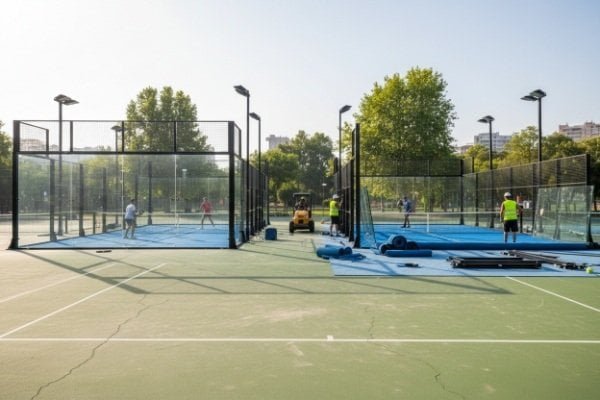
This is one of the most common questions I get from club owners in the United States and Australia. They have the land, but they do not want to pour new concrete. The good news is that most tennis courts already use a concrete base coated with acrylic paint. This is perfectly suited for a padel court.
Ground preparation is usually a huge part of the cost, estimated between $0 to $20,000 depending on the site. By using an existing tennis court, you save this money immediately. If you own the land, we can bolt the steel structure down directly.
However, I know some of you rent your land or want to test the market first. For this, we offer a custom-designed panoramic portable padel court. It integrates a portable ring system. This means we do not need to use screws to secure it to the ground. It is heavy and stable enough to stay in place, but you can dismantle it later.
When choosing a court for conversion, you have options:
- Panoramic: Great for viewing, strategically placed columns.
- Ultra Panoramic: No corner columns, 360-degree view, used in pro tournaments.
- Classic: Double columns, best for high-wind areas.
Regardless of the model, the installation is quick. This allows for short-term events or permanent setups right on top of your old tennis courts. It is the fastest way to upgrade your club.
Conclusion
Padel courts are smaller (20x10m) but far more profitable than tennis courts, fitting three courts in the same space. Conversion is simple on existing hard courts.
-
Learn how diversified income streams can enhance profitability and sustainability for sports facilities, ensuring long-term success. ↩