
Understanding the true padel court requirements is often a headache for club investors and engineering contractors. If you only focus on the official playing dimensions, you might face disastrous foundation failures or rejected building permits down the line. You need a comprehensive site, material, and documentation checklist to guarantee a smooth and profitable installation.
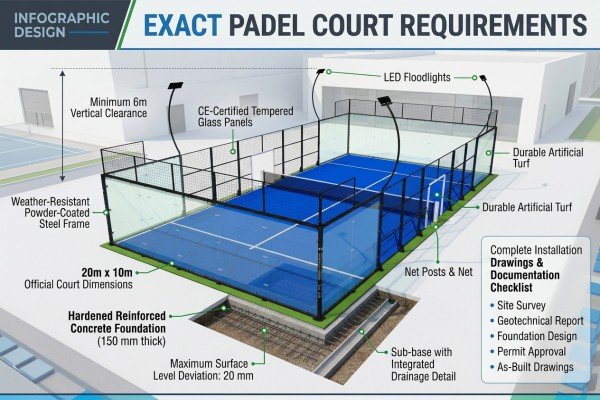
The core padel court requirements include a hardened concrete foundation (typically 15 cm thick), a maximum level deviation of 2 cm, and at least 6 meters of vertical clearance.1 Beyond civil works, a complete requirement covers weather-resistant steel frames, CE-certified tempered glass, artificial turf, lighting, and full installation documentation.
Preparing your site correctly prevents costly construction delays and long-term structural hazards. Let’s break down exactly what you and your local engineering team need to evaluate before ordering your padel court package.
What are the basic site preparation and concrete foundation requirements?
Pouring concrete sounds like a simple first step, but getting it wrong ruins the playing experience and compromises safety. Uneven ground or a thin slab will inevitably cause the heavy steel frame to shift, leading to cracked glass and structural instability.
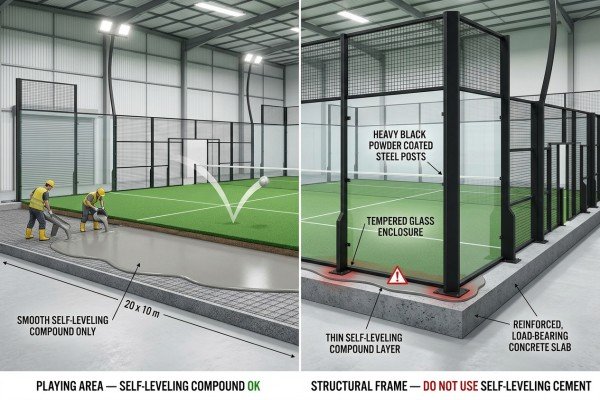
Site preparation requires a hardened, level concrete base. The overall level deviation must not exceed 2 cm across the footprint. Standard concrete thickness should be at least 15 cm, with 10 cm as an absolute minimum. Outdoor courts also require a 0.3% drainage slope from the center outward.2
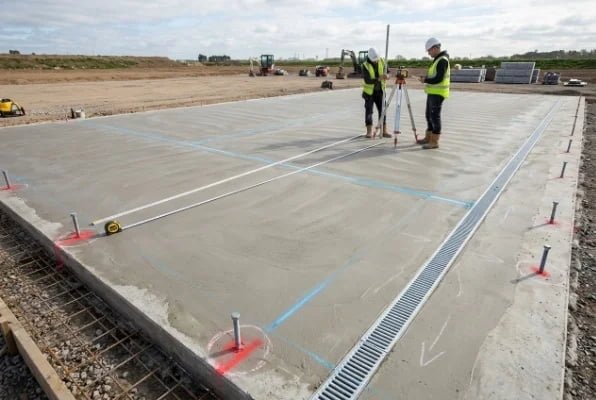
The site foundation is always the first real requirement I discuss with buyers. You cannot just place a court on loose dirt, asphalt, or an old, cracked parking lot without proper assessment. The court must be installed on a dedicated, hardened concrete base.
As a practical supplier guideline, we require the concrete surface to be extremely flat. The overall level deviation should not exceed 2 cm. If the ground is uneven, the glass panels will not align properly, and the frame bolts will be subjected to uneven stress.
For indoor courts, the base should be as flat as physically possible. For outdoor courts, water management is a priority. We advise creating a slight drainage slope of around 0.3% starting from the center of the court down toward the outer edges. This micro-slope helps rainwater flow away quickly without noticeably affecting ball bounce.
Concrete thickness heavily depends on your specific project risk and soil quality. Standard concrete hardening should be at least 15 cm thick. While 10 cm is the absolute minimum lower limit for highly stable indoor environments, we do not recommend pushing this limit outdoors. For special high-risk sites, such as coastal areas requiring a hurricane-resistant court designed for extreme wind conditions, the concrete thickness may need to be 30 cm or more.
I must emphasize that these supplier-side project preparation guidelines do not replace local engineering law. These values must still be verified against local building codes, wind-load calculations, and soil tests by your local civil engineer.
What are the spatial and vertical clearance height requirements?
Buying equipment without accurately measuring your building’s usable height is a costly commercial mistake. If the ceiling is too low, players cannot execute standard lobs properly, which immediately kills the club’s appeal to experienced players.
Both indoor and outdoor padel court requirements dictate a minimum unobstructed vertical clearance of 6 meters.3 However, for a premium playing experience and to meet professional tournament standards, a clear height of 8 meters or more is highly recommended.4
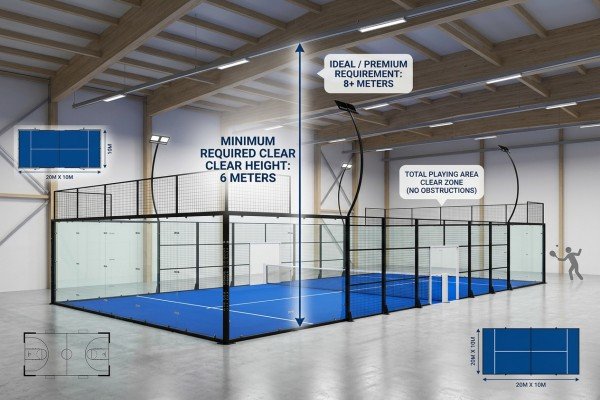
Clearance height fundamentally affects usability and project feasibility. When evaluating an indoor facility—like a warehouse or an old tennis hall—you must measure the distance from the finished concrete floor to the lowest hanging obstacle.
Investors often measure to the ceiling roof but forget about HVAC ducts, lighting fixtures, fire sprinklers, or structural support beams. The 6-meter minimum requirement must be completely free of any physical obstructions. If a player hits a lob and the ball strikes a ventilation pipe at 5.5 meters, the point is ruined. To attract high-level coaches and host tournaments, I always advise clients to secure locations with 8 to 9 meters of clear height.
Outdoor courts have vertical clearance requirements, too. While you do not have a ceiling, you must survey the open space above the intended court location. Look out for overhanging tree branches, low-hanging power lines, or architectural overhangs from adjacent buildings. You should reserve at least 6 meters, and ideally 8 meters, of completely open vertical space outdoors.
What happens if your site is not perfectly flat or requires unique spatial adaptations? Not every site is easily rebuildable. If you cannot reconstruct a sloping site, special customized structural posts may be available. We can engineer custom base plates and leg lengths for sloped sites with a deviation within 100 cm. However, this is not a standard catalog order. This type of engineering must be confirmed case by case with precise site measurements, foundation drawings, and a rigorous engineering review.
What are the environmental and weather protection requirements?
Placing a standard indoor court specification in a windy, humid coastal city will lead to rapid rust and aesthetic fading. Ignoring local weather extremes guarantees early equipment failure and voids long-term durability.
Environmental padel court requirements dictate specific surface treatments. Coastal or humid areas require zinc-rich epoxy primers for rust prevention.5 High-sun environments need UV-resistant powder coatings6, like AkzoNobel. Hurricane-prone zones demand heavy-duty structural steel frames and reinforced foundations.
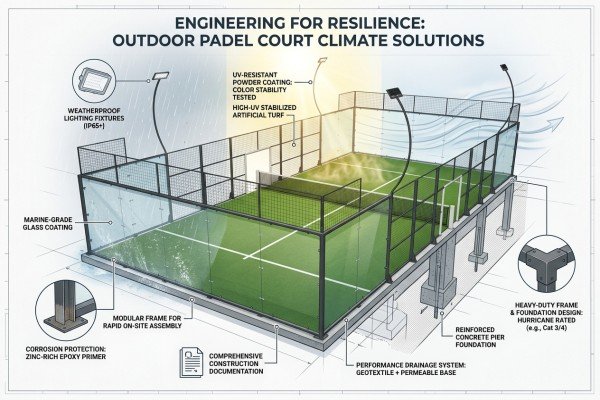
The outdoor environment drastically changes the frame protection requirements you must demand from your supplier. A classic indoor court simply relies on standard galvanization and powder coating. Outdoor courts endure constant abuse from the elements.
In humid, rainy, or coastal environments, the salt and moisture in the air aggressively attack steel structures. For these regions, we highly recommend adding a zinc-rich epoxy primer layer beneath the final topcoat. This extra barrier provides vastly superior frame protection against creeping rust, especially near the bolt holes and weld joints.
For outdoor courts exposed to long-term high temperatures and intense sunlight—such as those in the Middle East or South America—fading is a major issue. Standard paint will chalk and peel off within a few years. In these cases, your padel court requirements should specify a customized UV-resistant powder coating. We utilize high-grade options like AkzoNobel powder coating, which significantly improves surface durability and keeps the court looking brand new.
Wind load is another critical environmental factor. Standard panoramic courts look beautiful, featuring vast expanses of glass. However, they catch a lot of wind. In hurricane-risk zones, standard panoramic models are unsafe. You must opt for a specialized Hurricane Resistant Court (which makes up a small, customized percentage of our production). These utilize thicker steel profiles, smaller glass spans, and heavy-duty anchoring systems. Again, the specific wind ratings must be reviewed and approved by a local structural engineer before installation.
What is included in a complete equipment and material requirement list?
Sourcing individual parts from multiple disparate suppliers often leaves contractors scrambling for missing screws during installation. A fragmented supply chain creates mismatched tolerances, delays project handover, and destroys profit margins.
A complete padel court requirements list demands a strict Bill of Materials (BOM). This includes structural steel posts, welded frame netting, CE-certified tempered glass, artificial turf, LED lights, the tennis net, and a comprehensive set of matched fasteners and accessories.
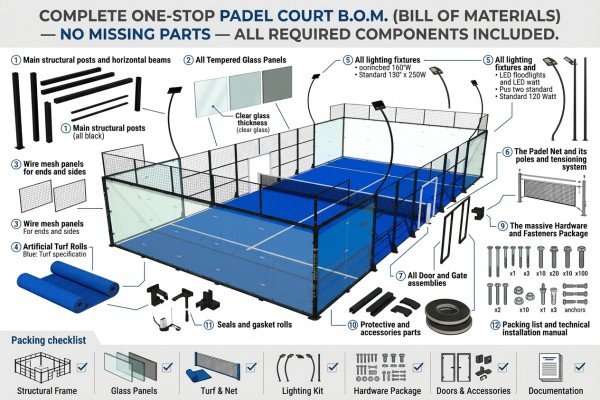
A true complete court requirement includes far more than just civil works and metal fencing. Buyers should always confirm the full court system package with their manufacturer. Missing a single box of specialized glass brackets can delay your grand opening by weeks.
At QHPADEL, we categorize typical buyers into club operators, civil contractors, equipment distributors, and public sectors. Regardless of the profile, everyone needs a complete BOM with zero missing parts to meet tight construction deadlines.
Here is a breakdown of the core material requirements:
- Steel Frame Structure: The backbone of the court, including columns, mesh panels, and light poles. Frame colors can be customized.
- Tempered Glass: Requires strict safety certifications (CE, AS/NZS 2208:1996). The glass must withstand player impacts and heavy ball strikes.
- Artificial Turf: Typically customized for Dtex and density. If you require OEM customized turf specifications, note that the standard manufacturing MOQ is 6 courts (approximately 1254 sqm).
- Lighting Fixtures: LED lights must be bright, evenly distributed, and certified (CE, AS 61347.2.13:2018).
- Hardware: Screws, anchors, and accessories must meet high stress and quality system approvals (e.g., AD 2000 WO certificate, PED 2014/68/EU).
| Component | Standard Specification | Key Certification Requirement |
|---|---|---|
| Glass | 10mm or 12mm Tempered | CE, AS/NZS 2208:1996, Bulletproof test |
| Turf | Texturized monofilament | CE, RoHS |
| Steel | Galvanized + Powder Coated | CE |
| Fasteners | Stainless steel / High tensile | AD 2000 WO / PED 2014/68/EU |
It is also vital to define spare parts packages. Glass panels can shatter due to mishandling, and small wear-and-tear items degrade. Your supplier should provide clear warranty terms and transparent pricing covering complete sets, partial sets, and accessory replacements.
What documentation and certification requirements should you expect?
Bidding for public sector projects or simply securing a local building permit is impossible without the right paperwork. Missing engineering certificates or poor installation guides will quickly halt your site contractors.
Documentation padel court requirements include comprehensive installation drawings, foundation drawings, packing lists, and maintenance manuals. Suppliers must also provide formal CE certifications, structural test reports, and ISO9001 factory compliance documents to satisfy local authorities.
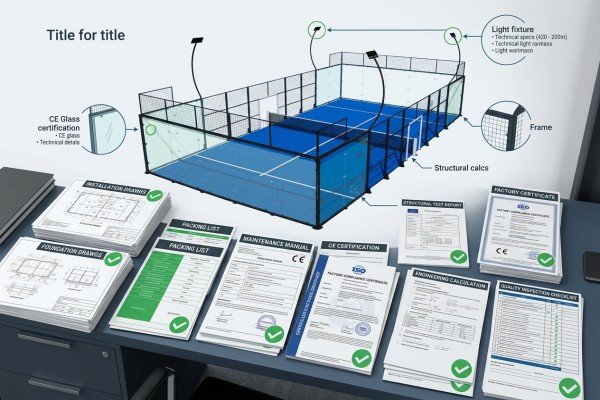
Selling a physical product is only half of the B2B transaction. The other half is supplying the engineering data required to actually build it. Government institutions, schools, and municipal sports bureaus rely heavily on public procurement. They have strict compliance rules regarding structural safety and traceable supply chains.
Before any concrete is poured, you need accurate foundation and pre-embedding drawings from your supplier. These drawings outline the specific tolerance requirements and exact hole positions for the structural posts. Without these, your civil contractor is just guessing.
When the containers arrive (usually taking 20-25 days to produce 4 courts in our factory), the shipment must include a highly detailed packing list. Clear component numbering ensures that local installation teams know exactly which bolt goes into which post. We also provide complete installation manuals and online guidance to ensure the final assembly matches the design intent.
Certifications are not just marketing material; they are legal shields. Treat supplier certifications as critical documents that you and your local permit office must verify. Whether it is CE marks for the steel frame, AS/NZS testing for the tempered glass, or RoHS compliance for the artificial turf, this documentation proves the equipment meets international safety baselines. Keep in mind that while we provide comprehensive structural data and factory testing, final structural approval and permit sign-off remain the responsibility of your local civil engineers.
Frequently Asked Questions
Do padel court requirements change for roofed or covered courts?
Yes. Adding a roof increases the wind resistance profile and structural load. The concrete foundation must usually be thicker and wider to support the heavy canopy columns. You will also need to adjust the LED lighting angles to prevent glare off the roof structure.
Can we install a padel court on an existing tennis court?
Yes, this is very common. An existing tennis court provides a solid base. However, you must still check the slope and overall levelness. The concrete or asphalt must be in good condition without severe cracking, and you must use appropriate chemical anchors for the steel posts.
What are the specific glass requirements for padel courts?
The glass must be fully tempered safety glass, typically 10mm or 12mm thick. It must pass strict impact testing and hold certifications like CE or AS/NZS 2208:1996. The panels feature countersunk holes to ensure all hardware sits flush, preventing unpredictable ball bounces.
How long does it take to manufacture the required court equipment?
Standard production is quite fast. For our factory, two courts take about 20 days, four courts take 20-25 days, and larger orders of more than four take a maximum of 30 days. Highly custom-made styles require up to 35 days for full production.
Conclusion
Successfully launching a new sports facility means strictly adhering to comprehensive padel court requirements. From ensuring a perfectly level, 15 cm thick concrete foundation and securing 8 meters of clearance height, to specifying UV-resistant coatings and managing meticulous CE-certified documentation, every detail impacts your project’s longevity. Remember, a great supplier provides the complete BOM and the technical guidelines, but your local engineers must finalize the site approval.
-
"Documents | Padel FIP", https://www.padelfip.com/documents/. See the International Padel Federation (FIP) Rules of Padel, which outline the mandatory structural dimensions, minimum vertical clearances, and acceptable tolerances for official court construction. Evidence role: general_support; source type: institution. Supports: The official FIP regulations regarding court dimensions, clearance, and structural tolerances.. Scope note: FIP rules dictate playing dimensions and clearance, but specific concrete thickness is typically governed by local civil engineering codes rather than the sports federation. ↩
-
"Official Padel Rules (FIP) — 2026 Summary and …", https://padel.how/rules/official-fip-padel-rules/. The International Padel Federation permits a maximum transverse slope of 1% for outdoor courts to facilitate drainage without noticeably altering ball trajectory. Evidence role: mechanism; source type: institution. Supports: The acceptable drainage slope parameters for outdoor padel courts.. Scope note: While 0.3% is a common contractor target, official rules permit up to a 1% gradient. ↩
-
"RULES OF PADEL INTERNATIONAL …", https://www.padelfip.com/wp-content/uploads/2024/11/FIP-Rules-of-Padel.pdf. According to the International Padel Federation (FIP) official rules, the minimum unobstructed height must be 6 meters across the entire playing area. Evidence role: definition; source type: institution. Supports: The mandatory minimum vertical clearance for padel courts.. ↩
-
"FIP Padel Lighting Requirements: Lux, Uniformity, Height …", https://reitalight.com/fip-padel-lighting-requirements/. The FIP recommends a minimum unobstructed height of 8 meters for newly constructed facilities and mandates this height for international professional tournaments. Evidence role: expert_consensus; source type: institution. Supports: The recommended vertical clearance for newly constructed facilities and professional tournaments.. ↩
-
"Research progress in organic zinc rich primer coatings for …", https://www.sciencedirect.com/science/article/abs/pii/S0300944020312510. Research on anti-corrosive coatings demonstrates that zinc-rich epoxy primers provide essential cathodic protection for steel structures exposed to C4 and C5 marine and coastal environments. Evidence role: mechanism; source type: paper. Supports: The use of zinc-rich epoxy primers for steel protection in highly corrosive environments.. ↩
-
"Powder coating", https://en.wikipedia.org/wiki/Powder_coating. Studies on architectural coatings indicate that specialized UV-resistant polyester powder coatings significantly reduce polymer chain degradation, preventing chalking and color fade in high solar irradiance zones. Evidence role: mechanism; source type: research. Supports: The mechanism by which UV-resistant powder coatings prevent photodegradation.. ↩