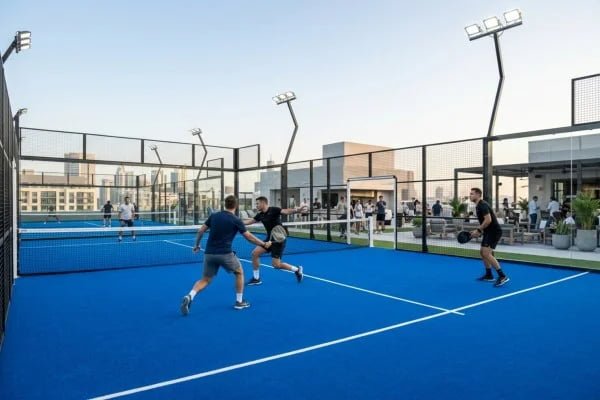
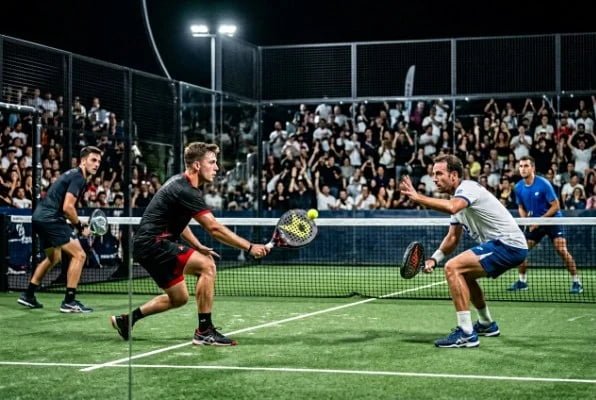
Singles padel rules can be confusing because many players and investors use the term to describe different things. A two-player game on a standard doubles court, a purpose-built singles court, and an officially sanctioned singles event are not automatically the same. I recommend separating these uses before selecting a court format or promoting a venue offering.
Singles padel rules usually begin with familiar padel fundamentals: rally scoring, an underhand serve, and legal use of the court walls1. However, there is no reason to assume that every two-player padel game follows one universal, officially sanctioned singles rulebook. Court boundaries, local house rules, event conditions, and the intended court format must be verified with the relevant association, organizer, supplier drawings, and local authorities.
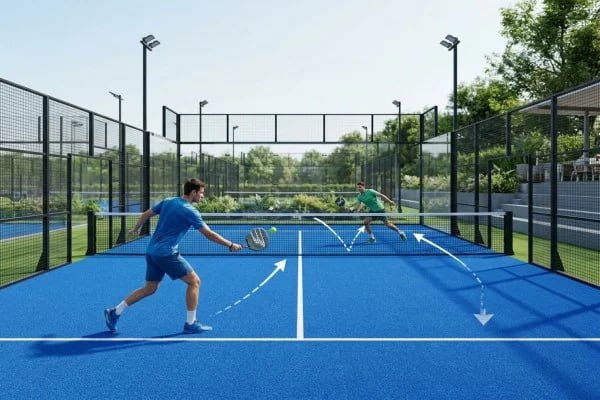
I see one procurement question behind most rules questions: what will the court actually be used for? A club may want a compact court for coaching or training, while a tournament-oriented venue may need mainstream doubles capacity. The difference affects court selection, customer expectations, marketing claims, and construction planning.
Are Singles Padel Rules the Same as Standard Padel Rules?
The phrase singles padel rules sounds straightforward, but it can create a costly assumption. Buyers may expect a complete official rulebook for one-versus-one competition when they are actually considering casual play or a specialist training court. I suggest starting with the basic gameplay rules and then checking what changes in the proposed format.
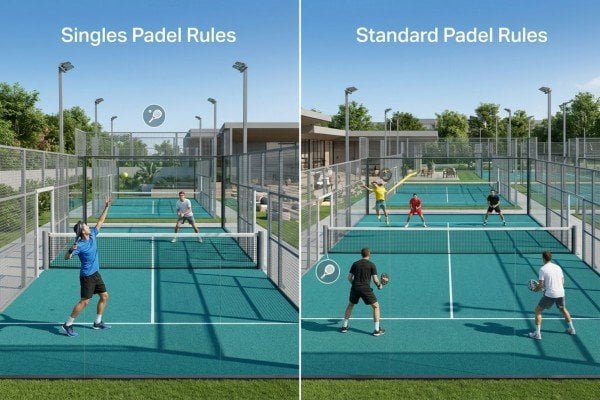
Singles padel rules often use the same practical baseline as ordinary padel: points are scored using padel’s standard scoring structure, serves are made underhand after a bounce, and walls may be used during rallies. However, standard padel regulations are commonly written around doubles play, so a two-player match or singles-court game should not be described as officially sanctioned without confirmation from the applicable governing body or event organizer.
The familiar padel baseline
For informal or training-oriented two-player play, participants often rely on the core principles that make padel recognizable. These usually include:
- Scoring: Many players use conventional padel scoring, which follows the familiar 15, 30, 40, game sequence. Tie-break procedures may apply depending on the match arrangement.
- Serving: The server generally allows the ball to bounce before hitting an underhand serve below waist height.
- Ball movement: A ball may bounce on the court surface and then rebound from an authorized wall or glass panel during a rally.
- Volleying: Players may volley during play, subject to the applicable rules and safe use of the court.
- Winning a point: A player wins a point when the opponent cannot return the ball legally or when the ball bounces twice on the playing surface.
However, I would not treat this list as a substitute for current official regulations. The International Padel Federation (FIP) publishes rules and technical materials that buyers, clubs, and event organizers should review directly. The relevant documents can change, and national associations may add competition conditions.
I write from publicly available rules, court-specification information, and industry observation. I do not provide officiating, coaching, engineering, legal, or tournament-authority guidance.
Why doubles rules do not automatically create a singles rulebook
The key issue is that mainstream padel is historically and commercially centered on doubles2. Standard courts, player movement patterns, booking systems, and many organized competition structures are designed for four players.
A two-player game can certainly use padel-style scoring and rallies. Yet that does not prove that the game qualifies as formal singles competition under a specific association or event. An organizer may define its own rules for:
| Rule area | Informal two-player play | Organized local event | Sanctioned competition |
|---|---|---|---|
| Court layout | May be agreed by players | Defined by organizer | Must follow applicable regulations |
| Service order | Usually simple alternation | Organizer may specify | Subject to competition rules |
| Scoring format | Flexible | Often set in event terms | Subject to official event conditions |
| Court boundaries | May use house rules | Must be communicated clearly | Must be verified against governing rules |
| Eligibility and officiating | Usually informal | Varies by organizer | Defined by authority or organizer |
I recommend that club investors publish simple house rules if they offer two-player sessions. Clear rules reduce disputes and help staff explain how the court should be used. Still, marketing should distinguish between “singles-friendly training or casual play” and “official singles competition capability.”
What Court Boundaries Apply Under Singles Padel Rules?
Court boundaries are where singles padel rules become especially important for procurement. A player may assume that a narrower court automatically creates a universal singles format. That assumption can lead to mismatched expectations when a venue intends to host events, sell memberships, or add courts later.
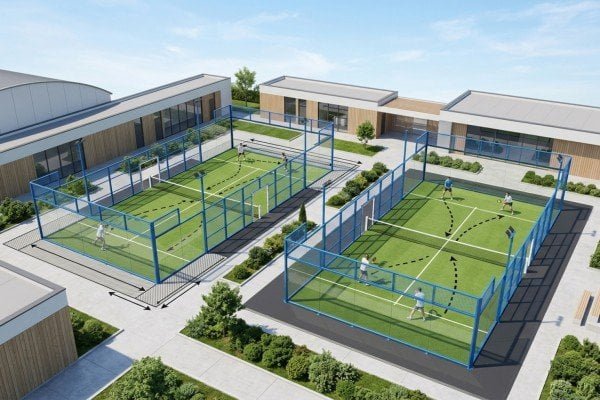
Court boundaries for singles padel depend on the court configuration and the rules adopted for the activity. A purpose-built singles court may use a narrower playing area than a standard doubles court, while two players on a doubles court may use the full court or agreed boundary lines. Buyers should verify current dimensions, clearances, access requirements, and competition acceptance with the relevant association, organizer, supplier, and local building authority before construction.
A court format is not just a painted line
From a buyer’s viewpoint, the physical court is more than its visible lines. A complete padel court system includes structural steel, glass, mesh panels, artificial turf, lighting, gates, fasteners, drainage considerations, foundations, and installation tolerances. A change in court width or layout can affect several connected items.
I would ask a supplier for a full technical package that identifies:
- Playing-area drawings with all dimensions clearly labeled.
- Foundation drawings that show anchor positions, levels, and site tolerances.
- Structural drawings for posts, welded mesh, glass supports, and access points.
- Bill of materials (BOM) listing frames, glass, turf, lighting, nets, screws, and spare items.
- Packing list and component numbering to support site receiving and installation.
- Maintenance documentation for turf, lighting, glass, and steel components.
At QHPADEL, our documented support can include installation drawings, foundation drawings, packing lists, and maintenance manuals. I would still advise every buyer to have qualified local professionals review these documents for the intended site and applicable regulations.
Verify dimensions instead of relying on generic online claims
Online discussions often state exact singles-court dimensions as if they apply everywhere. I would treat those claims carefully. The applicable court dimensions may depend on whether the installation is intended for informal use, coaching, a particular association’s event format, or a supplier’s proprietary product configuration.
The following questions are more useful than asking only, “How big is a singles court?”
- Does the venue need a court for casual two-player bookings?
- Will coaches use the court for repetition drills and private lessons?
- Does the operator want a space-constrained installation?
- Does the venue plan to host recognized competitions?
- Will future customers expect standard four-player padel?
- Does the selected format meet local rules for setbacks, fire access, electrical work, wind loads, drainage, and accessibility?
A narrower court may solve a space problem, but it may also limit how the venue can market, schedule, or expand its padel offer. That is why I recommend treating the court layout as a business decision first and a gameplay detail second.
Can Two Players Use a Standard Doubles Padel Court?
Many venues already have standard courts, so this is one of the most practical singles padel rules questions. A club may want to serve players who arrive in pairs without changing its physical infrastructure. The risk appears when informal use is advertised as something more formal than it is.
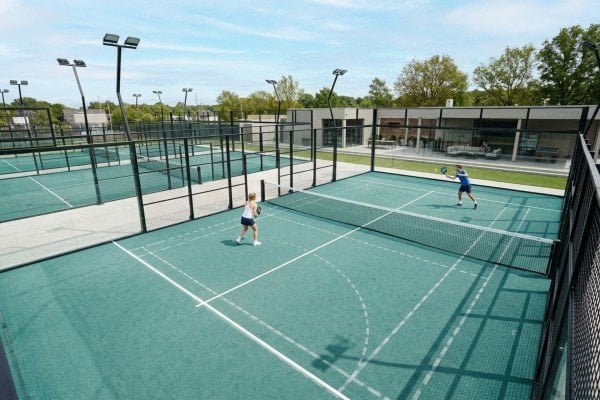
Two players can generally arrange casual padel-style play on a standard doubles court if the venue permits it and the players agree on the format. They may use the full court, establish house boundaries, or follow a coaching drill format. However, two-player use of a doubles court should not be presented as officially recognized singles competition unless the relevant association or event organizer has confirmed that status.
Practical formats for casual two-player play
A venue can create a better customer experience by choosing and communicating one approach rather than leaving every match to negotiation. I have seen industry discussions repeatedly return to three practical models.
1. Full-court two-player play
Each player covers one side of a conventional doubles court. This format is simple because no additional lines or temporary boundaries are needed.
Strengths:
- No physical modification is required.
- Staff can explain the format quickly.
- The full court remains available for doubles bookings.
- Players can enjoy a demanding fitness-oriented session.
Limitations:
- The court area per player is large.
- The game may feel very different from doubles padel.
- It may not suit all skill levels.
- It is not automatically an approved formal singles format.
2. Agreed restricted-area play
Players may decide to treat part of the court as out of bounds. A venue might use temporary guidance or clearly documented house rules, provided that the approach does not create a trip hazard or conflict with safe court use.
Strengths:
- The format can create a more compact two-player rally area.
- Clubs can adapt activities for coaching or beginner sessions.
- The operator can standardize a local recreational product.
Limitations:
- Boundary disputes are more likely if rules are unclear.
- Temporary markings require careful safety review.
- The format may confuse customers if it is marketed imprecisely.
3. Drill-based or coached sessions
In this model, the court supports structured exercises rather than a formal match. A coach may focus on serve return, wall recovery, volley placement, or movement patterns.
Strengths:
- The purpose is clear.
- The session can fit player-development goals.
- The operator can use otherwise quiet daytime periods.
Limitations:
- This is not a replacement for a standard match product.
- Qualified coaching and local operational procedures are needed.
- Participants may still prefer a conventional doubles experience.
Establish house rules before selling the booking
If a club allows two-player court use, I recommend that it state the format at the point of booking. A simple notice can clarify:
- Whether players use the full court or restricted zones.
- The scoring method.
- Whether serves alternate by game or another agreed method.
- Whether the booking is recreational, training-focused, or coached.
- Whether the format is eligible for internal leagues.
- What happens if a doubles booking takes priority during peak hours.
This transparency helps protect customer expectations. It also allows investors to test real demand before committing to a specialist court configuration.
When Should Investors Choose a Singles Padel Court?
A singles court can look attractive when a site has limited space or when an operator wants a differentiated training product. Still, singles padel rules should not drive the decision alone. I recommend assessing demand, revenue model, event strategy, and future flexibility before choosing a court type.
Investors should consider a singles padel court when their primary use case is coaching, training, casual two-player play, or a site with verified space constraints. They should not assume that a singles court replaces a standard doubles court for mainstream padel demand or formal events. The right decision depends on local customer behavior, applicable competition requirements, site engineering, and the venue’s commercial plan.
Match the court to the venue strategy
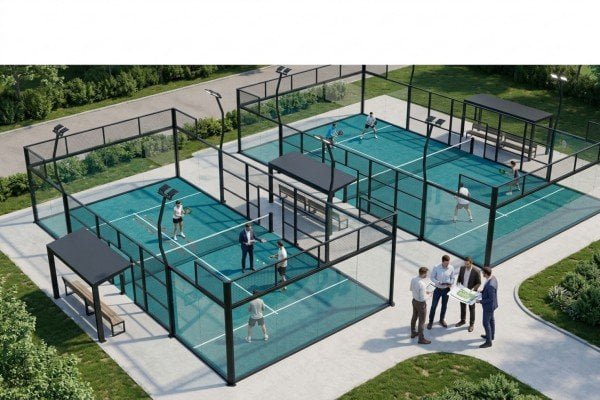
A court purchase is a long-term operational decision. The lowest initial quote does not necessarily produce the best fit if the format limits future bookings or does not meet customer expectations.
I would evaluate a singles-court proposal against these intended uses:
| Intended use | Potential fit for a singles court | Key verification point |
|---|---|---|
| Private coaching | Potentially suitable | Coach demand, session format, safe circulation |
| Skills training | Potentially suitable | Drill design and player expectations |
| Casual two-player play | Potentially suitable | House rules and booking demand |
| Small-space installation | Potentially suitable | Verified site plan and local compliance |
| Mainstream club play | May be limited | Local preference for doubles padel |
| League play | Depends on organizer | League rules and participant demand |
| Official events | Must be verified | Current association and event requirements |
| Hotel or resort amenity | Depends on guest profile | Expected group size and operating model |
Questions I would ask before requesting quotations
Buyers should give suppliers a clear project brief. This helps prevent quotes that compare only steel weight or court price while excluding important scope items.
Before procurement, I would ask:
-
Who will use this court most often?
Identify whether the target customer is a coach, a family, a two-player recreational group, a school, a hotel guest, or a club member. -
How many players do we expect per booking?
Mainstream padel demand often involves four players.3 A local market survey can provide more useful evidence than social-media trends. -
Will the site host formal competitions?
If the answer is yes, contact the relevant association or event authority before finalizing the layout. -
What local approvals apply?
Ask qualified local professionals about foundations, wind conditions, electrical systems, drainage, fire rules, noise, setbacks, permits, and accessibility. -
What documentation will the supplier provide?
Request current drawings, material specifications, packing lists, installation instructions, and certificates relevant to the quoted product. -
What does the quote exclude?
Confirm shipping terms, unloading equipment, civil works, installation labor, electrical connection, local permits, taxes, and spare parts.
Evaluate the supplier, not only the court concept
For a complete court package, buyers should inspect the supplier’s ability to control quality and documentation. At QHPADEL, we manufacture artificial turf and complete padel court systems, including turf, welded frame netting, structural posts, tempered glass, lighting fixtures, and nets. Our stated production capacity and export history may help buyers assess supply capability, but I recommend independently verifying all project-specific information before placing an order.
Buyers can request and verify documents relevant to the offered configuration, such as:
- Factory quality-management documents, including ISO 9001 records where applicable.
- Product-specific CE, RoHS, glass, lighting, or accessory documentation.
- Current test reports and certificates for the actual materials quoted.
- Weld, coating, glass, and turf specifications.
- Warranty terms and exclusions.
- Reference packing lists and installation drawings.
Certification documents should be checked for validity, scope, issuing body, product match, and applicability in the destination market. A certificate alone does not confirm that an entire installation complies with local law or project requirements.
Frequently Asked Questions
Are singles padel rules officially standardized worldwide?
No. I would not describe singles padel rules as one globally uniform official rulebook. Basic padel gameplay may provide a useful starting point, but official recognition, court layouts, competition conditions, and local rules can differ. Buyers should verify current requirements with the applicable association and event organizer.
Can I play singles padel on a normal doubles court?
Yes, two players can arrange casual or training-oriented play on a standard doubles court if the venue permits it. Players should agree on boundaries, scoring, and service order. However, I would not assume that this format is formally sanctioned singles competition.
Is a singles padel court suitable for a commercial club?
It may be suitable for coaching, training, casual two-player bookings, or constrained sites. It may be less suitable if the venue depends mainly on four-player bookings or event capability. I recommend reviewing local demand, target customers, and competition plans before procurement.
Are singles padel courts automatically cheaper than doubles courts?
No. I would not assume that a singles court is automatically cheaper or more profitable. Final cost depends on structural design, glass, steel, turf, lighting, freight, foundations, installation, local compliance, and the supplier’s scope. Revenue depends on real booking demand and venue operations.
What should I verify before ordering a singles padel court?
I recommend verifying intended use, current court drawings, foundation requirements, local permits, event requirements, certifications for the quoted components, installation support, spare parts, shipping scope, and warranty terms. Qualified local engineering and regulatory review is important for application-specific decisions.
Conclusion
Singles padel rules are best understood as a planning question rather than a single universal answer. Basic padel scoring, serving, and wall-play principles can support casual two-player sessions, but court boundaries and official recognition require separate verification. I recommend that investors define whether the court will serve coaching, training, recreational play, constrained-site development, or competition before procurement. If you are evaluating a complete padel court package, contact QHPADEL to request drawings, component specifications, and documentation for your proposed project.
-
"Documents – Padel FIP", https://www.padelfip.com/documents/. The International Padel Federation’s Rules of Padel set out the scoring sequence, the below-waist service after a bounce, and the circumstances in which rebounds from court walls remain in play. Evidence role: definition; source type: institution. Supports: The FIP Rules of Padel define scoring, service execution, and permissible ball rebounds from court structures.. ↩
-
"Padel vs. tennis doubles: a comparison of performance demands …", https://pmc.ncbi.nlm.nih.gov/articles/PMC12213881/. Descriptions of padel in sports reference works and participation literature characterize it as a game conventionally played by two teams of two players, placing standard court design and competition practice in a doubles context. Evidence role: historical_context; source type: paper. Supports: Sports-history or participation literature describes padel as a racket sport conventionally played in doubles.. Scope note: General descriptions of customary play do not quantify doubles participation in every local market. ↩
-
"Padel vs. tennis doubles: a comparison of performance …", https://pubmed.ncbi.nlm.nih.gov/40606278/. Participation descriptions of padel commonly identify doubles—two players on each side—as its usual format, supporting the relevance of four-player demand when evaluating conventional club courts. Evidence role: general_support; source type: research. Supports: Participation research or industry-neutral surveys indicate that padel is normally played in doubles, involving four participants.. Scope note: A general participation pattern does not substitute for a venue-specific demand survey. ↩