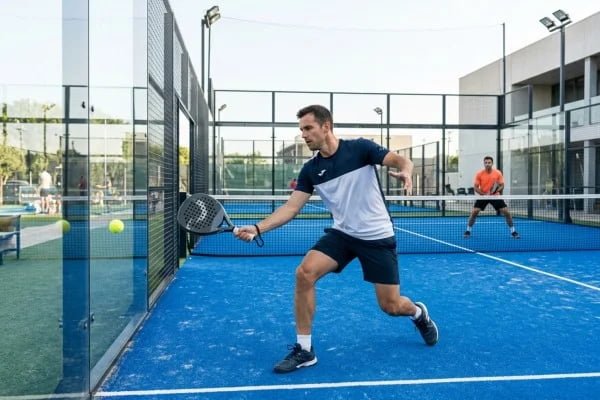
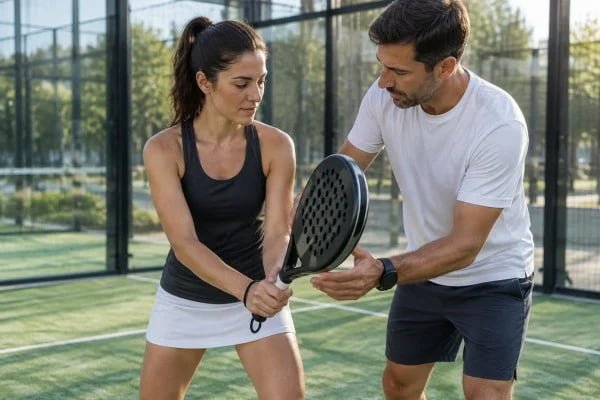
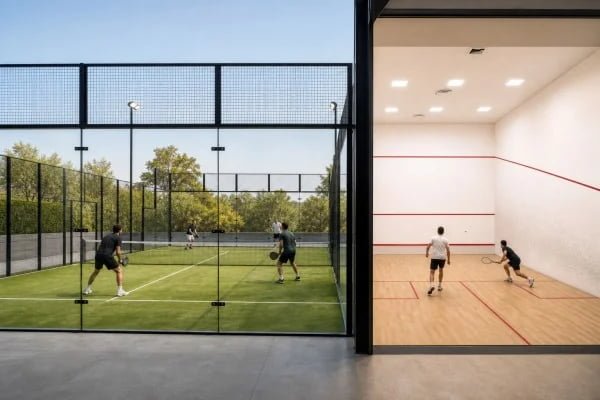
Padel in the USA is real, but its presence does not automatically prove that every American city can support a profitable club. Investors can become distracted by national growth headlines and overlook local demand, customer acquisition costs, and court utilization. I recommend validating the specific city and business model before purchasing equipment.
Yes, padel is played in the USA through dedicated clubs, private facilities, and sports developments in selected local markets. However, its presence varies considerably by city. Investors should verify nearby courts, active player communities, achievable pricing, expected utilization, competition, and operating costs before treating local padel participation as a viable investment opportunity.
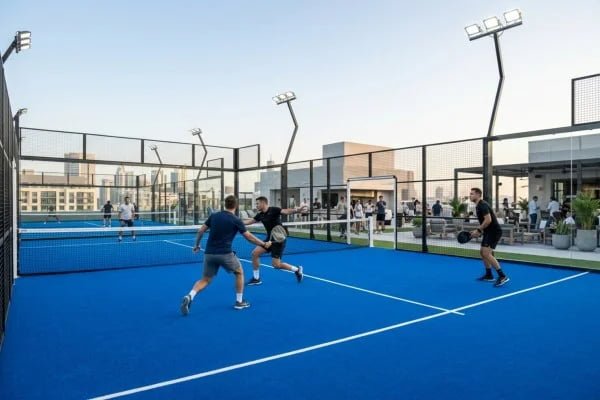
From our manufacturing position, we have supplied dozens of U.S.-bound courts through sports-facility importers and received customer installation photos. That experience confirms genuine project activity. It does not show nationwide participation, club revenue, exact final locations, or the financial performance of those facilities.
Is Padel in the USA a Real and Established Activity?
People researching padel in the USA often encounter two extremes. Some descriptions make the sport sound unknown, while others present nationwide expansion as inevitable. Neither view gives investors enough evidence. I find it more useful to separate proof of real activity from assumptions about market size and commercial maturity.
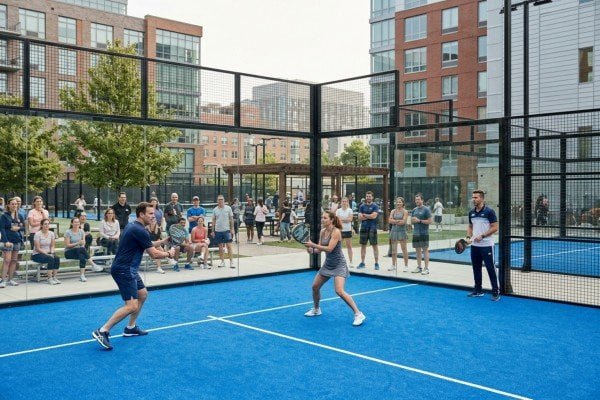
Padel is genuinely played in the United States1, and imported court orders, operating facilities, player groups, tournaments, and development projects provide evidence of real activity. However, I would not classify every U.S. city as an established padel market. Local court supply, player awareness, booking behavior, and commercial performance require separate verification.
What Our Supplier Experience Can Establish
QHPADEL has exported dozens of padel courts for U.S.-bound projects through sports-facility importers. We have also received installation photographs from customers. As a manufacturer, we can therefore provide bounded evidence that U.S. buyers are investing in padel infrastructure.
Our inquiries also reveal practical buyer interest in:
- Panoramic and ultra-panoramic court configurations
- Artificial turf specifications
- Tempered glass and steel-frame documentation
- Court lighting
- Packing plans and container loading
- Foundation and installation drawings
- Spare parts and replacement procedures
- OEM branding for importers and distributors
These questions usually indicate that buyers have moved beyond casual curiosity. A buyer who asks about component numbering, glass packaging, lead time, and foundation drawings is evaluating an actual procurement project.
However, I draw a firm line around what this evidence means.
Court exports confirm that projects exist. They do not confirm national popularity, local utilization, or investor profitability.
We have not worked directly with every end-user club connected to those orders. We have not independently verified the exact installation locations or operating results shown in every customer-supplied photograph. We also do not have access to club booking systems, membership retention, revenue, staffing expenses, or customer acquisition costs.
How Buyers Should Check Market Claims
I recommend asking for a source, publication date, definition, and geographic scope whenever someone provides a market statistic.
| Claim presented to an investor | Information needed before relying on it |
|---|---|
| “Padel is growing quickly” | Growth in players, courts, clubs, searches, or equipment sales? |
| “The USA has many courts” | Does the count include private, inactive, temporary, or planned courts? |
| “Participation is increasing” | Which cities, age groups, period, and research method? |
| “Clubs are fully booked” | Which clubs, days, hours, and booking categories? |
| “The investment pays back quickly” | What occupancy, pricing, financing, rent, and operating assumptions apply? |
Current market counts can change quickly. For that reason, I would compare dated information from governing bodies, facility directories, municipal records, club booking platforms, and local interviews rather than repeat an unattributed national headline.
How Is Padel in the USA Different From Pickleball?
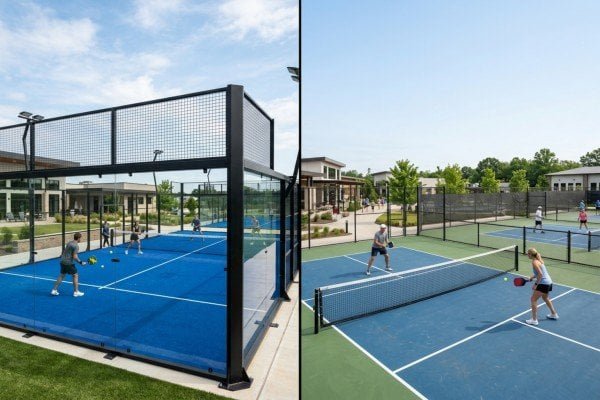
Investors sometimes use pickleball participation as a shortcut for assessing padel in the USA. That comparison can identify general interest in racket sports, but it can also create costly assumptions. Padel needs an enclosed court system, different equipment, a distinct playing format, and a more involved construction and procurement process.
Padel and pickleball are separate sports.2 Padel is generally played in doubles on an enclosed court where the surrounding glass forms part of play.3 Pickleball uses a smaller open court and different paddles, balls, and rules. Strong pickleball participation may suggest racket-sport interest, but it does not automatically establish demand for padel.
The Court Is a Major Difference
A padel project usually requires a coordinated system of structural and playing components. A complete package may include:
- Structural steel posts and frames
- Welded steel mesh
- Tempered glass panels
- Artificial turf
- LED lighting fixtures and supports
- A padel net and net posts
- Fasteners, anchors, and accessories
- Installation and foundation drawings
This enclosed structure makes supplier selection and local engineering review important. The concrete base, anchoring method, wind exposure, drainage, lighting design, electrical work, access route, and installation tolerances can all affect the final facility.
Pickleball demand therefore cannot substitute for a padel feasibility study. A city may have many pickleball players because courts are accessible, rules are familiar, and the entry cost is low. The same players may not know padel, accept the proposed booking price, travel to a dedicated facility, or play often enough to support the projected utilization.
The Customer Journey Is Also Different
When I review a potential project, I encourage the buyer to consider how a person becomes a regular padel customer. The process may include:
- First hearing about the sport
- Watching a demonstration
- Booking an introductory session
- Finding three additional players
- Renting or buying a racket
- Learning how to use the glass
- Joining a group at a similar skill level
- Returning often enough to form a playing habit
A strong pickleball or tennis community can help because those players already understand racket sports. However, the club still needs an acquisition and education plan. Coaches, introductory events, social leagues, corporate sessions, and player-matching systems can be as important as physical court quality.
Facility Costs Require Separate Analysis
I would also avoid comparing only the painted court area. A padel facility may need structural installation, glass handling equipment, lighting, engineering, permitting, drainage, climate control, or weather protection. Those requirements vary by location and facility type.
Qualified local professionals should evaluate structural loads, foundations, electrical work, fire and occupancy rules, accessibility, and planning approval. As a manufacturer, we can supply product documents and drawings, but we should not replace a U.S.-licensed engineer, contractor, architect, or permitting authority.
How Should Investors Evaluate Padel in the USA City by City?
National enthusiasm can hide weak local economics. A city may appear attractive because it has a large population, high income, or active sports culture. Yet a club can still struggle if its site is inconvenient, its audience is unfamiliar with padel, or its projected peak-hour demand is unrealistic.
I recommend evaluating padel in the USA as a city-level and catchment-area opportunity. Investors should map existing courts, interview target customers, test pricing, study adjacent racket-sport participation, and model realistic bookings by hour. A local waiting list, paid trial campaign, or pre-opening membership test provides stronger evidence than national publicity alone.

Start With the Real Catchment Area
A city’s total population is less useful than the number of suitable customers within a realistic travel time.4 I would define primary and secondary catchment zones around the proposed site. The analysis should consider rush-hour traffic, parking, public transport, neighborhood safety, workplace locations, and competing leisure options.
Investors can then map:
- Existing indoor and outdoor padel courts
- Tennis clubs and academies
- Pickleball facilities
- Soccer and multisport centers
- Universities and international communities
- Corporate offices
- Hotels and residential developments
- Comparable premium fitness concepts
Existing courts can be both competition and positive evidence. A busy nearby club may prove that people understand the sport. However, it may also have a stronger location, established coaches, and a loyal community. I would study why customers choose that club instead of assuming that overflow demand will reach a new facility.
Gather Behavioral Evidence
Survey answers can be overly optimistic.5 People often say that they would try a new sport, but a business needs repeat, paid bookings.
I prefer a sequence of increasingly strong evidence:
| Evidence | What it can show | Main limitation |
|---|---|---|
| Search interest | Initial awareness | Searches do not equal bookings |
| Social media engagement | Audience curiosity | Engagement may not be local |
| Survey responses | Customer preferences | Stated intent may not become action |
| Free demonstration event | Willingness to try | Free demand may overstate paid demand |
| Paid pop-up session | Price acceptance | Temporary events may attract enthusiasts |
| Refundable deposit | Stronger purchase intent | Terms must be clear and lawful |
| Recurring league registration | Repeat behavior | Requires an existing playing environment |
I once reviewed an inquiry in which the equipment discussion was highly detailed, but the customer profile remained vague. That contrast reinforced a simple lesson for me: a technically complete court does not create demand on its own.
Test Specific Customer Groups
A city may contain several possible padel audiences:
- Existing padel players seeking more court time
- Tennis or squash players interested in another racket sport
- International residents familiar with padel
- Families looking for social recreation
- Corporate groups
- University students
- Fitness and lifestyle consumers
- Coaches who can build programs
Each group may have a different acceptable price, travel distance, preferred booking time, and need for instruction. I would avoid combining them into one large theoretical market. The investor should test each segment separately and estimate how many paying sessions it can generate.
Does Demand for Padel in the USA Guarantee a Successful Club?
A city can have active padel players while a new club still fails to meet its financial targets. Demand may concentrate at a small number of evening hours, while rent, payroll, financing, utilities, insurance, and maintenance continue throughout the day. I see utilization quality as more important than general interest.
No, evidence that people play padel in the USA does not guarantee that a particular club will succeed. Commercial viability depends on site costs, court count, achievable pricing, utilization by time period, customer acquisition, repeat bookings, staffing, ancillary revenue, and financing. Investors need a conservative operating model and sensitivity analysis before procurement.
Model Bookable Hours, Not Just Average Occupancy
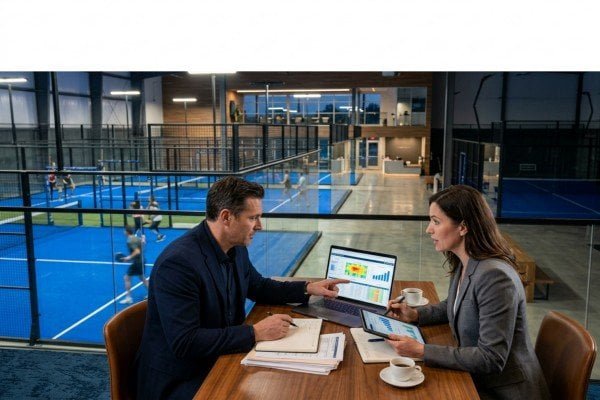
A simple monthly occupancy percentage can hide important weaknesses.6 For example, a club may sell most weekday evening sessions but leave weekday mornings and afternoons almost empty. Adding courts may then increase capital cost without solving off-peak demand.
I recommend modelling each day in time blocks:
- Early morning
- Weekday daytime
- After-school hours
- Weekday evenings
- Weekend mornings
- Weekend afternoons and evenings
For each block, the model should estimate:
- Available court hours
- Expected booking rate
- Average realized price
- Discounts and promotions
- Coaching or league use
- Cancellations and downtime
- Seasonal variation
The investor should then run downside, base, and upside scenarios. A downside case should not assume that every interested player becomes a recurring customer.
Include the Full Project Budget
Court equipment represents only part of a padel development. Depending on the project, the budget may also include:
- Land or building rent
- Site design and professional fees
- Permitting and inspections
- Concrete foundations and drainage
- Freight, duties, and inland transport
- Unloading equipment
- Installation labor
- Electrical supply and lighting work
- Heating, cooling, or weather protection
- Reception, changing rooms, and bathrooms
- Insurance and payment processing
- Staff recruitment and training
- Marketing and pre-opening events
- Maintenance and replacement stock
- Financing costs and contingency
I recommend keeping a contingency rather than treating the supplier’s court price as the complete installed cost. Local contractors and qualified professionals should prepare the site-specific cost estimate.
Examine Acquisition and Retention
A successful launch campaign can fill introductory sessions without creating a stable player base. The business also needs systems that make repeat play easy.
Those systems may include:
- Player matching by skill level
- Beginner coaching
- Social leagues
- Junior programs
- Corporate packages
- Membership benefits
- Automated reminders
- Off-peak promotions
- Tournaments and community events
The operating team should track customer acquisition cost, first-to-second booking conversion, booking frequency, churn, revenue per court hour, and peak versus off-peak utilization. We do not claim expertise in operating U.S. clubs, so investors should validate these metrics with experienced local operators and financial advisers.
What Should Buyers Verify When Sourcing Padel Courts for the USA?
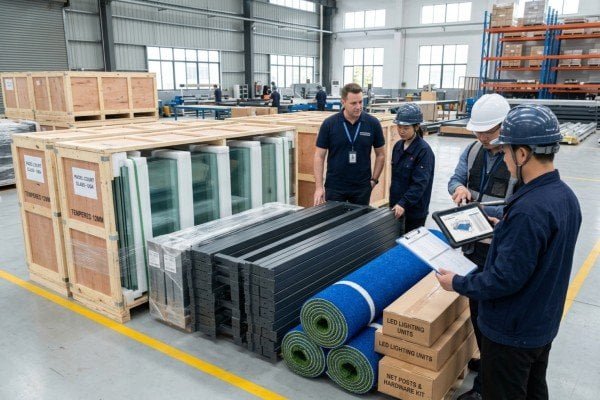
Once a buyer validates local demand, procurement introduces another risk. A low quotation can omit important parts, documentation, freight assumptions, or installation support. I have seen buyers focus heavily on frame appearance while giving too little attention to the bill of materials, packaging, drawings, and replacement procedures.
Buyers sourcing courts for padel in the USA should verify the complete bill of materials, material specifications, drawings, packaging, production schedule, spare parts, warranties, and supplier quality controls. They should also ask local engineers and authorities to review foundations, structural loads, electrical systems, accessibility, and permits for the specific installation site.
Compare Complete Technical Scope
I recommend comparing quotations line by line rather than using one total price.
| Procurement area | Questions I recommend asking |
|---|---|
| Steel structure | What grades, dimensions, coatings, and tolerances are specified? |
| Glass | What thickness, tempering records, edge treatment, and test documents are supplied? |
| Turf | What are the pile height, Dtex, density, backing, roll layout, and infill requirements? |
| Lighting | What fixtures, drivers, mounting positions, photometric data, and electrical documents apply? |
| Accessories | Are anchors, screws, nets, posts, gaskets, and connection parts included? |
| Drawings | Are foundation, assembly, component-numbering, and installation drawings provided? |
| Packing | How are glass, steel, turf, and small parts protected and identified? |
| After-sales support | How are shortages, damage, and replacement parts documented and handled? |
QHPADEL can supply complete court packages with artificial turf, welded frame netting, structural posts, tempered glass, lighting, nets, and related accessories. We also provide installation drawings, foundation drawings, packing lists, and maintenance manuals.
Our standard production guidance is:
- Two courts: approximately 20 days
- Four courts: approximately 20–25 days
- More than four courts: no more than 30 days
- Custom styles: no more than 35 days
These time frames concern production under standard planning conditions. Buyers should confirm the order-specific schedule, drawing approval period, shipping time, customs clearance, inland transport, and site readiness.
Treat Certificates as Documents to Verify
Our factory identifies its quality management certification as ISO 9001. Product documentation can include CE and other test or certification documents for specified components. However, buyers should not accept a certificate name alone.
I recommend checking:
- Certificate holder
- Product model and scope
- Issuing or testing organization
- Applicable standard
- Issue and expiry dates
- Report number
- Match between the tested sample and ordered product
- Acceptance by the relevant local authority or project professional
A CE-marked component does not automatically establish compliance with every U.S. building code, electrical code, wind requirement, or permitting rule. Local engineers and authorities must determine whether the proposed system is suitable for the site.
Frequently Asked Questions
Where is padel most commonly played in the USA?
Padel facilities tend to develop in selected metropolitan areas with suitable demographics, racket-sport communities, and investors willing to build enclosed courts. I recommend using current club directories, governing-body resources, booking platforms, and local searches because facility lists change and may include proposed, private, or inactive courts.
Is padel the same as pickleball?
No. Padel uses an enclosed court with glass and mesh walls that affect play. It is commonly played in doubles with padel rackets and sport-specific balls. Pickleball uses a different open-court layout, equipment, and rules. The two sports also require different facility investments.
Can a padel court be installed on an existing tennis court?
A conversion may be technically possible, but the existing slab, dimensions, drainage, access, structural capacity, lighting, and permits need professional review. I recommend obtaining a measured site survey and having qualified local engineers and contractors assess the base and anchoring system before ordering equipment.
How many padel courts should a new club purchase?
There is no universal number. The right court count depends on validated demand, site size, capital, programming, utilization, and operating costs. I suggest modelling several configurations and testing conservative booking assumptions. Buyers can purchase one equipment unit from QHPADEL, although turf customization has a six-court minimum of 1,254 square metres.
Do product certificates guarantee U.S. project approval?
No. Product certificates and test reports can support technical evaluation, but they do not replace site-specific approval.7 A qualified U.S. engineer, electrician, contractor, architect, or permitting authority should review applicable structural, wind, electrical, accessibility, fire, and planning requirements.
Conclusion
Padel in the USA is a genuine activity supported by clubs, player communities, imports, and new court projects. However, I would never treat national attention as proof that a specific club will succeed. Investors should validate city-level demand, paid booking behavior, pricing, utilization, customer acquisition, full project costs, and local compliance before procurement. QHPADEL can support buyers with complete court quotations, technical specifications, drawings, packing information, and production planning. Contact Alice Chen at alice@grass-supplier.com or WhatsApp +86 185 7566 0746 to discuss a U.S.-bound padel court project.
-
"Calendar", https://padelusa.org/calendar/. National and international padel-body materials document organized padel activity, including clubs and competitive events, in the United States. Evidence role: general_support; source type: institution. Supports: That organized padel facilities, events, and governing-body activity exist in the United States.. Scope note: Such sources establish the sport’s presence but do not measure participation or commercial viability in every U.S. city. ↩
-
"Padel", https://en.wikipedia.org/wiki/Padel. Official padel and pickleball rules describe different court configurations, equipment, and playing regulations, confirming that the sports are distinct. Evidence role: definition; source type: institution. Supports: That padel and pickleball are governed as distinct sports with different court designs, equipment, and rules.. ↩
-
"RULES OF PADEL INTERNATIONAL PADEL FEDERATION", https://www.padelfip.com/wp-content/uploads/2024/11/FIP-Rules-of-Padel.pdf. The official rules of padel specify doubles as the standard format and regulate play involving the court’s enclosing walls. Evidence role: definition; source type: institution. Supports: That standard padel rules provide for doubles play and allow the ball to remain in play after contact with the court walls.. Scope note: Recreational formats may vary, but the cited rules describe the standard form of the sport. ↩
-
"Application of Travel Time Data and Statistics to TTR Analyses", https://ops.fhwa.dot.gov/publications/fhwahop21058/chap3.htm. Spatial-accessibility research treats travel time and local catchment characteristics as important determinants of a facility’s effective market area. Evidence role: mechanism; source type: research. Supports: That accessibility and travel time shape the effective market area for a destination-based facility.. Scope note: The appropriate catchment radius depends on local congestion, service type, price, and customers’ willingness to travel. ↩
-
"Purchase intention and purchase behavior online: A cross …", https://pmc.ncbi.nlm.nih.gov/articles/PMC7322128/. Research on the intention-behavior gap finds that reported intentions are an imperfect predictor of later observed consumer behavior. Evidence role: mechanism; source type: paper. Supports: That stated intentions in surveys can differ materially from subsequently observed behavior.. Scope note: The size of the gap varies by population, product, price, and study design; it does not prove that a particular padel survey is inaccurate. ↩
-
"Forecasting Daily Demand for Hotel Occupancy Levels", https://www.bu.edu/bhr/2021/06/29/forecasting-daily-demand-for-hotel-occupancy-levels-an-empirical-application/. Revenue-management research shows that demand is time-varying; aggregate occupancy can therefore obscure peak-period constraints and off-peak underutilization. Evidence role: mechanism; source type: paper. Supports: That demand and capacity utilization commonly vary by time period, making aggregate utilization measures potentially misleading.. Scope note: The evidence is a general capacity-management principle and does not quantify the hourly demand profile of a particular padel club. ↩
-
"Plan Review and Inspection Requirements | Department of Labor …", https://www.pa.gov/agencies/dli/programs-services/labor-management-relations/bureau-of-occupational-and-industrial-safety/uniform-construction-code-home/historic-buildings/plan-review-and-inspection-requirements. Building-code guidance explains that product evaluation information may assist review, while final compliance and permit decisions remain subject to project-specific approval by the authority having jurisdiction. Evidence role: general_support; source type: institution. Supports: That code compliance and permit approval are determined for a specific project by the authority having jurisdiction under applicable local requirements.. Scope note: Approval procedures and the authority’s evidentiary requirements differ among U.S. jurisdictions. ↩