FIP in padel can confuse newcomers because suppliers, tournament organizers, and media often use the acronym in different contexts. That confusion becomes risky when buyers mistake a governing body’s name for a product certificate. I separate the institutions, competitions, technical documents, and local regulations before I evaluate any court claim.
FIP stands for the International Padel Federation, padel’s international governing body.1 It oversees areas such as international rules, member federations, competitions, and rankings.2 However, the acronym “FIP” does not automatically mean that a padel court, artificial turf system, glass panel, or lighting product is certified, approved, or suitable for a specific project.3
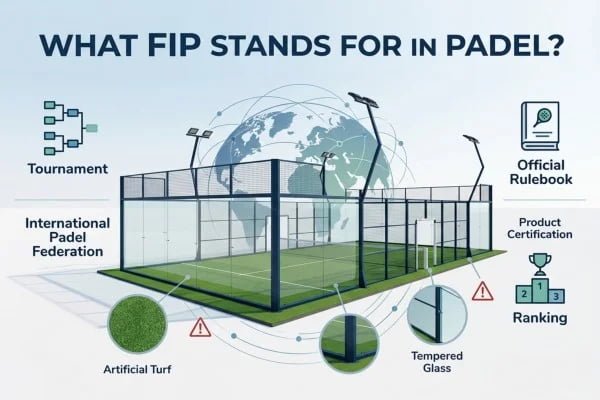
That short definition answers the acronym, but it does not resolve the procurement questions behind it. I recommend examining who made an “FIP” claim, which document supports it, and whether that document applies to the court design, competition, location, or individual component being purchased.
What Does FIP in Padel Mean?
Buyers sometimes see FIP beside tournament names, rankings, or court specifications and assume that every reference means the same thing. That assumption can blur the line between sports governance and product compliance. I start by defining the organization before I discuss equipment.
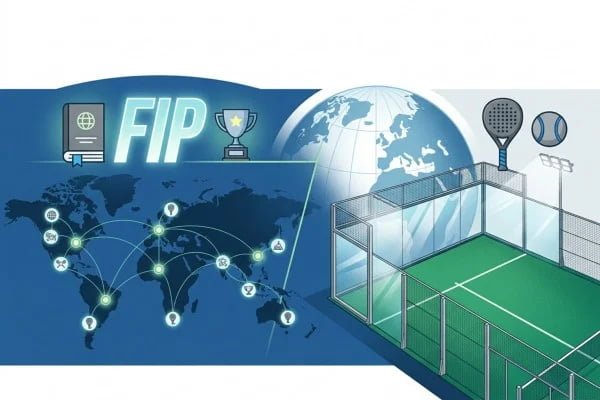
FIP in padel refers to the International Padel Federation, whose official identity is also expressed in French as the Fédération Internationale de Padel. I understand its role as international sports governance, including rules, competitions, rankings, and relationships with member federations. I do not treat its name as an automatic product certification.
I separate governance from manufacturing
The International Padel Federation operates within the sport’s organizational structure. A padel court manufacturer operates within a supply chain that includes steel fabrication, tempered glass, artificial turf, lighting, fasteners, packing, and export documentation. These roles can affect the same project, but they are not interchangeable.
I use the following distinction during early procurement discussions:
| Area | Typical responsible party | What a buyer should verify |
|---|---|---|
| International rules and governance | FIP | Current official rules and publications |
| International competitions and rankings | FIP and relevant competition organizers | Current competition regulations and eligibility |
| Country-level sports administration | National padel federation | National requirements and federation guidance |
| Structural design | Manufacturer, engineer, and local authority | Calculations, drawings, loads, and building codes |
| Product testing | Qualified testing or certification body | Test report, standard, scope, and validity |
| Installation | Contractor and supervising engineer | Foundation, tolerances, anchoring, and workmanship |
| Local approval | Municipal or national authority | Planning, safety, electrical, and construction requirements |
This distinction matters because FIP in padel is primarily an institutional term. It identifies a governing organization. It does not, by itself, identify a laboratory test, structural calculation, certificate number, or permit.
I verify current information at the official source
Organizational roles and tournament structures can change. I therefore advise buyers to check the federation’s current website, statutes, rules, and competition publications rather than relying on an old supplier brochure. I apply the same rule to technical specifications. A screenshot without a publication date may no longer reflect the current requirement.
When I review a reference to FIP, I look for:
- The full document title
- The issuing organization
- The publication or revision date
- The relevant clause or section
- The competition or project scope
- Any distinction between recommendations and mandatory rules
- Any requirements imposed separately by a national federation or event organizer
I have handled a customer discussion in which a buyer initially treated FIP as though it were a product certificate. I first separated the governing institution from the competition and from the component test documents. That simple step changed the discussion from “Is this FIP?” to the more useful question: “Which requirement must this court satisfy, and what evidence supports it?”
How Does FIP in Padel Differ From Premier Padel and National Federations?
Padel terminology becomes harder when FIP, Premier Padel, and national federations appear in the same announcement. Buyers can mistakenly treat all three as certification authorities. I find that a simple institutional map prevents that confusion before technical and commercial negotiations begin.
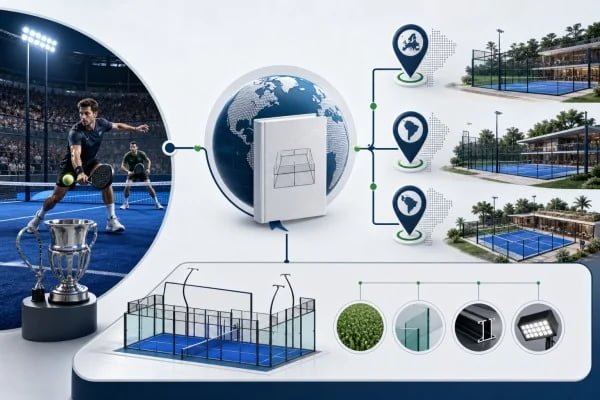
I distinguish them this way: FIP is the international governing federation; Premier Padel is a global professional competition brand or tour operating within the sport’s current international structure4; and national federations manage or represent padel at country level. Their relationships do not turn a tournament reference into a product certificate.
FIP is the international governing body
I associate FIP with international governance rather than manufacturing approval. Its official materials should be the primary source for its current statutes, rules, member information, rankings, and competition responsibilities.
A governing body can publish playing rules or competition conditions that influence court selection. For example, a project team may use current rules to review court layout, playing enclosure, access, lighting, or other competition-related details. However, conformance with one dimensional requirement does not establish full structural, electrical, fire, accessibility, or building-code compliance.
Premier Padel is a competition brand
I treat Premier Padel as a professional competition circuit, not as another name for FIP. The two are connected within the current global professional tour structure, but they remain different concepts.
That distinction has practical value. A photograph of a court at a professional event may demonstrate a design style, such as an ultra-panoramic viewing area. The photograph does not prove that another court from another factory has the same materials, engineering, testing, or event acceptance.
I ask buyers not to rely on phrases such as:
- “Tournament style”
- “Professional court”
- “Premier design”
- “FIP standard”
- “Used for competition”
- “Official dimensions”
These descriptions may be useful starting points, but they need supporting specifications and documents.
National federations operate at country level
National federations can have responsibilities that include domestic competitions, player development, national teams, club activity, or local implementation of sporting rules.5 Their exact authority and requirements vary by jurisdiction, so I never assume that one country’s process applies in another.
A club project can also involve organizations outside the sport:
- A local planning authority may review land use and noise.
- A building authority may review foundations and structural safety.
- A licensed engineer may calculate wind, seismic, or snow loads.
- An electrical authority may regulate lighting and wiring.
- A national federation or event organizer may review sporting requirements.
- An insurer may impose additional risk-control conditions.
This is why an understanding of FIP in padel should begin a compliance review, not end it. I recommend that buyers define the intended use first: recreational club, school facility, municipal project, national competition, or international event. Each use case can create a different approval path.
I treat institutional recognition, competition eligibility, product testing, and construction approval as four separate questions.
Does FIP in Padel Mean That a Court Is Certified?
The phrase “FIP-approved” can sound reassuring in marketing material, but an undefined claim gives a buyer very little protection. If the supplier cannot identify the approval document and its scope, the buyer may discover gaps only after the equipment reaches the construction site.
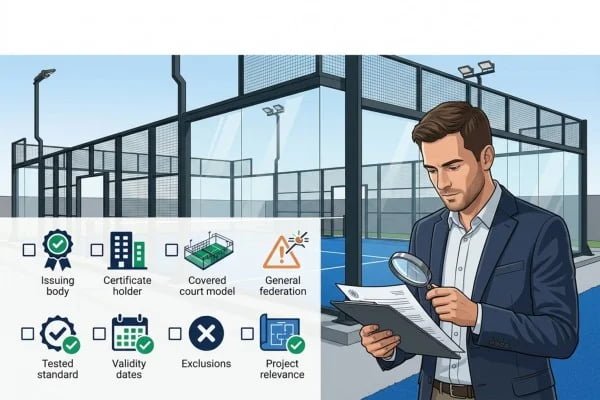
No, FIP in padel does not automatically mean that a court is certified. A buyer should request a specific, current document that defines any claimed recognition. The buyer should also verify the issuing body, certificate holder, covered model, tested standard, validity period, exclusions, and relevance to the intended project.
A name is not evidence of certification
A meaningful certification or test claim usually contains identifiable information. An acronym in a catalog does not provide enough evidence for technical procurement.
I look for the following details:
- Document type: certificate, test report, declaration, audit certificate, or calculation
- Issuing body: federation, laboratory, certification body, engineer, or authority
- Applicant or certificate holder: the legal company named in the document
- Product identification: model number, drawing, material, or sample description
- Applicable standard: the exact standard number and edition
- Date and validity: issue date, expiry date, or ongoing surveillance status
- Scope: the characteristics that were actually reviewed or tested
- Limitations: installation conditions, loads, locations, or excluded components
If a supplier claims that a padel court has a special FIP status, I would ask for the specific official document that creates and defines that status. I would then verify it with the purported issuer where possible. I would not infer approval from a logo, tournament photograph, or general statement about dimensions.
Different documents answer different questions
A complete padel court includes several product categories. No single generic certificate necessarily covers all of them.
| Document or evidence | What it may help demonstrate | What it does not automatically prove |
|---|---|---|
| Sports rules or court specifications | Playing dimensions and sporting conditions | Structural safety or local building approval |
| ISO 9001 certificate | A documented quality management system within its scope | Performance of every delivered product |
| CE-related documentation6 | Claimed conformity for covered products under applicable requirements | FIP recognition or universal project acceptance |
| Glass test report | Performance of the tested glass sample | Correct installation or frame strength |
| Steel material record | Material grade or batch information | Complete court resistance to site loads |
| Structural calculation | Design response under stated assumptions | Suitability when actual site conditions differ |
| Lighting test or photometric plan | Predicted or measured lighting performance | Electrical approval for every country |
| Factory inspection record | Manufacturing checks at a stated time | Compliance with all local construction rules |
At QHPADEL, we can provide documents associated with different components, including listed CE documentation for artificial turf, steel frame structures, tempered glass, and LED lights. Additional listed documentation includes RoHS for turf, specified AS/NZS glass and lighting standards, and documentation for screws and accessories. However, I advise every buyer to review the actual documents, model coverage, standards, dates, and project relevance. I do not present ordinary product certificates as FIP recognition.
Site engineering remains essential
A court can match playing dimensions and still be unsuitable for its location. Coastal corrosion, high wind, seismic activity, snow, drainage, soil conditions, and foundation design can change the engineering requirement.
I recommend qualified local professional evaluation for application-specific decisions. A structural engineer should assess the proposed design against local loads and codes. An electrical professional should assess lighting installation. The relevant authority or federation should confirm competition-specific requirements when the project will host regulated events.
What Should Buyers Verify When a Supplier Mentions FIP in Padel?
An unclear FIP claim can distract a procurement team from more important evidence. Missing foundation information, incomplete bills of materials, and unsupported structural assumptions usually create more immediate project risk. I use a document-based checklist to keep the evaluation focused.
When a supplier mentions FIP in padel, I ask for the exact rule, standard, approval, or certificate being referenced. I then compare its scope with the proposed court model and intended use. I separately verify structural engineering, component testing, quality controls, installation drawings, local codes, and tournament requirements.

1. I ask the supplier to define the claim
I avoid yes-or-no questions such as “Is your court FIP approved?” That wording lets an unclear claim remain unclear. I ask more precise questions:
- What does “FIP” mean in this quotation?
- Which official document supports the statement?
- Who issued the document?
- Which court model does it cover?
- Does it cover the full system or only selected specifications?
- Does it apply to a particular competition?
- Is independent verification available?
- Does the document remain current?
A credible supplier should be willing to clarify whether the statement refers to dimensions, rules, previous event use, a design description, or a formal document.
2. I review the complete court package
A complete package should be evaluated as a system even when individual parts have separate documentation. I normally review:
- Artificial turf specification, including pile characteristics, Dtex, density, color, backing, and infill requirements
- Steel grades, section sizes, coatings, welding quality, and traceability
- Tempered glass thickness, hole positions, edge quality, and test evidence
- Welded mesh dimensions and corrosion protection
- Structural posts, connection plates, and anchoring details
- Fastener grades and quantities
- LED power, optics, mounting, drivers, and electrical documents
- Net, posts, doors, handles, and protective accessories
- Spare parts and replacement procedures
- Packing list and component numbering
- Foundation and installation drawings
At our factory, I have seen how a small documentation gap can affect site work. A missing fastener description or unclear component number can delay installation even if the main steel and glass are correct. That experience is why I place a complete bill of materials beside any high-level marketing claim.
3. I match documentation to the project
I use a requirements matrix for larger purchases. This method makes gaps visible before the buyer pays the balance or books installation labor.
| Requirement | Evidence requested | Responsible reviewer |
|---|---|---|
| Playing layout | Current applicable sports rules and court drawing | Buyer, federation, or event organizer |
| Wind resistance | Site-specific design basis and structural calculation | Qualified structural engineer |
| Foundation | Foundation drawing and geotechnical/site input | Civil or structural engineer |
| Glass safety | Relevant test reports and product identification | Engineer, buyer, or authority |
| Turf performance | Technical data and applicable test documents | Buyer or sports-surface consultant |
| Lighting | Photometric plan and electrical documents | Lighting designer or electrician |
| Manufacturing quality | Inspection plan, tolerances, and quality records | Buyer or third-party inspector |
| Shipment completeness | Final packing list and loading evidence | Importer or logistics team |
| Local compliance | Permits, codes, and authority requirements | Local project professionals |
4. I verify the supplier as well as the product
Product documents matter, but supplier capability also affects delivery risk. I recommend checking factory identity, manufacturing experience, production capacity, export history, quality procedures, lead times, and replacement-part support.
QHPADEL operates 10 production lines and reports monthly capacity above 1.5 million square metres of artificial turf and 150 complete padel court systems. Our standard production guidance ranges from about 20 days for two courts to no more than 30 days for orders above four courts, while custom styles can require up to 35 days. Buyers should confirm the lead time in the final contract because specifications, order volume, holidays, and material availability can affect the schedule.
These capabilities do not replace project-specific technical review. They help a buyer evaluate whether the supplier can manufacture, document, pack, and deliver the agreed system.
Frequently Asked Questions
Is FIP a padel court certification?
No. FIP is the International Padel Federation. Its name alone is not a padel court certificate. If a seller claims a specific FIP approval or recognition, I recommend requesting the official supporting document and verifying its issuer, scope, covered model, date, and conditions.
Is Premier Padel the same as FIP?
No. I distinguish FIP as the international governing federation and Premier Padel as a professional competition brand or circuit within padel’s international structure. Buyers should check current official sources for their latest relationship because competition structures and commercial arrangements can change.
Does compliance with FIP rules guarantee local building approval?
No. Compliance with sporting rules does not automatically satisfy structural, electrical, fire, accessibility, planning, or environmental requirements.7 I advise buyers to consult qualified local engineers, contractors, authorities, and federation representatives for the requirements that apply to the intended site and use.
What should I request from a padel court supplier?
I recommend requesting a detailed quotation, complete bill of materials, technical drawings, foundation information, component specifications, relevant certificates and test reports, structural design basis, packing list, installation manual, warranty terms, and spare-parts policy. Buyers should verify each document’s scope rather than relying on marketing labels.
Can a CE document prove FIP recognition?
No. A CE-related document and an FIP-related claim concern different matters. I review CE documentation according to the applicable product and regulatory framework. I would only accept a claim of FIP recognition if a specific, current official document clearly defined that recognition and its scope.
Conclusion
FIP in padel stands for the International Padel Federation, the sport’s international governing body. I do not treat the acronym as automatic evidence that a court is certified, tournament-ready, or compliant with local construction rules. Buyers should separate federation rules, competition requirements, product documentation, and site engineering. They should then verify the exact standard, issuer, model, scope, and validity of every claim. For a documented padel court quotation, drawings, component specifications, or procurement checklist, contact Alice Chen at alice@grass-supplier.com or +86 185 7566 0746.
-
"International Padel Federation", https://en.wikipedia.org/wiki/International_Padel_Federation. The International Padel Federation identifies itself as the Fédération Internationale de Padel (FIP) and describes its international governance role for the sport of padel. Evidence role: definition; source type: institution. Supports: FIP’s full name and its role as the international federation governing padel.. ↩
-
"[PDF] SPORT DISCIPLINE REGULATIONS OF THE INTERNAtIONAL …", https://www.padelfip.com/wp-content/uploads/2023/02/3-SPORT-DISCIPLINE-REGULATIONS.pdf. FIP statutes and official regulations describe the federation’s functions in organizing international padel activity, maintaining rules and rankings, and coordinating with member federations. Evidence role: general_support; source type: institution. Supports: The federation’s published functions concerning rules, affiliated members, competitions, and rankings.. Scope note: The precise allocation of responsibilities can change with amended statutes or competition regulations. ↩
-
"Compliance FAQs: CE Marking", https://www.nist.gov/standardsgov/compliance-faqs-ce-marking. European Commission guidance explains that product conformity must be demonstrated through the applicable product-specific assessment and documentation; an organizational acronym alone is not evidence of conformity for a particular product or installation. Evidence role: general_support; source type: government. Supports: That conformity claims require identifiable, product-specific supporting documentation rather than an unexplained organizational reference.. Scope note: EU CE-marking guidance applies to products within relevant EU legislation and does not itself determine whether FIP offers any separate recognition program. ↩
-
"Qatar Airways Premier Padel Tour 2026", https://www.padelfip.com/calendar-premier-padel/. Official Premier Padel and FIP materials describe Premier Padel as an international professional competition circuit operating in connection with the sport’s international governance structure. Evidence role: definition; source type: institution. Supports: Premier Padel’s status as an international professional competition circuit and its relationship with FIP.. Scope note: Commercial and governance arrangements for professional tours may be revised over time. ↩
-
"Inclusive, sustainable, welcoming national sports federations", https://iris.who.int/bitstreams/a53a1b42-2ca4-42da-a28c-feaff98742e5/download. Sports-governance guidance describes national federations as bodies that commonly organize domestic competition, select national teams, support participation and clubs, and administer sport-specific rules within their jurisdiction. Evidence role: general_support; source type: institution. Supports: The typical governance functions exercised by national sports federations.. Scope note: The legal authority and operational responsibilities of any individual national padel federation depend on the relevant country and its federation statutes. ↩
-
"CE marking", https://en.wikipedia.org/wiki/CE_marking. European Commission guidance states that CE marking indicates a manufacturer’s declaration that a product meets applicable EU requirements; it is not a general quality endorsement or evidence of recognition by a sports federation. Evidence role: definition; source type: government. Supports: The purpose and limits of CE marking and associated EU conformity documentation.. Scope note: CE obligations apply only where harmonised EU product legislation covers the relevant product and intended market. ↩
-
"Building Codes, Standards, and Regulations: Frequently …", https://www.congress.gov/crs-product/R47665. Building-regulation guidance treats structural safety, fire safety, accessibility, and building services as separate compliance areas, so conformance with a sport’s playing rules does not by itself establish construction approval. Evidence role: general_support; source type: government. Supports: That construction projects are subject to separate structural, fire, accessibility, electrical, and planning requirements.. Scope note: The applicable codes, permits, and enforcement procedures depend on the country and local authority. ↩