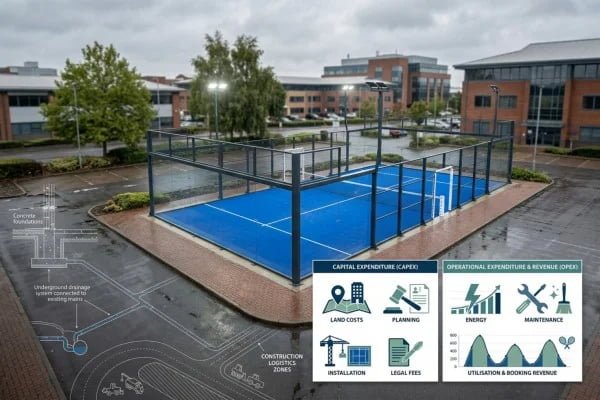
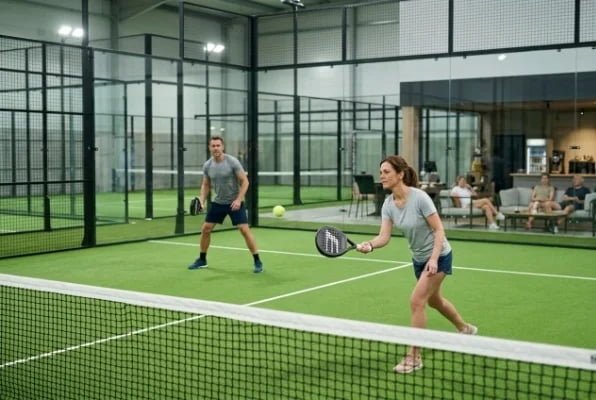
Padel vs. pickleball vs. tennis vs. paddle tennis can confuse investors because the sports share rackets, nets, and similar names. That confusion becomes expensive when it enters drawings, budgets, or tender specifications. I compare the sports by court design, playing style, target users, space needs, and operating model before recommending any facility.
Padel, pickleball, tennis, and paddle tennis use different court dimensions, equipment, rules, and playing environments. Padel requires an enclosed court with playable walls.1 Pickleball uses a compact open court and perforated ball.2 Tennis needs a larger open court. Paddle tennis varies regionally and must be defined before a venue is specified.
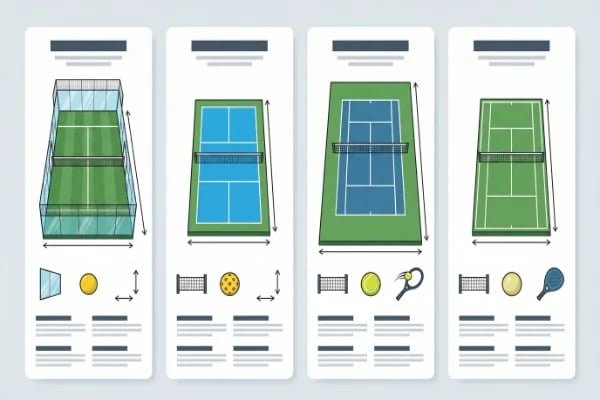
A basic sports comparison only starts the conversation. In my experience answering project inquiries, the more important questions are who will use the venue, what they expect to play, how much space is available, and whether the facility must generate revenue.
Padel vs. Pickleball vs. Tennis vs. Paddle Tennis: What Defines Each Sport?
Similar rackets and nets make these sports look interchangeable to a newcomer. However, that first impression hides major differences in walls, surfaces, balls, court dimensions, and play. I first identify the intended sport because every later procurement decision depends on that definition.
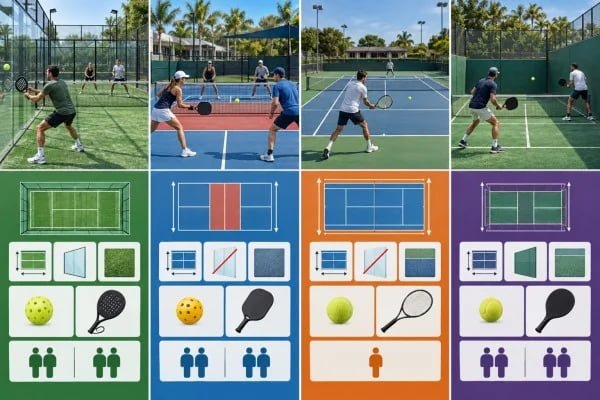
Padel is an enclosed doubles sport that allows play off the walls. Pickleball is a compact net sport with paddles, a perforated plastic ball, and a non-volley zone. Tennis uses strung rackets on a large open court. Paddle tennis generally uses solid paddles on a smaller court, but its exact meaning varies by region.
Padel
I describe padel as a purpose-built, enclosed racket sport. A standard court is 20 metres long and 10 metres wide.3 It is normally designed for doubles, although separate single-court formats also exist.
The enclosure forms part of the game. Players can return the ball after it rebounds from permitted glass or wall surfaces. The metal mesh also affects play under the applicable rules. A padel project therefore involves much more than painting lines and installing a net.
A complete commercial padel court package commonly includes:
- Structural steel posts and frames
- Tempered glass panels
- Welded mesh sections
- Artificial turf
- A court net and posts
- LED lighting fixtures
- Fasteners and connection accessories
- Foundation and installation drawings
- Packing lists and maintenance documentation
Padel uses a perforated, solid-faced racket and a pressurized ball that resembles a tennis ball. Its serve is underhand after a bounce.4 Its scoring format is traditionally close to tennis scoring, although event formats can differ.
Pickleball
Pickleball uses a 44-by-20-foot court, or approximately 13.41 by 6.10 metres. The same basic court dimensions apply to singles and doubles. The court includes a seven-foot non-volley zone on each side of the net5, commonly called the kitchen.
Players use solid paddles and a perforated plastic ball. The ball travels differently from a tennis or padel ball. Pickleball also does not depend on glass walls or a structural enclosure.
Its smaller footprint can make it attractive to schools, community centers, hotels, and multi-sport venues. However, I would not treat the smaller playing rectangle as the entire spatial requirement. Designers must also provide safe run-off space, circulation, fencing where needed, and separation between neighboring courts.
Tennis
Tennis has the largest playing area among the four sports in this comparison. A regulation court is 23.77 metres long. It is 8.23 metres wide for singles and 10.97 metres wide for doubles.6
Tennis uses strung rackets, pressurized felt-covered balls, and overhead serving. It can be played on several established surfaces, including:
- Hard court systems
- Clay
- Natural grass
- Synthetic turf
- Acrylic or cushioned coatings
Unlike padel, the perimeter fence is generally a ball-control feature rather than a playable wall. Tennis also requires significant space beyond the marked lines so that players can move safely.
Paddle Tennis
I use paddle tennis here as a broad term for smaller-court paddle games derived from tennis. I do not use it as another name for padel.
This distinction matters because “paddle tennis” is not interpreted uniformly worldwide.7 In some markets, people may mean traditional paddle tennis or POP Tennis. In others, they may actually mean platform tennis. Local speakers may even use “paddle” when they are referring to padel.
Those sports can have different:
- Court dimensions
- Perimeter systems
- Surface specifications
- Balls and paddles
- Serving rules
- Governing organizations
For that reason, I ask a buyer to provide the relevant rulebook, drawing, local federation name, or example venue before I prepare a technical proposal.
| Feature | Padel | Pickleball | Tennis | Paddle Tennis |
|---|---|---|---|---|
| Typical court concept | Enclosed court | Compact open court | Large open court | Smaller court; format varies |
| Playable walls | Yes | No | No | Depends on the defined sport |
| Main racket type | Solid, perforated racket | Solid paddle | Strung racket | Usually a solid paddle |
| Typical ball | Pressurized felt ball | Perforated plastic ball | Pressurized felt ball | Depends on the format |
| Common format | Doubles | Singles or doubles | Singles or doubles | Varies |
| Purpose-built structure | Normally required | Not always | Dedicated surfacing usually required | Depends on local definition |
These dimensions and descriptions are useful for early evaluation. Buyers should still verify current formal rules with the relevant governing bodies, such as the International Padel Federation, International Tennis Federation, and the applicable pickleball or paddle-sport organization in their market.
How Do Padel vs. Pickleball vs. Tennis vs. Paddle Tennis Court Requirements Compare?
A buyer can understand the rules and still choose the wrong facility. The real challenge appears when the sport reaches the site plan. Court footprint, foundations, enclosures, lighting, drainage, wind exposure, and installation scope can change both the budget and the approval process.
Padel usually requires the most integrated structural package because its glass and mesh enclosure forms part of play. Tennis needs the largest total site area. Pickleball has a smaller playing rectangle and can suit multi-court layouts. Paddle tennis requirements cannot be finalized until its regional format and governing rules are confirmed.
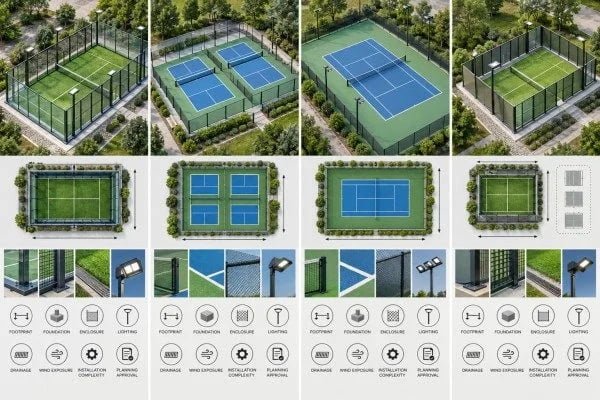
Playing Dimensions Are Not Total Project Dimensions
I often receive an inquiry that begins with a simple court measurement. I then explain that the official playing area is not the same as the total land requirement.
A project may also need space for:
- Player access and emergency exit routes
- Spectator seating
- Accessibility provisions
- Lighting columns or integrated fixtures
- Drainage channels
- Maintenance access
- Court-to-court separation
- Reception and equipment storage
- Structural foundations
- Protective perimeter fencing
A 20-by-10-metre padel playing area, for example, does not mean that a 20-by-10-metre plot is sufficient. The project team must allow for foundations, entrances, external clearances, construction tolerances, and local safety requirements.
Structural Scope
Padel has a distinctive procurement scope because the enclosure must work as a coordinated system. Glass thickness, hole locations, steel geometry, mesh alignment, fasteners, and foundation interfaces must correspond with one another.
When I review an inquiry, I look for answers to several practical questions:
- Is the site indoors or outdoors?
- What wind, snow, seismic, and corrosion conditions apply?
- Has a qualified local engineer reviewed the structure and foundations?
- Does the supplier provide numbered components and installation drawings?
- Are replacement glass and spare parts available?
- Who is responsible for installation and final acceptance?
Pickleball courts generally avoid the integrated glass-and-steel enclosure. However, outdoor facilities may still require perimeter fencing, wind screens, acoustic assessment, and lighting. Noise can be an important planning issue because paddle-to-ball contact has a distinctive sound.
Tennis projects also require more than a net and surface. A designer must consider base construction, court orientation, drainage, surface flatness, fencing, lighting, and run-off distances. The selected surface can also affect maintenance, ball speed, and user expectations.
Indoor and Outdoor Suitability
All four sports can appear in indoor or outdoor settings, but the site consequences differ.
| Site issue | Padel | Pickleball | Tennis | Paddle Tennis |
|---|---|---|---|---|
| Wind consideration | Critical for structural design outdoors | Affects ball flight and fencing | Affects play and fencing | Format dependent |
| Roof clearance | Must support lobs and lighting layout | Important but court-specific | Requires generous playing clearance | Must follow defined rules |
| Drainage | Essential outdoors | Essential outdoors | Essential outdoors | Surface dependent |
| Structural foundation | Required for the enclosure | Usually lighter scope | Primarily surface, fencing, and lights | Format dependent |
| Conversion potential | Limited without a purpose-built enclosure | Often possible on suitable existing slabs | Existing courts may support overlays | Must be assessed case by case |
I recommend that buyers avoid assuming an existing tennis slab can automatically become a compliant padel facility. A local structural professional should assess slab capacity, anchor locations, drainage, level tolerances, and foundation requirements. The court supplier can provide system loads and drawings, but local professionals must evaluate the actual site and applicable code.
Why Aren’t Padel and Paddle Tennis Interchangeable?
The words sound nearly identical, so buyers sometimes use them as synonyms. That creates a serious specification risk. A supplier may quote an enclosed padel system while the buyer expects a smaller open paddle court—or the buyer may approve drawings for a sport that local users did not request.
Padel and paddle tennis are not interchangeable because padel has a defined enclosed 20-by-10-metre court, playable walls, padel-specific rackets, and established rules. Paddle tennis usually describes a different small-court paddle sport, but its meaning varies by country. Buyers should define the governing rules before requesting drawings, prices, or approvals.
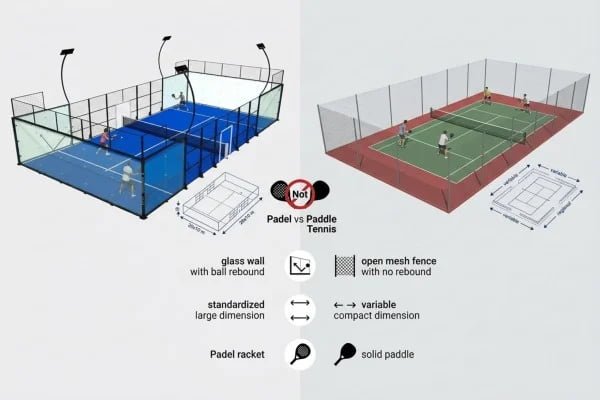
Similar Names Can Distort Procurement
I once handled the type of inquiry in which a buyer repeatedly wrote “paddle court” but attached photographs of panoramic padel courts. Instead of correcting one word and moving on, I asked what local customers called the sport, which clubs they visited, and whether walls were part of play. Those questions established the actual product category.
This terminology check matters at several project stages:
- Internal approval: Decision-makers may approve a concept without understanding the intended sport.
- Architectural planning: A designer may reserve the wrong footprint or omit structural foundations.
- Tender writing: A vague specification may attract incompatible quotations.
- Customer marketing: A club may promote a game that its installed court cannot support.
- Installation: Contractors may discover that the supplied structure does not match the prepared base.
- Final use: Players may reject the facility if it does not match familiar local rules.
A clear request should name the sport, governing rules, court dimensions, enclosure type, surface, and intended playing format.
Paddle Tennis, POP Tennis, and Platform Tennis
Regional terminology requires special care. Traditional paddle tennis and POP Tennis can refer to compact tennis-derived games played with solid paddles. Platform tennis is another distinct sport. It is commonly associated with a raised deck, a smaller court, and surrounding screens that can remain in play.
Those terms should not be collapsed into one universal specification. Even if two courts have similar dimensions, their playing surfaces, screen arrangements, balls, and construction methods may differ.
I use a simple confirmation process before discussing price:
- I ask for the exact sport name in the local market.
- I request a link to the relevant federation or official rules.
- I ask for reference photos or a venue address.
- I confirm whether the ball can rebound from walls or screens.
- I confirm the required playing dimensions.
- I ask whether the project needs competition compliance or leisure use only.
A court name is not a technical specification. Buyers should attach a recognized rule reference and dimensioned layout to every request for quotation.
Avoiding False Equivalence
Recreational venues sometimes adapt spaces for several activities. That flexibility can be commercially useful, but it does not make the sports or courts formally interchangeable.
A temporary pickleball layout on a suitable tennis surface may support casual play. It does not mean that every tennis court provides an ideal or compliant pickleball experience. Similarly, adding short fencing to an open court does not create a padel court. Padel depends on a coordinated enclosure with specific rebound surfaces and geometry.
I encourage buyers to label adaptations honestly. A “multi-use recreation court” and a “regulation padel court” create different expectations. Clear language protects the operator, contractor, supplier, and end user.
How Should Buyers Choose Between Padel, Pickleball, Tennis, and Paddle Tennis?
Choosing a sport only because it is growing elsewhere can expose a venue to weak local use. Choosing only by court footprint can create operational problems. I reframe the comparison around users, site conditions, and the business model because those factors determine whether a facility is practical.
Buyers should choose by answering three questions: Who will use the court and which sport has verified local demand? What space, climate, foundations, and approvals does the site support? Will the venue operate as a leisure amenity, public facility, school resource, or paid booking business?
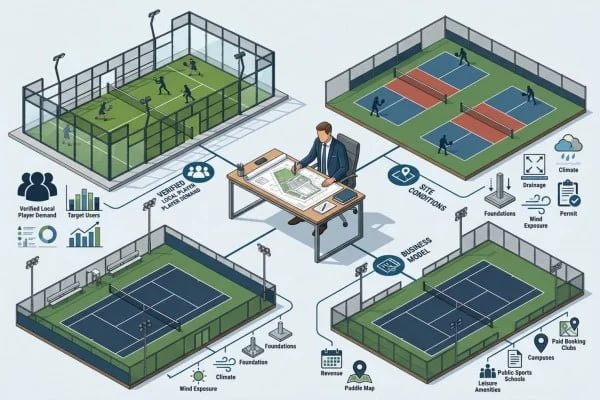
1. Who Will Use the Facility?
I start with users rather than equipment. A hotel may want a recognizable leisure amenity. A school may prioritize accessibility and class scheduling. A private club may need repeat bookings, coaching, leagues, and spectator appeal. A public buyer may focus on broad participation and documented compliance.
Useful demand evidence can include:
- Existing local clubs and utilization
- Search interest and social media communities
- Coaching availability
- Local leagues and federations
- Customer surveys
- Competitor pricing
- Age and skill profile of likely users
- Seasonal participation patterns
- Demand for singles versus doubles
Padel should not be assumed to be the best investment in every market. Pickleball, tennis, or a locally established paddle game may fit the audience better. The buyer should validate demand with local operating data rather than rely only on global participation headlines.
2. What Can the Site Support?
The site can eliminate options before a financial model begins. Tennis generally needs the most land. Pickleball allows multiple compact courts, although safe clearances remain necessary. Padel uses a moderate playing footprint but adds structural and foundation requirements.
I recommend reviewing:
- Available length, width, and overhead clearance
- Existing slab condition and level tolerance
- Soil and foundation conditions
- Wind, snow, seismic, and corrosion exposure
- Drainage and flood risk
- Vehicle and crane access
- Noise sensitivity
- Lighting restrictions
- Planning approval
- Fire and emergency access
- Local building and accessibility codes
For outdoor padel systems, structural suitability cannot be decided from a product catalog alone. A hurricane-prone coastal site and a sheltered inland venue do not create the same engineering conditions. Buyers should obtain site-specific evaluation from qualified local engineers and authorities.
3. How Will the Venue Operate?
The operating model affects layout and specification. A paid club usually needs more than playable courts. It may require booking access, spectator circulation, coaching space, storage, cleaning procedures, spare components, and rapid maintenance support.
| Operating model | Main decision factors |
|---|---|
| Commercial club | Demand, booking yield, court throughput, coaching, maintenance |
| Hotel or residential amenity | Ease of use, appearance, noise, guest profile |
| School or university | Supervision, durability, scheduling, documentation |
| Public facility | Accessibility, tender compliance, safety, lifecycle cost |
| Distributor demonstration venue | Standardized SKU, branding, resale support |
| Private residence | Space, neighborhood impact, maintenance, intended use |
I advise investors to compare total installed scope, not only the equipment price. The comparison should cover freight, customs, foundations, local labor, lifting equipment, electrical work, drainage, installation, approvals, and spare parts.
Supplier Evaluation for a Padel Project
Because QHPADEL manufactures complete padel court packages, I often see how an incomplete bill of materials can delay installation. A responsible evaluation should check whether the quotation includes glass, steel, mesh, turf, lights, nets, fasteners, drawings, and packing identification.
At QHPADEL, our standard documentation can include foundation drawings, installation drawings, packing lists, and maintenance manuals. Our factory reports ISO 9001 certification, while product components have various CE and other test documents. However, I always encourage buyers to request current copies, confirm their scope, check issuing bodies, and verify whether they satisfy local tender or code requirements.
A procurement checklist should include:
- A complete bill of materials
- Dimensioned court and foundation drawings
- Steel and glass specifications
- Turf Dtex, density, color, and infill requirements
- Lighting data and electrical requirements
- Certificate and test-report copies
- Packaging and component numbering
- Production and shipping schedule
- Installation responsibility
- Warranty exclusions and claim procedures
- Recommended spare parts
- Site-specific structural review requirements
No certificate should replace local professional approval. The architect, engineer, installer, electrical contractor, and authority having jurisdiction should review the application within their respective responsibilities.
Frequently Asked Questions
Is padel more similar to tennis or pickleball?
Padel shares tennis-style scoring, a felt-covered ball, and some stroke techniques with tennis. However, it uses solid perforated rackets, an underhand serve, a smaller enclosed court, and playable walls. Its compact dimensions may resemble pickleball at first glance, but the court structure and playing patterns are substantially different.
Can I convert a tennis court into padel or pickleball courts?
A tennis surface may sometimes support pickleball line marking or a planned conversion. Padel requires a purpose-built enclosure and suitable foundations, so conversion needs structural and site assessment. I recommend checking dimensions, slab condition, drainage, anchors, lighting, access, and local approvals before assuming that any conversion is feasible.
Is paddle tennis another name for padel?
No. Padel has recognized court dimensions, playable glass or wall surfaces, mesh sections, and its own rules. Paddle tennis usually refers to a different compact paddle sport, but the term changes across markets. Buyers should identify the local governing body and attach the correct rulebook to procurement documents.
Which sport requires the least space?
Pickleball has the smallest standard playing rectangle among the clearly defined sports in this comparison. However, the project still needs safe perimeter clearances, access, fencing where appropriate, and court separation. Paddle tennis dimensions vary by format, so buyers must confirm the exact version before comparing total land requirements.
What documents should I request from a padel court supplier?
I recommend requesting a complete bill of materials, technical specifications, foundation drawings, installation drawings, packing lists, maintenance guidance, warranty terms, and relevant certificates or test reports. Buyers should verify each document’s validity and scope. A qualified local engineer should also review structural loads, foundations, and code compliance.
Conclusion
The padel vs. pickleball vs. tennis vs. paddle tennis decision goes far beyond rackets and scoring. Each sport creates different requirements for land, surfaces, structures, installation, approvals, and daily operation. I recommend that buyers first verify local demand, then assess the site and define the operating model. Formal rules and regional terminology should also be confirmed before specifications are issued. For a complete padel court proposal, drawings, or procurement checklist, contact Alice Chen at alice@grass-supplier.com or +86 185 7566 0746 via phone or WhatsApp.
-
"Documents", https://www.padelfip.com/documents/. The International Padel Federation’s rules define padel as a game played on an enclosed court and specify how rebounds from the court walls may be played. Evidence role: definition; source type: institution. Supports: The official rules describe padel’s enclosed court and the circumstances in which balls rebounding from walls remain in play.. ↩
-
"What Is Pickleball", https://usapickleball.org/what-is-pickleball/. Official pickleball rules specify a perforated plastic ball and a marked court layout without the playable enclosing walls used in padel. Evidence role: definition; source type: institution. Supports: Official pickleball rules specify the perforated plastic ball and court configuration, which does not include playable enclosing walls.. ↩
-
"rules-of-padel.pdf", https://www.lta.org.uk/490bb5/siteassets/compete/padel/file/rules-of-padel.pdf. The International Padel Federation specifies a standard padel court measuring 20 metres in length and 10 metres in width. Evidence role: definition; source type: institution. Supports: The International Padel Federation’s court specifications give the standard court dimensions as 20 metres long by 10 metres wide.. ↩
-
"Padel Rules and Regulations", https://ilovepadel.eu/padel-rules-regulations-official-fip/. The International Padel Federation’s rules require the server to bounce the ball and strike it at or below waist level, producing the sport’s characteristic underhand serve. Evidence role: definition; source type: institution. Supports: The official padel rules prescribe a bounced serve struck at or below the permitted height.. ↩
-
"Pickleball Rules – Recreational Sports and Fitness Services", https://recsports.msu.edu/activity-rules/pickleball-rules. The USA Pickleball official rulebook defines the non-volley zone as the area extending seven feet from the net on each side. Evidence role: definition; source type: institution. Supports: The official rules define the non-volley zone as extending seven feet from each side of the net.. ↩
-
"[PDF] ITF RULES OF TENNIS", https://www.itftennis.com/media/7221/2026-rules-of-tennis-english.pdf. The International Tennis Federation’s Rules of Tennis specify a 23.77-metre court length, with widths of 8.23 metres for singles and 10.97 metres for doubles. Evidence role: definition; source type: institution. Supports: The ITF’s Rules of Tennis specify the length and singles and doubles widths of a regulation court.. ↩
-
"Paddle tennis", https://en.wikipedia.org/wiki/Paddle_tennis. Reference accounts distinguish paddle tennis (including POP Tennis) from platform tennis as related but separate tennis-derived paddle sports with different court and equipment conventions. Evidence role: historical_context; source type: encyclopedia. Supports: Reference sources distinguish paddle tennis or POP Tennis from platform tennis and describe separate rules, equipment, and court arrangements.. Scope note: Terminology remains market-dependent, so a reference source cannot determine how a particular local buyer uses the term. ↩