Are you frustrated by inconsistent game speeds on your courts? Understanding the variables behind ball velocity is crucial for player satisfaction and court longevity. Let’s fix this uncertainty today.
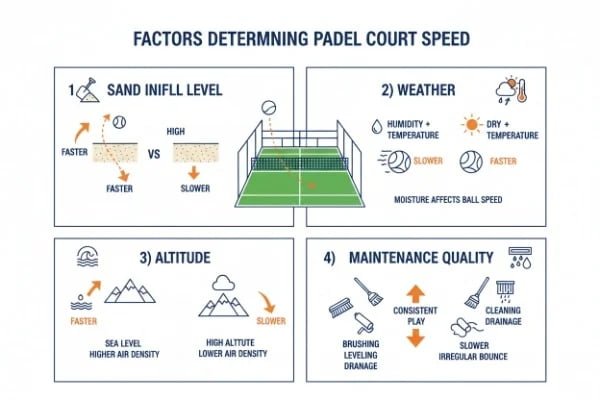
The speed of a padel court depends on sand infill levels, weather conditions like humidity and temperature, altitude, and maintenance quality. Lower sand levels create faster bounces, while high humidity and low altitudes slow the ball down. Proper maintenance ensures consistent playability.
I remember my early days as an artificial turf engineer. I was confused why the same turf played differently in two locations. I quickly learned that external factors matter just as much as the product itself. In this article, I will explain these critical factors clearly.
How Do Surface Type, Climate, and Altitude Influence Padel Court Speed?
Do your courts feel sluggish in winter or too fast in summer? Ignoring environmental impacts can ruin the playing experience for your club members.
Sand quantity is the primary factor; less sand means less friction and a faster game. Additionally, higher altitudes increase speed due to thinner air, while cold weather and wet surfaces increase friction and drag, making the game significantly slower.
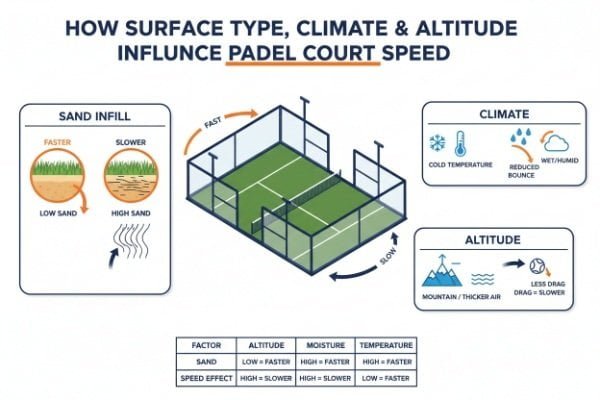
I see many club owners focus only on buying the turf. They often forget the environment. The sand infill is the first thing I check when analyzing speed. If you use a texturized turf with less sand, the ball interacts more with the fiber and the glass. This interaction creates a clean, smooth bounce. Consequently, the game becomes very fast. However, if you fill the court with a high volume of sand, the ball hits the sand layer first. Friction increases immediately. This friction slows the ball and the overall game pace.
You must also consider where you build your facility. Physics plays a huge role here. High altitude locations have lower air density. The ball flies through the air with very little resistance. It feels like a rocket coming off the racket. Conversely, at sea level, the air is thicker. This higher air density leads to greater drag, which naturally slows the ball down.
Weather changes everything too. In cold weather, the internal pressure of the ball decreases. It does not bounce well off the surface. If the turf is wet from rain or high humidity, the felt on the ball absorbs water. The ball becomes heavy. The wet turf also grabs the ball more aggressively. All these factors combine to dictate the pace. You must know your local conditions before you choose your turf type.
Key Environmental Factors
| Factor | Condition | Impact on Speed |
|---|---|---|
| Sand Infill | Low Content | Faster (Less friction) |
| Sand Infill | High Content | Slower (More friction) |
| Altitude | High Altitude | Faster (Low air density) |
| Altitude | Sea Level | Slower (High air drag) |
| Moisture | Wet/Humid | Slower (Heavy ball) |
| Temperature | Cold | Slower (Low ball pressure) |
What Role Does Regular Maintenance Play in Preserving Court Speed and Consistency?
Is your court speed dropping despite buying high-quality turf? Neglecting routine care leads to uneven bounces and unhappy players who might leave your club.
Regular brushing distributes sand evenly, ensuring a consistent and flexible game pace. Without maintenance, compaction and wear can reduce court speed by up to 20%. A well-kept surface preserves the intended speed and significantly extends the lifespan of your investment.
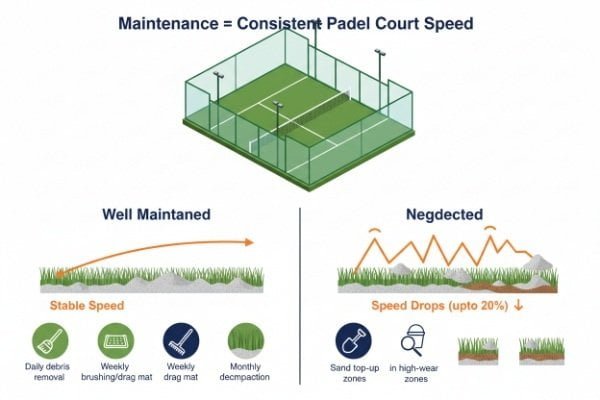
I always tell my clients that buying the court is just step one. I have seen premium courts turn terrible in six months without care. A smooth, well-maintained lawn ensures an even ball bounce. It keeps the game pace flexible and enjoyable. When you play on a neglected court, you feel the difference immediately. The ball might hit a patch with no sand and skid quickly, or hit a pile of sand and stop dead. This inconsistency frustrates players.
Wear and tear are natural in this business. However, a lack of maintenance exacerbates the problem significantly. In my experience, poor maintenance can reduce the effective speed of the game by up to 20% in specific areas of the court. When you do not brush the turf, the fibers lay flat. The surface becomes hard and slippery, or sometimes too slow due to compaction.
You need to brush the turf regularly. This simple action keeps the fibers upright. It keeps the sand level consistent across the playing area. This consistency is what players pay for. It is not just about looks; it is about performance reliability. If you want a fast court to stay fast, you must maintain it. If you want a slow tactical court to remain playable, you must groom it. A well-maintained court surface not only extends the court’s lifespan but also directly affects its speed.
Maintenance Tasks for Speed Control
- Daily Check: Remove debris that can deflect the ball.
- Weekly Brushing: Redistributes sand to prevent "dead spots" where the ball slows down.
- Monthly Decompaction: Loosens hard sand to restore the natural bounce and speed.
- Sand Top-up: Adds sand to high-wear areas to maintain friction levels.
Fast vs. Slow Padel Courts: How Should Players Adjust Their Tactics and Playing Style?
Do players struggle to adapt when switching between different court speeds? Failing to adjust tactics leads to unforced errors and frustrating losses during important matches.
On fast courts, players must shorten their swings and prioritize net dominance due to reduced reaction times. Conversely, slow courts require patience, focusing on consistent lobbing and controlling the rally to force opponents into making mistakes over long exchanges.
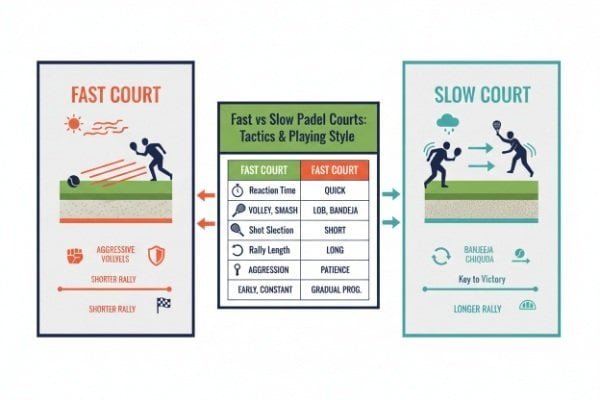
As someone who loves the sport, I adjust my game based on the surface I am playing on. You cannot play the same way everywhere. On a fast court, typically one with less sand or in dry heat, everything happens quickly. The ball skids off the glass with speed. You have very little time to think or prepare your shot. Mastering volleys and backhands is crucial here. The reaction time is significantly reduced. You need to be aggressive and take the net early. If you hesitate on a fast court, you lose the point.
Now, consider a slow court. This usually happens with more sand, old turf, or high humidity. The ball sits up after the bounce. It does not shoot away. Here, raw power is less effective. You cannot just smash the ball out of the court easily because the surface absorbs the energy. Controlling the net is key, but you must do it differently. You must maintain patience in prolonged rallies. You have to work harder to win the point.
For club owners, understanding this helps you market your courts better. You can advise players on what to expect. A hard racket works better on fast courts for control. A softer racket helps generate power on slow courts. Understanding these tactical shifts makes you an authority in the eyes of your customers. It shows you know the game, not just the construction materials.
Tactical Adjustments Table
| Feature | Fast Court Strategy | Slow Court Strategy |
|---|---|---|
| Reaction Time | Very Short | Longer |
| Shot Selection | Volleys, Block Shots | Lobs, Bandejas, Chiquitas |
| Rally Length | Short | Long and Fatigue-inducing |
| Key to Victory | Aggression and Reflexes | Patience and Consistency |
| Net Play | Essential for finishing points | Used to build pressure |
Conclusion
Understanding surface friction, climate, and maintenance helps you control court speed. Use this knowledge to optimize your facility, satisfy players, and maximize your business success with QHPADEL.