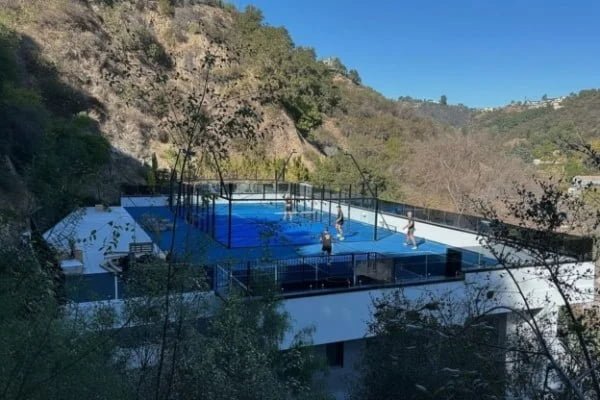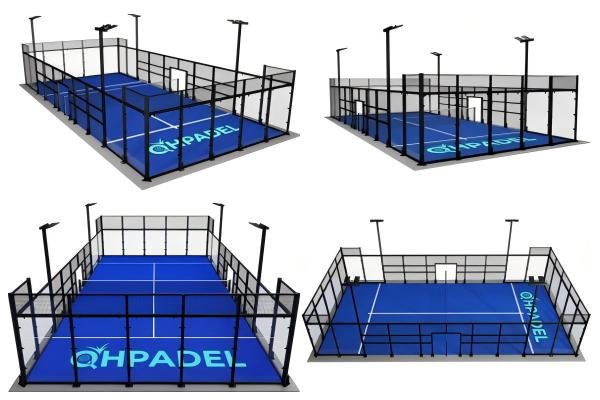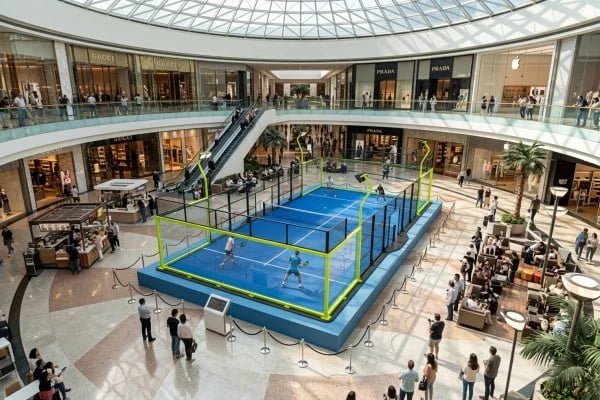

You invest heavily in your padel club, but unpredictable weather forces sudden cancellations. Every rained-out match or scorching afternoon burns a hole in your revenue. A retractable padel court roof solves this by turning weather-dependent courts into all-season profit centers.
A retractable padel court roof is a heavy-duty, motorized canopy structure designed to cover outdoor padel courts.1 It allows operators to open or close the roof based on weather conditions, protecting players from rain, snow, or extreme sun, thereby maximizing court rental hours and long-term club revenue.
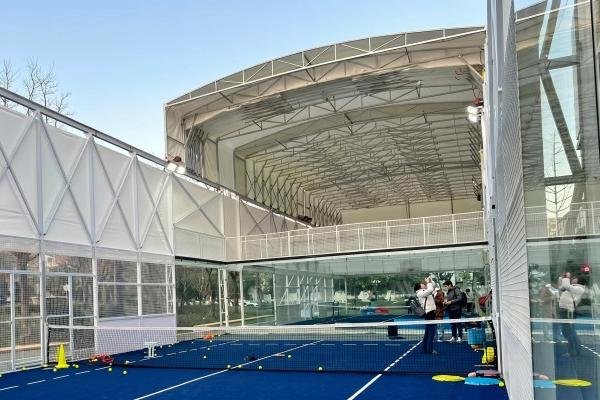
Understanding this system goes far beyond just buying a canopy. Let us look at how you calculate the true financial return, choose the right opening mechanism, and navigate the serious engineering requirements of these complex structures.
How does a retractable padel court roof generate ROI?
Justifying the upfront cost of heavy infrastructure can feel daunting. You might wonder if covering your courts is actually worth the high initial investment. The answer lies in recovering your lost operational hours.
A retractable padel court roof generates ROI by eliminating "dead hours" caused by bad weather. Club operators calculate this by multiplying their hourly court rental rate by the average number of hours previously lost to rain, snow, or extreme heat each year.
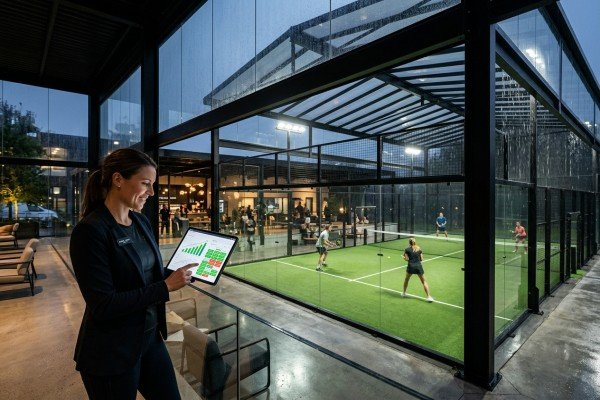
Many club investors view the roof as an expensive accessory. I always advise my B2B clients to view it as a critical revenue-protection tool. You cannot sell court time if the artificial turf is soaked or the midday sun is dangerously hot.
Let us look at a realistic financial scenario. Suppose your club charges $40 per hour for a court. If you lose an average of 4 hours a day to afternoon thunderstorms or intense midday heat for 80 days a year, you lose 320 hours per court. That equates to $12,800 in lost revenue per court, per year. If you operate a four-court club, that is over $50,000 left on the table annually. By installing a motorized canopy system, you instantly reclaim those lost hours.
Factors Influencing Your Payback Period
When evaluating the business case for your club, consider these variables:
- Local Climate Volatility: Regions with heavy seasonal rains (like parts of Southeast Asia or South America) see faster ROI because they recover more playable hours.
- Peak Hour Protection: Rained-out peak evening hours hurt your bottom line more than quiet morning hours. Guaranteeing play during prime time builds incredible customer loyalty.
- Premium Pricing Strategy: Covered courts often command a 10% to 20% higher rental fee. Players willingly pay a premium because they value guaranteed playtime without the risk of last-minute cancellations.
This is not a simple add-on. It is a heavy engineering investment. You need to forecast your exact local weather patterns to determine how quickly the recovered revenue will pay off the initial capital expenditure.
Which retractable padel court roof design is best for your climate?
Choosing the wrong roof design can lead to operational disaster. You install an expensive system, only to find water dripping onto your artificial turf during a storm. The culprit is often choosing aesthetics over pragmatism.
The best retractable padel court roof design depends on local rainfall. Single-opening roofs slide in one direction and offer superior waterproofing for rainy climates. Center-opening roofs split in the middle but are prone to seam leakage after prolonged use.
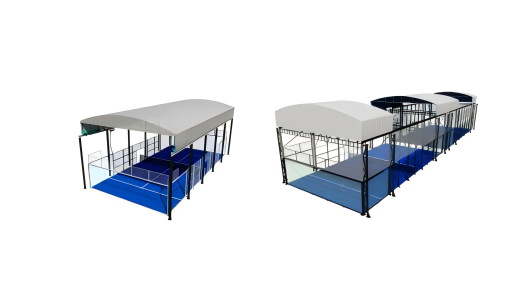
I see a major design trap in our industry today. Many club operators blindly request center-opening roofs because they look symmetrical and high-end when opening. I always pause the conversation here to discuss local weather realities.
The Center-Opening Trap
Center-opening (bi-parting) roofs have a seam directly down the middle of the court, directly above the net line. Over time, the rubber weather seals undergo thermal expansion and contraction from sun exposure. Dirt and dust get into the tracks. Eventually, the tight seal degrades. During a heavy downpour, that center seam becomes a vulnerability. Water drips directly onto the court, making the surface unplayable and creating a massive slip hazard for your players.
The Single-Opening Advantage
A single-opening roof pulls the entire canopy from one side of the structure to the other. There is no middle seam over the play area. The structural overlap protects the court completely, ensuring water runs off the sides rather than dripping into the middle.
Here is how I recommend evaluating your design options:
| Climate Profile | Recommended Design | Core Benefit | Main Drawback |
|---|---|---|---|
| Heavy Rain / Monsoon | Single-Opening | 100% waterproof protection over the play area | Asymmetrical visual look when open |
| Dry / Desert / High Wind | Center-Opening | Faster opening times, balanced visual aesthetic | High risk of seam leaks in rare storms |
If you operate in South America or Southeast Asia where sudden downpours are common, the single-opening design is your safest long-term investment. Reserve the center-opening models for arid regions in the Middle East where the primary goal is sun protection, not waterproofing.
How do engineering standards ensure padel court roof safety?
A collapsing roof is a club owner’s worst nightmare. Extreme weather events are increasing globally, and a cheap, flimsy structure puts both your players and your business at massive risk. You must prioritize structural integrity above all else.
Engineering standards ensure safety by calculating specific wind and snow loads for the retractable padel court roof. Using CE-certified, heavy-duty steel prevents structural deformation under stress, ensuring the heavy canopy frame withstands extreme local weather without collapsing.
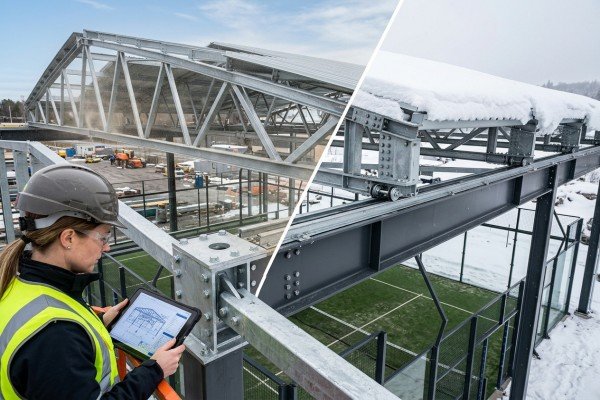
You cannot treat a retractable roof like a simple pop-up event tent. It is a massive steel structure suspended high over a playing area. The dynamic loads created by high winds, combined with the weight of a heavy motorized track system, demand strict engineering compliance.
In our factory at QHPADEL, we never guess on structural integrity. We rely on CE-certified materials and rigorous mechanical calculations.
Why Steel Thickness and Specification Matters
When high winds hit the side of a covered court, the large canopy structure acts like a sail, catching the wind. If the steel columns are too thin, the frame will experience structural deformation. This means the beams and tracks will bend. Once a track bends even a few millimeters, the motorized wheels will jam, and your roof will fail to open or close.
- Standard Courts vs. Roofed Courts: A standard classic or panoramic padel court frame cannot support a roof. A roofed court requires a completely upgraded, reinforced, and independent steel skeleton designed specifically for that dead weight.
- Foundation Requirements: The concrete footings must be significantly larger and deeper. They must anchor the increased weight of the steel and resist the upward lift generated by high winds trapping air beneath the canopy.2
Verifying Supplier Standards
When you evaluate manufacturers for this heavy equipment, do not just look at marketing brochures. You must ask for hard documentation:
- CE certificates for the steel frame structure.
- Wind load and snow load resistance test reports.
- Comprehensive structural engineering drawings.
We provide our B2B clients with precise engineering drawings and complete Bills of Materials (BOM) with zero missing parts. However, it is vital to understand that this is only half the equation. Your local engineering and civil contractors must execute these plans perfectly to guarantee final safety.
What are the real permit and maintenance requirements?
Many buyers assume the hard part is over once they pay for the equipment. Then, local authorities halt construction, or the motors seize up after a year of neglect. Ignoring local regulations and physical maintenance will derail your project.
Buyers face strict local building permit requirements before installing a retractable padel court roof. Additionally, the motorized system requires ongoing operational maintenance, including regular track cleaning, motor inspections, and lubrication to prevent mechanical failures over time.
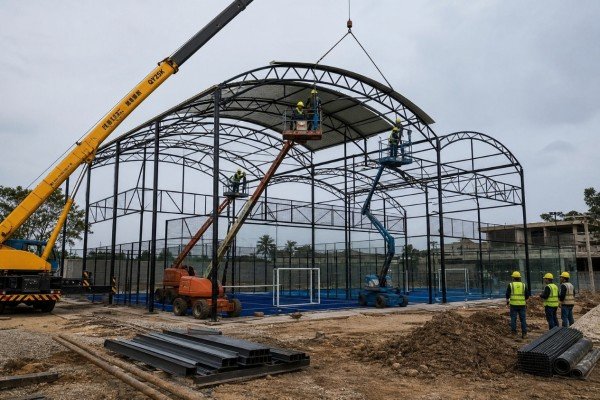
I need to be very clear about service boundaries in B2B transactions. As a manufacturer, QHPADEL supplies the CE-certified materials, structural calculations, and comprehensive installation drawings. We do not—and cannot—procure your local building permits or perform your daily physical maintenance.
The Reality of Building Permits
Securing a permit for an open-air padel court is generally straightforward. Securing a permit for a covered, motorized structure is an entirely different challenge. Municipalities often classify a roofed court as a permanent commercial building.
- You will need to submit our foundation and structural drawings to your local city planner.
- You will likely need a local structural engineer to stamp and approve the designs to meet specific local building codes.
- Do not order the equipment or pour concrete until you have preliminary written approval from your city.
The "Maintenance-Free" Myth
Any supplier who promises a 100% maintenance-free electric roof is not telling you the truth. Moving mechanical parts exposed to outdoor environments require consistent care.
To keep your system running smoothly, your club maintenance staff must follow a strict routine:
- Clear the tracks weekly: Leaves, dust, and sand will accumulate in the metal guide rails. If ignored, the wheels will grind against the debris and wear down prematurely.
- Lubricate moving parts: The gears, chains, and track wheels require weather-resistant lithium grease every few months to ensure smooth operation.
- Inspect electrical housing: Ensure the motor covers remain watertight. Check the wiring for wear to prevent electrical shorts during heavy rain.
Planning for these realities upfront ensures your heavy investment performs reliably for years to come.
Frequently Asked Questions
How much height clearance does a retractable roof need?
A standard roofed setup should offer at least 8 to 9 meters of clear internal height. This ensures players can comfortably execute lobs without hitting the canopy structure, tracks, or lighting fixtures.
Can I add a roof to my existing padel courts?
Rarely without major modifications. Standard court frames cannot bear the heavy load of a motorized roof. You typically need to upgrade the foundation and install a reinforced, independent steel framework over the existing court.
How fast does the motorized roof open and close?
Most industrial-grade motorized canopy systems take between 2 to 4 minutes to fully open or close. This allows operators to quickly secure the courts when unexpected rain suddenly begins.
Does the roof material block UV rays?
Yes, high-quality canopy materials are treated for heavy UV resistance. This protects players from extreme sun exposure and helps prevent the artificial grass from fading and degrading over time.
Conclusion
Investing in a retractable padel court roof transforms your facility from a weather-dependent gamble into a reliable, year-round business. By calculating your recovered lost hours, you can see the clear ROI of this upgrade. Remember to choose a single-opening design for rainy climates to avoid seam leaks, and always demand CE-certified steel to handle local wind loads. Proper planning for local building permits and routine motor maintenance will guarantee the longevity of your investment.
If you are a club operator or civil contractor looking for a reliable factory partner, contact QHPADEL today. We provide complete, export-ready court systems with precise engineering documentation to make your installation a success.
-
"typology of retractable roof structures in stadiums and sports halls", https://www.academia.edu/18969856/TYPOLOGY_OF_RETRACTABLE_ROOF_STRUCTURES_IN_STADIUMS_AND_SPORTS_HALLS. See architectural definitions of kinetic architecture and retractable sports enclosures, which describe these systems as motorized, load-bearing canopies designed for weather mitigation. Evidence role: definition; source type: encyclopedia. Supports: Defines retractable roofs in the context of sports architecture as motorized canopy systems.. Scope note: General architectural definitions may not specifically mention padel, focusing instead on broader tennis or multi-sport applications. ↩
-
"Wind Load Effects on Canopy Systems – Structure Magazine", https://www.structuremag.org/article/wind-load-effects-on-canopy-systems/. Aerodynamic studies on open-sided canopy structures show that wind flow can create significant positive pressure on the underside of the roof, generating severe upward lift forces that must be countered by the foundation. Evidence role: mechanism; source type: paper. Supports: Describes the aerodynamic mechanism by which wind creates positive pressure under a canopy, resulting in upward lift.. Scope note: The exact magnitude of the uplift force is highly dependent on the roof’s pitch angle and the presence of surrounding windbreaks. ↩