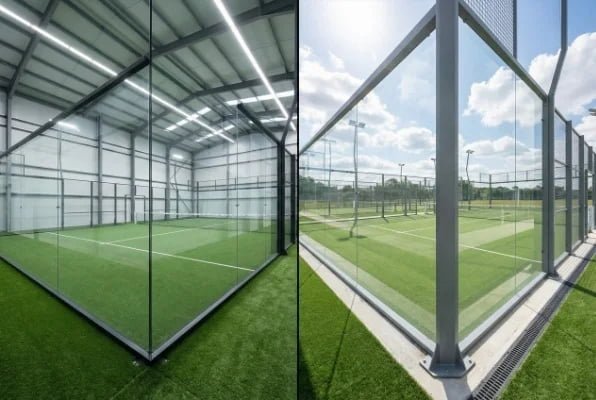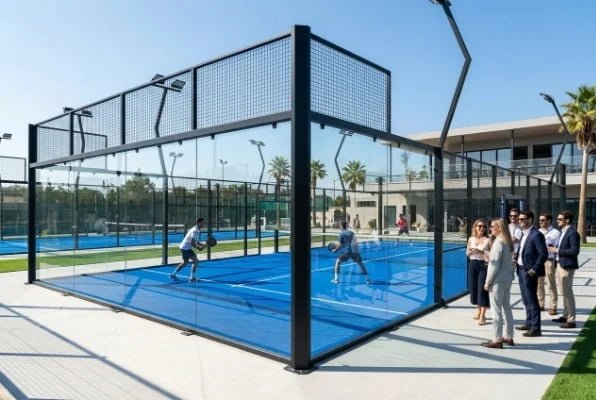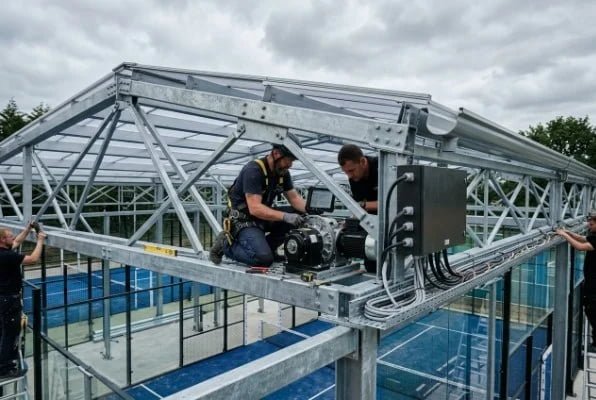

You secure a prime piece of commercial real estate for a new padel club, but the landlord strictly forbids pouring a permanent concrete foundation. Dealing with restrictive short-term leases and agonizingly slow municipal building permits can kill your project before it even starts. A temporary padel court solves this exact problem by bypassing destructive civil engineering entirely.
A temporary padel court is a highly engineered, modular sports facility built on a specialized all-terrain portable platform. Unlike traditional courts that require permanent concrete foundations, these systems use adjustable bases and counterweights, allowing investors to bypass building permits, protect short-term lease sites, and completely avoid end-of-lease demolition costs.
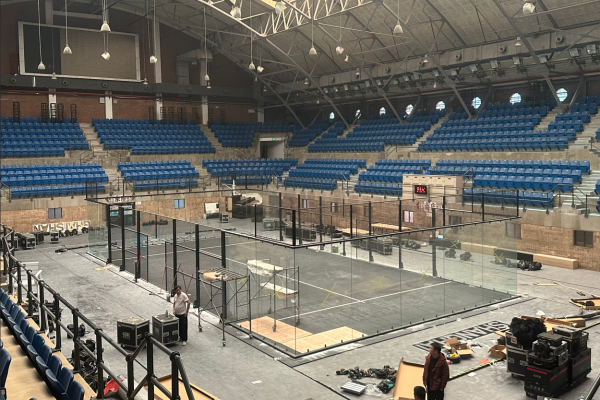
You might assume a portable system lacks professional rigidity or functions like a simple pop-up event tent. I want to walk you through the gritty logistical details of how these systems actually perform in the real world, and how they protect your commercial investment.
How does a temporary padel court save you money on short-term leases?
Club investors often panic when they see the premium price tag of a modular platform system. Spending more on equipment while leasing a temporary space feels counterintuitive. However, looking only at the equipment invoice blinds you to the actual total cost of ownership.
A temporary padel court saves money by eliminating hidden site costs. You bypass expensive concrete pouring, avoid lengthy delays waiting for municipal building permits, and completely erase the massive demolition and restoration fees required when you eventually return the leased land to the landlord.
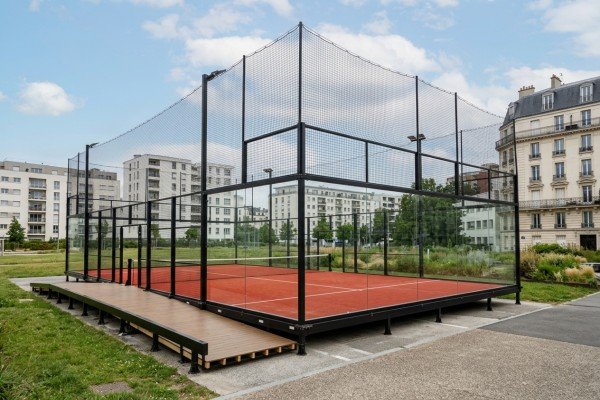
In my experience consulting for club operators and real estate developers, the initial price of a temporary padel court frequently causes sticker shock. But a specialized all-terrain portable platform is a calculated commercial strategy, not a cheap alternative to a standard court.
When you build a permanent court, the visible costs are just the beginning. You must excavate the land, lay a reinforced concrete slab, and wait weeks for the materials to cure. If you operate on a short-term lease—say, three to five years in a commercial plaza—your lease agreement will almost certainly contain a reinstatement clause.1 This means you must demolish that expensive concrete slab and restore the site to its original condition before you hand the keys back.
A temporary padel court completely changes this financial equation. By utilizing a heavy-duty portable platform, you turn a sunk cost (civil engineering) into a movable, depreciable asset.
Total Cost of Ownership Comparison
To understand the hidden cost savings, let us look at the fundamental differences in project phases:
| Project Phase | Traditional Concrete Foundation | Temporary Padel Court Platform |
|---|---|---|
| Site Preparation | Heavy excavation, soil removal, leveling. | Surface cleaning, marking footprint. |
| Foundation Build | Rebar grid installation, concrete pouring, curing. | Assembly of steel structural base network. |
| Permit Approval | Months of waiting for permanent structure permits. | Often classified as temporary equipment; much faster. |
| End of Lease | Heavy machinery demolition, waste disposal fees. | Disassembly, transport to a new profitable location. |
I recently helped a client who secured a highly profitable location in a retail parking lot. By opting for a modular platform rather than arguing with the landlord over digging rights, they opened their doors three months faster. Those three months of early revenue, combined with zero future demolition costs, easily paid for the premium price of the temporary structure.
Can you install a temporary padel court on any uneven surface?
Finding a perfectly flat piece of land in a high-foot-traffic commercial zone is almost impossible. You might find a great rooftop, an uneven grassy field, or a sloped parking lot, but correcting these surfaces traditionally requires heavy earthmoving machinery.
You can install a temporary padel court on uneven surfaces using a specialized adjustable base, but it requires meticulous on-site leveling. The system can compensate for height differences between 0 and 1 meter, but achieving a perfectly flat playing surface demands patience and professional measurement tools.
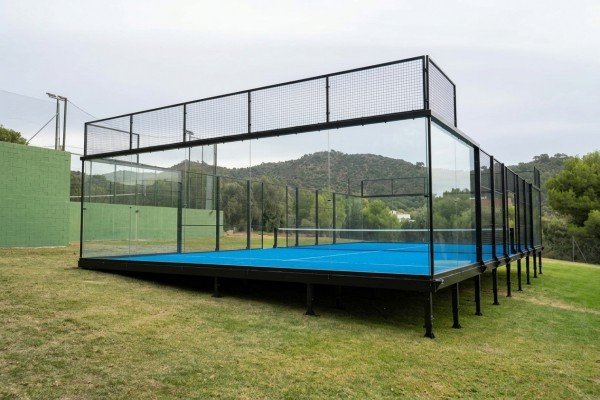
The ability to adapt to difficult terrain is the primary mechanical advantage of a temporary padel court. The base platform utilizes a network of heavy-duty adjustable steel jacks. These jacks allow the court to sit perfectly level even if the ground beneath it slopes drastically.
However, adjusting to height differences of 0 to 1 meter is the hard reality of ground leveling. Many buyers watch a time-lapse video of an installation and assume the platform magically aligns itself. It does not. The leveling process is a highly technical procedure.
The Reality of Precision Leveling
When local engineering contractors prepare the site, they must treat the portable platform with the same respect as a concrete slab. If the base is off by even a few millimeters, the tempered glass panels will not align properly, and the ball bounce on the artificial turf will suffer.
To achieve professional results, your installation team must follow a strict methodology:
- Establish a baseline: Use a professional laser level to identify the highest point of the uneven ground.2
- Adjust the jacks systematically: Begin setting the platform height from that highest point, adjusting each individual support foot outwards.
- Verify structural tolerance: Cross-check the level across multiple structural nodes before locking the bolts.
At QHPADEL, we provide comprehensive installation drawings and foundation blueprints. We expect our clients to hire competent local teams equipped with precise measurement tools. The system is brilliantly engineered to handle bad terrain, but patience during the leveling phase is absolutely mandatory.
Is building a temporary padel court a quick DIY project?
Because the system does not require concrete, many buyers mistakenly assume setting it up is like assembling household furniture. They plan to hire a few casual laborers and finish the entire build over a long weekend. This underestimation inevitably leads to broken materials and severe schedule delays.
Building a temporary padel court is not an easy DIY project. The structural integrity relies on professional-grade steel and heavy tempered glass. While an unexperienced local team can assemble the court by strictly following the manual, unloading the materials absolutely requires heavy machinery like a forklift.
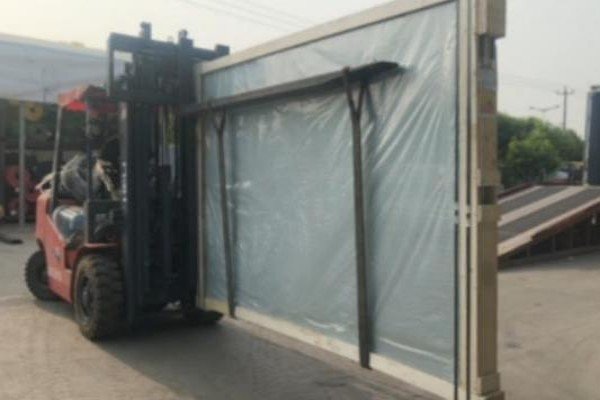
It is vital to break the illusion of effortless pop-ups. A temporary padel court uses the exact same professional-grade enclosure components as a permanent court. The word "temporary" refers only to its foundation methodology, not its structural weight or durability.
The logistics involved in handling these assets are intense. The steel frame structure is massive. The tempered glass panels (certified to strict standards like CE and AS/NZS 2208:19963) weigh hundreds of kilograms. You cannot unload a shipping container full of these materials by hand. Attempting to do so risks severe worker injury and guarantees shattered glass.
Mandatory Equipment for Safe Installation
If you are an equipment distributor or an event organizer managing your first portable installation, you must prepare the site properly. Unloading and assembly require specific tools:
- A heavy-duty forklift: Non-negotiable for safely extracting the A-frames of tempered glass and pallets of artificial grass from the shipping container.
- Industrial glass suction cups: Essential for lifting and positioning the heavy glass panels safely into the steel frame.
- Laser levels and string lines: As discussed, crucial for the specialized adjustable base.
- Torque wrenches: To ensure all high-tensile screws and accessories meet factory safety specifications.
An unexperienced local civil contractor can successfully install this system. The component numbering is clear, and the fastener kits are complete. However, they must leave their assumptions at the door, secure the right heavy machinery, and meticulously read the assembly manual step-by-step.
Are temporary padel courts safe against high winds?
Coastal cities and high-rise rooftops offer incredible views and heavy foot traffic for new padel clubs. However, exposing a large glass structure to strong gusts without permanent ground anchors creates a significant safety anxiety for investors and municipal planners alike.
Temporary padel courts are highly secure against wind, provided you perform a strict local wind load assessment. Because they do not use traditional anchor bolts drilled into concrete, the system relies entirely on the integrated platform weight and strategically placed extra counterweights to prevent tipping.
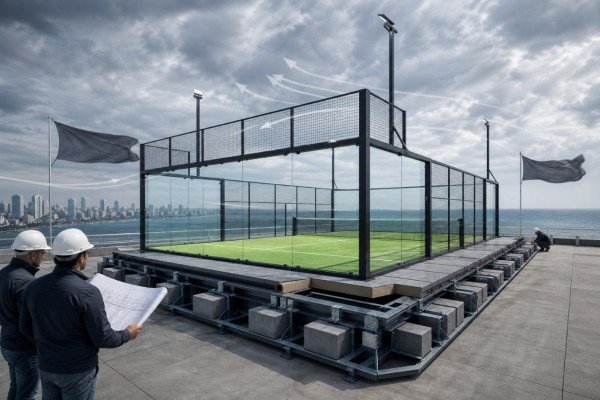
You cannot blindly install a court anywhere and expect it to survive a hurricane. The tempered glass walls of a padel court act like massive sails when high winds strike.4 On a traditional permanent court, deep chemical anchor bolts transfer this massive kinetic energy directly into a thick concrete foundation.5
A temporary padel court lacks these ground anchors. Therefore, we must replace that missing holding force with sheer mass. This is the wind load compromise: what you save in digging, you must make up for in strategic weighting.
Implementing Safe Counterweight Systems
Before installing a portable system in an open or elevated area, a strict assessment of the local climate is a non-negotiable safety requirement. You must consult local meteorological data and compare it against the structural limits provided by the manufacturer.
If the wind load assessment dictates it, the installation team must add mass to the platform base. This is typically achieved through several methods:
- Concealed concrete blocks: Heavy pre-cast blocks placed directly inside the hollow sections of the steel platform base.
- Sandbag ballasts: Durable sandbags strategically strapped to the lowest structural nodes.
- Water ballast tanks: Heavy-duty modular tanks integrated into the frame that can be drained when it is time to move the court.
Our steel structures at QHPADEL are CE-certified and engineered to withstand intense forces, but the platform must be properly ballasted to keep the entire unit rooted to the earth. Never skip the wind load assessment. Protecting your commercial investment means respecting the local weather conditions.
Frequently Asked Questions
Do I need a building permit for a temporary padel court?
While you bypass permanent foundation permits, you generally still need municipal approval. However, because these systems do not permanently alter the land, most local governments classify them as temporary or semi-permanent structures, significantly speeding up the approval process.
How long does a portable padel court last?
A temporary padel court has the exact same lifespan as a permanent one. The galvanized steel frames, tempered glass, and high-density artificial turf are built for long-term commercial durability, provided you follow standard maintenance protocols.
Can I move my temporary padel court to a new location?
Yes. The entire system is engineered for modularity. You can unbolt the steel framework, carefully remove the glass panels with suction cups, roll up the artificial turf, and transport the entire platform to a new commercial site.
What happens to the artificial turf when the court is moved?
The artificial grass is carefully rolled up during disassembly. When you reinstall the turf at your new location, you will likely need to brush in a fresh layer of silica sand infill to restore the optimal playing surface and ball bounce.
Conclusion
Understanding the true value of a temporary padel court requires looking beyond the initial equipment price. While the precision ground leveling requires patience, and the heavy-duty logistics demand forklifts and careful planning, the hidden cost savings are immense. By eliminating destructive civil engineering, bypassing lengthy permanent permit processes, and avoiding massive end-of-lease demolition fees, this system protects your capital on short-term leases. Always ensure your installation team respects the wind load requirements and utilizes proper counterweights.
-
"Commercial Make Goods: How To Avoid Landlord Disputes", https://www.tenantcs.com/blog/make-good-provision. In commercial real estate, reinstatement or ‘make good’ clauses are standard provisions requiring tenants to remove alterations and restore the premises to their original state at the end of the lease. Evidence role: definition; source type: institution. Supports: The definition and standard inclusion of reinstatement (or ‘make good’) clauses in commercial lease agreements.. ↩
-
"Surveying: Laser Level Basics", https://www.youtube.com/watch?v=7y1eGYiJDgw. Construction surveying principles dictate the use of rotary laser levels to establish an accurate datum point, typically the highest elevation, from which all subsequent leveling adjustments are calculated. Evidence role: mechanism; source type: education. Supports: The standard surveying methodology of using laser levels to establish elevation baselines for construction site grading.. ↩
-
"AS:NZS 2208 Safety Glazing Standard", https://www.elitesafetyglass.com/as-nzs-2208-safety-glazing-standard/. AS/NZS 2208:1996 is the joint Australian and New Zealand standard specifying the testing and performance requirements for safety glass, including tempered panels, used in building construction. Evidence role: definition; source type: institution. Supports: The definition and scope of the AS/NZS 2208:1996 standard for safety glazing materials in buildings.. ↩
-
"Aerodynamic Forces | Glenn Research Center – NASA", https://www1.grc.nasa.gov/beginners-guide-to-aeronautics/aerodynamic-force/. Structural engineering studies demonstrate that large, impermeable vertical surfaces, such as architectural glass walls, generate substantial stagnation pressure when subjected to high winds, requiring significant overturning resistance. Evidence role: mechanism; source type: paper. Supports: The mechanism of wind load pressure on solid vertical structures and how they capture kinetic energy.. ↩
-
"Chemical Anchors: The Ultimate Guide for Fastening …", https://fasteningspecialists.com/chemical-anchors/. Chemical anchors utilize a high-strength synthetic resin to bond a steel fastener to the concrete substrate, effectively transferring tensile and shear loads from the superstructure into the foundation. Evidence role: mechanism; source type: research. Supports: The engineering mechanism by which chemical anchors transfer structural loads into concrete substrates.. ↩