An “F padel racket” means a fiberglass padel racket in this article, but I would confirm that meaning with the seller because “F” is not a clear standalone category. Choosing by that label alone can leave you with the wrong racket. I recommend starting with your playing needs, then checking the complete specifications.
A fiberglass padel racket is often a suitable option for beginners, recreational players, lessons, rentals, and entry-level retail.1 I see it as a suitability choice, not simply a cheaper alternative to carbon. Its usefulness depends on the complete design, including its shape, weight, balance, core, construction quality, and price.
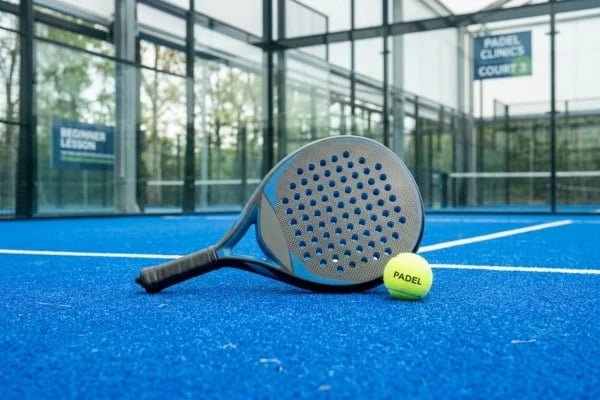
I approach this question from a seller’s and buyer’s perspective, rather than a materials engineer’s perspective. I want to connect the racket to its intended user. That means separating useful product information from material labels that promise more than they explain.
Who Is a Fiberglass Padel Racket Good For?
I understand why a new player wants a simple recommendation. Racket listings can make every material sound essential, while price differences make the decision harder. I start by asking what the player needs now, rather than what the most expensive model claims to deliver.
I consider a fiberglass padel racket a sensible candidate for beginners and recreational players who prioritize accessible playability and a manageable purchase price. However, I would only recommend a particular model after checking its weight, balance, shape, core, and handling2. The face material alone does not establish beginner suitability.3
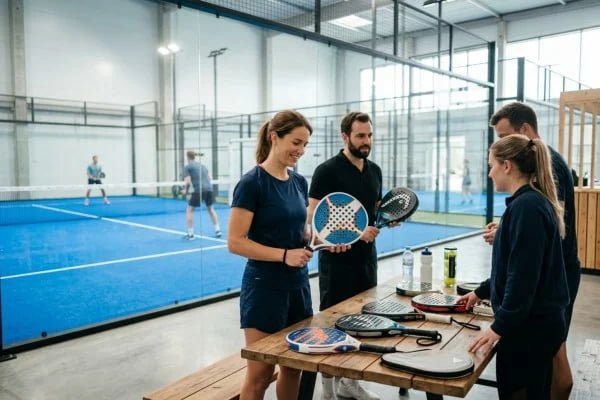
I match the racket to the player’s current needs
My starting point is not whether someone deserves an “advanced” material. I want to know whether the racket makes sense for their current use.
For a beginner, I would investigate these questions:
- The player’s experience: Has the buyer played padel before, or are they still learning basic positioning and stroke preparation?
- The playing schedule: Will the racket be used occasionally, every week, or across several weekly sessions?
- The handling preference: Does the player find the sample easy to prepare and reposition during normal play?
- The budget: Does the purchase leave room for lessons, court bookings, and other essential equipment?
- The buying horizon: Does the buyer want an introductory racket or a model they expect to keep using as their preferences develop?
A fiberglass padel racket can fit that brief without needing to outperform every carbon model. Its commercial role can be straightforward: it offers an accessible starting point when the complete product suits the player.
I do not assume every beginner needs the same racket
I would not give the same recommendation to every first-time buyer. A player with experience in another racket sport may have different preferences from someone starting their first racket activity. Two complete beginners may also disagree about the handling of the same sample.
That is why I prefer a supervised trial, where practical, over a decision based entirely on a product description. A qualified coach can help assess application-specific suitability, especially when a player struggles to distinguish a technique issue from an equipment preference.
I recognize who may be poorly served
A player with clear, demanding preferences may find that a particular entry-level model does not meet them. Someone may want a different balance, a more specific response, or tighter consistency between replacement rackets.
I would describe that as a mismatch with the model, not proof that fiberglass is an inferior category. Equally, I would not insist that a low-cost racket remains good value when the buyer already knows it does not suit their needs.
How Do I Evaluate a Fiberglass Padel Racket Beyond Its Face Material?
I become cautious when a listing treats “fiberglass” as a complete performance specification. That shortcut hides the features that determine whether the purchase fits the buyer. I ask for a fuller product description before comparing prices or recommending a sample.
I evaluate a fiberglass padel racket through its declared construction, shape, finished weight, balance, core, grip, and manufacturing consistency. I also check the warranty and specification tolerances. For personal purchases, I prioritize a practical trial; for commercial orders, I add sample approval and a documented inspection checklist.
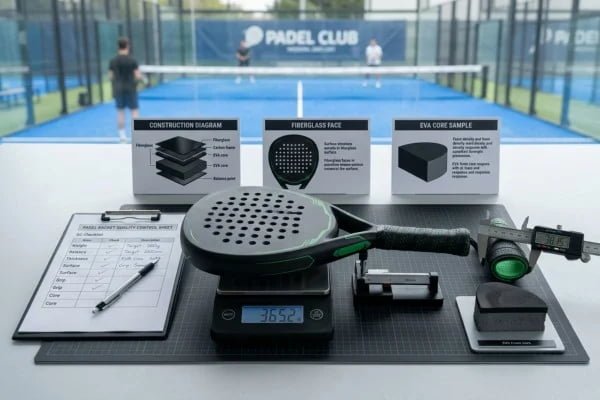
I turn a product label into a buying specification
I use the following checklist to make quotations more comparable. The purpose is not to predict every aspect of performance from a spreadsheet. The purpose is to expose missing information before money changes hands.
| Evaluation area | What I ask the seller | Why I consider it useful |
|---|---|---|
| Face construction | What material or material combination is used in the hitting faces? | I can distinguish a clear declaration from a vague marketing label. |
| Frame construction | What is the frame made from, and does it differ from the face? | I avoid assuming the entire racket uses one material. |
| Finished weight | What is the nominal weight, permitted variation, and measurement condition? | I can compare samples with the stated specification. |
| Balance | How does the supplier define and measure balance? | I can evaluate handling information more meaningfully. |
| Shape | What shape and dimensions does the model use? | I can identify design differences that deserve a playing trial. |
| Core | What core specification can the supplier document? | I avoid attributing the complete response to the face material. |
| Grip and strap | What grip dimensions and strap arrangement are supplied? | I can check the racket’s usability and completeness. |
| Warranty | What defects, exclusions, and claim procedures are documented? | I can assess after-sales responsibility before ordering. |
I separate published claims from verified information
Terms such as “soft,” “powerful,” and “forgiving” can be useful descriptions, but I do not treat them as universal consequences of fiberglass construction.
If a supplier claims that its model is more flexible or more durable than another, I ask what supports the comparison. A meaningful report should identify the tested model, the method, the conditions, and the comparison product. An unsupported adjective is not equivalent to a test result.
For a consumer purchase, a demo session can help establish personal preference. It cannot establish long-term durability. For procurement, an approved sample helps define expectations, but it does not prove that every production unit will match it.
I make quality control specific to the order
For a commercial purchase, I would agree on checks for visible damage, surface finish, grip assembly, strap attachment, labeling, and consistency with declared weight tolerances. I would also define how the inspection sample is selected and how nonconforming units are handled.
I would not invent a universal acceptable weight variation. The buyer and supplier should document an agreed range appropriate to the product and market.
If certification or testing is presented, I verify its scope, issuer, model identification, and destination-market relevance. A certificate for a factory or an unrelated product does not establish the performance or compliance of the racket being purchased.4
How Does a Fiberglass Padel Racket Compare With Carbon Fiber?
I often find that the buying question is framed too narrowly: “Is carbon better?” That framing encourages buyers to pay for a category rather than a suitable product. I compare intended use, complete construction, handling preferences, price, and upgrade expectations instead.
I treat a fiberglass padel racket and a carbon-fiber model as alternatives with potentially different design and price positions, not as fixed quality levels. Fiberglass models often appear in entry-level ranges, while carbon models span several tiers.5 Neither label alone proves greater power, easier handling, better durability, or better value.6
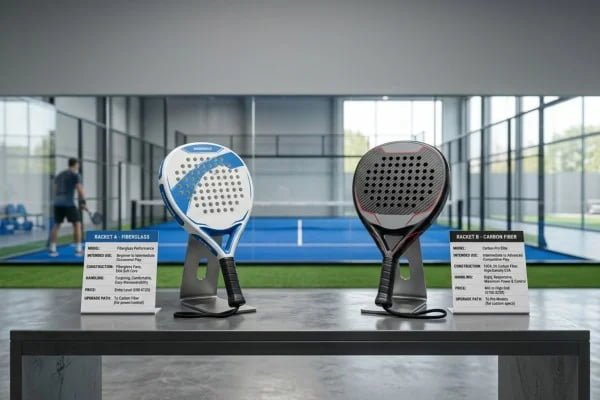
I compare buying decisions rather than material stereotypes
My comparison starts with the buyer’s situation. The table below is a selection guide, not a laboratory comparison of material properties.
| Buying factor | How I assess a fiberglass option | How I assess a carbon or hybrid option |
|---|---|---|
| Intended user | I check whether the model meets introductory or recreational needs. | I check whether the model addresses a defined preference or requirement. |
| Playing frequency | I assess the expected workload and supporting warranty. | I apply the same workload and warranty questions. |
| Feel | I request a trial rather than assuming a particular response. | I request a trial rather than assuming a firmer or more advanced response. |
| Ease of use | I consider weight, balance, shape, grip, and the player’s experience. | I consider the same complete set of factors. |
| Budget | I compare the full offer with similarly positioned models. | I ask whether the added cost delivers something the buyer actually wants. |
| Upgrade expectations | I check whether the model fits the intended ownership period. | I check whether the supposed upgrade solves an identified limitation. |
| Quality | I examine specifications, samples, inspection records, and support. | I require the same evidence rather than accepting the material label. |
I do not use price as a quality verdict
Two assumptions deserve particular attention: a low price must mean poor quality, and fiberglass must mean beginner-friendly. I reject both shortcuts.
A lower price may reflect product positioning, construction choices, order volume, distribution costs, or other commercial factors. It does not tell me enough about consistency, suitability, or defect handling.
Likewise, a more expensive carbon racket may be a poor purchase for someone who dislikes its handling. The buyer has not gained useful value merely by moving to a higher-priced material category.
I define an upgrade before recommending one
I ask buyers to finish this sentence: “I want my next racket to do something my current racket does not.”
The answer might concern handling, grip fit, a preferred response during a trial, or the availability of a consistently specified replacement model. Those are more useful starting points than “I have played long enough to need carbon.”
A frequent player may develop requirements that a particular fiberglass padel racket does not meet. However, playing frequency alone does not create a compulsory material upgrade.
I also treat “hybrid” as a term that needs explanation. I ask which materials are combined and where they are used. Without that detail, a hybrid label adds another category name without resolving the actual buying decision.
Where Does a Fiberglass Padel Racket Fit in a Club or Distributor Range?
I view commercial selection differently from an individual purchase. A club needs equipment that fits its users and operating process, while a distributor needs clearly positioned products. Choosing only the cheapest model can create a range that is difficult to explain, support, or replenish.
I position a fiberglass padel racket as a potential option for introductory lessons, rentals, casual play, and entry-level retail, subject to sample evaluation and quality checks. I then position carbon or hybrid models around specific user preferences and documented differences, rather than describing them as automatically better choices.
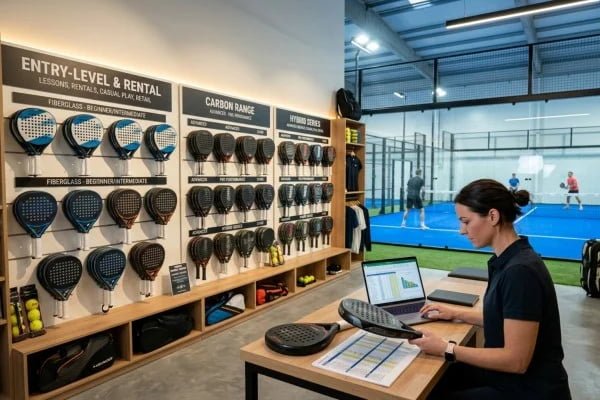
I give each model a clear commercial job
I prefer a small, understandable range over several nearly identical models with different material slogans.
| Commercial setting | Role I would consider | Evidence I would request |
|---|---|---|
| Introductory lessons | An accessible option for supervised first sessions | Coach evaluation of samples and clear product specifications |
| Rental operations | A model suitable for the planned users and workload | Handling trials, warranty terms, inspection guidance, and repeat-order consistency |
| Casual-play retail | An understandable first purchase | Accurate descriptions, transparent pricing, and suitable after-sales support |
| Distributor entry tier | A clearly defined introductory SKU | Approved samples, packaging details, tolerances, and batch identification |
| Upgrade tier | An alternative addressing a specific preference | A clear explanation of relevant differences and access to samples |
I do not confuse low purchase cost with low operating cost
For a rental fleet, I would track the cost of keeping rackets available for use, not only the invoice price.7 That assessment includes purchase cost, replacements, inspection time, and periods when equipment is unavailable.
I would not forecast a replacement interval without evidence from the actual model and operating environment. Instead, I would recommend a limited pilot before a larger commitment.
During that pilot, the club could record:
- Staff members could note which models users select and why.
- Coaches could document suitability observations without presenting them as laboratory findings.
- The operator could record visible wear, damage, and reasons for removing units from use.
- The purchasing team could compare delivered specifications with the approved sample.
Those records can inform a later order without turning a few informal comments into universal claims about fiberglass.
I make the retail message honest and useful
I would describe an entry-level model in terms of its intended audience, declared specifications, and available trial options. I would avoid promises such as “perfect for all beginners” or “the same performance as premium carbon.”
For distributors and importers, I would also establish agreed labeling, packaging, complaint handling, and replacement procedures. Local product obligations should be checked with qualified compliance support where needed.
My commercial boundary is important here: QHPADEL’s supplied business information covers artificial grass and complete padel court systems, not a documented racket product range. I would not use its court-component certifications, production capacity, or factory claims as evidence of racket quality. A racket procurement decision needs its own product-specific documentation.
Frequently Asked Questions
Does “F” always mean fiberglass in a padel racket listing?
I use “F” to mean fiberglass in this article, but I would not assume every seller uses it that way. It could be a model code or another abbreviation. I recommend asking the seller to confirm the face and frame materials in writing before comparing products.
Is a fiberglass padel racket always good for beginners?
No. I consider fiberglass a useful starting category, not a guarantee of suitability. A beginner may still dislike a model’s weight, balance, grip, or overall response. I recommend reviewing the complete specification and, where possible, trying the racket with guidance from a qualified coach.
Should I choose fiberglass if I only play occasionally?
I would include it among the options, especially when purchase price matters. However, occasional use does not make every fiberglass model suitable. I would compare handling, warranty, and total cost with other rackets in the same budget, then choose the model that best matches your needs.
When should I replace fiberglass with carbon or a hybrid racket?
I would consider a change when you can identify a requirement your current model does not meet, rather than after a fixed number of months. A trial may reveal a better match in another construction. The reason to change should be a useful difference, not the material name alone.
Conclusion
I see a fiberglass padel racket as a suitability choice, not a lesser version of carbon. It can serve beginners, recreational players, and introductory commercial ranges when the complete design fits the job. I recommend checking specifications, trying samples, and agreeing on quality expectations before buying. Players with more specific preferences may need a different model or construction. For a wider club project, I welcome inquiries to Alice Chen at QHPADEL for court-system documentation and quotations; racket selection should remain a separate, product-specific evaluation.
-
"Performance Analysis in Padel: A Systematic Review – PMC", https://pmc.ncbi.nlm.nih.gov/articles/PMC10694705/. Evidence on padel equipment selection indicates that novice players’ racket needs should be assessed through handling, weight, balance, and playing experience rather than through face material alone. Evidence role: general_support; source type: research. Supports: That beginner padel-racket selection is commonly based on controllability, comfort, weight, balance, and player experience, with materials considered alongside these factors.. Scope note: This contextual evidence does not establish that every fiberglass model is appropriate for all beginners, rental fleets, or lessons. ↩
-
"Performance Analysis in Padel: A Systematic Review – PMC", https://pmc.ncbi.nlm.nih.gov/articles/PMC10694705/. Studies of racket mechanics show that mass, balance point, and geometry influence a racket’s moment of inertia and handling behavior, supporting their consideration in equipment selection. Evidence role: mechanism; source type: paper. Supports: That racket mass distribution and geometry affect inertial behavior, maneuverability, and impact-related performance variables in racket sports and padel-specific testing where available.. Scope note: Mechanical findings do not by themselves determine an individual player’s preferred racket or establish the effect of every padel-racket core construction. ↩
-
"Identifying the Inertial Properties of a Padel Racket – PMC", https://pmc.ncbi.nlm.nih.gov/articles/PMC9741144/. Padel-racket suitability is multifactorial: construction materials interact with geometry, mass distribution, and the player’s technique and preferences, so face material alone is not a complete selection criterion. Evidence role: general_support; source type: research. Supports: That padel-racket performance and usability arise from the interaction of construction, mass distribution, geometry, and the player’s characteristics.. Scope note: The evidence supports a multifactorial approach but does not rank particular commercial materials for every beginner. ↩
-
"A guide to EU standards and conformity assessment", https://www.govinfo.gov/content/pkg/GOVPUB-C13-07a06d81c863b5241d6249891a51fb90/pdf/GOVPUB-C13-07a06d81c863b5241d6249891a51fb90.pdf. Management-system certification concerns an organization’s documented processes and should not be interpreted as product-specific evidence that a particular racket model meets defined performance or regulatory requirements. Evidence role: definition; source type: institution. Supports: That management-system or facility certification differs from product-specific conformity assessment, testing, and technical documentation.. Scope note: The exact evidentiary value of any certificate depends on its scope, issuing body, applicable standard, and the identified product. ↩
-
"Padel Racket Market Size, Share, Growth, Global Outlook …", https://www.businessresearchinsights.com/market-reports/padel-racket-market-117807. Market and product-range analyses commonly segment padel rackets by intended player level and price, with material labels used alongside—not independently of—other product specifications. Evidence role: general_support; source type: research. Supports: That padel-racket product ranges commonly segment models by materials, price, and intended player level, while material categories occur across more than one market position.. Scope note: Market segmentation varies by country, brand, season, and retailer; it does not establish a fixed price or quality tier for fiberglass or carbon. ↩
-
"Modern tennis rackets, balls, and surfaces – PMC – NIH", https://pmc.ncbi.nlm.nih.gov/articles/PMC2577483/. Racket performance and service life depend on complete design, manufacturing quality, and loading conditions; a fiberglass or carbon label alone cannot demonstrate superior power, handling, durability, or value. Evidence role: mechanism; source type: paper. Supports: That racket performance and durability are affected by full design, manufacturing quality, loading conditions, and use, rather than by reinforcement category alone.. Scope note: Value remains partly economic and user-specific, so engineering evidence cannot determine value for every buyer. ↩
-
"Life-cycle costing as a tool in mainstreaming green public …", https://www.oecd.org/en/publications/life-cycle-costing-in-public-procurement-in-hungary_8d90f627-en/full-report/component-5.html. Life-cycle costing in procurement evaluates costs incurred over use, including acquisition, operation, maintenance, replacement, and availability effects, rather than relying solely on initial purchase price. Evidence role: mechanism; source type: government. Supports: That lifecycle-cost assessment includes acquisition, operation, maintenance, replacement, and disposal or downtime-related costs where relevant.. Scope note: A fleet-specific lifecycle estimate requires local data on usage, damage, labor, warranties, and replacement lead times. ↩