Are you struggling to figure out the exact difference between a single and double padel court for your next sports project? Space limitations and budget constraints often frustrate club owners and private buyers during the planning phase. Fortunately, understanding the actual dimensions and manufacturing costs makes choosing the right layout straightforward.
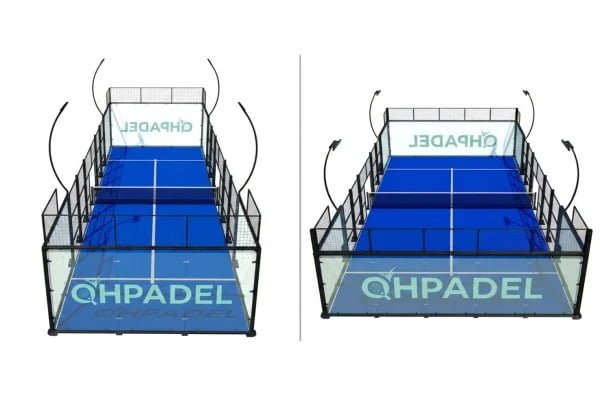
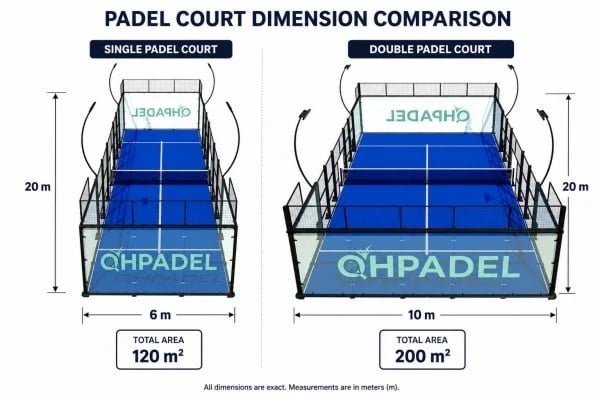
The main difference between a single and double padel court lies in width and intended use. A standard double court measures 20×10 meters and is designed for traditional 2v2 play. A single court measures 20×6 meters and is built strictly for 1v1 practice or fitting into narrow land spaces.
Knowing the physical sizes is just the starting point. Let us look closer at how these dimensional differences impact the bill of materials, overall manufacturing costs, and long-term facility planning for your sports club or private residence.
What are the exact dimensions of single and double padel courts?
Designing a sports facility without exact measurements leads to disastrous installation delays. Contractors often scramble when concrete foundations do not match the required steel structures. Getting the exact dimensions right on paper eliminates these expensive onsite mistakes.
A standard double padel court measures exactly 20 meters long by 10 meters wide, requiring a minimum play area of 200 square meters. A single padel court retains the 20-meter length but reduces the width to 6 meters, taking up only 120 square meters of ground space.
When I review foundation drawings submitted by civil contractors, space estimation is usually the first point of failure. Buyers often forget that the physical dimensions of the court structure are not the same as the total required site area. You always need a concrete ring beam that extends beyond the playing lines.
The Double Court Standard
The 20x10m double court is the universal global standard. Padel is inherently a highly social game built entirely around 2v2 play. If you visit any commercial club or watch professional tournaments, 99% of the courts you see are double courts. They require a 200 sqm footprint for the artificial turf, but you must factor in additional space for safe structural anchoring and player access gates.
The Single Court Reality
The 20x6m single court cuts the total width by 40%. This specific size is exclusively built for 1v1 play or intensive coaching drills. The overall length remains fixed at 20 meters because the physical dynamics of serving, running forward, and returning balls off the back glass require the exact same longitudinal depth as a standard game.
Let us compare the core specifications clearly:
| Specification | Double Padel Court | Single Padel Court |
|---|---|---|
| Internal Dimensions | 20m x 10m | 20m x 6m |
| Total Turf Area | 200 sqm | 120 sqm |
| Player Capacity | 4 Players (2v2) | 2 Players (1v1) |
| Primary Application | Commercial clubs, global tournaments | Private villas, narrow land gaps |
You cannot simply squeeze a double court into a 9.5-meter wide space. The tempered glass and steel frame must sit perfectly flush on the foundation. If your land cannot comfortably accommodate at least a 10.5-meter width for structural concrete footings, a single court becomes your only physically viable option.
Why isn’t a single padel court significantly cheaper than a double court?
Many buyers assume that a smaller court automatically means massive cost savings. When the quotation arrives, they are shocked to see the price drop is minimal. Understanding why a single court is not cheap prevents budget forecasting errors.
A single padel court is not 40% cheaper than a double court because the reduction in materials is not proportional. While you save on artificial turf, you still require the same number of expensive corner posts, lighting poles, and heavy tempered glass panels along the side walls.
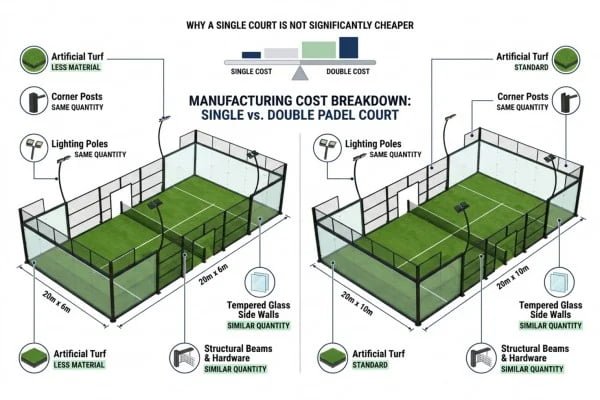
As a manufacturer, I deal with this specific pricing misconception weekly. A club investor or private buyer will email our factory asking: "A single court is 40% smaller than a double court in total area, so why is the quoted price only 10% to 15% lower?"
To understand the reality of pricing, we must look directly at the Bill of Materials (BOM). The manufacturing cost of a padel court does not scale linearly with its floor area.
The Unchanged Material Costs
When we shrink the width of the court from 10 meters down to 6 meters, a massive portion of the heavy, expensive materials remains completely unchanged in our production lines:
- The 20-Meter Side Walls: The length of the court is still 20 meters. You require the exact same amount of welded steel frame netting, structural side pillars, and side glass panels as a double court.
- Lighting Systems: You still need four sturdy structural lighting poles and specialized LED lights (certified to standards like AS 61347.2.13:2018) to properly illuminate the 20-meter stretch.
- Core Engineering & Fasteners: The main corner posts—which bear the most structural wind stress and glass weight—are identical. The complex AD 2000 WO certified screws and accessories are still required to anchor the massive structure.
Where You Actually Save Money
The manufacturing cost reductions only apply to the width-dependent materials at the front and back ends of the court:
- Artificial Turf: You buy 120 square meters of high-density artificial grass instead of 200 square meters.
- Back Glass Panels: You need fewer tempered glass panels for the back walls (covering 6 meters wide instead of 10 meters).
- Cross-court Steel: We weld shorter steel cross-beams at the top and bottom of the back walls.
Because the CE-certified steel frame structure, the heavy tempered glass, and the factory labor make up the bulk of the final manufacturing cost, a single court remains a premium structural investment rather than a budget alternative.
Who actually buys a single padel court?
Pouring money into a single padel court seems risky if commercial players vastly prefer 2v2 matches. Club operators worry about a low return on investment for 1v1 courts. However, mapping the exact buyer profiles reveals highly profitable use cases for single courts.
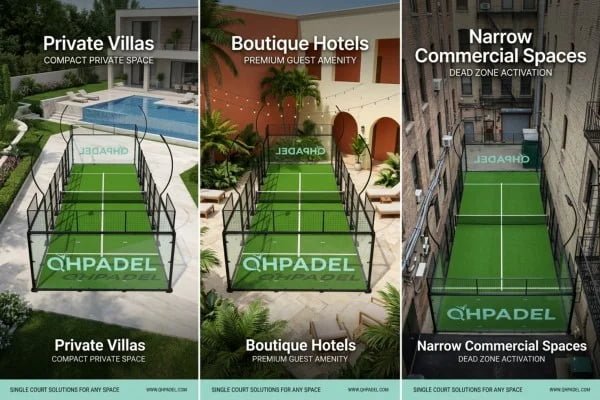
Single padel courts are primarily purchased by villa owners for private backyard use, boutique hotels adding premium amenities in restricted spaces, and commercial club operators monetizing narrow "dead zones" on their property that cannot accommodate a standard 20x10m court.
Based on our factory’s extensive export data spanning South America, the Middle East, and Southeast Asia, single courts make up roughly 1% of our total global sales volume. While they are undeniably a niche product, they serve highly specific, strategic purposes for astute buyers.
The typical clients purchasing single courts fall into three distinct profiles:
1. Private Residence and Villa Owners
Private buyers want the luxury of playing padel at home without leaving their property. However, backyard dimensions rarely perfectly match commercial zoning sizes. A 20x6m footprint easily tucks alongside a long driveway, a property boundary wall, or behind a swimming pool where a 10-meter-wide structure would violate local municipal building setbacks.
2. Boutique Hotels and Resorts
Hospitality managers know that padel is currently a massive draw for high-net-worth guests1. Boutique hotels often lack the sprawling grounds found at massive global resorts. Installing a single court allows hotel operators to market "On-site Padel Facilities" and offer exclusive 1v1 coaching sessions to premium guests without destroying their landscaping layout.
3. Commercial Club Operators (Monetizing Dead Space)
This is the most analytical buyer profile we encounter. Imagine an investor leases an indoor warehouse or an outdoor plot that measures exactly 25 meters long by 18 meters wide.
- If they only construct double courts, they can only fit one 20x10m court. They are left with 8 meters of unusable, wasted width.
- If they build one double court (10m) and one single court (6m), they maximize their revenue per square meter.
That 6-meter gap goes from being useless "dead space" to a highly rentable training court for private professional coaching, drastically increasing their daily court utilization rate.
Can single padel courts have high-end panoramic designs?
Buyers often fear that opting for a single court means settling for an ugly, outdated design. A heavy, metal-filled cage can ruin the aesthetic of a high-end residential property. Thankfully, shrinking the court width does not mean sacrificing modern architectural beauty.
Yes, single padel courts can fully support high-end panoramic and ultra-panoramic designs. Manufacturers use the same heavy-duty structural posts and thick tempered glass to provide unobstructed views, ensuring the 1v1 court looks just as premium as a standard double court.
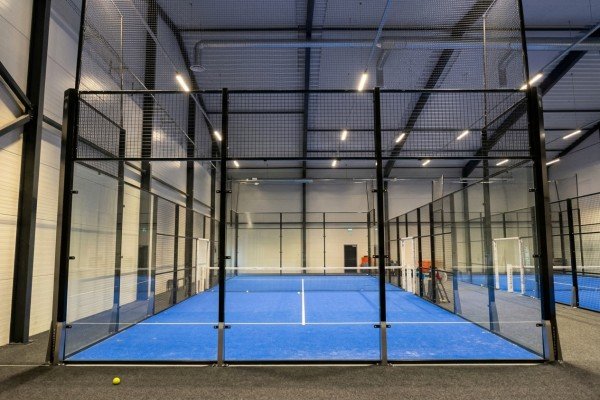
There is a persistent myth among equipment distributors that single courts are just basic "budget cages" made of cheap steel mesh. This is completely false. A single court can feature the exact same luxury aesthetics as our top-tier professional tournament models.
Adapting Panoramic Technology
In our factory production lines, Panoramic courts account for 50% of total sales, while Ultra-Panoramic models make up another 40%. The defining feature of any panoramic court is the complete removal of the vertical steel pillars between the back glass panels. This design offers spectators a beautiful, unobstructed view of the game.
When we engineer a panoramic single court, we apply the identical structural logic used in our most expensive models:
- Thick Tempered Glass: We utilize 10mm or 12mm thick CE-certified tempered glass that strictly meets global impact standards (such as AS/NZS 2208:1996 and AS/NZS 4666:2012). The glass panels simply span a 6-meter width instead of a 10-meter width.
- Reinforced Engineering: Because the middle support pillars are removed in a panoramic design, the structural corner posts must bear the entire weight of the wind loads and intense player impacts. We use the exact same heavy-duty steel profiles (hot-dip galvanized and powder-coated) as we do for global tournament courts.
The Importance of Engineering Precision
Customizing a single court into a panoramic layout actually demands extreme manufacturing precision. Because single courts are frequently squeezed into very tight property lines, there is absolutely zero room for error during the installation process.
As a responsible manufacturer, we provide strict foundation drawings, pre-embedding blueprints, and detailed packing lists. Civil contractors must pour the concrete ring beams with exact tolerances. If the foundation is off by even a few centimeters in a tight backyard, the heavy panoramic glass panels will not align properly. Whether you buy a classic framed court or a premium ultra-panoramic unit, the engineering integrity remains uncompromised.
Frequently Asked Questions
Can you play 2v2 on a single padel court?
No. A single padel court is only 6 meters wide, which is physically too narrow for four players to swing their rackets safely. It is designed strictly for 1v1 recreational play, intense cardiovascular practice, or individual professional coaching drills.
How much total land space is needed to install a single padel court?
While the internal play area is 20×6 meters, you must allow extra space for a concrete ring beam foundation. We recommend a minimum clear site area of 21×7 meters to ensure safe installation, proper structural anchoring, and enough room to clean the exterior glass.
Are the maintenance costs lower for a single padel court?
Maintenance is slightly cheaper because there is 40% less artificial turf to sweep and replenish with silica sand. However, you still have the exact same amount of 20-meter side glass to wash regularly and the same four lighting fixtures to power and maintain.
Conclusion
In summary, the true difference between a single and double padel court comes down to strategic land utilization rather than massive budget savings. A double court remains the undisputed commercial standard for 2v2 play. However, a single court is the perfect problem-solving asset for private villas, boutique hotels, and clubs looking to monetize narrow spaces without sacrificing high-end panoramic aesthetics.
If you are evaluating land layouts and need an honest, transparent breakdown of manufacturing costs, QHPADEL is here to assist. With over 10 years of factory production experience, we supply CE-certified steel structures and premium artificial turf worldwide. Contact Alice Chen at alice@grass-supplier.com or WhatsApp +86 185 7566 0746 to discuss precise structural drawings, factory-direct pricing, and container logistics for your next padel project.
-
"Padel Is the New It-Girl Amenity at Luxury Hotels", https://www.cntraveler.com/story/the-best-padel-courts-around-the-world. Market analyses of the sports tourism and luxury hospitality sectors indicate that integrating padel facilities significantly increases property appeal and guest retention among high-net-worth demographics. Evidence role: general_support; source type: research. Supports: The growing trend of padel as a premium amenity in the luxury hospitality sector.. ↩