
You want your padel club packed with players from dusk till dawn. But if players are constantly blinded during high lobs or complaining about dark corners, they simply will not book a second time. Choosing the right padel court lighting is an absolute necessity for player retention and long-term facility safety.
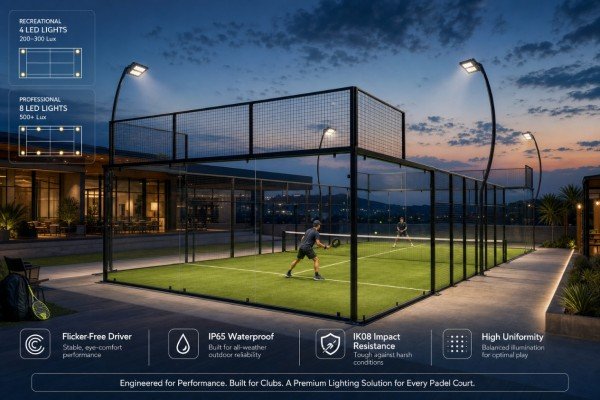
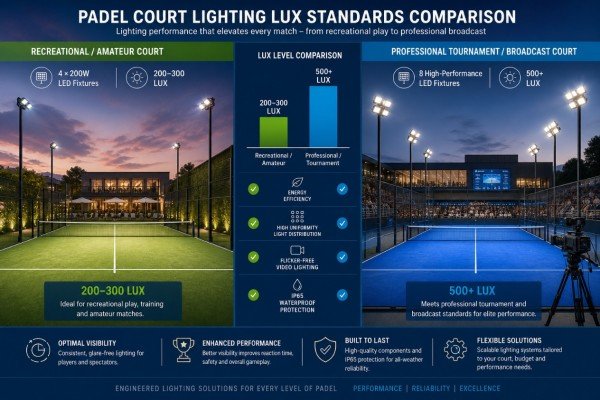
The ideal padel court lighting requires specialized asymmetric LED fixtures that prevent glare during high lobs. A standard recreational court needs eight 200W lights delivering 300+ Lux.1 For commercial clubs and tournament play, an upgraded system of four 400W lights can achieve 400 to 500+ Lux2 for optimal visibility.
Knowing the basic wattage is only the beginning of the procurement process. Let us look at how proper optics prevent commercial churn, and why separating your lighting procurement from your court structure is a costly mistake.
Why is glare a massive commercial risk for padel clubs?
Imagine a player looking up to smash a crucial lob, only to be blinded by a harsh, unfocused floodlight. They miss the shot, get frustrated, and ultimately choose a different facility next week.
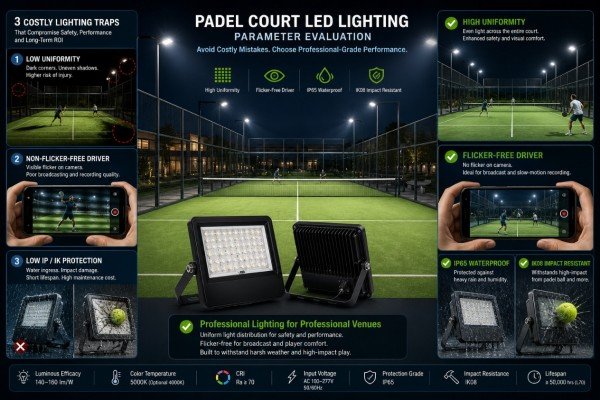
Padel relies heavily on high aerial shots, making glare a direct threat to player experience.3 Standard floodlights blind players looking upward. Professional padel court lighting uses specialized asymmetric lenses that push the light beam forward and downward4, keeping the light strictly on the court surface and out of players’ eyes.
The game of padel is unique. Unlike tennis, where the ball stays relatively low and fast, padel heavily involves the lob. Players spend a significant amount of time looking directly up into the night sky to track the ball. If you install basic symmetrical outdoor floodlights, you are actively creating a terrible optical environment for your customers.
When a standard symmetrical light shines, it throws illumination equally in all directions. This creates a massive halo of glare above the court.5 Professional padel court lighting, however, relies on asymmetric optics. An asymmetric lens behaves almost like a visor on a cap. It physically redirects the light path, forcing the beams to travel forward and sharply down6 onto the artificial turf.
From a commercial perspective, preventing glare is a direct retention strategy. I always remind club operators that players do not usually understand optical engineering. They will not complain about "symmetrical light distribution." They will simply say, "I didn’t play well at that club," or "The lights gave me a headache."
By investing in proper asymmetric LED fixtures, you guarantee a comfortable, high-visibility environment. Here is what correct optics achieve for your business:
- Zero upward glare: Players can easily track lobs without squinting or losing sight of the ball.
- Even surface illumination: No dark patches in the corners where the glass meets the mesh.
- Energy efficiency: All the lumens are directed onto the court, meaning you do not waste electricity lighting up the surrounding neighborhood.
For club owners, the right lighting setup directly correlates to repeat bookings, positive word-of-mouth, and maximized evening revenue.
Which padel court lighting configuration is right for your business?
Choosing court lights can feel like guessing in the dark when you stare at raw lumen numbers and wattages. Buy too little, and the court feels cheap. Buy too much, and you waste your initial investment budget.
You should match your padel court lighting to your venue’s business model. Entertainment courts perform perfectly with eight 200W lights averaging 300 Lux. Standard commercial clubs require four 400W lights hitting 400 Lux, while professional tournament venues need an optimized four 400W setup designed to exceed 500 Lux.
One of the most common questions I receive from investors and civil contractors is exactly how many watts they need per court. My answer is always the same: stop guessing wattages and start looking at your target audience. At QHPADEL, we map our lighting packages into a proven "Three-Tier" system based on real-world business applications.
Tier 1: Standard / Entertainment
This setup utilizes eight 200W lights, usually generating an average of 300+ Lux. I want to be clear—a 200W setup is not "inferior." It is highly efficient and perfectly designed for residential complexes, hotel amenities, and local park facilities where the primary goal is casual recreation.
Tier 2: Upgraded / Standard Club
This is our most popular configuration for commercial padel clubs. We use four 400W lights that deliver a powerful 400+ Lux. This tier provides the bright, crisp visibility that paying club members expect. It ensures excellent contrast against the artificial turf and tempered glass, minimizing eye strain during fast-paced matches.
Tier 3: Top Tournament
For venues hosting professional events, broadcasting matches, or simply aiming for the absolute premium end of the market, we utilize a specialized four 400W configuration that pushes past 500+ Lux. This level of brightness guarantees perfect visibility for high-definition video recording and elite-level play.
Here is a quick breakdown to help you evaluate your procurement needs:
| Facility Type | Fixture Configuration | Average Lux Level | Best Suited For |
|---|---|---|---|
| Entertainment | 8 x 200W LED | 300+ Lux | Hotels, private residences, parks |
| Standard Club | 4 x 400W LED | 400+ Lux | Commercial clubs, chain brands |
| Tournament | 4 x 400W LED (Optimized) | 500+ Lux | Pro competitions, televised matches |
By selecting the tier that accurately matches your business plan, you optimize your capital expenditure while delivering the exact experience your specific customer base demands.
Why is buying padel court lighting separately a structural trap?
Sourcing cheap lights from a separate supplier to save a few dollars seems like a smart procurement strategy. However, mismatching lighting fixtures and structural posts almost always leads to catastrophic installation disasters on site.
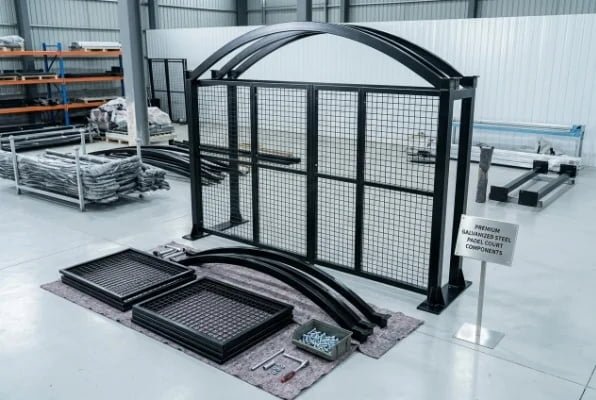
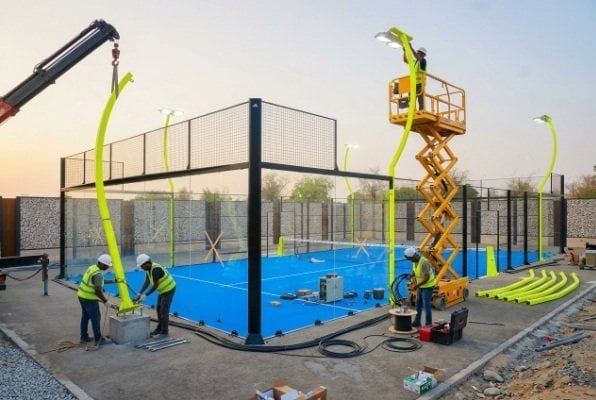
Procuring padel court lighting separately from the court frame creates severe structural mismatches. When third-party lights do not fit the pre-drilled post holes, installers are forced to drill new holes on site. This destroys the steel’s galvanized anti-rust layer, drastically reducing the lifespan and safety of your entire structure.
As an exporter with over a decade of experience, I have seen the devastating results of fragmented procurement. I once consulted with an investor in South America who decided to buy his court frames from one factory and his LED lights from a separate local wholesaler.
When the installation team arrived at the site, they faced a massive problem: the mounting brackets on the local lights did not align with the pre-drilled, laser-cut holes on the court’s structural posts. Under pressure to meet a deadline, the contractors did what they always do—they grabbed a power drill and forced new holes directly into the steel posts.
This is a structural nightmare. By drilling into the post on site, they instantly shattered the factory-applied, hot-dipped galvanized coating. Raw steel was exposed to the humid, rainy environment. Within just three months, dark rust began bleeding down the pristine posts.7 The structural integrity was compromised, and the entire aesthetic of the club was ruined. The money the investor "saved" on cheap lights was instantly wiped out by the cost of premature repairs and reputation damage.
Padel court lighting and the structural frame are inseparable. They must be manufactured, tested, and shipped as a single, unified system.
When you procure a complete padel court system from a qualified B2B manufacturer like QHPADEL, the integration is flawless. The lighting brackets, the mounting holes, the internal wiring paths, and the fasteners are engineered together. Everything aligns perfectly out of the box, requiring zero on-site modifications. Furthermore, the entire structural and electrical assembly carries matching certifications—including CE, RoHS, and AS/NZS compliance—protecting you from legal and safety liabilities.
Never encourage or attempt separate procurement. Integrated manufacturing is your absolute best defense against installation delays and early structural failure.
How do integrated lighting systems eliminate engineering headaches?
Building a commercial padel facility requires coordinating dozens of safety and engineering factors. As an investor or a local contractor, calculating wind loads, fixture weights, and structural tolerances should not be on your daily to-do list.
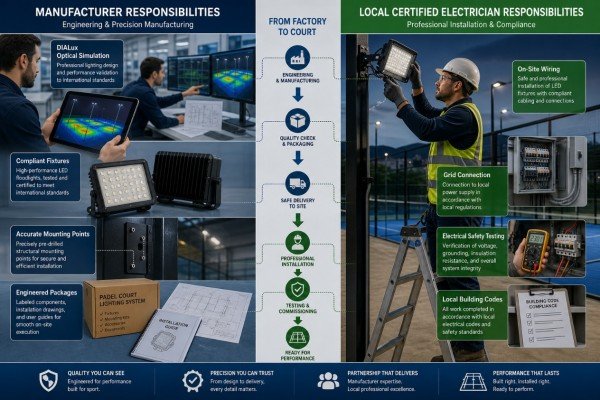
Integrated padel court lighting systems completely remove engineering burdens for buyers. When you purchase a complete court package, the factory automatically calculates the exact wind load, fixture weight, and electrical routing required for your specific lighting tier, pairing it with structurally validated posts for a safe installation.
Every light fixture you attach to the top of a padel court acts like a sail catching the wind. A 400W lighting fixture is heavier and has a larger surface area than a 200W fixture. If you attempt to piece together a court yourself, you must hire an engineer to ensure the steel posts can withstand the specific wind load and weight of the lights you selected.
By purchasing a complete, turnkey system from a specialized manufacturer, you bypass this headache entirely. At QHPADEL, we manufacture over 150 complete court systems every month. Because we control the entire Bill of Materials (BOM), we automatically handle the engineering math in the background.
Whichever lighting tier you choose, we pair it with the exact steel post thickness, base plate design, and reinforced structure needed to hold it safely. Here is how our integrated manufacturing protects your project:
- Wind Load Compliance: We calculate the drag coefficient of the exact LED fixtures provided, ensuring the structural posts will not bend or sway under heavy wind conditions.
- Internal Wiring Safety: Our posts feature smooth, pre-cut internal pathways. Installers simply drop the wires through the post, protecting the electrical cables from weather and physical damage.
- Hardware Compatibility: Every bolt, washer, and nut is standardized and certified (AD 2000 WO, PED 2014/68/EU)8. You will never find yourself missing a specialized screw on installation day.
- Comprehensive Documentation: We provide exact foundation drawings, precise installation guides, and complete packing lists. Your local civil contractors will know exactly how to erect the system quickly and safely.
Procuring a complete system means you are buying certainty. Whether you are installing a Panoramic Court in the Middle East or a classic setup in Southeast Asia, the factory-level integration guarantees that your padel court lighting is as structurally sound as it is visually impressive.
Frequently Asked Questions
How many lights are on a padel court?
A standard padel court features either four or eight lights. The most common configurations utilize eight 200W LED fixtures for recreational play, or four 400W LED fixtures for commercial clubs. These are mounted on structural posts at the corners or sides of the court.
What is the required Lux level for a padel court?
Recreational and community courts require an average of 300 Lux. Standard commercial padel clubs should aim for 400 Lux. Professional tournament venues and courts designed for television broadcasting require 500 Lux or more to ensure optimal player and audience visibility.
Can I use standard LED floodlights for a padel court?
No. Standard outdoor floodlights emit symmetrical light, creating severe glare that blinds players during high lobs. Professional padel court lighting requires asymmetric lenses that direct the light beam strictly downward and forward onto the artificial turf.
Why should I buy lights and court frames together?
Buying them together ensures total structural compatibility. Procuring lights separately often results in mismatched mounting brackets. This forces installers to drill new holes on site, destroying the steel’s galvanized anti-rust coating and drastically shortening the lifespan of your court.
Conclusion
Choosing the correct padel court lighting is far more than a simple electrical decision; it is a critical strategy for commercial success and structural integrity. By utilizing asymmetric lenses, you protect your players from glare, ensuring they return to your club week after week. Furthermore, matching your Lux configuration to your business model—and insisting on a fully integrated system—prevents costly installation disasters and guarantees a safe, certified facility.
If you are a club operator, investor, or contractor looking for zero-headache, complete padel court solutions, QHPADEL is ready to help. With over 10 years of export experience and a massive manufacturing capacity, we provide perfectly integrated lighting, frames, and turf. Contact Alice Chen at alice@grass-supplier.com or via WhatsApp at +86 185 7566 0746 to secure a proven, tournament-ready court package today.
-
"Lighting Regulations for Padel Courts", https://ledpadel.com/en/padel-court-lighting/regulations/. See the European Standard EN 12193 for sports lighting, which outlines Class III requirements for recreational padel and tennis at 300 Lux. Evidence role: statistic; source type: institution. Supports: Supports the standard that recreational and local sports facilities (Class III) require approximately 300 Lux for safe play.. Scope note: Specific wattage requirements (e.g., 200W) depend on the luminous efficacy of the specific LED fixtures used, rather than being a universal standard. ↩
-
"FIP Padel Lighting Requirements: Lux, Uniformity, Height and Player …", https://reitalight.com/fip-padel-lighting-requirements/. The International Padel Federation (FIP) and EN 12193 Class I standards mandate a minimum of 500 Lux for national and international competitions. Evidence role: statistic; source type: institution. Supports: Supports the requirement of 500 Lux for professional (Class I) padel competitions.. Scope note: Televised or broadcasted matches often require significantly higher illumination, sometimes exceeding 1000 Lux, depending on camera specifications. ↩
-
"Padel Match Analysis: Notational and Time-Motion Analysis during Official …", https://pmc.ncbi.nlm.nih.gov/articles/PMC9324445/. Notational analysis of professional padel indicates that the lob is one of the most frequently used shots, accounting for a significant percentage of total strokes during a match. Evidence role: statistic; source type: paper. Supports: Supports the high prevalence of the lob (globo) as a fundamental tactical shot in padel match play.. Scope note: Shot frequency distributions can vary significantly between amateur and professional levels of play. ↩
-
"5 common outdoor sports lighting mistakes | How to solve", https://www.zgsm-china.com/blog/5-common-outdoor-sports-lighting-mistakes-and-how-to-solve-them.html. Illuminating Engineering Society (IES) guidelines detail how asymmetric floodlights utilize specialized reflectors and lenses to project light forward, reducing direct glare for players looking upward. Evidence role: mechanism; source type: research. Supports: Supports the use of asymmetric optics in sports luminaires to direct light toward the playing surface while minimizing upward light spill.. Scope note: While asymmetric lenses reduce glare, improper mounting angles can still result in visual discomfort. ↩
-
"Photometric testing – symmetric or asymmetric lighting distribution", https://www.zgsm-china.com/blog/photometric-testing-symmetric-or-asymmetric-lighting-distribution.html. Standard symmetrical floodlights distribute light evenly in all directions from the central axis, which can result in significant upward light spill and glare if used without visors or baffles in sports applications. Evidence role: definition; source type: encyclopedia. Supports: Supports the definition of symmetrical luminaires as fixtures that distribute luminous intensity evenly around their axis, contributing to upward light spill if not properly shielded.. Scope note: Symmetrical lights can be modified with external shields to reduce the halo effect, though this reduces overall efficiency. ↩
-
"US20180224715A1 – Asymmetric zones in a fresnel lens", https://patents.google.com/patent/US20180224715A1/en. Optical engineering principles demonstrate that asymmetric lenses utilize total internal reflection and refraction to bend light rays downward, effectively acting as an integrated optical visor. Evidence role: mechanism; source type: research. Supports: Supports the optical mechanism by which asymmetric lenses and reflectors alter the trajectory of photons to create a targeted, non-uniform beam pattern.. Scope note: This is a general principle of optical engineering and is not exclusive to LED sports lighting. ↩
-
"Marine Atmospheric Corrosion of Carbon Steel: A Review – PMC", https://pmc.ncbi.nlm.nih.gov/articles/PMC5506973/. Atmospheric corrosion studies indicate that unprotected carbon steel exposed to environments with high relative humidity and frequent rainfall can develop visible iron oxide (rust) within a matter of weeks. Evidence role: general_support; source type: paper. Supports: Supports the rapid atmospheric corrosion rate of unprotected carbon steel when exposed to high relative humidity and precipitation.. Scope note: The exact timeframe of three months is illustrative; actual corrosion rates depend heavily on local salinity, temperature, and pollution levels. ↩
-
"PED 2014/68 EU & AD2000 Merkblatt W0 Certification – Energy Bolting", https://www.energybolting.com/post/ped-2014-68-eu-ad2000-merkblatt-w0-certification. The AD 2000-Merkblatt W0 and the Pressure Equipment Directive (PED 2014/68/EU) establish stringent quality requirements for material manufacturers, frequently used to certify the metallurgical integrity of high-grade fasteners. Evidence role: definition; source type: institution. Supports: Supports the definition of AD 2000-Merkblatt W0 and PED 2014/68/EU as European standards governing the quality and certification of materials, including fasteners.. Scope note: These standards are primarily designed for pressure vessels and equipment, though their material quality requirements are often adopted for high-stress structural fasteners. ↩