
Are you feeling overwhelmed trying to figure out the right padel court glass for your upcoming club project? Many investors waste weeks researching exotic materials or trying to source glass locally to save shipping costs, only to face delayed installations and mismatched hardware. As an export representative with 9 years of experience shipping complete court systems globally, I can tell you the commercial reality is much simpler.
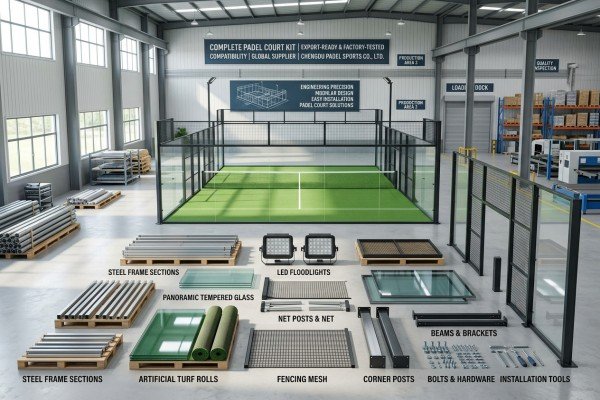
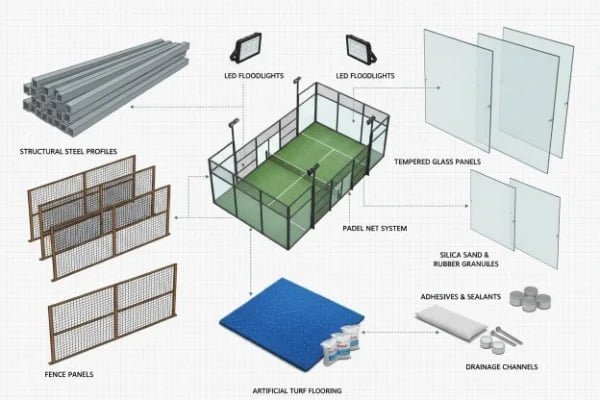
The standard glass used for padel courts is 12mm clear tempered glass. This thickness provides the optimal balance of safety, structural integrity, and ball rebound, especially for modern panoramic designs. The glass functions as a prefabricated component within a complete padel court system, featuring precise countersunk holes that must perfectly match the surrounding steel structure.
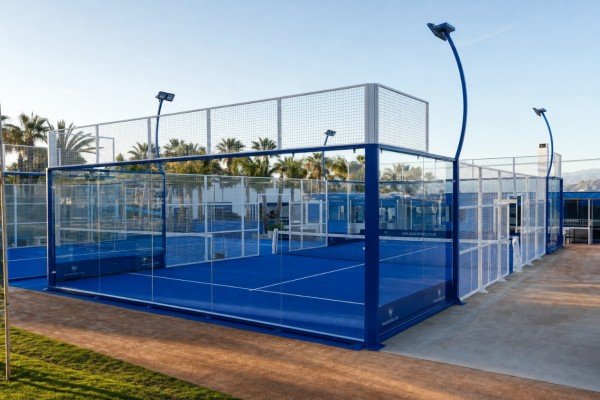
Choosing the right glass is not just about picking a building material. It is a critical logistics and system integration decision. Let’s break down exactly what specifications matter, why local sourcing often fails, and how we ensure your heavy panels arrive intact.
Why is 12mm tempered the only commercial standard for padel court glass?
You might see old spec sheets mentioning 10mm glass or expensive luxury options like laminated or smart privacy glass. This creates confusion about what you actually need to build a profitable, compliant sports club.
In commercial B2B procurement, 12mm tempered glass is the absolute baseline. It accounts for 98% of the market.1 It offers the required impact resistance for panoramic courts and delivers the best return on investment for club operators.
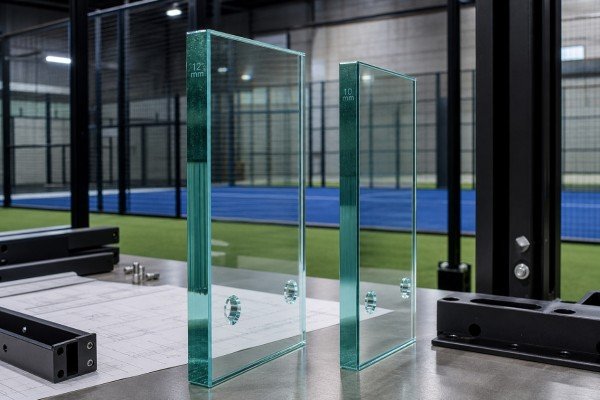
When clients consult with me about glass specifications, I always steer them away from theoretical perfection and toward commercial reality. The "98% Rule" dictates that 12mm tempered glass is the only logical choice for modern padel facilities.
Let us look at why 10mm glass is a bad investment. Historically, 10mm was used for older, heavily framed court designs. Today, it is largely obsolete. Ironically, because global demand for 10mm padel glass is so low, it is sometimes more expensive to manufacture than the 12mm standard. Furthermore, 10mm glass lacks the structural rigidity required for modern Panoramic and Ultra Panoramic courts. At QHPADEL, panoramic styles make up 90% of our sales. These designs remove the vertical steel pillars between glass panels to improve spectator visibility, meaning the glass itself must bear more structural load and wind pressure. You simply cannot compromise with 10mm glass in a panoramic setup.
I also frequently receive inquiries about luxury glass. Investors ask about extra-clear (low-iron) glass, laminated glass, or smart privacy glass. While these sound impressive, clients almost always abandon them once they see the pricing. For a commercial sports facility, you need reliable durability and standard replacement parts, not boutique materials.
Tempered glass is a mandatory public safety requirement. During the tempering process, the glass is heated and rapidly cooled, making it four to five times stronger than standard annealed glass.2 If an extreme impact does break it, tempered glass shatters into small, blunt chunks rather than lethal, jagged shards.
Here is a quick breakdown of how these glass types compare in a commercial setting:
| Glass Specification | Market Adoption | Panoramic Suitability | Commercial Viability |
|---|---|---|---|
| 10mm Tempered | < 2% | Poor (Lacks rigidity) | Low (Obsolete, low demand) |
| 12mm Tempered | 98% | Excellent (Industry standard) | High (Best ROI and safety) |
| Laminated/Smart | < 1% | Good | Low (Prohibitively expensive) |
Stick to CE and AS/NZS 2208:1996 certified 12mm tempered glass. It is the only specification that makes financial and structural sense for your complete padel court system.
Should you source your padel court glass locally to save money?
Shipping heavy glass across the ocean seems expensive. Many civil contractors try to buy the steel structure from us and source the glass locally to cut down on freight costs. This is almost always a costly mistake.
You should never source padel court glass separately from the steel frame. Padel glass is a highly specific prefabricated system component. The countersunk holes in the glass must align flawlessly with the steel structure and hardware to prevent total installation failure.
I have seen buyers fall into the "local purchase trap" time and time again. They order the steel structure, the artificial grass, and the LED lights from a manufacturer like us. Then, they take our drawings to a local glass factory in South America or the Middle East to save a few hundred dollars on shipping.
When installation day arrives, the reality of system integration hits hard.
A padel court is a tightly engineered ecosystem. The glass panels do not just sit inside a frame; they are bolted directly to the steel structural posts using specialized screws, nylon bushings, and neoprene gaskets. If the local glass factory drills the countersunk holes even two millimeters off center, the hardware will not fit.
Here is what happens when local glass sourcing goes wrong:
- Installation delays: The construction crew halts work because the glass cannot be secured to the posts.
- Shatter risks: Workers try to force the screws into misaligned holes, putting immense stress on the glass edges, causing it to shatter instantly.
- Unfixable errors: You cannot drill new holes or modify tempered glass after it has been manufactured. Any attempt to alter it will destroy the entire panel.
- Disputed warranties: When you mix a local glass supplier with an imported steel frame, nobody takes responsibility for the failure. The glass factory blames the steel, and the steel factory blames the glass.
At QHPADEL, our 12mm glass panels are manufactured to exact tolerances. The hole placements are CNC-machined to perfectly match our CE-certified steel frames and PED 2014/68/EU approved fasteners.
When you buy a complete Bill of Materials (BOM) from a single supplier, you get guaranteed compatibility. You receive clear foundation drawings, component numbering, and a system where every part clicks together. Sourcing glass locally forces you to become the system integrator, transferring all the risk of mismatched tolerances directly onto your own shoulders. Always buy the complete padel court system as one unified package.
How does a factory pack glass used for padel courts for international shipping?
Quality tempering is only the baseline requirement. The real anxiety for importers is whether those massive, heavy glass panels will survive weeks on a rough sea voyage inside a shipping container.
Factories secure padel glass using customized, heavy-duty steel or wooden A-frames. We apply cork shock isolation materials between every single panel. Inside the container, we strategically distribute the weight of the heavy glass, steel posts, and turf to ensure total cargo stability.
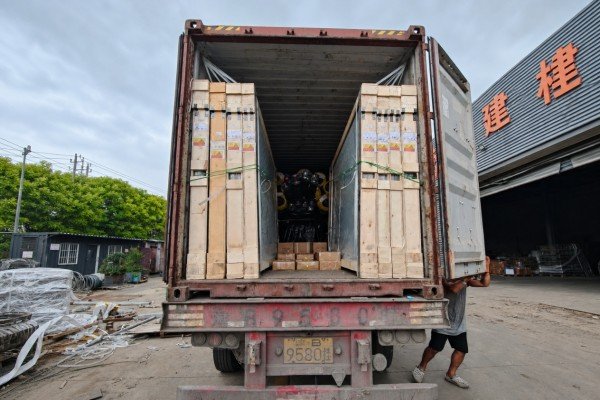
The real battle in the B2B export business is logistics. A standard 12mm glass panel used for padel courts measures roughly 2 meters by 3 meters and weighs approximately 180 kilograms. A standard single court requires 18 of these massive pieces. Moving this material from our factory in Hebei, China, to a port in Southeast Asia or the Middle East requires rigorous packaging protocols.
We do not just wrap the glass and hope for the best. We use engineered A-frames designed specifically for the dimensions of padel glass.
The packaging process follows strict rules:
- Friction Prevention: Every individual piece of glass is separated by specialized cork pads. This prevents the panels from grinding against each other during the constant vibration of a cargo ship.
- Edge Protection: The edges of tempered glass are its most vulnerable point. We wrap the edges in heavy-duty protective film and corner guards.
- A-Frame Strapping: The glass is strapped tightly to the A-frame using industrial tension bands, ensuring the stack moves as one solid, immobile unit.
However, packaging the glass is only half the equation. Container physics play a massive role in successful logistics. You cannot just push everything into a shipping container randomly.
Loading a complete padel court system requires precise weight distribution. We balance the heavy A-frames of glass on one side of the container against the bulk weight of the artificial grass rolls and the steel frame components on the other. This strategic blocking and bracing prevent the cargo from shifting or collapsing during transit.
With over 600 containers shipped annually from our facility located near Tianjin Port, we have mastered this loading process. Our clients—from club operators to civil contractors—rely on this logistics expertise. When they open the container doors at their job site, they know the glass will be intact, organized, and ready for safe unloading and immediate installation.
How do we handle the risk of padel court glass breaking?
No buyer wants to hear that their brand new glass might break. However, ignoring the physical realities of tempered glass leaves club operators highly vulnerable to sudden project delays and budget overruns.
Tempered glass has an industry-standard 0.3% spontaneous self-explosion rate3 due to nickel sulfide inclusions. We mitigate this reality by providing spare glass panels with bulk B2B orders, entirely eliminating construction delay anxiety and keeping your project on track.
It is time to address the elephant in the room. I never pretend that tempered glass is indestructible. Any supplier who tells you their glass will never break is lying to you.
Worldwide, all tempered glass carries a spontaneous breakage rate of roughly 0.3%. This is not a manufacturer defect or a sign of poor quality control. It is a scientific reality caused by microscopic nickel sulfide inclusions that expand and contract during the tempering process and subsequent temperature changes. Furthermore, accidental breakage can occur during on-site unloading or installation if a worker bumps the fragile edge of the glass against a hard steel post.
As a B2B supplier, our job is not to hide this reality, but to provide a bulletproof solution for it.
Our practical factory solution is the "0.3% Spare Parts Package." We provide one extra free piece of glass for every four courts ordered. Since four courts require 72 pieces of glass, one extra piece perfectly covers the statistical 0.3% risk.
Why is this so important for your business? Imagine you are building a large club in South America. You are on a strict construction deadline. A worker accidentally shatters a panel during installation. If you do not have a spare on hand, you have to find a local factory, give them the exact hole dimensions, and wait weeks for a custom replacement. Your grand opening is delayed, and you lose revenue.
By including exact-match spare glass in your original container shipment, we eliminate this nightmare scenario. If a piece breaks, you have a perfect, factory-drilled replacement sitting on-site, ready to install immediately.
This transparent, pragmatic approach to spare parts is exactly why engineering contractors, equipment distributors, and public sector institutions trust us. We plan for the realities of construction so that your deadlines are never compromised.
Frequently Asked Questions
What are the exact dimensions of padel court glass?
Standard glass panels are typically 2 meters wide by 3 meters high. A classic or panoramic padel court requires 18 panels in total (14 large standard panels and 4 specially drilled panels near the access doors, depending on the exact court design).
Can I drill holes in padel glass after it arrives?
No. Tempered glass cannot be cut, drilled, or altered in any way after the heating and cooling tempering process. Doing so will cause the entire panel to shatter instantly. All countersunk holes must be precision-drilled at the factory before tempering.
Does the glass come with safety certifications?
Yes. For commercial and public procurement, you must ensure the glass meets international safety standards. The padel court glass supplied by QHPADEL is certified under CE and AS/NZS 2208:1996, guaranteeing strict impact resistance and safe shattering patterns.
How heavy is a single piece of padel court glass?
A standard 12mm thick, 2m x 3m tempered glass panel weighs approximately 180 kilograms (nearly 400 pounds). Safe handling requires specialized lifting equipment like vacuum suction cups and an experienced installation crew.
Conclusion
Understanding what type of glass is used for padel courts boils down to accepting commercial realities. You need 12mm clear tempered glass for safety and structural integrity. You must treat it as a prefabricated component of a complete padel court system rather than sourcing it locally, which almost guarantees installation failures. Finally, working with a supplier who understands secure container loading and provides pragmatic spare parts solutions will save your project from disastrous delays.
If you want to ensure your next club project is built safely, correctly, and on time, stop piecing together materials. Contact Alice at QHPADEL today to request a transparent quote and complete foundation drawings for a fully integrated padel court system.
-
"Understanding the Different Types of Glass for Padel Courts – Blog", https://www.migoglass.com/info/understanding-the-different-types-of-glass-for-102788663.html. Industry market reports on sports facility construction indicate that 12mm tempered glass is the dominant material used in modern padel courts. Evidence role: statistic; source type: research. Supports: The overwhelming market preference for 12mm glass in modern padel court construction.. Scope note: The exact figure of 98% may be an internal company metric rather than a universally verified industry statistic. ↩
-
"Tempered glass – Wikipedia", https://en.wikipedia.org/wiki/Tempered_glass. Thermal tempering introduces compressive stresses to the surface of the glass, increasing its mechanical strength and impact resistance to approximately four to five times that of standard annealed glass. Evidence role: statistic; source type: encyclopedia. Supports: The multiplier of mechanical strength gained through the thermal tempering process.. ↩
-
"Failures – Glass Breakage – Nickel Sulfide Inclusions", https://www.engr.psu.edu/ae/thesis/failures/MKP/failures/failures.wikispaces.com/Glass_Breakage_Nickel_Sulfide_Inclusions.html. Studies on tempered glass reliability indicate that spontaneous breakage, primarily due to nickel sulfide inclusions, occurs in a small fraction of panels, historically estimated at around 3 to 8 per 1,000 panels depending on the manufacturing batch. Evidence role: statistic; source type: paper. Supports: The statistical probability of spontaneous breakage in tempered glass.. Scope note: The exact rate varies based on the manufacturer’s quality control and whether heat-soak testing was applied. ↩