Your players complain about bad bounces, and you worry about injuries on your court. If you ignore the condition of your silica sand, you risk losing customers and damaging your expensive artificial turf.
To maintain optimal performance, you should refill silica sand every 12 months for high-traffic courts and every 18 to 24 months for others. You must also check for signs like slippery surfaces, exposed turf fibers, or uneven ball bounces. Regular maintenance ensures safety and extends the lifespan of your court.
I have spent years in this industry, from the factory floor to managing exports. I know that sand is not just a filler. It is the life of your court. Many club owners focus only on the grass, but the sand holds it all together. If you get this right, your investment lasts years longer. If you get it wrong, you will face complaints and early repair bills. Let me show you exactly what to look for and how to fix it.
What Are the Clear Signs That Your Padel Court Needs Silica Sand Renewal?
Is your court acting strangely during matches? If players slip or the ball dies in certain spots, your reputation is on the line. You need to identify these warning signs before an injury happens.
The clearest signs include uneven ball bounces, visible "bald patches" where turf fibers lean over, and a slippery playing surface. If the ground feels hard underfoot or drainage slows down due to compaction, it is time to check the sand levels immediately.
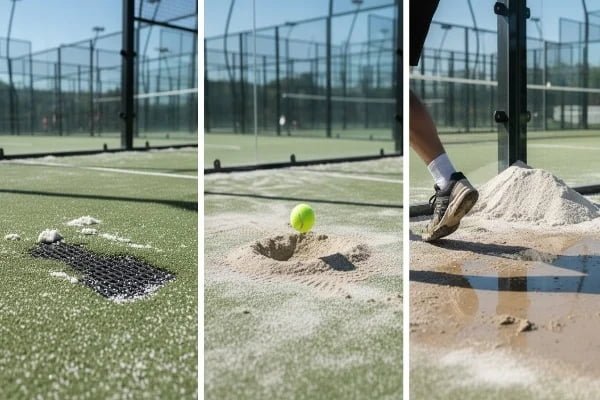
As an artificial turf engineer, I always tell my clients to trust their feet and eyes. The wear of silica sand is a gradual process. You might not notice it day by day, but the signs are there if you look closely. I have visited clubs where the owners thought the grass was defective, but the real problem was the sand.
Here is a breakdown of the specific issues you need to watch for:
1. Uneven Ball Bounce
This is the first complaint you will hear from players. If the ball hits a spot and shoots off at a weird angle or does not bounce as high as it should, you have a problem. This usually means the sand has shifted. It piles up in corners and leaves the center empty. This displacement creates an unpredictable game.
2. The "Bald Patch" Effect
Look at the grass fibers. Are they standing straight up? They should be. Silica sand supports the fiber. When the sand level drops, the fibers lose their support. They begin to tilt and lay flat. We call these "bald patches." If you see the tips of the grass bending over significantly, it indicates uneven sand distribution. The fiber will wear out much faster if it is not supported by sand.
3. Surface Hardening and Safety Risks
Silica sand provides friction. This allows players to stop and turn safely. However, over time, sand can get compacted. It mixes with dust and sweat. The surface becomes hard. When you walk on the field, you will clearly feel this hardness under your feet. A hard surface is bad for player joints. A slippery surface is even worse. If the sand is compacted or too low, players will slip. This increases the risk of injury significantly.
| Sign | What it Means | Impact on Business |
|---|---|---|
| Uneven Bounce | Sand has moved to the edges. | Players get frustrated with the game quality. |
| Fiber Tilt | Sand level is too low to support grass. | Artificial turf wears out years too early. |
| Hard Surface | Sand is compacted with dirt. | High risk of player injury and lawsuits. |
How Often Should You Replace or Refill Silica Sand Based on Court Usage?
Are you guessing when to schedule maintenance? If you wait until the court looks bad, you are already too late. You need a specific schedule based on how busy your club is to save money and time.
High-intensity use fields typically require sand replacement or refilling every 12 months. Medium-to-low-intensity use fields generally require attention every 18 to 24 months. However, extreme weather like heavy rain or strong winds accelerates sand displacement, so monthly inspections are crucial regardless of your court’s traffic volume.
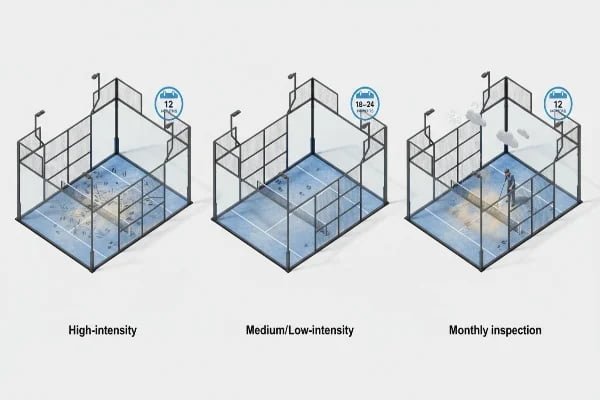
I have helped set up courts in rainy regions and hot deserts. The schedule is never exactly the same for everyone. You must look at two main factors: traffic and weather.
High-Intensity vs. Low-Intensity
If your courts are booked 8 to 10 hours a day, you have a high-intensity field. The constant movement of feet kicks the sand around. The sand grains grind against each other and become smaller dust particles. For these busy courts, I recommend a major refill or replacement every 12 months.
If you have a private court or a club that is only busy on weekends, you fit into the medium-to-low category. The wear is slower. You can likely wait 18 to 24 months. But do not just set a calendar alert and forget it.
The Weather Factor
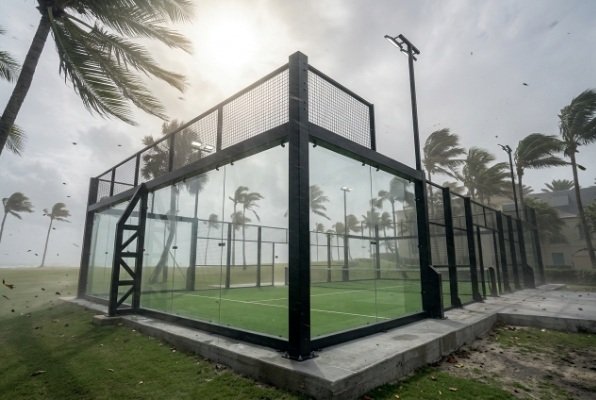
In my experience, weather changes everything. If your court is outdoors in an area with heavy rainfall, water will wash the sand away over time. Even with good drainage, fine particles move. Strong winds are another enemy. They blow the dry sand out of the court structure. If you face these extreme weather conditions, the sand will wear out or shift much more quickly.
The Monthly Inspection Rule
This is my golden rule for all my clients at QHPADEL. Do not wait for the year-end maintenance. You should inspect the components at least monthly. Walk the court. Check the high-traffic zones, like the service line and the net area. These spots lose sand first. If you catch low spots early, you can do a quick top-up. This is much cheaper than a full renovation later.
What Is the Step-by-Step Process for Successfully Renovating Padel Court Sand?
Are you afraid that renovating the court is too complicated? Many owners delay this because they think it requires a full construction crew. The reality is that the process is straightforward if you follow the right steps.
First, use a sweeper or manual tools to remove the old, compacted sand. Next, spread the new silica sand evenly ensuring all areas are covered. Finally, use a brushing machine to fully integrate the sand with the grass fibers, which improves friction and bounce.
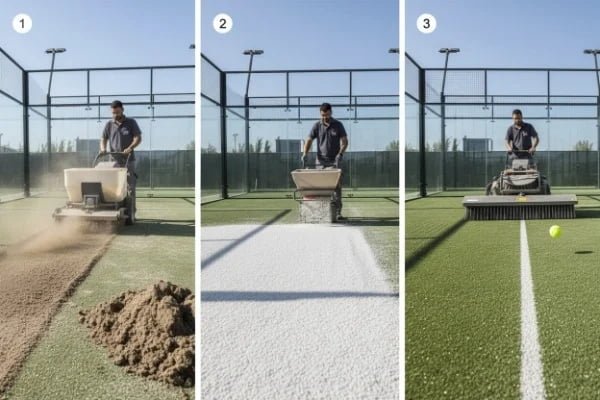
The renovation process is not complicated. I have guided many purchasing staff and club owners through this. You do not need to be an engineer, but you do need to be thorough. Here is how we do it to ensure the court plays like new.
Step 1: Removal of Old Material
Over time, some areas accumulate sediment. The sand gets dirty and hard. You cannot just put new sand on top of bad sand. You need to de-compact the surface. Use a mechanical sweeper with stiff bristles. This machine lifts the flattened grass fibers and pulls up the old, compacted sand. If you have a small area, manual labor with hard rakes works, but a machine is better. You want to loosen everything up.
Step 2: Spreading New Silica Sand
Once the surface is clean and the fibers are standing up, it is time for the new sand. You must use the correct type of silica sand—rounded grains are best to protect the fiber. Spread the sand evenly. Do not dump it in piles. I recommend using a drop spreader. This ensures that every square meter gets the exact same amount of weight. You want a uniform layer across the entire track.
Step 3: Brushing and Integration
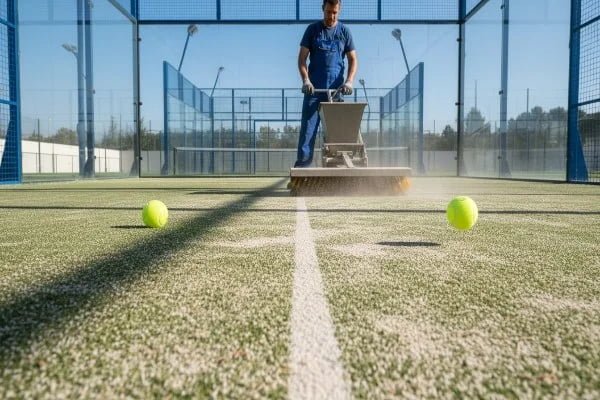
This is the step most people do wrong. You cannot just leave the sand sitting on top of the grass. You must use a brushing machine. Brush the court in different directions—lengthwise, then crosswise. This action forces the sand down to the base of the carpet.
Why is this important?
- It supports the fiber so it stands straight.
- It creates the correct friction for player shoes.
- It ensures the ball bounce is consistent.
When you are done, the sand should be filled to about 2-3mm from the top of the grass tips. You should not see the sand clearly as a beach layer; it should be hidden inside the turf. When you finish this process, the court will feel brand new.
Conclusion
To keep your Padel court profitable, inspect it monthly and renew the sand every 12 to 24 months. Clean the old sand, spread fresh material, and brush it well to ensure safety and quality play.