Sourcing Padel court parts individually is a logistical nightmare that eats into your profits. Why struggle with compatibility issues when a simpler path exists?
Choosing a complete solution ensures all components, from steel frames to glass, are compatible and manufactured to the same standard. It reduces shipping costs, prevents installation delays, and minimizes breakage risks by consolidating everything into a single, factory-loaded container shipment.
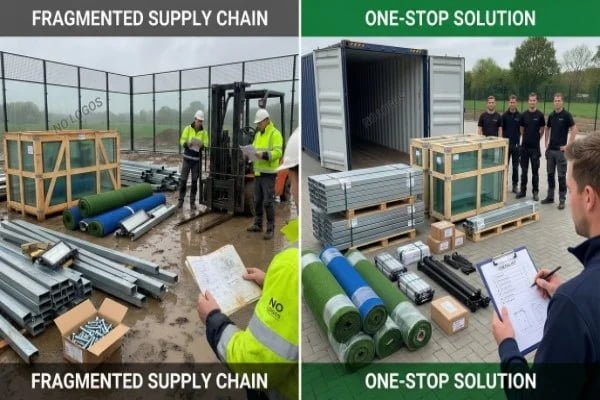
I often compare building a court to buying a computer. You usually buy a ready-to-use system. You rarely buy a motherboard, CPU, and power supply separately to assemble them yourself. Padel courts work the same way. When you buy parts from different places, you face a huge risk. The parts might not fit together. The shipping schedules might not match. This creates a mess for your project.
How Does Sourcing from Multiple Suppliers Impact Your Project Timeline and Communication?
Juggling five different suppliers for one project creates endless email chains and confusion. One missed message can delay your entire construction schedule by weeks.
Working with multiple vendors leads to disjointed production schedules and misaligned delivery dates. A single supplier unifies communication, ensuring that steel, turf, and glass arrive together, keeping your installation team on schedule.
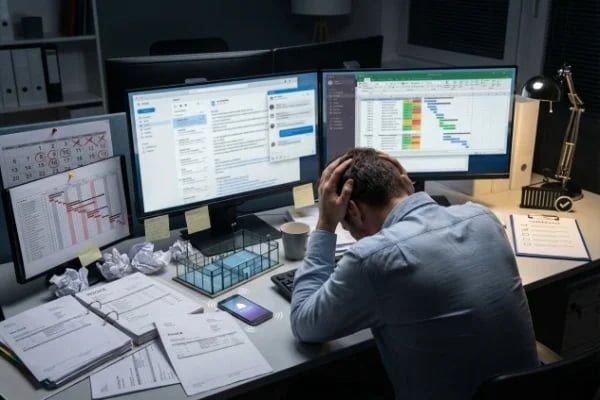
When I worked as an artificial turf engineer, I saw many projects fail. The problem was rarely the product quality alone. The problem was poor coordination. Imagine you order steel from one factory and glass from another. The steel factory finishes production in 15 days. The glass factory needs 30 days. Your steel sits at the port waiting, or you ship it separately. This doubles your work.
At QHPADEL, we solve this with a centralized supply chain. You talk to one team. You give us your court information and specific requirements once. We handle the rest. We coordinate the production of the steel frame, the tempered glass, and the artificial turf.
Here is a breakdown of the communication difference:
| Feature | Multiple Suppliers | QHPADEL One-Stop Solution |
|---|---|---|
| Point of Contact | 5+ Sales Reps (Steel, Glass, Turf, Lights, Net) | 1 Dedicated Project Manager |
| Production Sync | Uncoordinated; parts arrive at different times | Synchronized; all parts finish together |
| Responsibility | Suppliers blame each other for errors | Single point of accountability |
| Documentation | Multiple invoices and packing lists | One complete set of export documents |
In my experience, compatibility is the biggest hidden trap. If the glass panel is 2mm too wide, it will not fit the steel column. If you bought them separately, the glass supplier blames the steel supplier. The steel supplier blames the glass supplier. You are stuck in the middle with a court you cannot build. With a one-stop solution, we ensure every bolt matches the frame. We provide a zero missing parts guarantee. This keeps your project timeline safe.
How Can a "One-Stop" Package Significantly Reduce Your Shipping and Customs Costs?
Paying separate shipping fees and customs duties for every component destroys your profit margins. Do not let logistics costs eat up your budget.
Consolidating orders into a single shipment eliminates the high costs of LCL (Less than Container Load) fees and multiple customs filings. A unified package maximizes container space, significantly lowering the shipping cost per court.
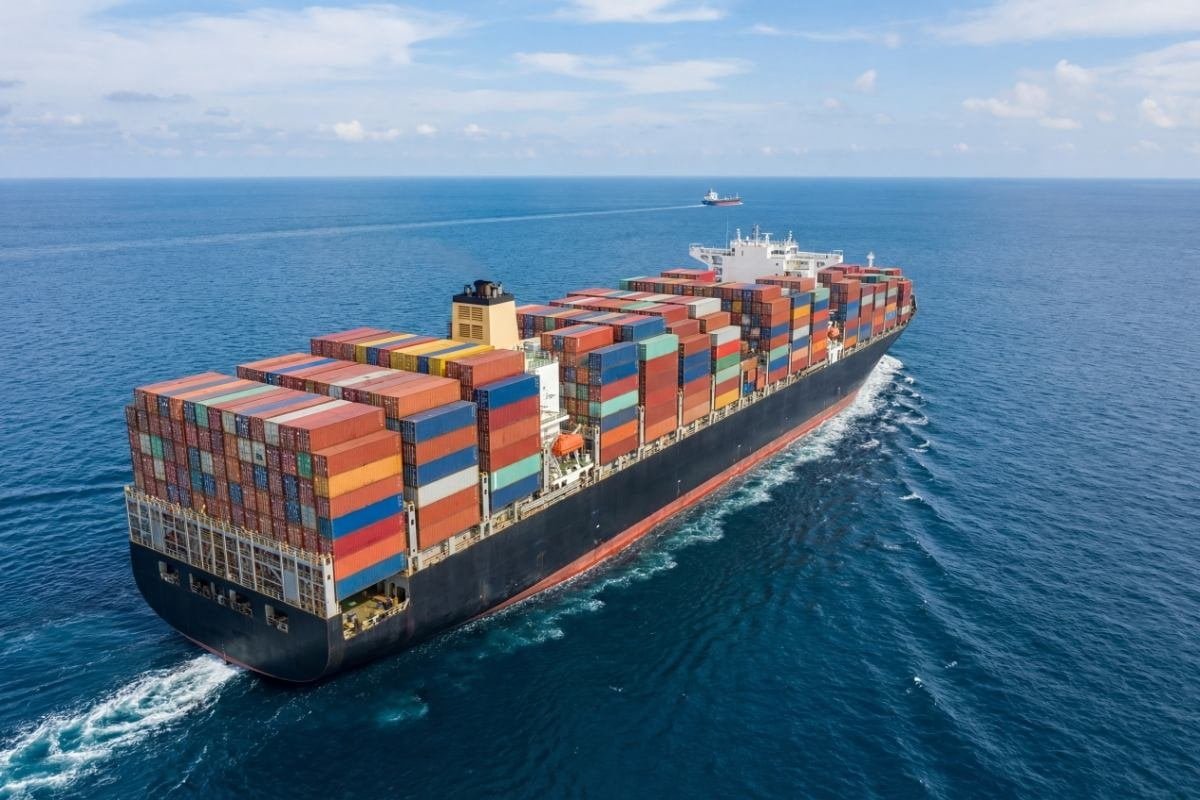
Shipping is expensive. It is often the second largest cost after the materials. When you buy components separately, you usually use LCL (Less than Container Load) shipping. This is the most expensive way to ship. You pay for the volume, but you also pay high handling fees at both ports.
Let me explain the hidden costs of separate sourcing. Imported goods typically go through a long chain:
- Supplier ships to a freight forwarder.
- Forwarder unloads and warehouses the goods.
- Forwarder loads goods into a consolidated container.
- Sea freight occurs.
- Destination port unloads and warehouses the goods.
- Goods are loaded onto delivery trucks.
- Finally, they are unloaded at your address.
Every step in this list costs money. You pay for the truck to the forwarder. You pay for the warehousing. You pay for the handling. If you have three suppliers, you pay these fees three times.
With QHPADEL, we bypass the middlemen. We load the container directly at our factory. We ship it to your installation address. You pay one shipping fee. You pay one customs entry fee.
We also optimize the space. A 20GP container fits exactly all components for two padel courts. A 40HC container fits four padel courts. We calculate the volume of the steel, glass, and turf (usually rolls of 7500 dtex or higher) to fill every inch of the container. You do not pay for empty air. If you buy turf separately, it is bulky and hard to stack. If you buy it with the steel, we place the rolls inside the structure or on top of flat pallets. This efficient packing can save you thousands of dollars per project.
Why Is Consolidated Container Loading (20GP/40HC) Safer for Your Padel Materials?
Damaged glass or bent steel frames upon arrival is every importer’s worst nightmare. Shipping goods through multiple warehouses drastically increases this breakage risk.
Direct container loading at the factory minimizes handling. We load a 20GP or 40HC container once and seal it, ensuring your glass and steel remain untouched until they reach your installation site.
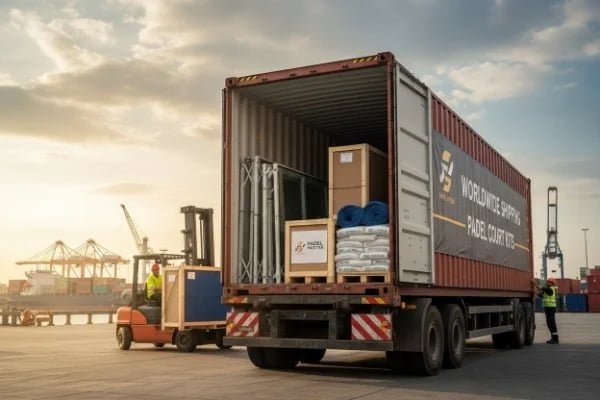
The safety of your materials depends on how many times people touch them. In the logistics industry, we know that damage happens during transfer. It rarely happens while the ship is moving. It happens when a forklift picks up a pallet and moves it.
If you source separately, your goods are moved at least four to six times before they reach the ship. The warehouse workers at a general freight forwarder do not know Padel courts. They do not know that tempered glass is fragile on the edges. They might stack a heavy crate on top of your lighting fixtures.
When we load a container at the QHPADEL factory, we are the only ones touching your goods. We know exactly how to pack a Classic Padel Court to withstand the journey. We use specific techniques:
- Steel Frames: We strap them securely so they do not slide and scratch the zinc-rich epoxy primer.
- Glass: We pack 12mm tempered glass in specialized A-frame wooden cases. We place them in the container where they experience the least vibration.
- Turf: We place turf rolls so they do not get crushed by heavier items.
Even if you only need one court, I still recommend using a 20GP container. Or if you need three courts, use a 40HC. Why? Because exclusive use of a container minimizes transfer. It maximizes the integrity of all parts. You seal the door at our factory, and you open it at your club. This peace of mind is worth the investment. We have delivered over 600/years containers globally, and this direct method is the only way to ensure safety.
What Are the Risks of Importing Padel Accessories Separately vs. a Complete Set?
Discovering that your LED lights do not fit the steel posts during installation creates panic. Small incompatibility issues can stop a big project instantly.
Importing accessories separately often leads to size discrepancies and installation failures. A complete set guarantees that bolts, turf, and lights are engineered to fit the structure perfectly, preventing costly onsite modifications.
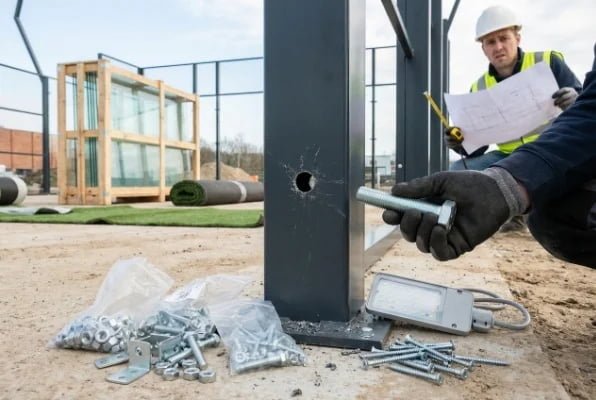
You might think you can save money by buying the net or the lights from a local supplier or a cheaper online vendor. This is a common mistake. Padel courts are precision engineered systems.
Let’s look at the LED lighting. Our courts use lights that fit specific pre-drilled holes in the steel columns. If you buy lights separately, the mounting brackets might be different. You will have to drill new holes on site. This damages the anti-rust coating on the steel. It leads to rust and structural weakness later.
Consider the glass connectors. In our Panoramic Padel Courts, the glass panels connect directly to each other or to small brackets. If you buy glass from one place and screws from another, the tolerances might be off. If the screw is too big, it puts pressure on the glass. This can cause the glass to explode spontaneously months later.
Here is a list of risks when you separate the accessories:
- Turf Glue: We supply two-component polyurethane adhesive. It is tested with our specific turf backing. A generic glue might react poorly with the backing, causing the turf to peel up after one season.
- Bolts and Nuts: Our kits come with the exact count plus spares. Sourcing these locally means you might get the wrong grade of stainless steel, leading to corrosion.
- Sand: While we recommend buying sand locally to save weight, we provide the exact grading specifications. For everything else, relying on the manufacturer ensures the "system" works.
My goal is to help you achieve greater profits and success. That means avoiding the cost of fixing mistakes. When you buy a complete set, you are buying insurance that everything fits.
Conclusion
Sourcing a complete Padel court solution saves you time, reduces shipping costs, and guarantees that all parts fit together perfectly. Trusting a one-stop expert like QHPADEL minimizes your risks and maximizes your profit.