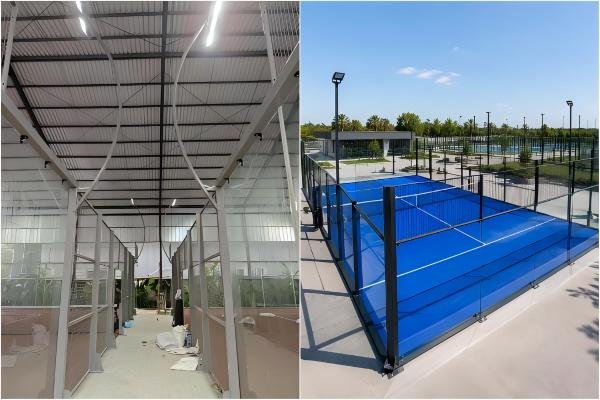
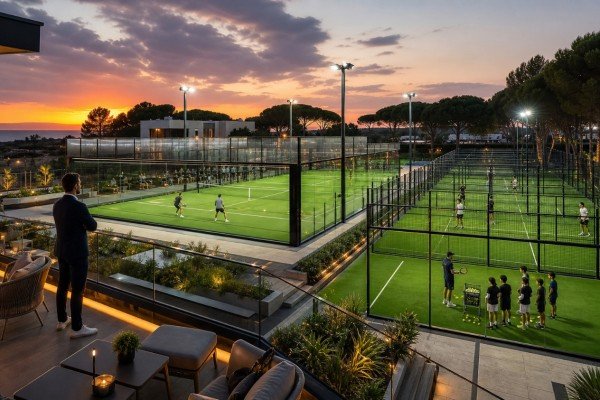
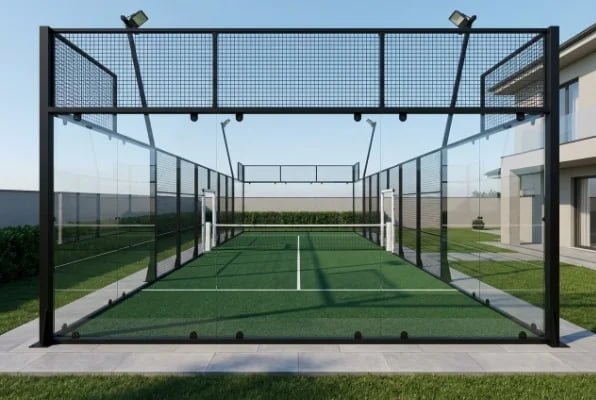
Padel courts operate as coordinated playing and facility systems, but buyers sometimes evaluate them as simple collections of steel, glass, and turf. That approach can create installation conflicts, approval delays, or unexpected site work. I recommend examining how every component, foundation requirement, and installation handoff contributes to a safe, playable court.
Padel courts operate by combining an enclosed rebound area with artificial turf, a central net, structural framing, mesh fencing, tempered glass, and lighting. The walls remain active during play, while the foundation, drainage, accurate installation, electrical work, inspections, and local approvals allow the complete facility to open and operate safely.
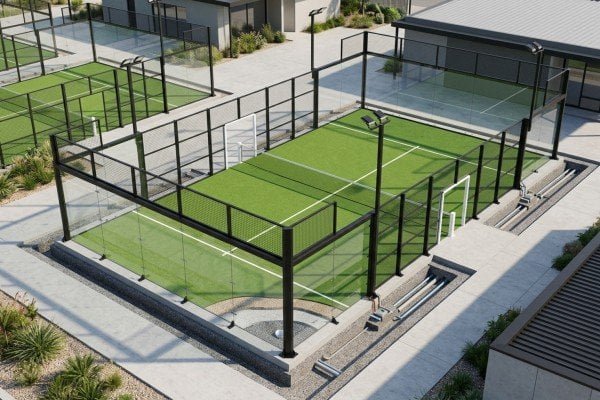
I have found that the playing mechanism is only the starting point. A court can look complete in a container or on an invoice but remain far from operational. Buyers must connect equipment selection with civil work, assembly quality, local compliance, commissioning, and long-term maintenance access.
How Do Padel Courts Work During Play?
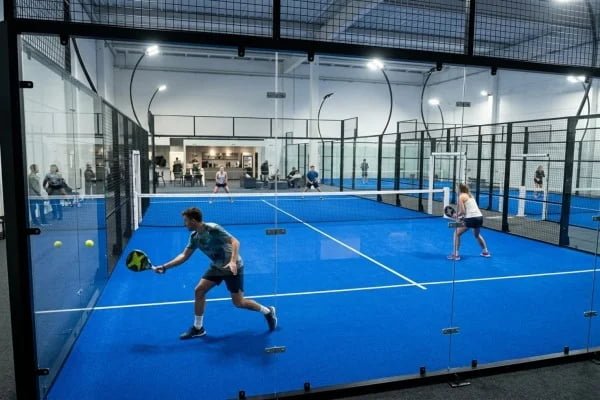
I often receive questions about court size, turf color, and panoramic visibility before buyers ask how the enclosure affects play. That order can hide a critical issue. Unlike ordinary perimeter fencing, the walls influence rebounds, movement, safety, and the consistency that players experience.
A padel court works by keeping play within an enclosed area where the ball can rebound from approved glass and mesh surfaces under the applicable rules. The net divides the playing area, while the turf supports movement and ball bounce. Correct wall alignment, stable fixings, and consistent surface installation help preserve predictable play.
The enclosure is part of the game
I explain to new buyers that the glass and mesh are not decorative boundaries. Players use the surrounding walls during rallies, so their position and stability affect how the court operates. If panels are misaligned, fixings are unsuitable, or joints create irregular transitions, the enclosure may not perform as intended.
Most full-size doubles courts use a 20-by-10-metre playing area, although buyers should verify the required layout against the governing rules and tender documents for their project. The net divides the court across its width. Glass panels form key rebound zones, while metal mesh completes the enclosure and allows specific forms of ball interaction.
I focus on several operational relationships:
- Tempered glass provides a visible rebound surface. Its dimensions, holes, edges, markings, and installation hardware must correspond with the frame design.
- Welded mesh contains play and supports defined ball interactions. Its panel geometry and fixing points must match the structural system.
- Structural posts keep the enclosure in position. Their base plates, anchors, alignment, and connections depend on the approved foundation design.
- Artificial turf supports traction and bounce.1 Its pile characteristics, installation direction, seams, and infill influence the finished surface.
- The net creates the central playing division. Its posts, tensioning system, and installed height must follow the relevant playing requirements.
Predictable rebounds depend on installation
A certificate alone does not guarantee consistent rebound behavior. I advise buyers to review how the glass will be supported, separated from metal contact where required, tightened, and inspected. Installers also need clear panel identification because apparently similar glass pieces may have different hole layouts or positions.
From my involvement in remote installation support, I have seen how a small alignment issue can spread through the assembly sequence. If the first posts are not positioned correctly, later mesh and glass panels may not align with their holes. Installers may then face rework, unsafe improvisation, or a delayed handover.
I treat dimensional control at the start of installation as a commissioning issue, not merely an aesthetic detail.
Players ultimately experience the combined result. They do not separate the frame, glass, turf, and foundation when a rebound feels irregular. Buyers should therefore evaluate the playing enclosure as one coordinated assembly rather than selecting each item only by its individual price.
Which Components Make Padel Courts Operational?
I regularly see procurement lists that appear complete at first glance but omit small accessories, electrical interfaces, or spare items. These gaps become expensive when an installation crew is already on site. A complete operational package needs coordinated components, documented quantities, and clearly assigned responsibilities.
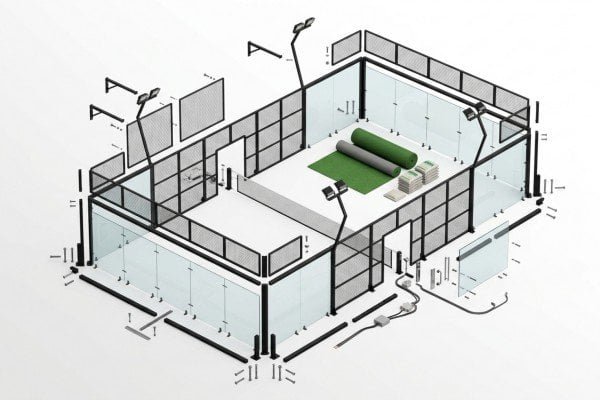
Padel courts become operational when the frame, mesh, tempered glass, artificial turf, infill, net, lighting, fasteners, anchors, and accessories work as one compatible package. Buyers should verify the bill of materials, drawings, component numbering, electrical scope, and spare-parts plan before shipment because one missing interface can stop commissioning.
Each component performs a different job
I use a system-level bill of materials because every major component supports a distinct function. I also distinguish between supplied court equipment and locally sourced installation materials, since this division varies by contract and destination.
| Component | Operational function | Buyer verification point |
|---|---|---|
| Steel frame and posts | They support the enclosure and connect it to the base. | Buyers should verify steel details, coating, hole positions, and structural documentation. |
| Tempered glass | It provides transparent rebound walls. | Buyers should check panel layouts, edge quality, hole positions, test documents, and protective packing. |
| Welded frame mesh | It contains play and forms part of the playing enclosure. | Buyers should confirm mesh dimensions, weld quality, coating, and frame compatibility. |
| Artificial turf | It creates the movement and ball-contact surface. | Buyers should review pile height, Dtex, density, backing, drainage behavior, and intended infill. |
| Infill | It helps stabilize the turf system and influences surface behavior. | Buyers should confirm the specified material, quantity, grading, and local availability. |
| Net and posts | They divide the playing area. | Buyers should verify dimensions, tensioning, anchors, and replacement availability. |
| LED lighting | It supports play in low-light conditions. | Buyers should review photometric design, glare, mounting, wiring scope, and local electrical rules. |
| Fasteners and accessories | They connect and protect the system. | Buyers should check quantities, grades, corrosion protection, and labeling. |
| Anchors or embedded parts | They transfer frame loads to the foundation. | A qualified engineer should verify their suitability for the site and structural design. |
The bill of materials should match the drawings
I recommend cross-checking the packing list against three documents:
- The approved court configuration should identify the purchased model and options.
- The installation drawing should show where numbered components belong.
- The packing list should state what has actually entered each crate or bundle.
At QHPADEL, our manufacturing and delivery experience has taught us that component identification matters almost as much as component presence. A crate may contain every post, but installers can still lose time if the labels do not correspond with the assembly drawings.
Buyers should also define who supplies consumables and local works. Depending on the contract, the factory package may not include concrete, electrical distribution boards, external cabling, lifting equipment, sealants, drainage channels, or all installation tools. The commercial quotation should state these exclusions clearly.
Documentation reduces handoff risk
I provide foundation drawings, installation drawings, packing lists, and maintenance manuals as part of project support. However, I advise buyers to have project-specific documents reviewed by their local contractor and qualified professionals. Generic drawings should not override local soil conditions, wind requirements, electrical codes, accessibility rules, or authority requirements.
QHPADEL holds or supplies documentation associated with ISO 9001 and relevant component certifications, including CE documents for several product groups. Buyers should treat every certificate as a document to verify, not as a universal approval. They should check the issuing body, certificate scope, model reference, test standard, validity, and acceptance by the local authority.
When Are Padel Courts Actually Ready to Open?
I sometimes hear buyers say that their courts will be ready as soon as the containers arrive. That assumption creates avoidable scheduling pressure. Delivered equipment still requires a suitable site, controlled assembly, electrical completion, inspections, corrective work, and any approvals required by the project location.
Padel courts are ready to open only after the foundation and drainage are suitable2, all components are correctly installed, lighting and electrical systems are completed, safety checks are passed, and local approvals are obtained. Equipment delivery marks a logistics milestone, but it does not prove that the facility is playable, compliant, or commissioned.
The foundation controls the installation starting point
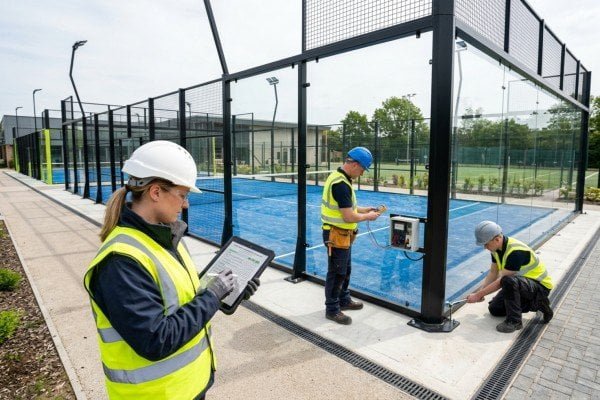
I regard the foundation as the physical interface between the site and the supplied court. If the base dimensions, elevations, anchor positions, or flatness fall outside the approved project tolerances, the installation team may struggle to align the structure.
The appropriate foundation depends on site-specific factors, including:
- The local soil and geotechnical conditions affect the foundation solution.3
- The applicable wind and structural loads affect the engineering requirements.4
- The drainage strategy affects water management around and beneath the surface.
- The selected court model affects base plates and connection locations.
- The local building rules affect design review and approval.
- The indoor or outdoor location affects weather exposure.
I do not recommend copying a foundation solution from another project without professional review. A local structural or civil engineer should verify the design for the actual site. The supplier’s drawings can provide equipment dimensions and connection information, but the local professional remains important for application-specific decisions.
Installation follows a controlled sequence
A typical project progresses through several linked stages. The exact sequence can vary, but I expect the handoff plan to cover the following work:
- The contractor surveys the completed base. The contractor checks dimensions, levels, anchor locations, drainage, and access.
- The installation team sorts the delivered parts. The team reconciles labels and quantities with the packing list.
- The team establishes reference lines. Accurate reference points help prevent cumulative alignment errors.
- The team assembles the frame and mesh. The installers follow the specified sequence and connection requirements.
- Qualified installers fit the tempered glass. They use appropriate lifting, protection, separation, and tightening procedures.
- The surface team installs the turf. The team controls roll direction, trimming, seams, tension, brushing, and infill distribution.
- A qualified electrician completes the lighting.5 The electrician verifies wiring, protection, earthing, controls, and local compliance.
- The responsible parties inspect the court. They record defects, complete corrections, and document acceptance.
Commissioning should use a written checklist
I encourage buyers to avoid verbal-only handover. A written commissioning record provides traceability and separates supply issues from site or installation issues.
The checklist should review:
- The inspectors should check glass condition, support, alignment, and fixings.
- The inspectors should check exposed edges, protrusions, and potential contact hazards.
- The installers should confirm fastener completion and specified tightening procedures.
- The surface contractor should check turf seams, edges, infill, wrinkles, and drainage.
- The electrician should test lighting controls and electrical safety.
- The project team should verify the net, gates, access points, and court markings.
- The owner should receive maintenance instructions and spare-parts information.
- The responsible authority should complete any required inspection or approval.
The opening date should include time for corrective work. I have learned from customer feedback that an aggressive schedule often ignores small but real issues, such as replacing a damaged panel, adjusting a gate, redistributing infill, or resolving a lighting control problem.
How Should Buyers Choose Between Padel Court Models?
I understand why buyers compare models by appearance and initial price. Panoramic glass creates a strong visual impression, while classic structures can appear more conventional. However, a visual comparison alone can overlook structural requirements, viewing needs, installation access, weather exposure, and future maintenance.
Buyers should choose padel court models according to intended use, site exposure, local structural requirements, spectator visibility, installation constraints, maintenance access, and downtime risk. No single model suits every project. Buyers should obtain local engineering verification and compare complete installed scopes rather than selecting only by appearance or equipment price.
Model names do not replace technical evaluation
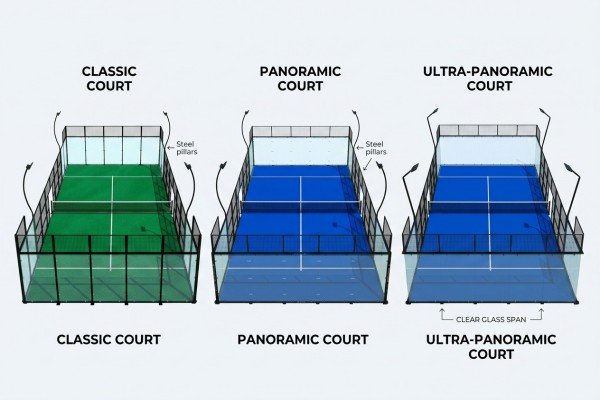
The market commonly uses terms such as classic, panoramic, and ultra-panoramic. However, buyers should not assume that every supplier defines those terms in exactly the same way. I recommend comparing drawings and component schedules rather than relying on model names.
QHPADEL’s product range includes Panoramic, Ultra Panoramic, Classic, Single, Roofed, Hurricane Resistant, and custom court options. Panoramic and Ultra Panoramic courts represent most of our current sales, but sales volume does not prove that either option suits a specific site.
| Evaluation factor | Why it affects operation | Question I recommend asking |
|---|---|---|
| Intended users | Clubs, schools, hotels, and competition venues may have different priorities. | Who will use the court, and what rules or tender conditions apply? |
| Viewing requirements | Structural arrangements can affect spectator and camera sightlines. | Does the project need open views for spectators or broadcasting? |
| Wind exposure | Local wind actions influence the required structural solution. | Has a qualified local professional verified the design basis? |
| Indoor clearance | Roof height, columns, and access routes can constrain installation. | Do the site survey and layout confirm adequate clearance? |
| Installation access | Glass handling and lifting require planned working space. | Can equipment and crews safely reach every installation position? |
| Maintenance access | Lamps, glass, mesh, turf, and fasteners need future attention. | Can technicians replace or inspect components without major disruption? |
| Corrosion environment | Coastal, humid, or industrial locations can demand specific protection. | Does the proposed coating system suit the documented environment? |
| Downtime risk | A damaged proprietary component may take time to replace. | Which spare parts should the owner store locally? |
Buyers should compare the complete installed scope
A lower equipment quotation may exclude items that another proposal includes. I advise buyers to normalize quotations before comparing them. The comparison should cover:
- The quotation should define every structural and playing component.
- The supplier should state glass specifications and packing methods.
- The supplier should identify turf specifications, infill scope, and installation assumptions.
- The proposal should define lighting fixtures, poles, brackets, cables, and controls.
- The contract should allocate anchors, civil works, drainage, unloading, lifting, and labor.
- The supplier should provide document lists and replacement procedures.
- The parties should agree on warranty scope and responsibility boundaries.
I also recommend reviewing production capacity and lead time in relation to the actual order. QHPADEL operates 10 production lines and reports monthly capacity above 1.5 million square metres of artificial turf and 150 complete court systems. Our standard planning allows approximately 20 days for two courts, 20–25 days for four courts, and no more than 30 days for larger standard orders under normal agreed conditions. Custom styles may require up to 35 days. Buyers should still confirm the current schedule, approved drawings, payment milestones, and shipping availability in the purchase contract.
How Can Padel Courts Remain Operational After Opening?
I have seen projects devote significant attention to installation while leaving maintenance responsibilities undefined. That gap can turn minor wear into avoidable downtime. An operating plan should establish routine inspections, cleaning procedures, replacement contacts, documentation control, and clear reporting for safety-related damage.
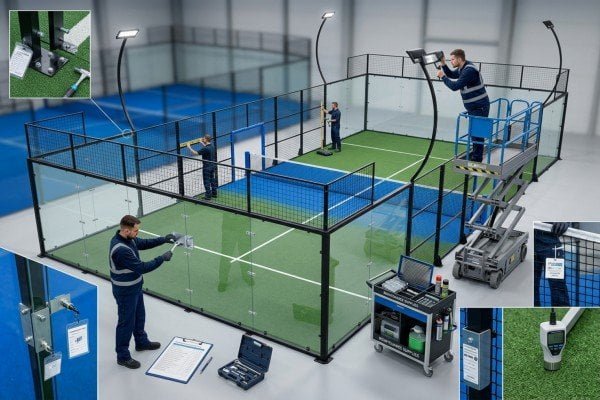
Padel courts remain operational through planned inspection and maintenance of the glass, frame, mesh, fasteners, turf, infill, net, gates, drainage, and lighting. Operators should follow the supplier’s manual, record defects, restrict access when damage may affect safety6, and use qualified professionals for structural, glass, or electrical assessments.
Maintenance should focus on conditions, not fixed promises
I avoid promising a universal service life because climate, usage, installation quality, cleaning, UV exposure, corrosion, and maintenance frequency vary widely. I instead recommend a condition-based inspection routine supported by the manufacturer’s maintenance guidance.
Operators can organize checks by frequency:
Before routine use, staff should:
- Staff should look for visibly damaged glass or loose components.
- Staff should check gates, net condition, and obvious surface hazards.
- Staff should remove debris that could affect footing or drainage.
- Staff should report unusual movement, noise, or lighting faults.
During scheduled maintenance, technicians should:
- Technicians should inspect frame coatings, joints, fasteners, and mesh.
- Surface specialists should examine turf seams, wear areas, and infill distribution.
- Cleaning staff should clear drainage routes according to the site design.
- Qualified electricians should inspect lighting and electrical equipment.
- The operator should update the maintenance and incident records.
Spare parts can reduce avoidable downtime
I often recommend that commercial operators discuss a project-specific spare-parts package before shipment. The right package depends on the model, local inventory, shipping time, and the consequences of closure.
Potential spares can include:
- The operator can store compatible fasteners and protective accessories.
- The operator can keep net components and common wear items.
- The project can include touch-up materials approved for the coating system.
- The buyer can consider spare glass based on handling and replacement risk.
- The facility can retain lighting components when local replacements are difficult to source.
The operator should store glass and other components in suitable conditions and follow the manufacturer’s handling instructions. A spare part only reduces downtime when staff can identify it and qualified personnel can install it correctly.
I also advise operators to retain final drawings, certificates, packing records, inspection reports, and electrical documentation. These records help future contractors identify the installed system. They can also support warranty discussions and procurement of compatible replacement parts.
Frequently Asked Questions
What is the standard size of a padel court?
A full-size doubles padel court commonly has a 20-by-10-metre internal playing area. However, I recommend verifying all dimensions, clearances, access zones, and enclosure details against the applicable federation rules, local requirements, and approved project drawings before construction begins.
Can a padel court operate immediately after delivery?
No. I treat delivery as the completion of the supply stage, not the opening stage. The project still needs a verified foundation, drainage, assembly, turf installation, electrical work, safety checks, correction of defects, and any locally required inspections or approvals.
Why do padel courts use glass walls?
Padel courts use glass because transparent walls allow visibility while forming active rebound surfaces during play. The glass must correspond with the frame and applicable design requirements. Buyers should verify glass documentation, panel layouts, packing, installation methods, and local acceptance rather than relying only on a general “tempered glass” description.
Do all padel court models work in windy locations?
No. I do not consider any model universally suitable for windy sites. The project team should establish local wind actions, exposure, terrain, foundation conditions, and building requirements. A qualified structural professional should evaluate the proposed court and foundation for the specific location.
What documents should a padel court supplier provide?
I recommend requesting approved product drawings, foundation interface drawings, installation instructions, a detailed bill of materials, packing lists, maintenance guidance, warranty terms, and relevant certificates or test reports. Buyers should verify that each document matches the supplied model and satisfies the destination market’s procurement and approval requirements.
Conclusion
Padel courts operate successfully only when their playing surfaces, rebound walls, structure, turf, lighting, foundation, installation, and maintenance plan function together. I recommend evaluating the complete operational pathway rather than treating equipment delivery as project completion. Buyers should verify the bill of materials, supplier documents, local engineering, electrical scope, installation tolerances, approvals, and spare-parts strategy before confirming an opening date.
For a complete court proposal, drawings, component options, or procurement review, contact Alice Chen at QHPADEL via alice@grass-supplier.com or WhatsApp +86 185 7566 0746.
-
"Quantifying Field Variability Effects on Surface Performance …", https://vtechworks.lib.vt.edu/bitstreams/6001e03c-9e03-4d13-ac95-1b8974388d6c/download. Sports-surface research and testing protocols show that artificial-turf system characteristics, including fibres, infill, and compaction, influence traction and ball rebound behaviour. Evidence role: mechanism; source type: research. Supports: That artificial-turf construction and maintenance influence traction and ball-surface interaction characteristics.. Scope note: Evidence from artificial-turf sports generally is informative but may not quantify performance for every padel-specific turf system. ↩
-
"the building commissioning guide", https://schools.utah.gov/financialoperations/formsapplications/repositorypracticalresources/commissioning/BCG_3_30_Final_R2-x221_0Z5RDZ-i34K-pR.pdf. Building-control and construction-commissioning guidance treats delivery of materials as distinct from completion: relevant systems must be installed, inspected, tested, documented, and approved where regulations require before a facility is put into use. Evidence role: general_support; source type: government. Supports: That constructed facilities require inspection, testing, completion documentation, and any applicable approvals before operational use.. Scope note: The exact approvals, inspections, and commissioning records depend on local law, procurement arrangements, and the facility’s specific services. ↩
-
"Chapter 4 – NHI-05-037 – Geotech – Bridges & Structures", https://www.fhwa.dot.gov/engineering/geotech/pubs/05037/04a.cfm. Government geotechnical-design guidance explains that foundation selection and design depend on site-specific subsurface conditions, soil properties, groundwater, and anticipated structural loads. Evidence role: mechanism; source type: government. Supports: That foundation design requires consideration of subsurface conditions and geotechnical investigation results.. Scope note: The guidance supports the need for site-specific assessment but does not prescribe a foundation design for an individual padel court. ↩
-
"[PDF] Directional extreme wind speed data for the design of buildings and …", https://nvlpubs.nist.gov/nistpubs/Legacy/BSS/nbsbuildingscience160.pdf. Recognized structural design standards, including ASCE 7 and Eurocode 1, require designers to determine wind actions from site-specific factors and incorporate applicable loads into structural design. Evidence role: expert_consensus; source type: institution. Supports: That structural design must account for site-dependent wind actions and other applicable loads.. Scope note: The cited standards establish the design principle; a qualified engineer must determine the governing loads and structural solution for the specific project location. ↩
-
"1910.332 – Training | Occupational Safety and Health Administration", http://www.osha.gov/laws-regs/regulations/standardnumber/1910/1910.332. Electrical-safety guidance identifies installation, inspection, and testing work as tasks requiring qualified persons who understand applicable hazards, protective measures, and regulatory requirements. Evidence role: expert_consensus; source type: government. Supports: That electrical work and safety verification should be performed by qualified persons under applicable electrical requirements.. Scope note: Qualification requirements and inspection procedures vary by jurisdiction and by the electrical scope of the installation. ↩
-
"1910.334 – Use of equipment. | Occupational Safety and … – OSHA", http://www.osha.gov/laws-regs/regulations/standardnumber/1910/1910.334. Occupational and public-safety guidance generally requires hazardous damaged equipment or installations to be taken out of service, isolated, or otherwise controlled until competent assessment and corrective action are completed. Evidence role: general_support; source type: government. Supports: That equipment or structures presenting a potential safety hazard should be removed from service or access-controlled until assessed and corrected.. Scope note: The appropriate restriction method and legal duty depend on the nature of the defect, the venue, and applicable local safety law. ↩