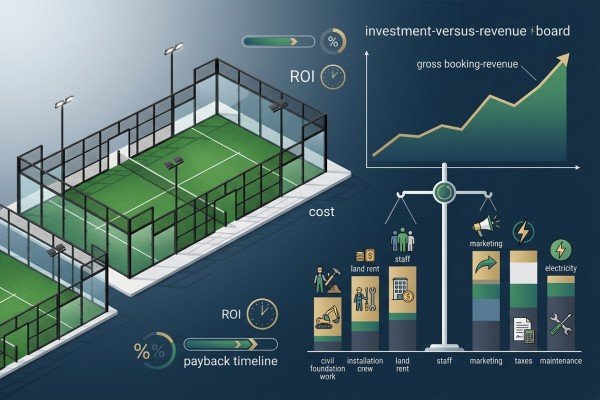

You might be wondering if making a padel court business profitable is as easy as the industry hype suggests. Many investors jump in expecting rapid returns, only to watch their budget drain away on hidden construction costs and delayed openings. The secret to long-term success is not just about choosing a great location; it requires smart procurement and strict control over your capital expenditure.
Yes, owning a padel court business can be highly profitable, but success depends on strict control of your initial capital expenditure (CAPEX) and minimizing operational downtime. By optimizing court configurations, securing certified materials, and factoring in total landed costs, investors can significantly shorten their payback period and maximize returns.
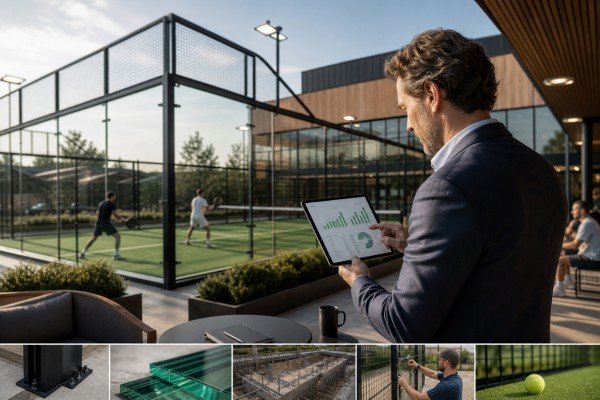
As a B2B padel court manufacturer helping international buyers build their facilities, I see the financial realities of this industry every day. Let us break down how to accurately calculate your true initial costs and structure your hardware investment for maximum financial efficiency.
What is the biggest CAPEX blindspot for a padel court business profitable plan?
Calculating your business budget based only on the factory price of the equipment is a critical error. Surprising logistical and civil expenses can ruin your financial projections before the first ball is even hit. You need a comprehensive view of your total landed costs.
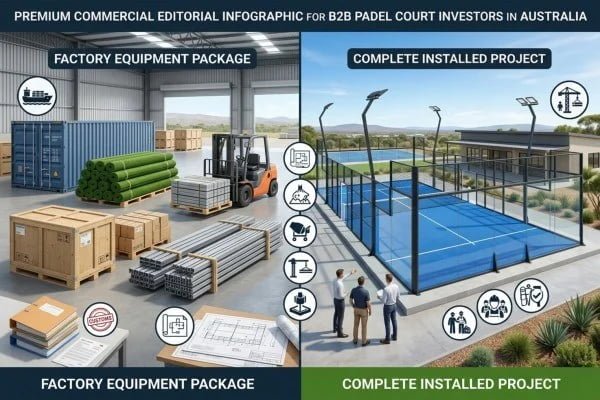
The largest CAPEX blindspot for investors is ignoring the total landed and installation costs. A true financial plan must include ocean freight, local foundation pouring, unloading logistics, and ancillary facilities. The factory equipment price is only one part of the total investment required.
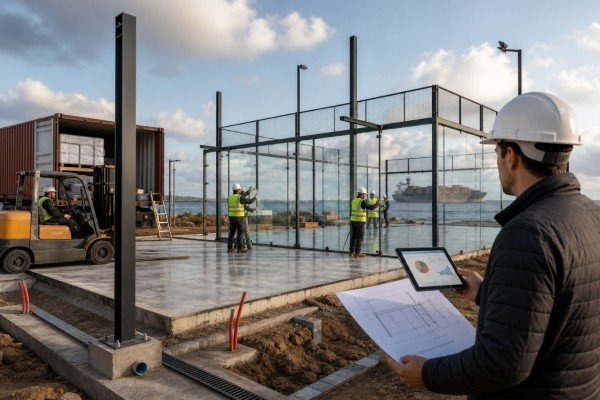
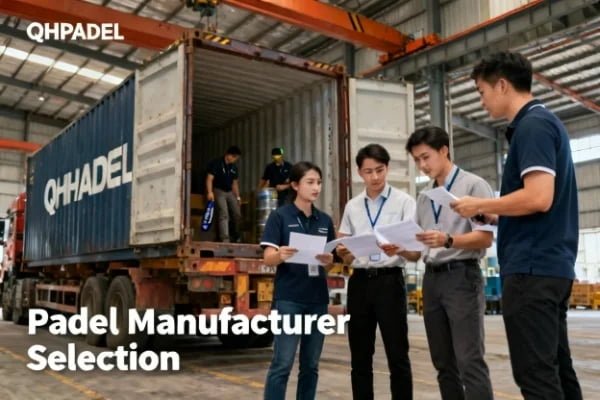
When developers send me their initial business plans, they often calculate their payback period using only our FOB (Free On Board) equipment price. I always remind them that a successful procurement strategy looks at the whole picture. I recently spoke with a developer in South America who almost paused his project because he forgot to budget for container unloading cranes and local site preparation.
To evaluate your true startup costs, you must divide your capital expenditure into four main pillars.
The Four Pillars of Padel CAPEX
| CAPEX Category | Key Components to Calculate |
|---|---|
| 1. Factory Equipment | Court frames, tempered glass, artificial turf, lighting fixtures, and nets. |
| 2. Logistics & Import | Ocean freight, customs clearance, import duties, inland trucking, and unloading equipment. |
| 3. Civil Engineering | Concrete foundation pouring, drainage systems, and site leveling. |
| 4. Local Installation | Contractor labor, assembly tools, and heavy lifting equipment for glass panels. |
A profitable business model relies on highly precise foundation work. Local civil contractors must pour the concrete according to strict tolerance requirements provided by the manufacturer. If a foundation is uneven, the steel frame will not sit flush. This forces local installers to bend or force the structure, which creates immense stress on the tempered glass.
Understanding these hidden costs prevents cash flow crises during construction. Always request complete foundation drawings and pre-embedding instructions from your supplier before you finalize your local contractor budget.
How does a tiered investment strategy keep your padel court business profitable?
Buying top-tier, ultra-panoramic courts for every single pitch is tempting but financially risky. Overspending on premium equipment for non-premium spaces extends your payback cycle unnecessarily. A mixed-court strategy balances visual appeal with budget control.
A tiered investment strategy keeps a padel court business profitable by mixing different court models. You can install premium Ultra-Panoramic courts in high-visibility center areas to drive marketing, while using cost-effective Classic courts for standard coaching areas, thereby lowering your overall CAPEX.
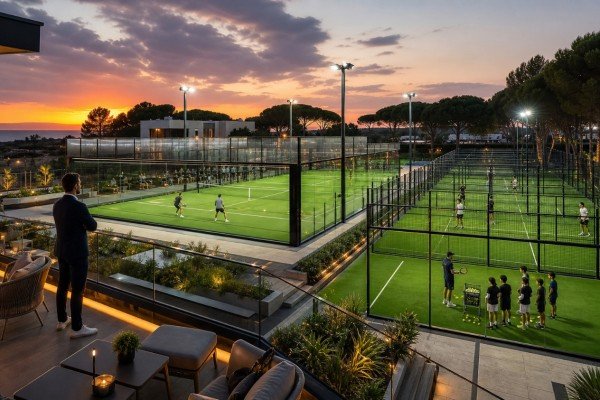
You do not need to spend maximum dollars on every square meter of your club. Smart investors use a "Main + Side court" configuration strategy to optimize their budget without sacrificing the player experience.
In our export data at QHPADEL, we see clear procurement trends from successful club operators. Currently, our Panoramic Courts make up about 50% of our sales, and Ultra Panoramic Courts account for 40%. The remaining volume consists of Classic Courts, Roofed Courts, and specialized Hurricane Resistant models.
Zoning Your Facility for Profit
To shorten your payback period, zone your facility logically:
- Center/Showcase Courts: Place your Ultra Panoramic courts here. These have no visual obstructions and are perfect for tournaments, VIP bookings, and social media marketing. You can charge a premium hourly rate for these courts.
- Standard/Coaching Courts: Use standard Panoramic or Classic models for the edges of your facility. These courts are structurally excellent but cost less to manufacture. They are ideal for daily lessons, high-volume casual play, and overflow bookings.
This tiered approach directly reduces your initial investment. It allows you to maintain a high-end brand image while keeping the average cost per court under strict control. Furthermore, standardizing certain components across different court models—like using the exact same lighting fixtures and artificial turf specifications across both tiers—simplifies your maintenance schedule later.
What is the silent profit killer in padel club operations?
You cut corners on equipment to save money upfront, but now a glass panel has shattered. Your court sits empty for weeks while you wait for a replacement. This operational downtime bleeds revenue and damages your local reputation.
Equipment downtime is the silent profit killer for padel clubs. If low-quality glass breaks or turf tears prematurely, the court cannot be rented. The lost revenue from weeks of waiting for overseas replacement parts often exceeds the money saved by buying cheap, uncertified equipment initially.
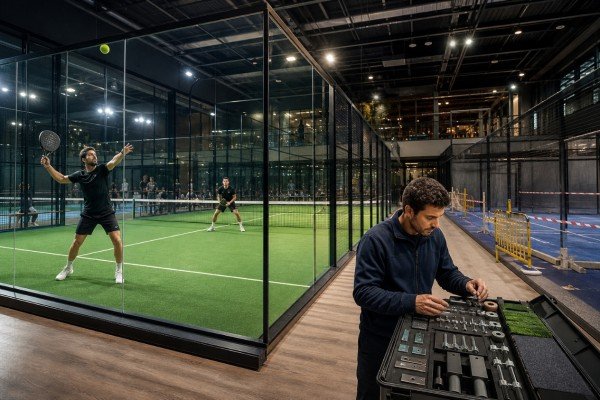
Investors often focus heavily on the initial purchase price, but the actual cost of cheap equipment is realized in lost revenue. Imagine a scenario where a heavily booked court is forced to close because a substandard glass panel shatters during a match.
If you do not have spare parts on site, you must order a replacement from overseas. Ocean freight alone can take 30 to 40 days, plus production and customs time. During those six to eight weeks, that specific court generates zero income. For a busy commercial club, the financial loss of a dead court quickly dwarfs the few hundred dollars saved during the initial procurement phase.
Technical Specifications Protect Cash Flow
Technical specifications are not just numbers on a page; they are direct defenses against downtime.
- Structural Accuracy: Cheap manufacturing leads to imprecise hole positions in the steel frame. When parts do not align easily, local installers force the screws. This creates invisible tension points. Months later, a minor impact causes the stressed glass to shatter.
- Turf Density: Turf is the highest-wear item in your facility. If you choose an artificially low Dtex or density to save money, the grass will flatten and tear rapidly.1 Worn turf becomes slippery and unsafe, forcing you to replace it much sooner than the standard lifecycle.
To maintain profitability, evaluate hardware based on its ability to survive continuous commercial abuse. Durable, accurately manufactured components ensure that your courts remain open, rentable, and revenue-generating 365 days a year.
How can zero-downtime procurement make a padel court business profitable?
Hoping nothing breaks is not a viable business strategy. International supply chains take time, and a broken component can halt your operations. You need a preventative procurement model to secure your continuous cash flow and protect your asset.
To ensure profitability, implement a zero-downtime procurement strategy. This means buying strictly certified components and planning for spare parts upfront. Purchasing extra tempered glass panels, turf patches, and hardware during the initial shipment eliminates waiting periods and keeps your courts operational.
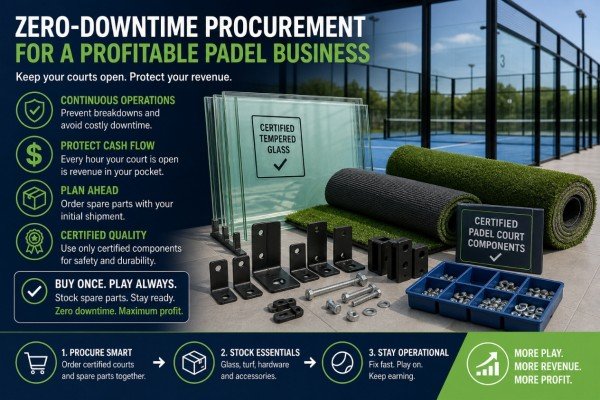
Profitability requires anticipating failures before they happen. When buyers place orders with us, we strongly advise them to adopt a preventative procurement mindset. The most cost-effective time to buy spare parts is when you are already paying for an ocean shipping container.
The Spare Parts Strategy
We recommend a specific formula for our clients: for every four courts you order, you should include at least one spare glass panel in the container. You should also order an extra roll of artificial turf and a surplus package of specialized screws and fasteners. If a panel breaks two years after opening, your maintenance team can replace it the very next morning from your own storage room. Your downtime is measured in hours, not months.
Verifying Supplier Certifications
You must also protect your investment by verifying your supplier’s documentation. Treat certifications as essential documents that you, as the buyer, must independently check.
- Glass: Ensure the tempered glass carries CE marks and complies with rigorous standards like AS/NZS 2208:1996 and AS/NZS 4666:2012.2
- Steel & Accessories: Look for CE certification on the steel frame structure. Even the smallest components matter; for instance, verify that screws and accessories meet AD 2000 WO and PED 2014/68/EU quality system approvals.3
- Factory Quality: Confirm the manufacturing facility holds an active ISO9001 certification.4
Finally, insist on clear installation documentation. A responsible supplier provides comprehensive packing lists, component numbering, and detailed installation drawings. When local civil contractors have perfectly clear instructions, they make fewer errors, ensuring your equipment performs exactly as designed for years to come.
Frequently Asked Questions
How long does it take to manufacture padel courts for a new business?
Standard production for two courts takes about 20 days. Four courts usually take 20 to 25 days, and larger orders exceeding four courts take no more than 30 days. Custom-made styles require slightly more time, generally completing within 35 days.
Can I customize the artificial turf and frame colors for my brand?
Yes, OEM and ODM customization is highly common. You can customize steel frame colors and artificial turf specifications, including color, Dtex, and density. Note that custom turf usually requires a minimum order quantity (MOQ) equivalent to about six courts (roughly 1,254 square meters).
Do manufacturers provide installation services overseas?
As a B2B manufacturer, we supply the complete hardware packages. We do not fly teams overseas to install them. Instead, we provide comprehensive installation drawings, foundation layouts, detailed packing lists, maintenance manuals, and online guidance for your local contractors to execute.
What certifications should a padel club demand from suppliers?
To protect your investment, demand verifiable certifications. You should look for CE and AS/NZS standards for tempered glass, CE marks for the steel frame and LED lights, and CE/RoHS for the artificial turf.
Conclusion
Determining if your specific project will be a padel court business profitable venture comes down to how well you manage your initial capital and operational risks. By avoiding CAPEX blindspots, using a tiered court strategy to optimize your budget, and executing a zero-downtime procurement plan, you can dramatically shorten your payback period. Never compromise on certified materials or upfront spare parts, as continuous operation is the only way to guarantee revenue.
-
"Synthetic Turf: History, Design, Maintenance, and Athlete Safety", https://pmc.ncbi.nlm.nih.gov/articles/PMC6299344/. Sports engineering studies evaluating artificial turf demonstrate that higher Dtex (linear mass density) and greater pile density significantly improve the surface’s resistance to mechanical wear, flattening, and fiber degradation. Evidence role: mechanism; source type: paper. Supports: the correlation between higher Dtex/density and increased wear resistance in artificial turf.. ↩
-
"AS/NZS 2208:1996", https://www.standards.org.au/standards-catalogue/standard-details?designation=as-nzs-2208-1996. AS/NZS 2208:1996 and AS/NZS 4666:2012 are joint Australian/New Zealand standards that specify the testing and performance requirements for safety glazing materials and insulating glass units used in buildings. Evidence role: definition; source type: government. Supports: the definition and scope of the AS/NZS 2208:1996 and AS/NZS 4666:2012 standards for safety glazing.. ↩
-
"Pressure Equipment Directive (EU)", https://en.wikipedia.org/wiki/Pressure_Equipment_Directive_(EU). The European Pressure Equipment Directive (PED 2014/68/EU) and the German AD 2000-Merkblatt W0 establish stringent quality assurance and certification requirements for manufacturers of metallic materials and components. Evidence role: definition; source type: government. Supports: the scope of the PED 2014/68/EU directive and AD 2000 W0 certification for material quality.. Scope note: These standards primarily govern pressure equipment, though their material quality requirements are often adopted as benchmarks for high-stress structural hardware. ↩
-
"Quality management system", https://en.wikipedia.org/wiki/Quality_management_system. ISO 9001 is an internationally recognized standard published by the International Organization for Standardization, which sets out the criteria for a quality management system to ensure consistent product quality and customer satisfaction. Evidence role: definition; source type: institution. Supports: the definition and purpose of the ISO 9001 standard for quality management systems.. ↩