
Club investors often face a confusing maze when calculating the cost to install a padel court. Opaque quotes from local "turnkey" contractors can make your ROI look disastrous, while cheap factory prices hide heavy secondary expenses. You need a transparent way to calculate your true project budget.
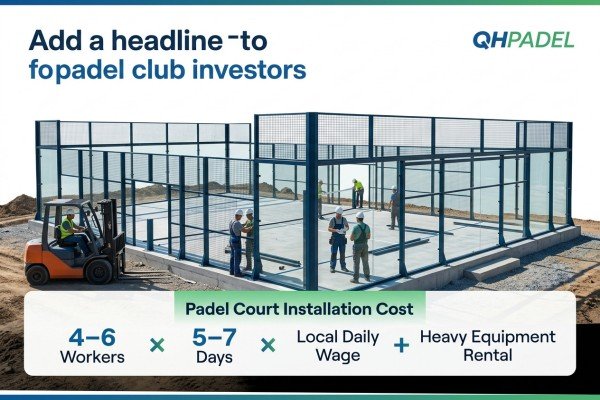
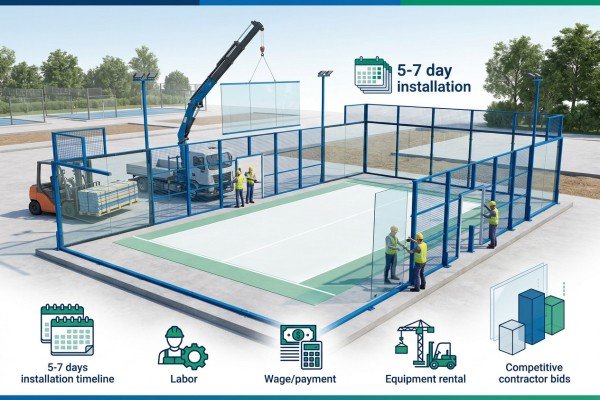
The actual cost to install a padel court depends entirely on local labor and civil works. Instead of a fixed global price, use this exact formula: calculate (4 to 6 workers × 5 to 7 days × your local daily wage), then add the cost of heavy equipment rentals.
Bridging the gap between the factory floor and a fully playable court requires understanding where your money actually goes. Let us break down the exact variables so you can take control of your commercial property budget and negotiate fairly.
What is the exact formula for the cost to install a padel court?
You ask local contractors for a quote, and the numbers are all over the place. Without a standardized baseline, you risk overpaying for basic labor. You need a concrete estimating tool to evaluate contractor bids fairly and accurately.
To accurately estimate your installation budget, use this formula: (4 to 6 workers × 5 to 7 days × local daily wage) + crane and forklift rental costs. Bring these specific parameters to your local general contractor to get a realistic, transparent quote for the job.
When I consult overseas club investors, the very first questions I ask are: "Is your site indoor or outdoor? Is your concrete foundation ready?" Calculating the final cost to install a padel court is about mastering a specific formula, not hunting for a fixed global price tag. Labor rates in South America differ vastly from those in the Middle East or Southeast Asia.1
Breaking Down the Installation Formula
If this is the first time a local crew is assembling a complete padel court package, they will inevitably move a bit slower. That is perfectly normal. Here is the exact breakdown you should hand to your local construction manager to calculate your baseline costs:
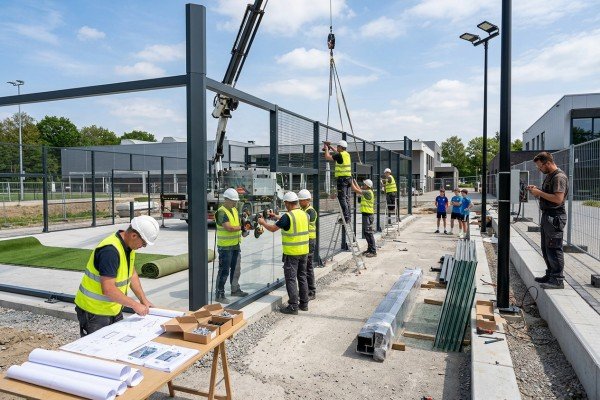
- Labor Force: You need a dedicated team of 4 to 6 general construction workers.
- Time Frame: Allocate 5 to 7 full working days per court for a first-time crew. As they learn the process, subsequent courts will take closer to 3 to 4 days.
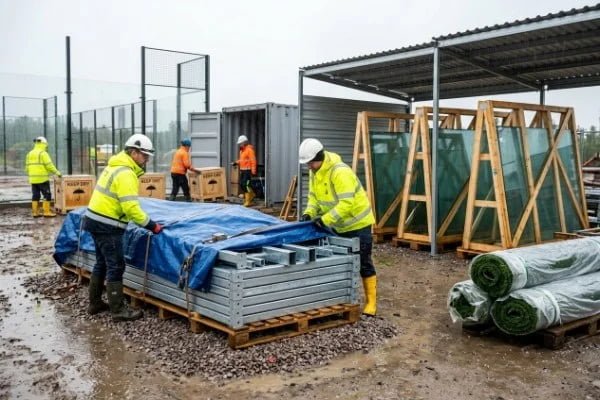
- Heavy Machinery: You must factor in daily rental rates for a forklift (to unload the shipping container) and a small crane or glass-lifting robot (to maneuver the heavy AS/NZS certified tempered glass panels safely).
Do not accept vague, flat-rate proposals. Hand your local civil contractor our provided foundation drawings, packing lists, and standard installation manuals. Tell them exactly how many days and men the job requires. This forces the contractor to quote based on actual daily wages rather than perceived "specialty sport" premiums, protecting your investment capital.
Why are local "turnkey" padel installation quotes so expensive?
Many commercial property developers suffer massive sticker shock when getting quotes from all-in-one local court builders. These inflated prices threaten to kill the project’s ROI before it even begins. You must understand the markup myth to protect your funds.
Local turnkey contractors heavily mark up imported materials and exploit the myth that you need a specialized padel installation team. In reality, any competent local construction crew can easily assemble a court using factory drawings, numbered components, and our online guidance.
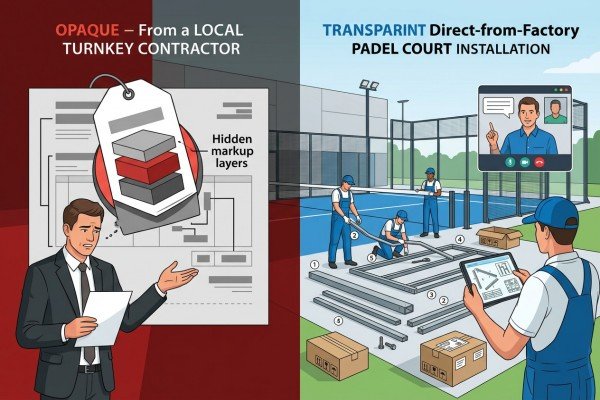
I speak with chain brand operators every week who are frustrated by local bids. The fundamental problem is the information gap. Many local "turnkey" contractors position themselves as exclusive experts, but they are often just importing the exact same complete padel court systems from manufacturers like us and adding a massive profit margin to both the materials and the labor.
The "Specialized Installer" Myth
The single biggest driver inflating the cost to install a padel court is the false belief that you need European or highly specialized sports contractors to do the heavy lifting. This simply is not true.
The structure of a padel court is essentially a giant erector set. It involves standard civil engineering practices: pouring concrete, drilling expansion bolts, assembling structural steel posts, lifting tempered glass, and rolling out CE-certified artificial turf. A standard local construction or civil engineering team with zero prior padel experience can easily complete the job.
Direct Sourcing vs. Local Markup
By importing directly from a transparent B2B manufacturer with over 10 years of production experience, you eliminate the middleman’s material markup. We provide comprehensive documentation for your local team to succeed, including:
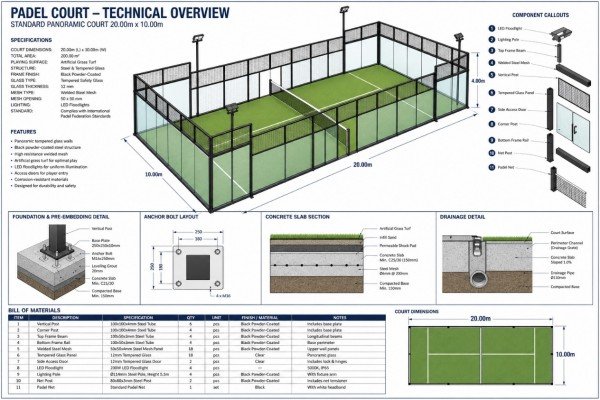
- Precise foundation and pre-embedding drawings with strict tolerance requirements
- Clear component numbering and complete fastener kits (AD 2000 WO certified)
- Detailed maintenance manuals and installation blueprints
- Online video guidance and technical troubleshooting
Hiring your own standard civil contractors and paying them their standard daily wage is vastly more cost-effective than overpaying a "padel specialist" who is just subcontracting the same local workers anyway.
How do different court models affect the cost to install a padel court?
Buyers often assume all court styles cost the exact same amount of money to erect. Treating a massive roofed structure the same as a standard panoramic design leads to severely underfunded budgets and delayed launch dates.
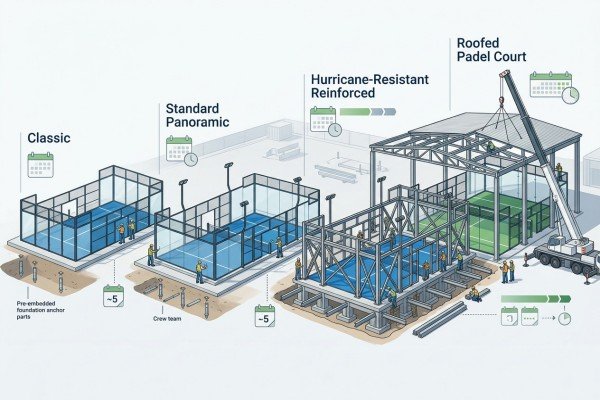
The cost to install a padel court changes based on the structural complexity. Standard Panoramic and Classic models take roughly 5 days. However, Hurricane-resistant and Roofed courts require massive pre-embedded parts, more structural steel, and canopy installations, drastically increasing labor hours.
In our manufacturing facility, the Panoramic Court accounts for 50% of our sales, while the Ultra Panoramic makes up 40%. These standard designs have predictable, streamlined assembly processes. But if your specific market application requires advanced weatherproofing, you must adjust your budget accordingly.
Standard vs. Complex Installations
When estimating the total cost to install a padel court, you must align your labor formula with the physical reality of the materials being moved. Not all courts are created equal, and your local construction team will charge you based on the tonnage of steel and the difficulty of the rigging.
| Court Model Type | Structural Complexity | Estimated Installation Time | Labor Impact |
|---|---|---|---|
| Panoramic & Ultra Panoramic | Standard steel frame, standard glass lifting | 5 to 7 days | Standard baseline cost |
| Classic Court | More vertical pillars, traditional mesh | 5 to 7 days | Standard baseline cost |
| Hurricane Resistant Court | Heavy-gauge steel, deeper pre-embedded anchors | 7 to 10 days | Medium to High increase |
| Roofed Court | Substantial overhead steel, heavy tarps, complex rigging | 10 to 14+ days | Significant increase |
If you are a club owner in a coastal region buying a Hurricane-resistant court (which accounts for a very specific, durable segment of our production), your local team must deal with much heavier steel profiles and stricter foundation tolerances. The pre-embedded parts must be perfectly aligned before the concrete cures.
Similarly, Roofed courts involve high-altitude work. Your civil contractors will need scissor lifts, larger cranes, and specialized rigging to secure the canopy. Always separate your labor quote by the exact SKU you are purchasing to ensure your budget reflects reality.
You secured a great factory price and negotiated a fair labor rate, but suddenly you are bleeding cash. Overlooking secondary project requirements will quickly drain your capital reserves and ruin your financial projections.
Buyers often mistake the factory price for the total landed project cost. The heaviest hidden blindspots impacting the cost to install a padel court include civil works for concrete foundations, heavy machinery rentals, and local destination customs clearance fees.
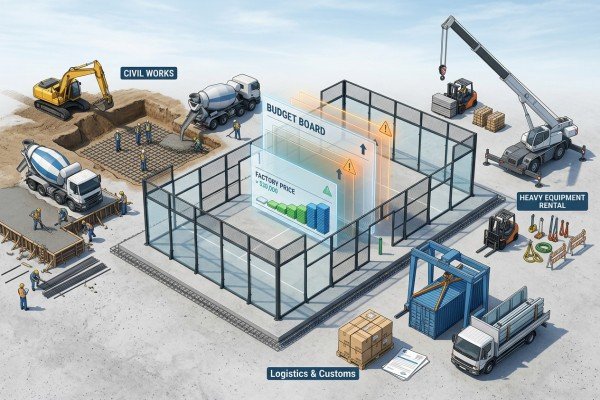
Transparency is the most important trait in a B2B supplier relationship. As an exporter managing over 600 containers annually, I constantly remind equipment distributors and investors that our FOB or CIF price is just the beginning of their spreadsheet.
To calculate your true return on investment, you must illuminate the hidden cost blindspots that local turnkey operators use to justify their high prices.
Civil Works and Site Preparation
A padel court is only as good as the ground it sits on. You cannot simply bolt 12mm tempered glass to uneven dirt. You must build a proper foundation before the containers ever arrive at your site.
- Concrete Ring Beams: Most outdoor courts require a reinforced concrete ring beam perimeter to anchor the steel posts securely2.
- Porous Concrete Floors: The playing surface under the artificial turf must be poured with precise drainage slopes to prevent water pooling. This civil engineering work is entirely separate from the court assembly and forms a massive part of your localized budget.
Logistics and Machinery Rentals
Do not forget the unboxing process. A single complete padel court weighs thousands of kilograms. You will inevitably incur fees for:
- Destination port charges, unloading fees, and local customs clearance taxes.3
- Inland trucking from the shipping port to your club site.
- Forklift rentals to pull massive pallets of artificial grass and steel out of the shipping container.
- Crane rentals to safely position the glass panels without shattering them.
Factor these elements into your baseline calculations, and you will never be surprised by an invoice again.
Frequently Asked Questions
Do I need a specialized padel installation team?
No. Any standard local civil engineering or construction crew can assemble a padel court. We provide complete installation drawings, component numbering, and online guidance, allowing general contractors to successfully execute the project without charging "specialty sport" premium rates.
How long does it take to install one padel court?
For a first-time local construction crew, a standard Panoramic or Classic padel court takes 5 to 7 days to install. Once the team is familiar with the process, subsequent courts generally take 3 to 4 days. Complex models like Roofed courts take significantly longer.
Does QHPADEL send workers to install the courts overseas?
No, we do not deploy overseas construction teams. We are a B2B manufacturer focused on delivering high-quality equipment. We empower your local contractors by providing comprehensive foundation drawings, installation manuals, packing lists, and remote technical support.
What equipment is needed to unload and install the court?
Your local team will need a forklift to safely remove the heavy pallets of steel, artificial turf, and glass from the shipping container. They will also require a small crane or glass-lifting robot to maneuver and install the tempered glass panels safely.
Conclusion
Calculating the true cost to install a padel court requires looking past inflated turnkey quotes and understanding your local variables. By separating your material factory costs from your localized labor and civil works, you regain control of your budget. Remember to utilize the labor formula, account for heavy machinery rentals, prepare your concrete foundation in advance, and adjust your timeline based on the specific court model you select.
If you are a club operator or civil contractor looking for a transparent manufacturing partner, reach out to QHPADEL. With 10 years of experience, CE-certified structures, and rapid 20-30 day lead times, we supply the complete systems and technical documentation you need to build a profitable facility. Contact us today to discuss your next project.
-
"Infrastructure and Employment Creation in the Middle East …", https://openknowledge.worldbank.org/bitstreams/4dbe9ef0-0b6f-5407-af34-9f72f56eafff/download. International Labour Organization (ILO) statistical databases track construction sector wages globally, demonstrating significant variance in median hourly compensation between emerging markets in South America, the Middle East, and Southeast Asia. Evidence role: statistic; source type: institution. Supports: Provides comparative statistical data on construction industry wages across different global regions.. Scope note: Wage data fluctuates based on currency exchange rates and specific national economic conditions rather than broad regional averages alone. ↩
-
"Ring Beam – an overview", https://www.sciencedirect.com/topics/engineering/ring-beam. Reinforced concrete ring beams are utilized in foundation engineering to distribute the point loads of structural steel posts evenly across the soil, providing a stable perimeter anchor for modular enclosures. Evidence role: mechanism; source type: education. Supports: Describes the engineering function of concrete ring beams in supporting steel-framed structures.. ↩
-
"Know Your Incoterms", https://www.trade.gov/know-your-incoterms. According to the International Chamber of Commerce (ICC) Incoterms rules, buyers importing goods under standard terms (such as CIF or FOB) are typically responsible for destination terminal handling charges, import duties, and local customs clearance fees. Evidence role: general_support; source type: institution. Supports: Outlines the standard destination charges and customs fees associated with international freight shipping.. ↩