
As the sport explodes globally1, many investors see fully booked clubs and immediately wonder about padel court annual revenue. The problem is that guessing these figures based on a busy Friday night often leads to disastrous business plans. To avoid financial distress, you must calculate expected returns using a realistic, data-driven approach rather than relying on assumed maximums.
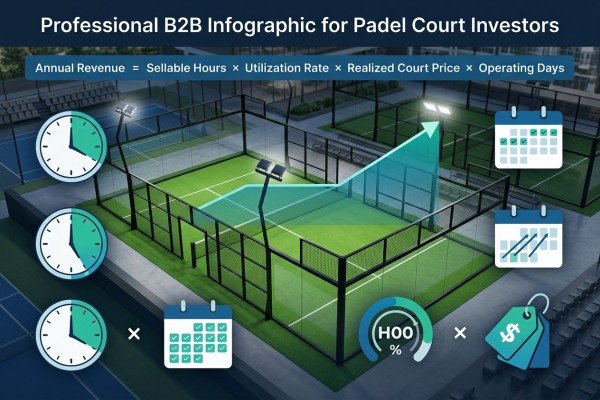
A single padel court does not generate a universal annual revenue figure. Instead, padel court annual revenue must be calculated using a specific formula: sellable hours × actual utilization rate × average realized court price × operating days. Actual returns depend entirely on local demand, weather conditions, and operational efficiency, requiring a customized financial model for every new project.
Before you sign a commercial lease or order structural equipment, you need to validate your local market demand. Let’s break down exactly how you should model your expected income, evaluate total costs, and avoid the most common investment traps in the padel industry.
What is the true formula for padel court annual revenue?
Are you struggling to project realistic earnings for your new club facility? Relying on hearsay from other venue owners leaves too much room for financial error. You must build your operational model from the ground up using verified, conservative metrics.
To accurately project your padel court annual revenue, use a transparent direct-booking formula. You must multiply your total daily sellable hours by your expected utilization rate, then multiply that outcome by your average realized price per hour, and finally by your total operating days per year.
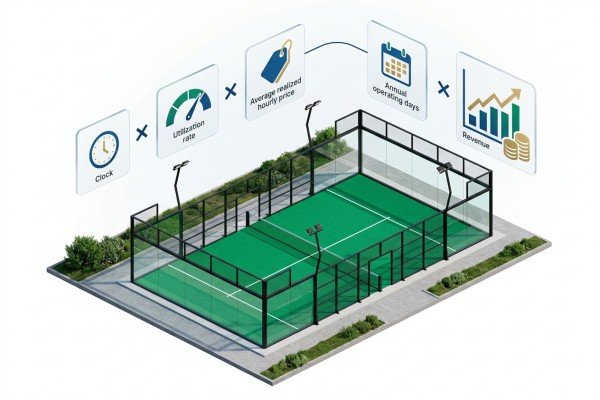
When I sit down with new club investors to discuss court configurations and project budgets, they often ask me for a guaranteed income number. I always tell them the exact same thing: as a manufacturer at QHPADEL, I can quote you exact equipment costs and precise manufacturing lead times, but your revenue model is entirely local.
You should run three different mathematical scenarios—conservative, base, and optimistic—to see if the business remains viable under poor operating conditions.
The Core Calculation Variables
To build your model, you need to define four critical inputs based on your specific city:
- Sellable Hours: How many hours per day is your facility legally allowed to be open? (e.g., 14 hours).
- Actual Utilization Rate: What percentage of those hours will actually be booked by paying players?
- Average Realized Price: The blended hourly rate, accounting for off-peak discounts, loyalty programs, and member rates.
- Operating Days: You must factor in weather downtime if you are building an outdoor or classic court without a roof.
Example Revenue Scenarios (Per Court)
| Scenario | Sellable Hours / Day | Utilization Rate | Avg. Hourly Price | Operating Days | Projected Annual Revenue |
|---|---|---|---|---|---|
| Conservative | 14 | 35% | $30 | 340 | $49,980 |
| Base Case | 14 | 50% | $35 | 350 | $85,750 |
| Optimistic | 14 | 70% | $40 | 360 | $141,120 |
Note: The prices and utilization rates above are strictly placeholder examples. You must verify local booking rates, competitor pricing, and expected volume in your specific region before committing to a construction project.
Why do many investors miscalculate padel court annual revenue?
It is incredibly easy to look at a busy commercial club during peak hours and assume the owners are printing money. This "peak-hour illusion" causes many buyers to over-leverage themselves, expecting financial returns that simply do not exist in reality.
Investors often miscalculate padel court annual revenue by multiplying their highest peak-hour price by a fully booked calendar. This critical mistake ignores off-peak emptiness, weather downtime, booking cancellations, and the heavy discounts required to attract daytime players during the standard workweek.
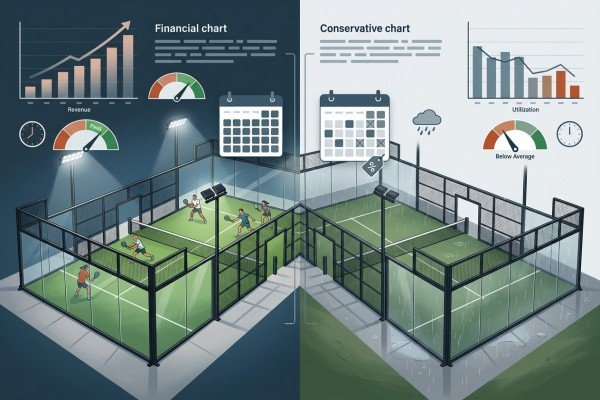
In my years supplying padel court systems to commercial developers in South America, the Middle East, and Southeast Asia, I have seen too many business plans built on a 100% occupancy assumption. A fully booked schedule from 6 PM to 10 PM does not guarantee a successful business if the courts sit entirely empty from 8 AM to 4 PM.
The Peak-Hour Fallacy
Assuming your highest peak pricing applies to every hour of the day is a fatal error in business planning. Actual utilization and realized price are heavily influenced by several market realities:
- Time of Day Dynamics: Morning and early afternoon time slots usually require steep promotional discounts to attract players who have flexible schedules.
- Seasonality and Extreme Weather: Outdoor courts lose operational days to rain, extreme summer heat, or high winds. For instance, in the Middle East, daytime summer play is virtually nonexistent, forcing clubs to rely entirely on late-night bookings. Even our Hurricane Resistant Courts, while structurally safe under severe conditions, will not generate booking revenue if players refuse to play in a storm.
- No-Shows and Cancellations: Without strict booking software cancellation policies, reserved hours do not always translate to realized income in the bank.
- Local Player Density: A city with ten established clubs operates very differently than a region where padel is a brand-new concept requiring heavy customer education and marketing spend.
When calculating your projected income, you must use a blended hourly rate. If your peak evening rate is $50 and your off-peak morning rate is $20, your average realized price might only be $30 when factoring in the actual volume of play during different times of the week.
How does total investment compare to padel court annual revenue?
Generating strong top-line sales is exciting, but it means very little if your initial capital expenditure and ongoing operational costs eat every dollar earned. Many buyers fail to separate top-line booking revenue from actual profitability and investment payback periods.
You cannot equate your factory equipment quotation with your total project investment. While padel court annual revenue looks attractive on paper, actual profitability requires subtracting civil works, installation labor, land rent, staffing, customer acquisition, utilities, taxes, and ongoing maintenance from your gross earnings.
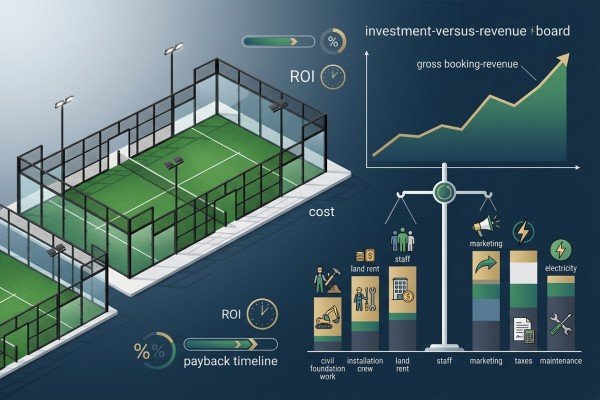
As a B2B manufacturer, I provide precise Bill of Materials (BOM) quotations to our clients. For example, if you order four Panoramic Courts from QHPADEL, I can tell you down to the last screw what the physical equipment will cost. We can produce those four courts in 20 to 25 days, complete with CE-certified steel frames, AS/NZS certified tempered glass, and ISO9001 certified artificial turf. However, that factory gate price is only one piece of your financial puzzle.
Breaking Down the True Investment Scope
To understand how quickly your revenue will pay back your investment, you must account for the full spectrum of project costs:
- Civil Works and Foundations: Preparing the concrete ring beams and porous asphalt base requires local engineering. We provide clear foundation and pre-embedding drawings with specific tolerance requirements, but local civil contractors will determine the earthworks budget.
- Facilities and Amenities: Bathrooms, changing rooms, pro shops, and parking lots often cost more than the court equipment itself.2
- Operational Expenses (OpEx): Monthly commercial rent, electricity for the LED lighting fixtures, club management software fees, and staffing salaries.
- Maintenance and Spares: Regular sand sweeping, structural tension checks, and replacing wear-and-tear items. We always recommend investors budget for spare parts packages (like extra glass panels) to minimize downtime if an accident occurs.
Profitability vs. Revenue
Revenue is just cash flowing into the business. Profitability is what remains after you service your bank debt, pay your operational bills, and cover material depreciation. I strongly advise all my clients to secure professional local financial evaluation to accurately map these site-specific costs. High gross revenue does not automatically equal a fast payback period if your local construction and rent costs are severely inflated.
What extra streams boost padel court annual revenue?
Relying solely on direct court rentals limits your earning potential and leaves your club vulnerable to local market shifts. However, assuming that every secondary revenue stream will instantly succeed is equally dangerous for your cash flow planning.
Beyond direct hourly court bookings, you can boost your overall padel court annual revenue through secondary business modules. These additional streams include professional coaching academies, premium memberships, local tournaments, food and beverage (F&B) sales, equipment retail, and corporate sponsorships.
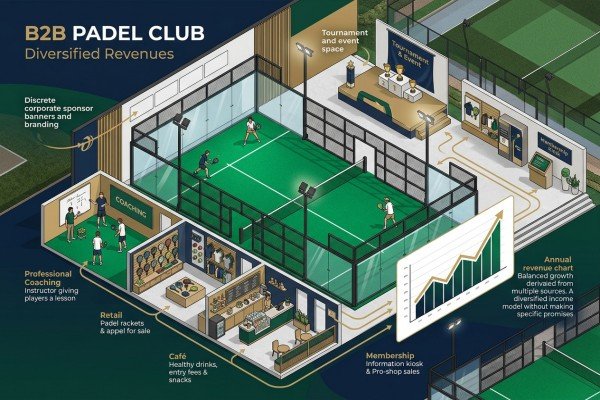
When I review project scopes with multi-city chain operators or equipment distributors, they almost always plan for secondary revenue streams in their financial models. However, these streams must be treated as optional business modules that require their own management effort, not automatic income generated simply because a court exists.
Secondary Revenue Modules
- Coaching and Academies: Offering private lessons or group clinics can heavily drive daytime utilization when courts would otherwise sit empty.
- Food and Beverage (F&B): A well-placed cafe, juice bar, or restaurant keeps players at the club longer, significantly increasing the average financial spend per visitor.
- Pro Shop Retail: Selling or renting rackets, padel balls, grips, and branded apparel.
- Tournaments and Events: Hosting weekend amateur leagues or corporate team-building events can generate bulk booking fees and local sponsorship opportunities.
The Indirect Value for Commercial Properties
For our specific clients in the hotel, real estate, and mixed-use commercial sectors, the financial impact of a padel court looks quite different. In these environments, you must separate measurable booking income from harder-to-attribute property benefits.
A luxury hotel installing our Ultra Panoramic Court might not charge overnight guests an hourly fee at all. Instead, the revenue impact is measured by increased hotel room bookings, higher overall property appeal, enhanced guest experience, and increased foot traffic to the property’s main restaurants. For real estate developers, adding premium sports facilities often increases residential property values or leasing rates. The true return on investment in these scenarios is property value uplift and customer retention, rather than direct hourly yield.
Frequently Asked Questions
How long does it take to get a return on investment for a padel court?
Payback periods vary widely, typically ranging from 18 months to 4 years. It depends entirely on your local land rent, initial civil construction costs, average hourly booking rates, and how quickly you can achieve a consistent 40-50% utilization rate.
What is a good utilization rate for a padel club?
A healthy, established commercial padel club generally aims for a blended weekly utilization rate between 45% and 60%. Hitting numbers higher than 65% is exceptional and usually indicates peak capacity, meaning it may be time to expand and build more courts.
How much does a padel court cost to maintain annually?
Routine maintenance costs are generally low, focusing mostly on adding silica sand, brushing the artificial turf, and cleaning the tempered glass. However, you should budget an annual contingency fund for potential replacements, such as damaged netting, worn turf patches, or accidentally broken glass panels.
Conclusion
Calculating your expected padel court annual revenue is the most crucial step before launching a new sports facility. By using a realistic formula—multiplying sellable hours, actual utilization rates, average realized prices, and operating days—you can protect yourself from the dangerous peak-hour fallacy. Remember to separate your top-line revenue from your total project investment, including civil works, rent, and operational costs.
If you have validated your local market demand and are ready to discuss exact equipment costs, structural configurations, and factory lead times, we are here to help. Contact QHPADEL today to receive a transparent, complete Bill of Materials quotation and expert guidance on your next padel court project.
-
"FIP World Padel Report 2025: Padel Expansion Statistics", https://www.linkedin.com/posts/fip-international-padel-federation_fipworldpadelreport-padelfip-activity-7401686097602256897-VSq-. See reports by the International Padel Federation (FIP) detailing the year-over-year increase in affiliated national federations and global player participation. Evidence role: statistic; source type: institution. Supports: Quantifies the global growth rate and increasing participation numbers in padel.. Scope note: Participation metrics often rely on estimates from national federations rather than exact census data. ↩
-
"SPORT CLUB BUDGET AND FINANCE GUIDE | RecSports", https://recsports.ufl.edu/wp-content/uploads/2020/02/Sport-Club-Budget-and-Finance-Guide.pdf. Analyses of sports facility construction budgets consistently show that site preparation, civil engineering, and ancillary amenities typically account for a larger percentage of total capital expenditure than the specialized sports equipment. Evidence role: statistic; source type: research. Supports: Provides typical cost breakdowns showing that civil works and amenities often comprise the majority of a sports facility’s initial capital expenditure.. Scope note: Exact ratios vary heavily based on local labor costs and existing site conditions. ↩