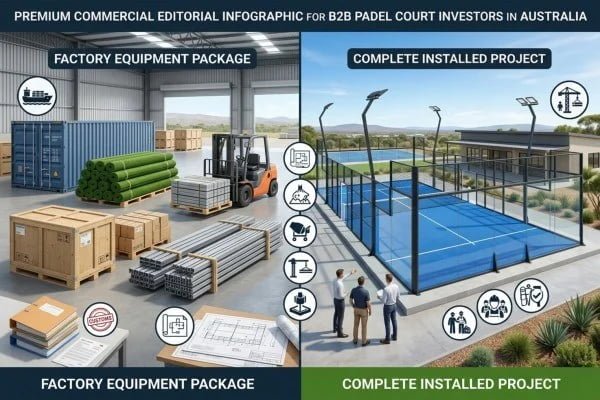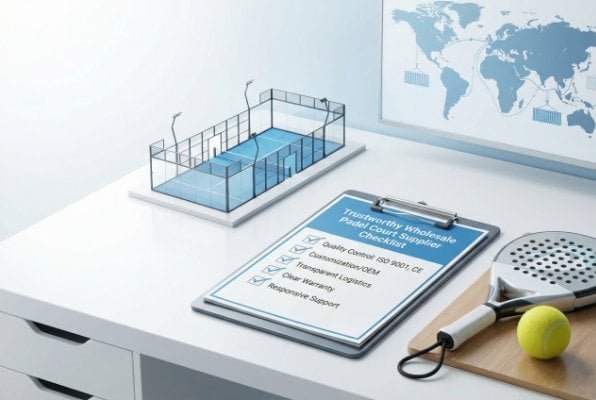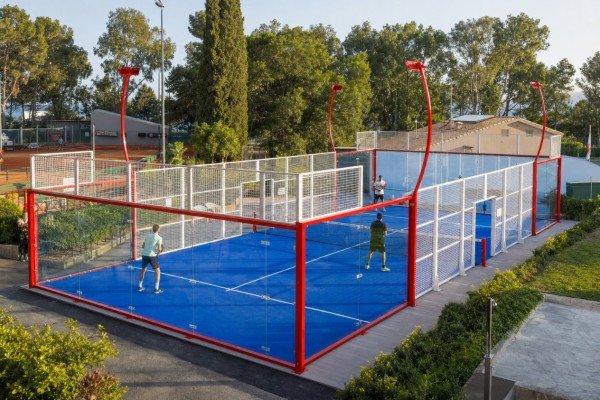

Investing in club infrastructure is stressful, and choosing the wrong padel court supplier in China can lead to disastrous hidden costs. You worry about shattering glass, rusting steel frames, and delayed container shipments ruining your grand opening. The solution is moving beyond the lowest base quote to conduct a rigorous audit of bills of materials (BOM), verifiable certifications, and supply chain transparency.
To find a reliable padel court supplier in China, you must evaluate their complete Bill of Materials (BOM) for hidden omissions. Request surprise video tours of their factory floor and match CE certificate entities with their business licenses. Finally, verify their customized packaging methods and ask for climate-specific structural adjustments to ensure long-term return on investment.
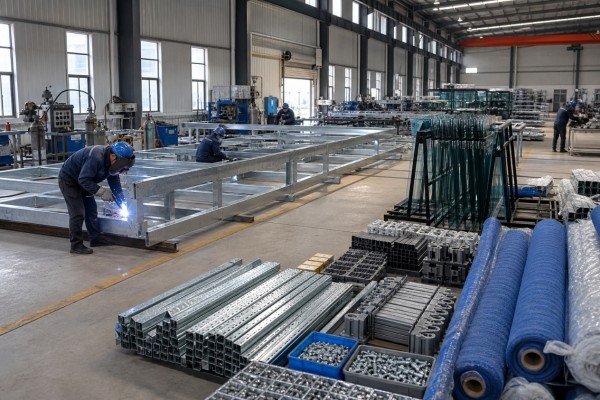
I have spent nine years exporting sports infrastructure, managing factory operations with a 150-court monthly capacity, and shipping over 600 containers annually. Over time, I have seen buyers make expensive, easily preventable mistakes. Let’s break down exactly how you can vet manufacturers remotely and protect your capital.
How do you conduct remote due diligence on a padel court supplier in China?
Sifting through Alibaba or Google search results is overwhelming. Fake trading companies often mask themselves as source factories, leading to inflated prices and zero direct quality control. You need a foolproof, data-driven way to verify who you are actually paying.
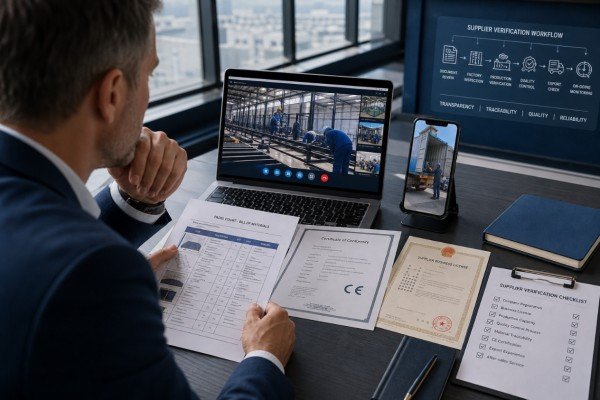
Demand a live video call of the production and loading areas to verify factory authenticity. Always cross-reference the company name on their CE certifications with their official Chinese business license. Finally, request an itemized Bill of Materials (BOM) and use AI tools to compare quotes for missing parts.
The Surprise Video Call Test
Fake suppliers hesitate when you ask for an unannounced WhatsApp or WeChat video call. A real factory will gladly walk you straight onto the floor. During the call, ask them to show you their welding stations, powder-coating lines, and packing areas. Look for active workers, raw materials like steel pipes, and stacks of tempered glass waiting in loading bays.
The Certificate Match
Many unreliable vendors borrow or Photoshop CE certificates. If you are buying tempered glass (which must comply with standards like AS/NZS 2208:1996 or CE), look closely at the test reports. Check that the entity listed on the document is the exact company name on the proforma invoice and their official Chinese business license. Treat certifications as legal documents that you must independently verify.
The AI Comparison Strategy
Here is my most actionable advice for evaluating quotes. Ask three different suppliers for their complete BOM. Do not accept a vague "1 panoramic padel court" line item. You want the exact count of screws, the thickness of steel plates, and the specifics of their packaging materials.
Take these three BOMs and feed them into an AI tool like ChatGPT. Prompt the AI: "Compare these three padel court quotes. Identify any missing parts, thinner materials, lower specifications, or hidden omissions."
AI will instantly flag if one supplier left out the safety glass washers, quoted 10mm glass instead of 12mm, or provided insufficient lighting poles. This forces the supplier to be transparent and eliminates the guessing game from your procurement process.
What are the common price traps when buying from a padel court supplier in China?
A quote that is 30% cheaper than the market average looks tempting on a spreadsheet. However, accepting a lowball offer usually means the supplier has quietly downgraded critical materials, leaving you with immediate maintenance nightmares and severe safety liabilities.
Cheap quotes hide cold-galvanized steel that rusts quickly, non-certified glass prone to shattering, and low-Dtex turf that wears out fast. Furthermore, poor packaging without iron frames leads to missing fasteners and broken glass during transit, causing expensive installation delays.
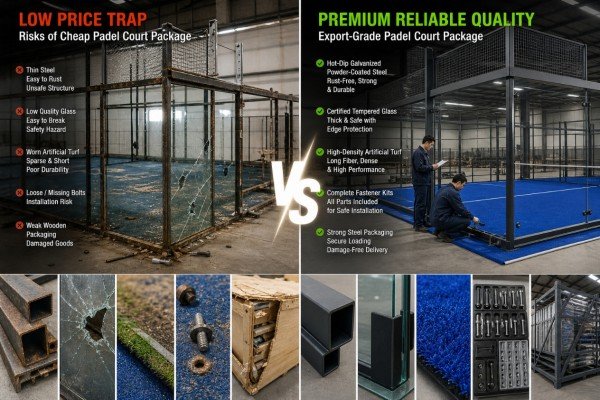
Over my years in the export business, I have stepped in to "rescue" clients who initially bought from the cheapest vendor they could find. They come to me needing replacement glass or new artificial grass because their first courts failed within six months.
Here is a breakdown of exactly where bad suppliers cut costs and how it impacts your club’s return on investment:
Deconstructing the Specifications
- Steel Galvanizing (The Rust Risk): Unreliable suppliers use cold-galvanized steel or apply a thin, cheap powder coating. Within a year, sweat, rain, and humidity will cause rust1 to bleed through the paint, weakening the structural joints. You must specify hot-dip galvanized steel tubes with outdoor-grade powder coating.
- Tempered Glass (Safety & Liability): A panoramic court relies heavily on structural glass. Cheap quotes often substitute impact-tested sports glass with standard architectural glass. If a player crashes into a wall and it shatters improperly, your club faces massive legal liability. Always verify AS/NZS 4666:2012 or CE compliance for glass, and ask about bulletproof testing standards.
- Artificial Turf (Wear and Tear): Turf density (Dtex) matters immensely. A low Dtex means the grass fibers will flatten and break under heavy foot traffic. A cheap turf might save you $500 upfront, but it will cost you thousands to replace prematurely.
- LED Lighting (The Blind Spot): Subpar 200W LEDs suffer from rapid lumen depreciation and poor glare control. Ensure the lights meet CE or AS 61347.2.13:2018 standards for safety, lifespan, and visual comfort.
The Installation Killer: Packaging
This is the most overlooked trap. Cheap suppliers load loose metal pipes and unprotected glass directly into the container to save space and labor. When it arrives, glass is shattered, and you are missing 50 crucial screws. A reliable supplier uses dedicated iron-frame packaging for glass and strict numbering systems to ensure zero missing parts upon delivery.
Spec Comparison Table
| Component | The "Cheap Trap" Spec | The Reliable Supplier Spec | Impact on Your Club |
|---|---|---|---|
| Steel Frame | Cold-galvanized | Hot-dip galvanized + Zinc primer | Prevents rapid rusting and structural failure. |
| Glass | Uncertified 10mm glass | CE / AS/NZS certified 12mm glass | Eliminates severe shattering risks and liability. |
| Packaging | Loose loaded in container | Welded iron-frame crates | Prevents transit damage and lost fasteners. |
| Turf | Low Dtex / Recycled yarn | High Dtex / Virgin material | Extends lifespan from 1-2 years to 5+ years. |
Can a padel court supplier in China customize for extreme climates?
A standard padel court specification will fail if deployed in the wrong environment. Installing a generic court in a coastal hurricane zone or a blistering desert leads to rapid structural degradation, faded turf, and collapsed frames.
Yes, a qualified supplier will adapt structural integrity and material chemistry for your climate. They will adjust wind-load ratings for coastal areas, increase UV resistance for desert turf, and enhance anti-corrosion treatments for high-humidity regions.
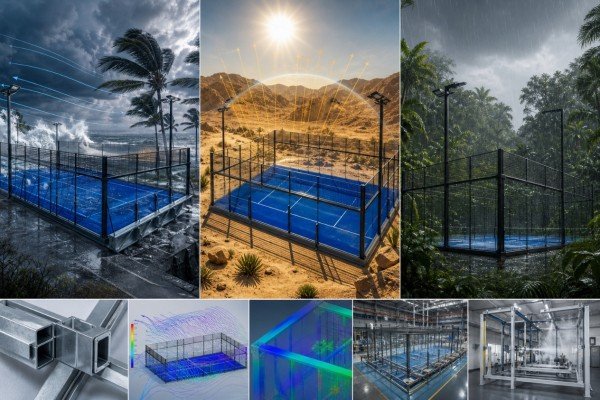
When evaluating a potential partner, you must conduct a "climate stress test" during your initial conversations. Ask them specific questions about your local weather conditions. If their only answer is "Don’t worry, our quality is good," you should walk away. A true manufacturing partner will offer engineered solutions based on environmental data.
High-UV Environments (Middle East, South America)
Artificial turf degrades under intense sun. You must ask for the specific UV resistance index of the turf yarns. If the UV protection is substandard, the vibrant blue or green courts will fade to a chalky gray within a single summer, and the plastic fibers will turn brittle and snap off.
Coastal and High-Humidity Zones (Southeast Asia, Island Nations)
Salty sea air aggressively destroys steel. For clients in these regions, I always mandate upgraded hot-dip galvanizing and a specialized marine-grade epoxy primer2 before the final color powder coating. Ask the supplier about their specific anti-corrosion warranty years for the steel structure in coastal applications.
High-Wind and Hurricane Areas
Standard classic courts cannot withstand Category 2+ hurricane winds.3 Your supplier needs to offer engineered hurricane-resistant courts. These systems feature thicker steel profiles, reinforced base plates, double structural posts, and specific glass mounting systems. Ask for the engineering calculations proving the wind load capacity.
Customized Foundations
A good factory does not just ship metal and grass. They provide detailed foundation drawings and pre-embedding plans tailored to your soil type and local building codes. If the foundation tolerances are off by even a few millimeters, the tempered glass will not align properly during installation.
Why are quotes from a padel court supplier in China so much lower?
You might look at a Chinese quote and assume it is "too cheap to be good." This stigma causes buyers to overpay European brands for the exact same physical product, crushing their initial capital efficiency and extending their ROI timeline.
Prices are lower due to a fully integrated local supply chain, massive raw material concentration, and high economies of scale. Many prominent European brands actually OEM their courts in Chinese factories, taking advantage of these exact structural efficiencies.
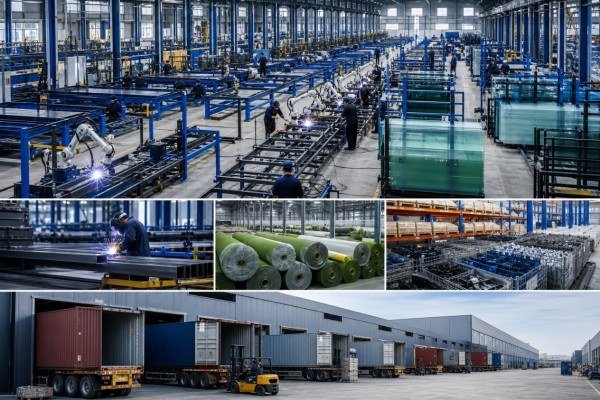
It is critical to objectively understand why you are saving 30% to 50% by buying direct. It is not necessarily because corners are being cut—assuming you follow the rigorous vetting steps outlined above.
Supply Chain Integration
In Hebei, China, we are surrounded by some of the world’s largest steel mills, glass manufacturers, and artificial turf yarn extruders.4 We do not have to import raw materials; everything is sourced locally. This eliminates massive logistical overheads and import tariffs from the baseline production cost.
Economies of Scale
A small, boutique workshop in Europe might build 10 courts a month. A high-capacity factory operates 10 continuous production lines and outputs over 150 complete padel court systems monthly. This massive scale allows us to negotiate bulk pricing on steel, glass, and LED fixtures that smaller, localized competitors simply cannot match.
The OEM Reality
The best-kept secret in the global sports industry is that several premium European padel brands do not actually manufacture their own steel frames or weave their own turf. They act as design, marketing, and distribution houses while subcontracting the heavy fabrication to Chinese source factories. When you buy direct from a reliable factory, you are essentially skipping the middleman’s markup and paying the true factory-gate price.
Building Trust Through Inspection
If you or your investors are still skeptical, demand pre-shipment trial assembly. We routinely assemble a section of the court frame at our factory before packing to guarantee perfect hole alignment. Furthermore, you should always welcome third-party inspection agencies (like SGS or TUV) to verify the shipment’s quality, quantities, and packaging before you pay the final balance.
Frequently Asked Questions
What is the typical lead time for a padel court supplier in China?
Standard production takes 20 days for two courts, 20-25 days for four courts, and up to 30 days for larger orders. Custom frame colors or specialized turf specifications (such as unique Dtex or density) may extend lead times up to 35 days.
Do Chinese padel court factories provide installation services?
Most source factories do not send installation crews overseas due to visa constraints and travel costs. Instead, a reliable supplier provides comprehensive installation drawings, foundation blueprints, and online video guidance for your local civil contractors.
How do suppliers ensure no parts are missing upon arrival?
High-quality suppliers implement strict pre-shipment anti-omission systems. This includes precise component numbering, heavy-duty iron-frame packaging for glass, and meticulously detailed packing lists verified against the BOM prior to container loading.
What certifications should I request for padel court components?
Always verify CE and ISO9001 for the factory. Ensure the glass meets AS/NZS 2208:1996 or CE standards, structural steel components are CE certified, and LED lighting complies with AS 61347.2.13:2018 for safety and performance.
Conclusion
Finding a reliable padel court supplier in China requires shifting your focus from the lowest initial price tag to total supply chain transparency. By demanding a complete BOM, utilizing AI comparison tools, verifying certifications, and insisting on climate-specific customization, you protect your investment from hidden maintenance costs and installation delays. A true manufacturing partner provides heavy-duty packaging, trial assemblies, and clear documentation.
-
"DoD 2013-3557", https://www.waru.edu/sites/default/files/Migrated/CopDocuments/Examination%20of%20Zinc%20Galvanized%20Steel%20Corrosion%20Rates%20in%20Various%20Atmospheric%20and%20Soil%20Exposure%20Conditions.pdf. Metallurgical studies on corrosion demonstrate that hot-dip galvanizing creates a thicker, metallurgically bonded zinc-iron alloy layer, whereas cold galvanizing (zinc-rich paint) provides only a mechanical bond that is more vulnerable to environmental degradation. Evidence role: mechanism; source type: research. Supports: Explains the difference in zinc coating thickness and metallurgical bonding between cold and hot-dip galvanizing, and how this affects corrosion resistance.. ↩
-
"Experiment-based numerical simulation of chloride …", https://www.sciencedirect.com/science/article/pii/S2772991525000581. Corrosion engineering studies confirm that airborne chlorides in coastal zones act as catalysts for rapid steel oxidation, requiring barrier coatings such as marine-grade epoxies and thick zinc galvanization to prevent structural failure. Evidence role: mechanism; source type: research. Supports: Describes how airborne chlorides in coastal regions accelerate the oxidation of steel and how epoxy primers act as a barrier.. ↩
-
"Saffir-Simpson Hurricane Wind Scale", https://www.nhc.noaa.gov/aboutsshws.php. Structural engineering guidelines indicate that Category 2 hurricane winds (96–110 mph) exert significant dynamic pressure on large planar surfaces like glass walls, requiring reinforced steel profiles and specialized mounting systems to prevent catastrophic blowouts. Evidence role: general_support; source type: education. Supports: Provides engineering context on the wind load forces exerted by Category 2 hurricanes and the structural requirements for outdoor enclosures.. ↩
-
"Hesteel Group – Wikipedia", https://en.wikipedia.org/wiki/Hesteel_Group. Economic and geographic profiles of China identify Hebei province as the country’s leading producer of crude steel and a major center for heavy industries, including glass manufacturing, due to its proximity to raw materials and Beijing. Evidence role: general_support; source type: encyclopedia. Supports: Confirms that Hebei province is one of China’s primary industrial centers for steel and glass production.. ↩