
Many buyers struggle with high costs and confusing import steps when building a new padel club. This guide solves these problems. I will show you the exact steps to succeed.
You can build a padel club by planning space requirements carefully, selecting a reliable manufacturer for direct import, and managing local assembly. A standard court needs a 21×12 meter area. You should buy high-quality materials and hire basic local labor for installation to maximize your club profits.
You want the best return on your investment. Let me walk you through every single step to avoid common mistakes and keep your customers reading.
Project Planning: What Are the Space and Budget Requirements to Open a Padel Club?
Picking the wrong site wastes your money. A bad layout ruins the player experience. I will explain the exact dimensions and budgets you need for your construction project.
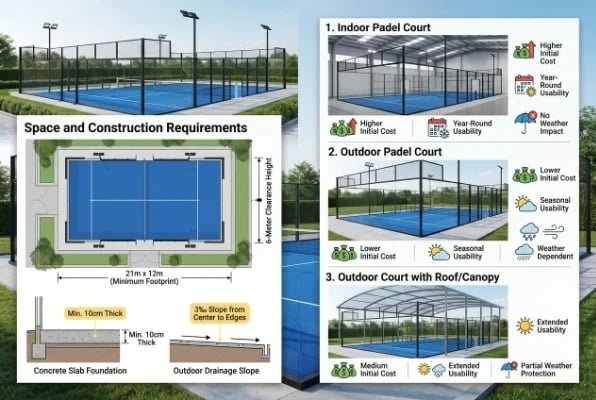
A padel court requires a minimum footprint of 21×12 meters. You also need a 6-meter clearance height. You must build a level concrete slab at least 10 cm thick. Outdoor courts need a 3-part-per-thousand slope to ensure good water drainage.
Choosing Between Indoor and Outdoor Padel Courts
You must decide between an indoor facility or an outdoor venue. Each option has clear benefits and drawbacks. I always tell my clients to look at their local weather and rental costs first. Indoor venues charge higher rent. However, players can use indoor courts all day without weather problems. Outdoor venues cost less to rent. But players cannot use outdoor courts during heavy rain or intense sunlight. You could add a canopy to an outdoor court. This extra roof will increase your total construction cost. You must weigh these factors carefully to protect your profit.
Preparing the Concrete Base
You must prepare a solid foundation. The concrete slab is very important. I recommend a thickness of at least 10 cm. The ground surface must be perfectly level. For outdoor courts without a roof, you must add a slight slope. I advise a 3‰ slope starting from the center of the court. This slope pushes rain water to the outside edges.
| Venue Type | Setup Cost | Daily Usability | Weather Impact | Required Height |
|---|---|---|---|---|
| Indoor | High | 24 Hours | None | 6 Meters |
| Outdoor | Low | Limited | High | 6 Meters |
| Outdoor + Roof | Medium | Good | Medium | 6 Meters |
You should use these facts to plan your project budget accurately.
Sourcing Strategy: Should I Buy Padel Courts Locally or Import Directly from Manufacturers?
High local prices hurt your budget. Bad shipping plans delay your opening day. I will help you choose the best buying method for your new sports club.
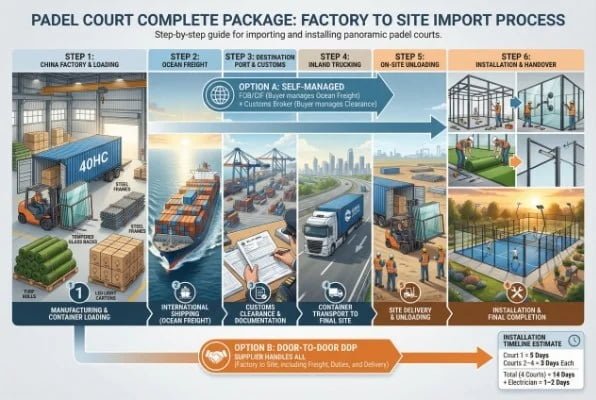
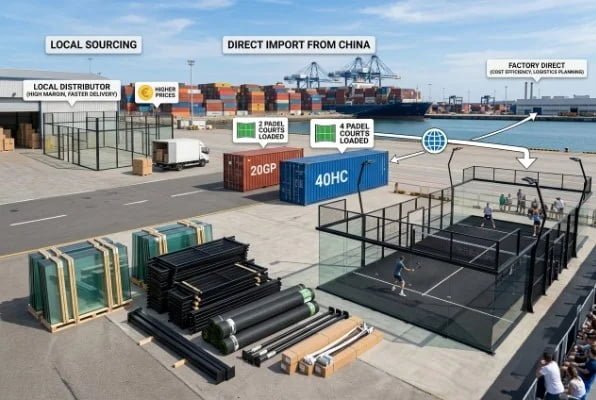
You should import directly from China to get premium materials at low costs. You must buy at least four courts to fill a 40HC container and save on shipping. If you only need one court, you should buy from a local supplier to avoid high freight fees.
Understanding the True Cost of Importing
China has a top-tier supply chain. Chinese factories produce high-quality padel courts at very low prices. You can save a lot of money when you import from China. However, you must calculate the import taxes and shipping fees for your country. For example, buyers in Spain pay high import duties and sea freight. The final cost to import one court to Spain almost equals the local price. You also wait about 50 days for the shipment. Therefore, you must check local fees first.
Maximizing Shipping Container Space
You must use container space smartly to save money. A 20GP container holds two courts. A 40HC container holds four courts. The shipping price for a 20GP container and a 40HC container is very similar. I always tell my clients to order four courts. This order fills the 40HC container completely. You get the lowest shipping cost per court this way. If you have a small budget, you should start with at least two courts. You can expand your club later.
| Container Size | Court Capacity | Shipping Cost Efficiency | Best Use Case |
|---|---|---|---|
| LCL (Less Container) | 1 Court | Very Poor | Local Purchase is Better |
| 20GP Container | 2 Courts | Moderate | Small Club Startups |
| 40HC Container | 4 Courts | Excellent | Standard Club Projects |
Supplier Selection: How to Find and Evaluate a Reliable Padel Court Supplier?
Fake factories send you bad parts. Missing certificates stop your customs clearance. I will teach you how to pick a trusted manufacturer to protect your business.
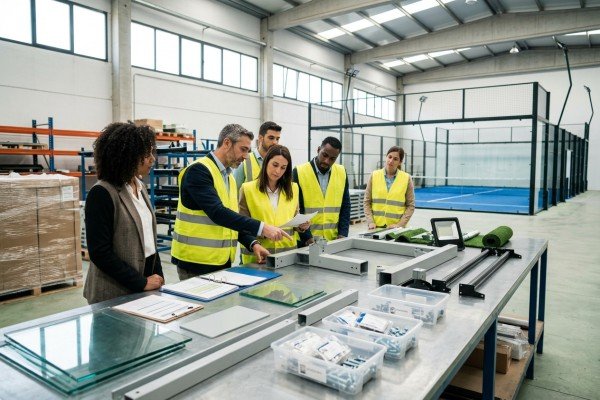
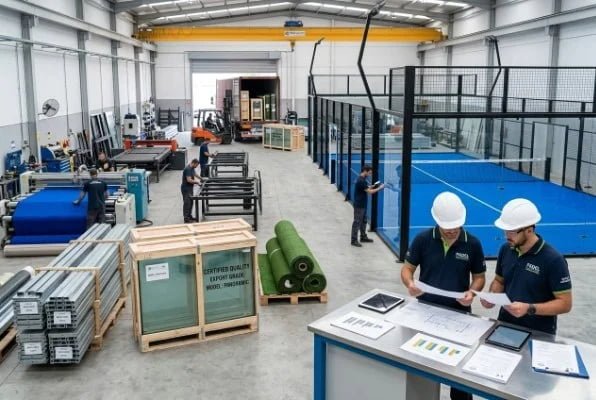
You should choose an integrated manufacturer with its own factory, like QHPADEL. The supplier must assemble and test courts before shipping. You must also ask for CE, AS, and RoHS certifications for glass, turf, and steel frames to pass customs easily.
Why Choose an Integrated Manufacturer
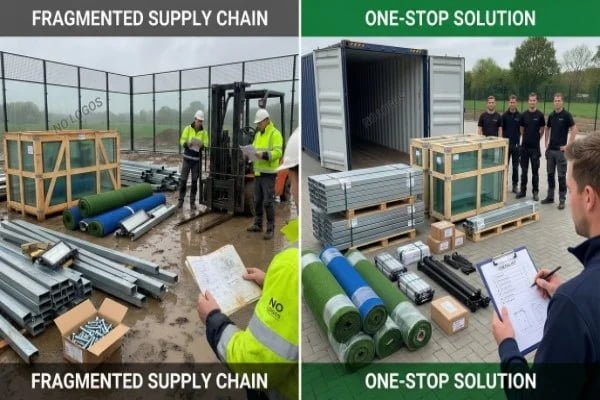
A padel court uses many different parts. No single factory makes every small piece. Many suppliers are just pure trading companies. Trading companies buy parts from different places. These parts often do not fit together well. You might face big problems during installation. I recommend working with a company like QHPADEL. We have our own large artificial turf factory. We make the core materials. We also source other parts carefully. We test the complete assembly in our factory before we ship it to you. This test stops installation errors.
Checking Export Experience and Certifications
You must protect your investment with proper paperwork. Your local government requires documents for building permits. You need CE and AS certificates for glass and lighting. You need CE and RoHS certificates for artificial turf. You also need an MSDS report for the glue. QHPADEL provides all these documents. We follow the ISO 9001 quality system. We produce over 150 courts every month. We load containers safely. We give you detailed CAD drawings. These drawings help your local workers install the court without any stress.
| Supplier Type | Production Control | Pre-shipment Assembly | Risk of Part Mismatch |
|---|---|---|---|
| Trading Company | Low | Rare | High |
| Integrated Factory | High | Standard Procedure | Low |
Quality vs. Price: How to Compare Padel Court Materials and Avoid Hidden Traps?
Cheap quotes hide terrible material quality. Weak steel rusts fast and thin glass breaks easily. I will show you how to spot these bad deals quickly.
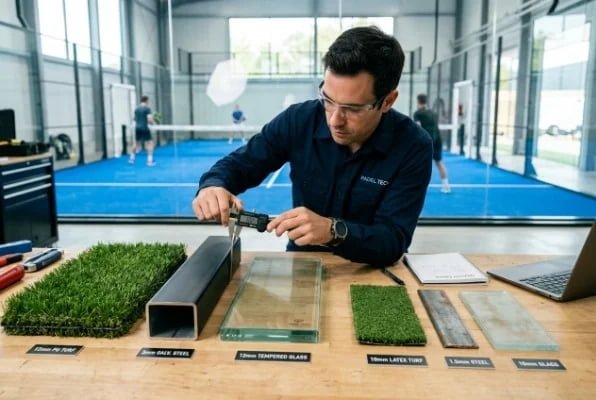
You must check the exact specifications of the turf, steel, and glass. High-quality courts use 12mm PU-backed turf, 3mm thick galvanized steel, and 12mm certified tempered glass. You should always request physical material samples before you place a final order.
What Makes a Good Padel Artificial Grass? (Dtex, Density, and Speed)
Padel turf usually has a 12mm pile height. The dtex rating ranges from 7,000 to 13,500. A higher dtex number means stronger grass fibers. When you fill strong grass with silica sand, the ball bounces much faster. Professional clubs choose our premium 13,500 dtex turf with PU backing. The PU backing holds the grass fibers very tightly.
How to Evaluate the Safety of Steel Frames and Tempered Glass
You must demand strong metal and glass. A good steel frame is 3mm thick. The factory must use Q235B hot-dip galvanized steel. They must add powder coating. Coastal areas need extra zinc primer to stop rust. The tempered glass must be 12mm thick and hold safety certificates. This glass protects the players.
Why Are Some Quotes Too Cheap? Understanding the "Price Trap"
Many buyers fall into a price trap. Bad factories lower the price by using cheap SBR backing on the turf. They reduce the steel thickness to 2.5mm. They only use cold-galvanized steel. Cold-galvanized metal rusts very quickly. Some factories even use thin 10mm glass without certificates. You must avoid these traps.
| Component | High Quality Standard | Cheap Trap Warning |
|---|---|---|
| Artificial Turf | 13,500 Dtex, PU Backing | Low Dtex, SBR Backing |
| Steel Frame | 3mm, Hot-dip Galvanized | 2.5mm, Cold Galvanized |
| Glass | 12mm Tempered, Certified | 10mm, No Certificate |
The Export Package: What Exactly Is Included in a Complete Padel Court BOM?
Missing parts halt your construction project. Buying unexpected items locally kills your profit. I will list exactly what your court package must include.
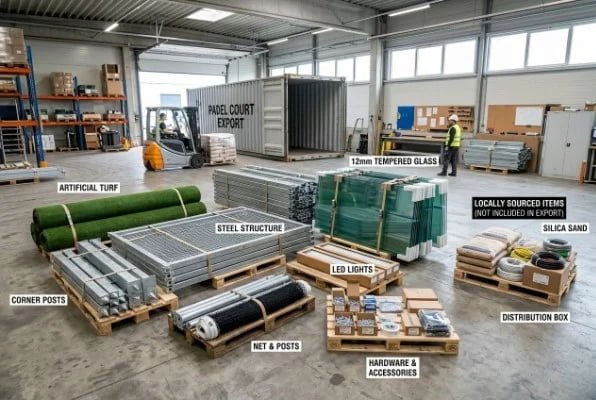
A complete court package includes 209 square meters of artificial turf, steel frames, nets, 12mm tempered glass, LED lighting, fasteners, and seaming tape. The package does not include silica sand, electrical wiring, and distribution boxes. You must buy these specific items locally.
Checking the Included Hardware and Accessories
You need to know what arrives in your shipping container. A standard 200-square-meter court requires 209 square meters of artificial turf. We give you this extra turf for safe installation. We pack the full frame and net structure. We count these parts twice to ensure nothing is missing. The glass industry accepts a small breakage rate. Because of this, we give you one free extra glass panel for every four courts you buy. We include eight 200W LED lights or four 400W LED lights. We also supply 10% extra screws and washers.
Planning for Locally Sourced Items
You cannot import everything easily. Some countries have strict rules about liquid glue. You might need to buy the two-component turf adhesive locally. You must also buy silica sand in your city. Each court needs about 1 to 1.6 tons of sand. The exact sand amount depends on your turf model. Finally, you must hire a local electrician. The electrician will supply the electrical wiring and the distribution box.
| Category | Item Name | Supply Source | Note |
|---|---|---|---|
| Included | Turf, Steel, Glass, LEDs | QHPADEL | Comes with 10% extra screws |
| Included | PET Tape & Net | QHPADEL | Check local glue import rules |
| Not Included | Silica Sand | Local Supplier | 1 to 1.6 tons per court |
| Not Included | Wiring & Power Box | Local Electrician | Prepare before installation |
Club Branding: How to Customize (DIY) a Unique Padel Court for Your Business?
Boring generic courts attract zero premium players. A basic design hurts your brand image. I will explain how to make your court look unique and professional.
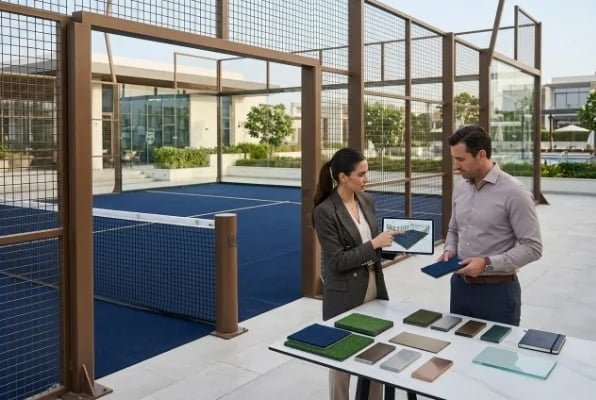
You can customize your padel court with specific turf colors and frame finishes. We print your logo on the net posts for free. You can also add glass decals and cut logos into the metal columns to build a strong club identity.
Elevating Your Club’s Visual Identity
A great club needs a great visual brand. Standard products look boring. High-end clients want to play on beautiful courts. Large chain clubs must use standard corporate colors for every location. I understand this need very well. QHPADEL offers many customization options. You can pick special colors for the artificial turf. You can change the paint color of the steel frame. You can choose different styles for the LED lighting poles. This matching color scheme makes your club look very expensive.
Placing Your Logo on the Court
We help you put your brand everywhere. Even if you buy our basic black frame and blue turf model, we help you stand out. We screen print your logo on the support posts for free. We can also print your logo on the net. We can place custom logo decals on the clear tempered glass panels. We can even laser-cut your logo directly into the steel support columns. My design team works with you to create 3D pictures. You check these pictures before we start production.
| Customization Area | Options Available | Impact on Branding |
|---|---|---|
| Steel Frame | Custom paint colors, Laser-cut logos | High |
| Artificial Turf | Various turf colors | Very High |
| Glass & Nets | Decals, Printed logos | Medium |
| Posts | Free screen printing | High |
Import Process: How Long Does It Take to Produce and Ship Padel Courts?
Late deliveries destroy your grand opening plan. Slow factories cost you money. I will share the exact timelines for production and ocean shipping.
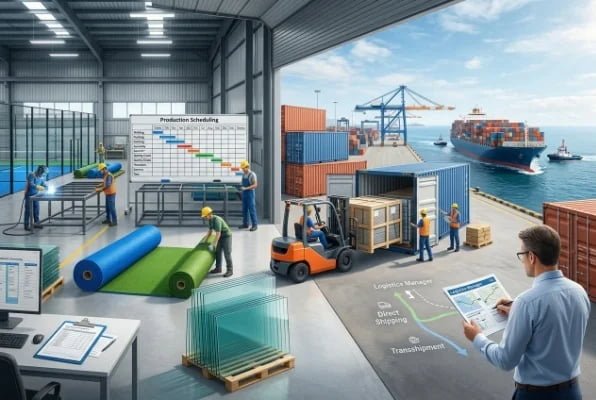
Production takes about 20 days for two courts and 20 to 25 days for four courts. Custom designs need up to 35 days. Direct shipping lines are fast but expensive, while transshipment lines are slow but cheap. You must plan your schedule carefully.
Understanding Factory Production Timelines
You must build a realistic project schedule. I manage a large factory. We can produce 200 courts every month. Standard orders move very quickly. If you buy standard colors and no custom logos, we finish two courts in about 20 days. An order of four courts takes 20 to 25 days. Orders between 4 and 20 standard courts take about 30 days. If you want custom paint or special turf colors, we need more time. Custom orders are ready for loading in 35 days. You can trust our speed.
Choosing the Right Shipping Method
The factory time is only one part of the journey. You must also calculate the ocean shipping time. You will work with a freight forwarder to ship the container. You have two main choices. Direct shipping routes deliver the goods very fast. However, direct shipping costs more money. Transshipment routes stop at other ports. This method takes much longer, but the price is much lower. You must talk to your logistics team to choose the best option.
| Order Type | Quantity | Factory Production Time |
|---|---|---|
| Standard | 2 Courts | ~20 Days |
| Standard | 4 Courts | 20-25 Days |
| Standard | 4 to 20 Courts | ~30 Days |
| Custom Design | Any Quantity | Up to 35 Days |
Step-by-Step Assembly: How is a Padel Court Installed by Local Contractors?
Expensive foreign installers drain your startup funds. Complex assembly confuses local workers. I will explain how any basic crew can build your court easily.
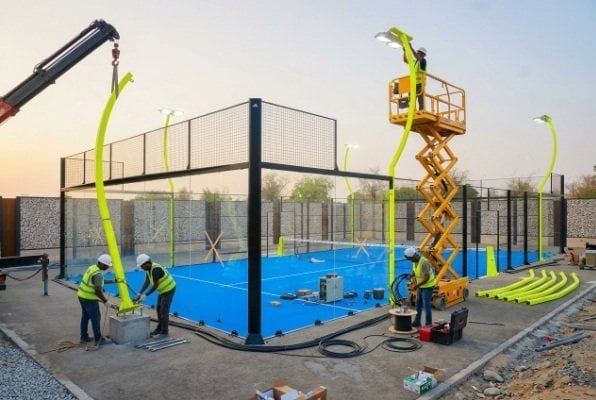
You do not need expensive professional installers. A local team of 4 to 5 people can build the first court in five days using simple instructions. You must only hire a certified electrician for half a day to connect the LED lights safely.
Building the Court with General Workers
Many people think court installation is very hard. This is not true. You absolutely do not need to hire a professional padel construction team. You can hire 4 to 5 local workers with zero padel experience. They can build an outdoor open-air court in about five days. Once they learn the steps on the first court, they build the next courts in just 3 to 4 days. I provide very clear instruction manuals. The manual shows you how to unload the container. It shows you the exact place for every single screw. Building the court is just like building a large LEGO set. We also provide remote video calls if your team needs extra help.
Managing the Electrical Installation
General workers can build the frame and glass. However, general workers cannot touch the power system. You must hire a professional, licensed electrician. The electrician will install the LED lighting system. This job only takes half a day for one court. The LED lights have a built-in 6kV surge protector. You just need to buy the cables and power box locally.
| Task Description | Required Personnel | Time to Complete (1 Court) |
|---|---|---|
| Frame Assembly | 4-5 General Workers | 2-3 Days |
| Glass & Turf Installation | 4-5 General Workers | 2-3 Days |
| Lighting Connection | 1 Licensed Electrician | 0.5 Days |
Long-Term Care: How Should I Maintain the Padel Court to Maximize Its Lifespan?
Dirty glass annoys your players. Hard, flat turf ruins the game bounce. I will show you simple maintenance rules to keep your court perfect.
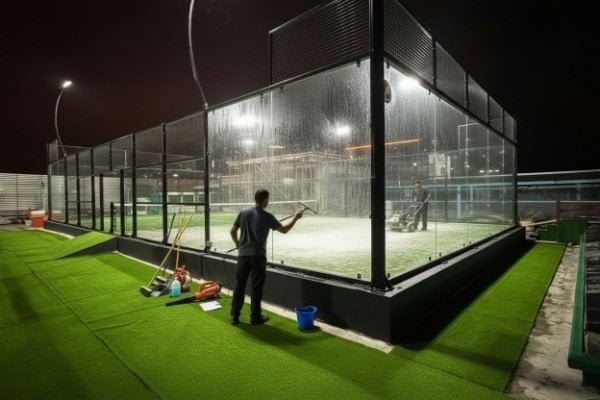
You should check the court for trash daily and clean the glass weekly. You must inspect screws, nets, and sand levels every month. You should replace the artificial turf every 5 to 6 years to maintain perfect bounce and player safety.
Daily and Monthly Court Inspections
A good maintenance plan protects your money. An outdoor court lasts 6 to 8 years. An indoor court lasts over 10 years. You must look at the court every day to remove trash. You must check the lights daily. Every month, you must check the steel frame, glass, nets, and sand. You must find any loose screws. You must check for cracked glass panels. You must clean the glass once a week. You must use the right water temperature. Hot water breaks cold glass. Cold water breaks hot glass.
Replacing the Artificial Turf
The artificial turf requires very little work. You do not water it. You only need to brush the sand evenly every month. You add new sand every 10 to 24 months. However, the turf takes heavy damage from running shoes. After five years, the plastic grass fibers lose their curl. The turf loses its bounce. The court looks fine, but the ball speed drops. Players slide too much. I strongly suggest you buy new artificial turf after 5 to 6 years. You keep the old frame and glass.
| Maintenance Task | Frequency | Action Required |
|---|---|---|
| Remove Trash | Daily | Visual check, clean floor |
| Clean Glass | Weekly | Wash carefully, check water temp |
| Check Frame & Sand | Monthly | Tighten screws, brush sand level |
| Replace Turf | 5-6 Years | Remove old grass, install new roll |
Conclusion
Building a successful padel club requires careful planning, smart importing, and regular maintenance. You can save money and achieve great results by following these simple installation and sourcing steps.