
Many club investors and contractors struggle to identify the top padel court manufacturers in Spain amidst a sea of aggressive marketing claims. Choosing the wrong supplier leads to missing structural components, compliance failures, and severely delayed club openings.1 Fortunately, a structured procurement approach helps you navigate this crowded market safely and objectively.
There is no single list of the top padel court manufacturers in Spain that fits every buyer. The best supplier depends entirely on your specific project needs. Buyers must evaluate suppliers based on complete Bill of Materials (BOM) accuracy, verified manufacturing locations, transparent certifications, and their ability to support contractors or distributors.
Based on my years of reviewing supplier quotations and technical documents in the padel export industry, I have learned that brand fame does not guarantee project success. Let us explore exactly how you should evaluate these Spanish suppliers to protect your investment.
How do you group the top padel court manufacturers in Spain?
Buyers often look for arbitrary top-10 rankings when beginning their research. This approach fails because a brand suited for a multi-city club chain might lack the documentation needed for a public sector tender. You must align the supplier’s business model with your exact procurement profile.
You should categorize the top padel court manufacturers in Spain by their ideal customer profile. Some excel at supplying turn-key solutions for club operators, while others focus on standardized, high-volume SKUs for global equipment distributors or heavily certified courts for public sector tenders.
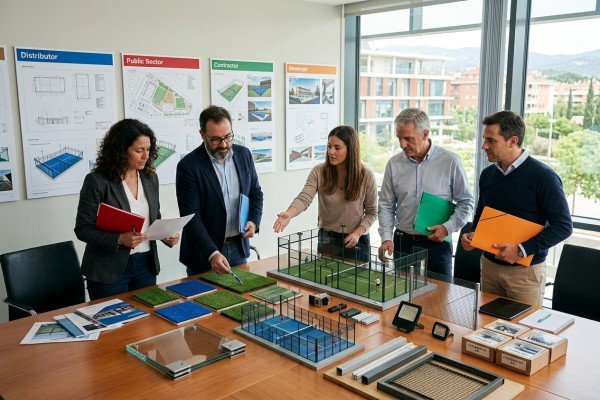
Instead of chasing a universal "best" brand, experienced buyers categorize suppliers based on project fit. I always advise clients to match their operational reality with the manufacturer’s demonstrated strengths. Here is a breakdown of how different buyers should view the Spanish market:
1. Club Operators & Chain Brands
Investors, real estate developers, and hotel operators need a zero-missing-parts guarantee. If you are opening a 10-court facility, you cannot afford a missing batch of specialized screws halting your construction crew. You should look for suppliers offering tiered pricing options (from Classic to Ultra Panoramic designs), comprehensive spare parts packages for glass and wear-and-tear items, and highly transparent warranty terms.
2. Engineering & Civil Contractors
Local sports contractors care heavily about installation tolerances and technical documentation. The best suppliers for this group provide precise foundation drawings, clear pre-embedding instructions, and logical component numbering. A massive pain point for contractors is ambiguous after-sales responsibility. You must choose a supplier that clearly defines the line between a manufacturing material defect and an installation error.
3. Equipment Distributors & Importers
If your business involves reselling courts through existing local networks, you need standardized, highly resaleable SKUs. Distributors require marketing material packages containing 3D drawings and unbranded catalogs. More importantly, you need a partner capable of stable delivery schedules, transparent pricing systems for partial sets, and reliable OEM labeling support.
4. Public Sectors & Institutions
Government bodies, schools, and municipal sports bureaus rely heavily on public procurement or bidding. Suppliers targeting this segment must provide exhaustive document trails. This includes technical response texts for bidding, strict compliance with structural safety standards, weather resistance data, and long-term traceable supply chains. A famous brand name means nothing to a municipal bidding committee if the technical files are incomplete.
What should you inspect when comparing top padel court manufacturers in Spain?
Looking at two identical panoramic court photos tells you absolutely nothing about their structural integrity. Buyers who rely solely on marketing brochures often face hidden costs and delayed installations. You must strip away the branding and compare the raw, unedited technical data.
When evaluating the top padel court manufacturers in Spain, buyers must compare the complete, itemized Bill of Materials (BOM). You need to verify steel structure dimensions, glass specifications, turf density, lighting certifications, and whether installation drawings and spare parts are explicitly included.
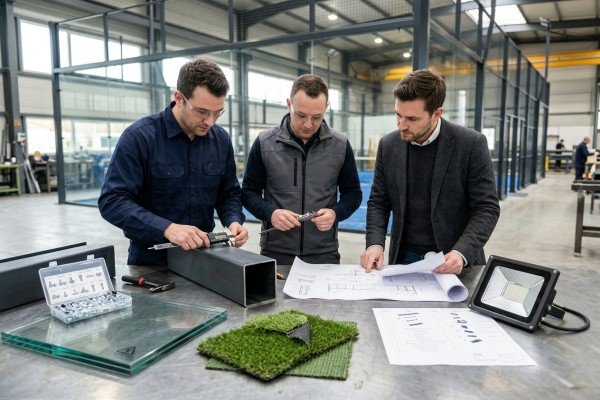
I have reviewed hundreds of supplier quotations over the years. A remarkably common mistake is comparing a fully loaded quotation from one supplier against a stripped-down quotation from another. Similar-looking panoramic courts are rarely technically equivalent. To conduct a true like-for-like evaluation, you must request current technical files and an exhaustive itemized quotation.
The Complete Bill of Materials (BOM) Comparison
Use a strict checklist when reviewing Spanish supplier documents. Do not accept vague descriptions; demand exact specifications.
| Component Category | Critical Specifications to Verify in the Quotation |
|---|---|
| Steel Frame Structure | Exact steel grade, tube wall thickness (e.g., 3mm vs 4mm), galvanization method (hot-dipped vs cold), powder coating thickness, and CE certification for structural safety. |
| Tempered Glass | Thickness (10mm or 12mm), compliance with local structural standards (e.g., CE, AS/NZS 2208:1996), and documented bulletproof or impact test reports. |
| Artificial Turf | Yarn material (PE/PP), Dtex rating, density (stitches per square meter), UV resistance rating, and CE/RoHS compliance. |
| Fasteners & Accessories | Exact stainless steel grade (304 vs 316 for coastal/humid areas), total count inclusion, and PED 2014/68/EU quality system approvals. |
| Lighting Systems | LED wattage (typically 200W per fixture), total lumen output, pole height, and electrical safety certifications (e.g., AS 61347.2.13:2018). |
Scrutinizing Documentation and Support
Beyond the physical hardware components, you must critically evaluate the paperwork. Does the supplier provide detailed foundation drawings with specific tolerance requirements? Do they include a detailed packing list that perfectly matches the shipping container layout? Remember, a quotation is just a sales document; you must verify that the provided certificates actually cover the specific materials being sold to you.
I highly recommend asking for project references in your specific climate zone. Furthermore, confirm their exact replacement procedures. If a glass panel shatters in transit, how fast can they dispatch a replacement, and who absorbs the freight cost?
Do the top padel court manufacturers in Spain actually produce locally?
Buyers often assume that buying a Spanish brand guarantees the product is forged in a Madrid or Valencia factory. This assumption can lead to dangerous supply chain blind spots and warranty disputes. You need to know exactly where your core components originate to assess true risk.
Not all top padel court manufacturers in Spain manufacture 100% of their components locally. Buyers must clearly distinguish between a "Spanish brand" and "manufactured in Spain," as many companies outsource turf, glass, or steel fabrication to global supply chains.
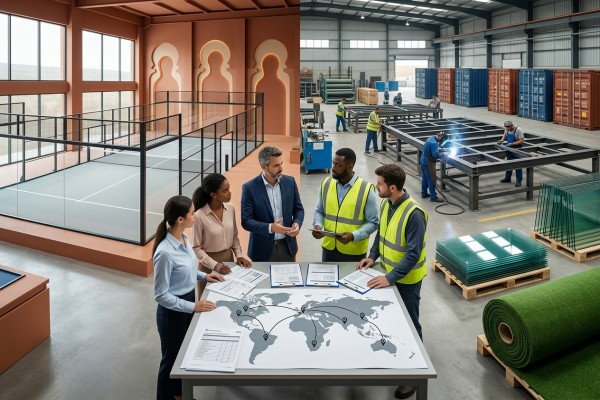
In the B2B industrial manufacturing world, brand headquarters and physical factory locations are frequently two entirely different things. You must treat "Spanish brand" and "manufactured in Spain" as separate claims requiring independent verification.
Understanding Global Supply Chains
Many renowned European sports brands manage the structural design, global marketing, and final quality control, while outsourcing the heavy manufacturing processes. For instance, the tempered safety glass or the artificial turf might be produced in specialized factories in Asia, shipped to Spain, and packaged into the final kit.
There is nothing inherently wrong with this globalized manufacturing model—provided the supplier maintains strict quality control and assumes total, transparent warranty ownership. However, as a buyer, you deserve to know what you are paying for. Are you paying a premium for European manufacturing, or are you paying a premium for European marketing applied to imported components?
Due Diligence Questions for Your Supplier
To uncover the true manufacturing origin and protect your investment, I strongly recommend asking these specific questions during your procurement due diligence:
- Do you directly own the factory that welds and coats the steel frame, or is this heavily subcontracted?
- Where exactly is the artificial turf extruded and tufted? Can you provide the factory origin?
- If a major structural component fails, who holds the ultimate legal warranty—the Spanish brand, or the third-party overseas component manufacturer?
- Can we arrange a third-party factory audit (via SGS or Intertek) at the production site before placing the initial deposit?
Do not infer production quality, durability, or after-sales service capabilities from a brand’s geographical location alone. Always request hard evidence relevant to your project’s specific jurisdiction.
Are there alternatives to the top padel court manufacturers in Spain?
Relying exclusively on European brands can stretch your procurement budget and increase your lead times, especially during peak season. Smart engineering teams know that exploring global factory-direct options can yield identical, or even superior, structural compliance and logistics control.
Yes, direct B2B manufacturers in Asia offer highly competitive alternatives to the top padel court manufacturers in Spain. Facilities with ISO9001 certification and extensive export experience provide fully certified, customizable complete court systems directly to global buyers.
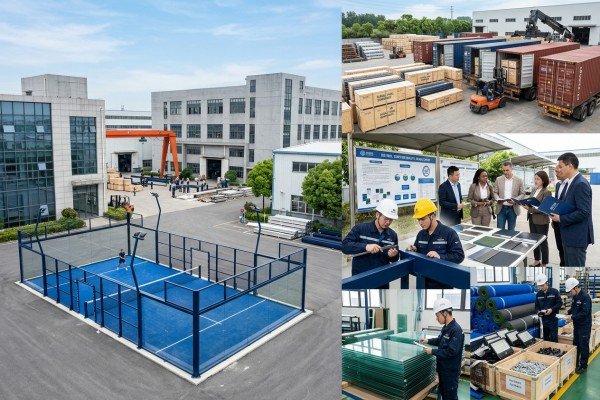
If your procurement strategy allows you to look beyond Spain, China has rapidly become a dominant force in complete padel court manufacturing.2 This is exactly where my company, QHPADEL (Hebei Qinghong Artificial Grass Co., Ltd.), operates. Based in Hebei, China, we are a dedicated B2B manufacturer and exporter of artificial grass and complete padel court systems.
The Factory-Direct Advantage
We do not pretend to be a Spanish brand. Instead, we offer transparent, highly capable factory-direct manufacturing. With over 10 years of production experience and 9 years of export history, we understand the rigorous, non-negotiable demands of club operators, civil contractors, and equipment distributors globally. Our annual export volume exceeds 600 containers, primarily serving South America, the Middle East, and Southeast Asia.
- Verified Compliance: Our factory operates under strict ISO9001 certification. Our steel frame structures, tempered glass, LED lights, and artificial turf all carry verified CE certifications. We also meet strict regional standards, including AS/NZS 2208:1996 for tempered glass and AS 61347.2.13:2018 for lighting.
- Complete System Control: We provide complete BOMs with zero missing parts. Our core product lineup includes Panoramic Courts (50% of our sales) and Ultra Panoramic Courts (40% of our sales), backed by comprehensive installation drawings, foundation drawings, packing lists, and maintenance manuals.
- OEM/ODM Customization: For distributors and large clubs, we customize structural frame colors and exact turf specifications (color, Dtex, and density). Our turf MOQ is highly accessible at just 6 courts (1,254 sqm).
- High-Capacity Production & Logistics: With 10 dedicated production lines, our monthly output exceeds 1.5 million sqm of artificial turf and 150 complete padel court systems. We can produce four complete courts in just 20 to 25 days. Furthermore, our facility is located just 120 minutes from Tianjin Port, ensuring rapid cross-border dispatch.
While we respect the heritage and design influence of Spanish padel brands, evaluating a direct manufacturer ensures you are investing your capital directly into raw material quality and structural engineering.
Frequently Asked Questions
How much does a padel court from Spain cost?
A complete padel court from Spain typically costs between $18,000 and $35,000 USD3, excluding international shipping, foundation groundworks, and local installation. Prices vary heavily based on whether you select a standard club model or a highly engineered ultra-panoramic court with premium structural specifications.
What is the standard lead time for Spanish padel courts?
Standard lead times for Spanish manufacturers range from 4 to 8 weeks for production, depending on seasonal demand and customization requirements. International shipping can add an additional 3 to 6 weeks, making it critical for buyers to plan procurement at least three months before club opening dates.
Do Spanish manufacturers install the courts globally?
Most top padel court manufacturers in Spain do not dispatch internal crews to install courts globally. Instead, they provide detailed installation drawings, packing lists, and remote online support. They rely entirely on your local engineering and civil contractors to handle physical site preparation and final assembly.
What certifications should I verify for padel courts?
Always verify CE marks for structural steel, tempered safety glass, and LED light fixtures. Additionally, check for region-specific requirements, such as AS/NZS standards for Australia and New Zealand, and ensure the artificial turf has CE and RoHS certifications for basic safety and environmental compliance.
Conclusion
Selecting the right supplier requires diligent, document-based evaluation. There is no absolute list of the top padel court manufacturers in Spain; your final choice must align with your operational role as a club investor, local contractor, or equipment distributor. Always compare the complete itemized bill of materials, verify the actual manufacturing location, and demand transparent, up-to-date certification documents.
-
"Drivers of Delays in Procurement of Infrastructure Projects", https://openknowledge.worldbank.org/bitstreams/62234fde-fbe8-4e31-a93d-51aab47e0634/download. See academic literature on construction supply chain management, which consistently identifies inadequate supplier vetting as a primary driver of material shortages and subsequent project delays. Evidence role: general_support; source type: research. Supports: Research on construction supply chains demonstrating that poor supplier evaluation significantly increases the risk of material shortages and project delays.. Scope note: Most supply chain research focuses on general commercial construction rather than the niche market of padel court installation. ↩
-
"Optimizing and forecasting the development of China’s sports …", https://pmc.ncbi.nlm.nih.gov/articles/PMC12578256/. Global trade reports indicate that China has become a primary manufacturing hub for racket sports infrastructure, accounting for a significant portion of global padel court exports. Evidence role: statistic; source type: research. Supports: Market data corroborating China’s significant market share in the global export of sports infrastructure and padel courts.. Scope note: Export data often aggregates padel courts with broader sporting goods or steel structures, making exact court-specific volume difficult to isolate. ↩
-
"Padel Court Construction Cost Guide for Project Owners …", https://sportsvenuecalculator.com/knowledge/padel-courts/padel-court-construction-cost/. Sports infrastructure market reports generally estimate the material cost of a European-manufactured padel court to fall between $18,000 and $35,000 USD, excluding groundwork and installation. Evidence role: statistic; source type: research. Supports: Industry estimates for the capital expenditure required to purchase padel court materials from European manufacturers.. Scope note: Prices fluctuate frequently based on global raw material costs, currency exchange rates, and specific structural upgrades. ↩