Padel in Australia can seem unusually expensive when an attractive factory price becomes a much larger installed-project budget. If buyers treat the equipment quotation as the total cost, freight, foundations, approvals, installation, and missing components can create serious overruns. I recommend comparing complete landed scopes before selecting a supplier.
Padel is expensive in Australia because a playable court is a site-specific construction project, not simply an imported product. The final budget can include court equipment, international freight, customs charges, civil works, engineering review, approvals, installation, electrical work, access equipment, and contingency. Each buyer should compare these costs on a like-for-like basis.
I have handled Australian enquiries in which buyers initially compared only the headline equipment prices. Once we reviewed the bill of materials and local responsibilities, the apparent price difference changed significantly. The following framework explains where the money goes and how buyers can avoid false savings.
Why Does the Padel Court Cost in Australia Exceed the Equipment Price?
A low equipment quotation can make a project look affordable, but it rarely covers every activity needed to open the court. The gap becomes a problem when investors commit to a site or business plan before identifying civil works, local services, installation interfaces, and compliance responsibilities.
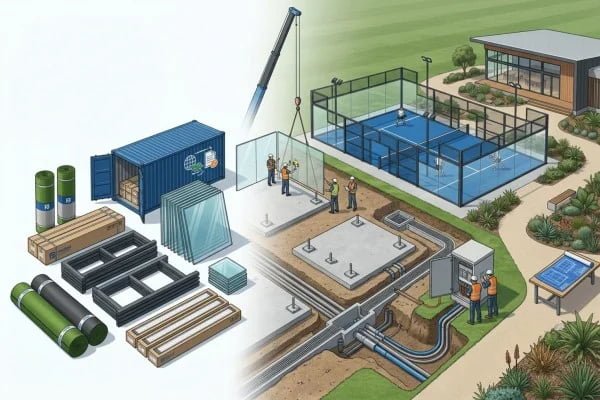
The padel court cost in Australia exceeds the equipment price because the factory package is only one part of the project. Buyers may also need to fund shipping, customs clearance, foundations, drainage, installation, lifting equipment, electrical connections, professional reviews, approvals, landscaping, access paths, and supporting club facilities.
I Separate Product Cost From Project Cost
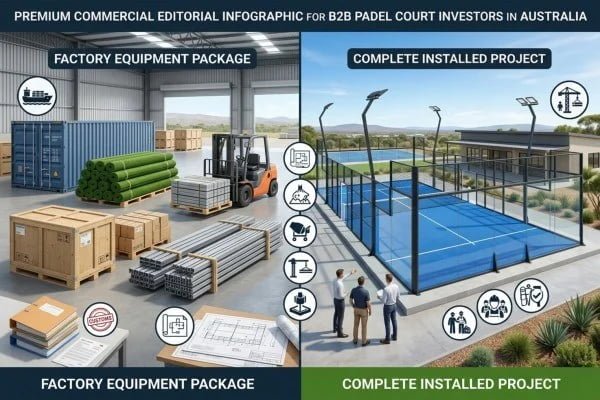
I usually divide an Australian padel project into three cost levels:
- The ex-factory equipment cost covers the defined products supplied by the manufacturer.
- The landed equipment cost adds transport, insurance, port handling, customs processes, taxes where applicable, and delivery to the site.
- The installed project cost adds civil works, professional services, assembly, electrical work, testing, approvals, and site-specific facilities.
This distinction sounds simple, but I often see buyers compare a factory equipment offer with another company’s delivered or partly installed quotation. Those prices do not represent the same scope.
A typical complete court package may include structural steel, welded mesh, tempered glass, artificial turf, lighting fixtures, a playing net, fasteners, and selected accessories. However, the package may not include the concrete slab, drainage, electrical cabling, local machinery, unloading, worker accommodation, or permit-related documentation.
I Use a Cost-Scope Map
| Cost group | Possible items | Key question I ask |
|---|---|---|
| Court equipment | Steel, mesh, glass, turf, lights, net, fasteners | Does the quotation contain a complete bill of materials? |
| Export logistics | Packing, inland transport, sea freight, insurance | Which Incoterm applies, and where does supplier responsibility end?1 |
| Import costs | Clearance, port charges, taxes, inspection fees | Has a licensed Australian customs broker reviewed the shipment? |
| Site works | Excavation, slab, drainage, conduits, retaining work | Has a local contractor priced the actual site conditions? |
| Installation | Labour, lifting equipment, access equipment, supervision | Who is responsible for dimensions, alignment, and handover? |
| Professional services | Surveying, engineering, approval support | Which documents must qualified local professionals prepare or review? |
| Club infrastructure | Reception, toilets, parking, shade, fencing | Does the business budget include more than the playing enclosure? |
| Contingency | Delays, replacements, storage, variations | What allowance covers unresolved site and logistics risks? |
I once reviewed an anonymised Australian enquiry where the buyer viewed the court package price as a near-complete construction budget. The discussion changed when local contractors added the slab, drainage, electrical connection, unloading, and installation. I did not independently calculate those local prices, but the customer’s feedback showed why the original comparison was incomplete.
Australian prices, taxes, freight rates, and approval expenses can change by location and date. I therefore recommend obtaining current written quotations from local contractors, freight forwarders, customs brokers, engineers, electricians, and the relevant approval authority.
How Should Buyers Compare Padel Court Quotations in Australia?
Two padel courts can look almost identical in a rendering while using different steel sections, glass specifications, turf systems, lighting layouts, fasteners, packaging methods, and support documents. If a buyer compares only the final number, an incomplete quotation can appear more competitive than a properly defined package.
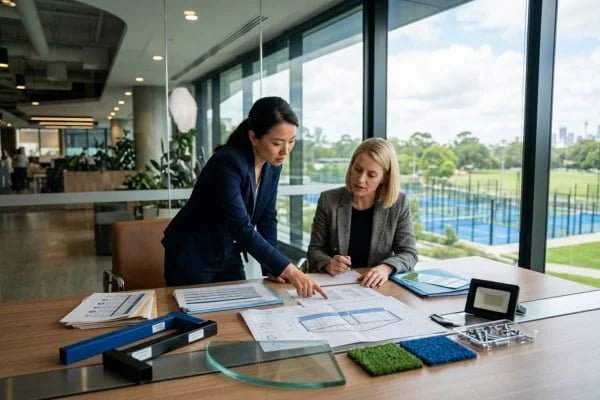
Buyers should compare padel court quotations in Australia with a line-by-line scope matrix. Each comparison should identify quantities, specifications, included documents, packaging, spare parts, delivery terms, installation support, warranties, and exclusions. Buyers should also normalise currency, Incoterms, tax treatment, and quotation validity before judging price.
I Start With the Physical Bill of Materials
I ask suppliers to state what they will deliver rather than relying on phrases such as “complete court.” At a minimum, I would review:
- The supplier should identify every structural post, frame, brace, and welded mesh panel.
- The quotation should state the glass type, thickness, dimensions, hole pattern, edge treatment, and quantity.
- The supplier should define the artificial turf by fibre type, pile height, Dtex, density, backing, colour, roll plan, and infill requirements.
- The lighting schedule should show fixture quantities, rated power, mounting arrangement, and available technical documents.
- The fastener list should identify bolts, anchors, screws, gaskets, and protective components.
- The package should state whether it includes the net, posts, doors, handles, protective pads, and other playing accessories.
- The packing list should explain how glass, steel, turf, and lights will be protected and identified.
- The supplier should list any spare parts rather than describing them as “free accessories.”
I also request component numbering and installation drawings. A court can contain many similar-looking pieces. Clear labels reduce the risk that an installation team uses the wrong member or loses time searching through mixed packages.
I Normalise the Commercial Terms
A useful comparison table can prevent an attractive headline price from controlling the decision.
| Comparison point | Quote A | Quote B | Buyer action |
|---|---|---|---|
| Currency and validity | Record both | Record both | Compare on the same date and exchange-rate basis. |
| Incoterm and destination | Confirm named place | Confirm named place | Identify exactly where risk and cost transfer. |
| Product scope | List every item | List every item | Resolve missing quantities before ordering. |
| Freight | Included or excluded | Included or excluded | Obtain comparable freight assumptions. |
| Installation | Labour, guidance, or neither | Labour, guidance, or neither | Define supervision and local labour duties. |
| Foundation documents | Included or excluded | Included or excluded | Arrange local engineering review. |
| Spare parts | Itemised | Itemised | Compare practical replacement coverage. |
| Warranty | Written scope | Written scope | Review exclusions and claim procedures. |
| Certification documents | Named reports | Named reports | Verify issuer, model coverage, and validity. |
In one quotation comparison, I found that the cheaper-looking offer did not clearly include all fasteners, spare glass provisions, detailed packing documentation, or installation support. The higher offer was not automatically better, but it was more complete. Once the buyer priced the omitted responsibilities, the initial difference became less meaningful.
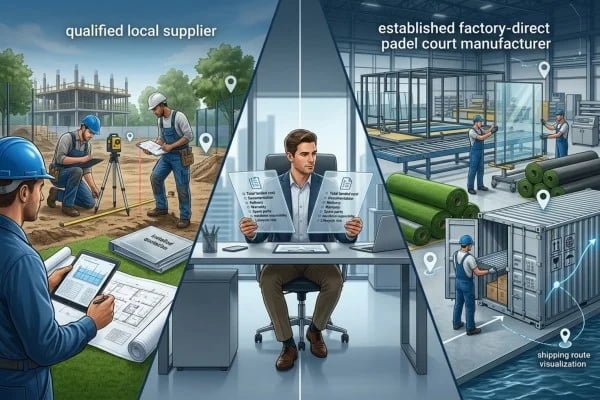
Buyers should also be cautious when comparing Chinese, European, and Australian offers. Country of origin alone does not make the comparison valid. I first normalise the equipment specification, delivery point, local work, tax treatment, warranty responsibility, and documentation scope.
How Do Australian Site Conditions Affect Padel Court Cost?
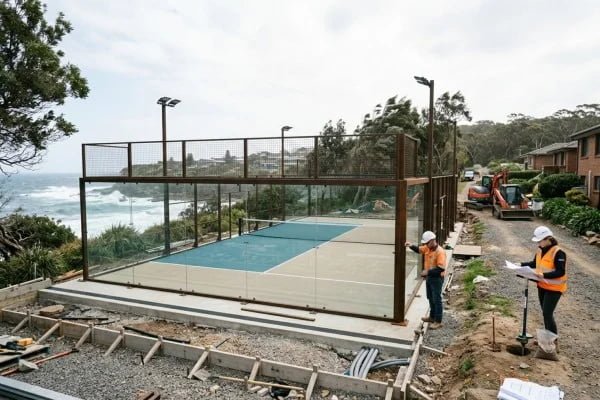
A standard court drawing cannot account for every Australian site. Wind exposure, soil conditions, drainage, coastal corrosion, temperature, access, surrounding buildings, and intended usage can influence the required design2. If buyers select a configuration before reviewing the site, later changes can increase the padel court cost.
Australian site conditions affect padel court cost because the structure, foundation, drainage, protective finish, access plan, and installation method must suit the actual location. Exposed, coastal, constrained, or heavily used sites may require different solutions. A qualified local engineer and relevant authorities should evaluate all application-specific requirements.
I Review the Site Before Finalising the Court
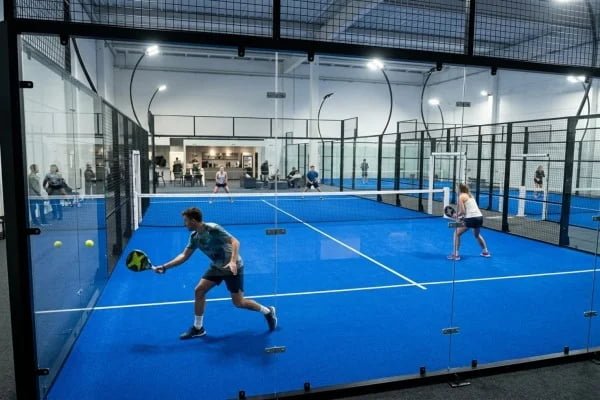
A standard doubles padel playing area is generally based on a 20-metre by 10-metre enclosure, but the total development area must be larger. A project can also need access zones, drainage, external circulation, maintenance space, emergency routes, fencing, seating, or roof-related clearances.
I ask buyers to collect several inputs before confirming the specification:
- A licensed surveyor should verify the site levels and boundaries where necessary.
- A geotechnical or engineering professional should assess the ground when the project requires that expertise.
- The project team should document local wind exposure and surrounding terrain.
- The buyer should identify coastal, high-salt, industrial, or other corrosive conditions.
- The contractor should review drainage paths and flood-related constraints.
- The installation team should confirm truck, forklift, crane, or telehandler access.
- The electrical contractor should assess supply, cabling, isolation, and lighting connections.
- The relevant authority should clarify planning, building, noise, lighting, accessibility, and operational requirements.
I provide foundation and installation drawings as part of our manufacturing support, but I do not treat a manufacturer’s drawing as a substitute for local engineering. A qualified Australian professional should review the structure-foundation interface, site loads, materials, and applicable requirements.
I Treat Wind and Corrosion as Site-Specific Issues
A court’s glass walls and mesh structure can face significant environmental loads. However, I avoid claiming that one “heavy-duty” design works everywhere. The project engineer should determine the applicable loads and assess the complete system, including the court frame, anchors, concrete, soil support, and any roof.
Coastal exposure also needs careful evaluation3. A coating description alone does not prove long-term suitability. Buyers should request the coating system, surface preparation method, thickness criteria, inspection approach, repair instructions, and maintenance expectations. They should then ask a qualified professional whether the proposed system suits the site.
A low-cost configuration can become expensive if the project later needs:
- Redesigned steel members or connections.
- Different anchors or foundation details.
- Improved drainage and water management.
- A more suitable protective coating.
- Revised glass or fencing arrangements.
- Additional access equipment for installation.
- Replacement products after unsuitable materials arrive.
I have seen Australian discussions pause because site wind or foundation questions were raised after the equipment quotation. Early review would not eliminate every expense, but it would make the procurement decision more informed and reduce the risk of redesign.
Which Hidden Gaps Make Padel in Australia More Expensive?
Missing products are only one source of extra cost. Responsibility gaps can be equally damaging. When the supplier, freight forwarder, civil contractor, installer, electrician, and project owner each assume that another party controls an interface, delays and variations become more likely.
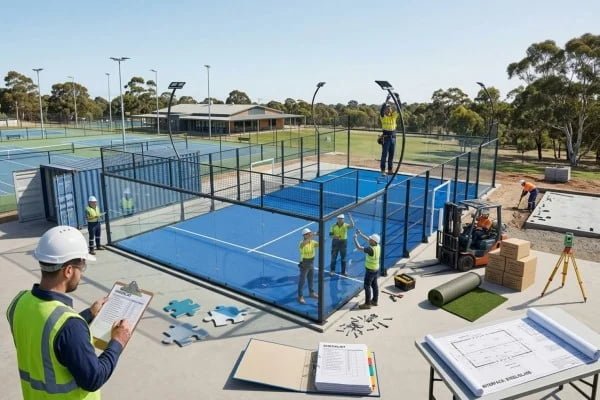
Hidden gaps make padel in Australia more expensive when quotations omit freight interfaces, foundations, unloading, fasteners, spare parts, installation tools, electrical work, documentation, or replacement procedures. Buyers can reduce these risks by assigning each task to a named party and recording every inclusion, exclusion, deadline, and acceptance criterion.
I Create a Responsibility Matrix
I recommend a simple responsible, supporting, and approving party matrix before the purchase contract is signed.
| Project task | Typical responsible party | Point to confirm |
|---|---|---|
| Site survey | Local project team | The drawings should use verified dimensions and levels. |
| Foundation design | Qualified local engineer | The design should match the court reactions and site conditions. |
| Equipment production | Court manufacturer | The products should match the approved technical schedule. |
| Export packing | Manufacturer | The packing should protect glass and identify components. |
| International transport | Agreed logistics party | The contract should define risk transfer and insurance. |
| Customs clearance | Importer or broker | The importer should verify current duties, taxes, and requirements4. |
| Unloading and storage | Buyer or contractor | The site should have suitable machinery and protected storage. |
| Court installation | Appointed installer | The installer should follow reviewed drawings and tolerances. |
| Electrical connection | Licensed local contractor | The work should meet applicable local requirements. |
| Inspection and handover | Project-appointed parties | The contract should define acceptance evidence and defect handling. |
This matrix matters because a supplier may provide online installation guidance without providing local labour. A civil contractor may build the slab without accepting responsibility for the court anchor pattern. An installer may assemble the frame without taking responsibility for the electrical supply. Each arrangement can work, but the contract must state it clearly.
I Evaluate Documentation as Part of the Product
For Australian institutional, contractor-led, and commercial projects, documentation can affect both approval and handover. I advise buyers to request documents before shipment rather than after a problem appears.
The documentation package may include:
- The manufacturer should provide a detailed bill of materials and packing list.
- The drawing set should include court assembly and foundation interface information.
- The supplier should provide product data sheets and maintenance guidance.
- The supplier should identify available certificates and test reports.
- The parties should agree on inspection records and production photographs.
- The contract should define warranty coverage and the claims process.
- The supplier should describe the replacement method for transit damage or missing parts.
QHPADEL’s available documents include ISO 9001 factory certification and various CE, RoHS, AS/NZS, AD 2000 W0, and PED-related documents for specified product categories. However, I encourage every buyer to verify the issuing body, report number, tested model, standard edition, expiry status, and relevance to the supplied product. A certificate should never be accepted merely because a logo appears in a catalogue.
I also recommend that buyers distinguish between a product document and project approval. A glass test report, lighting document, or factory quality certificate does not automatically approve a complete court for a particular Australian site. Local professionals and authorities must determine what evidence the project needs.
How Can Buyers Control the Padel Court Cost in Australia?
Aggressive price negotiation cannot fix an undefined project. Buyers usually gain better control by resolving specifications, interfaces, and exclusions before ordering. This approach may not create the lowest initial quotation, but it can reduce variations, missing-component delays, storage costs, and avoidable replacement work.
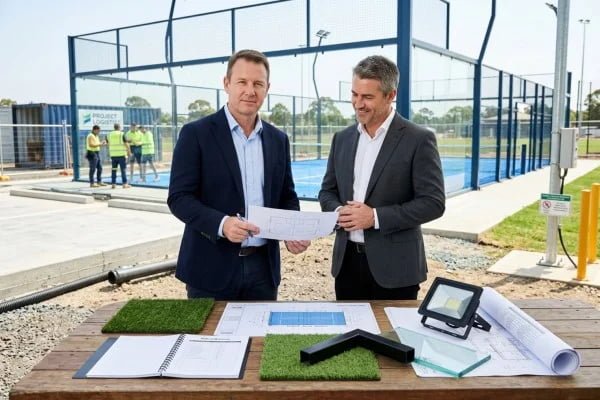
Buyers can control the padel court cost in Australia by completing site due diligence, issuing one comparison schedule to every supplier, confirming the bill of materials, obtaining local installation prices, verifying documents, and setting a contingency. The purchase decision should consider total landed risk rather than equipment price alone.
I Follow a Structured Procurement Process
I recommend the following sequence:
- I define the commercial use. The project team should record whether the court will serve a private venue, busy club, school, hotel, or public facility.
- I collect site information. The buyer should confirm dimensions, levels, access, environment, utilities, and known planning constraints.
- I consult local professionals. Qualified parties should review structural, civil, electrical, and approval requirements.
- I issue one technical schedule. Every supplier should quote the same court type, material requirements, documentation, and delivery point.
- I compare the complete scope. The evaluation should include products, logistics, civil works, installation, documentation, warranty, and exclusions.
- I verify critical evidence. The buyer should check certificates, reports, drawings, references, and manufacturing records.
- I agree on interfaces. The contract should assign responsibility for dimensions, foundations, anchors, unloading, installation, and electrical work.
- I plan spares and claims. The parties should define spare quantities, damage reporting, replacement lead times, and freight responsibility.
- I retain a realistic contingency. The buyer should base the allowance on the project’s unresolved risks rather than using one universal percentage.
- I approve before production. The project team should sign off drawings, colours, turf specifications, lighting, packing, and delivery details.
I Evaluate the Supplier’s Delivery Capability
Price remains important, but I also examine whether the supplier can reliably produce and ship the agreed package. Relevant questions include:
- Can the supplier provide a complete and version-controlled bill of materials?
- Can the factory demonstrate quality checks for steel fabrication, glass, turf, lights, and packing?
- Can the supplier maintain consistent component numbering?
- Can the factory provide production and loading records?
- Can the supplier explain standard and customised lead times?
- Can the supplier support installation questions across time zones?
- Can the supplier provide replacement components with traceable specifications?
For context, QHPADEL operates 10 production lines and reports monthly capacity above 1.5 million square metres of artificial turf and 150 complete court systems. Our standard stated lead times range from about 20 days for two courts to no more than 30 days for orders above four courts, while custom styles can take up to 35 days. Buyers should treat all lead times as quotation-specific commitments and confirm them in the contract.
Production speed alone does not control the final padel court cost in Australia. A court that arrives before the slab is ready can create storage and handling costs. Good scheduling should align design approval, production, shipping, customs clearance, site preparation, and installation.
Frequently Asked Questions
How much does a padel court cost in Australia?
I do not recommend using one fixed national price. The total depends on the court specification, exchange rates, freight, site conditions, foundations, drainage, professional services, approvals, installation, and supporting facilities. Buyers should obtain current equipment and local construction quotations for a realistic project budget.
Is importing a padel court cheaper than buying locally?
Importing can reduce the equipment price in some cases, but I would compare complete landed and installed scopes. A local quotation may include services that an overseas factory price excludes. Buyers should normalise product specifications, freight, taxes, documentation, installation, warranty response, and local responsibilities before deciding.
What should a complete padel court quotation include?
I expect a complete quotation to identify the steel structure, mesh, tempered glass, artificial turf, lighting, net, fasteners, doors, accessories, spare parts, packaging, drawings, documentation, warranty, delivery term, and exclusions. The buyer should separately identify foundations, unloading, installation, electrical work, and approvals.
Do overseas certificates guarantee Australian compliance?
No. I treat certificates and test reports as evidence that buyers and qualified professionals must verify. Buyers should confirm the issuer, tested product, standard edition, validity, and project relevance. An overseas manufacturer should not replace the local engineer, certifier, electrician, customs adviser, or approval authority.
Why do cheap padel court quotations become expensive later?
Cheap quotations become expensive when they omit components or leave responsibilities unclear. Freight changes, missing fasteners, unsuitable foundations, poor packaging, redesigns, storage, installation delays, and replacement shipments can erase the initial saving. I recommend resolving these gaps through a detailed scope matrix before placing an order.
Conclusion
Padel in Australia is expensive because buyers must fund a complete, site-specific facility rather than a single equipment package. I recommend separating factory, landed, and installed costs; comparing every quotation line by line; and confirming local engineering, civil works, installation, and approval responsibilities. Buyers should also verify certificates instead of assuming that documents guarantee project compliance. If you need a detailed padel court bill of materials or a quotation structured for like-for-like comparison, contact Alice Chen at alice@grass-supplier.com or +86 185 7566 0746.
-
"Incoterms", https://en.wikipedia.org/wiki/Incoterms. The International Chamber of Commerce explains that Incoterms rules allocate defined responsibilities for delivery, costs, and transfer of risk between buyers and sellers in international sales contracts. Evidence role: definition; source type: institution. Supports: International Chamber of Commerce material should support that Incoterms allocate specified delivery obligations, costs, and risk between contracting parties.. Scope note: Incoterms do not by themselves determine product specifications, payment terms, title transfer, or all contractual liabilities. ↩
-
"Marine Atmospheric Corrosion of Carbon Steel: A Review – PMC", https://pmc.ncbi.nlm.nih.gov/articles/PMC5506973/. Australian building and structural-design guidance requires relevant site and environmental conditions, including wind actions, ground conditions, and exposure, to be considered in the design of building elements and associated works. Evidence role: mechanism; source type: government. Supports: Australian building and structural-design guidance should support that design actions and construction solutions are determined with reference to location, wind, ground, drainage, exposure, and site conditions.. Scope note: The exact requirements depend on the jurisdiction, classification, structural system, and site assessment. ↩
-
"Development and Use of an Australian Atmospheric …", https://www.academia.edu/17023621/Development_and_Use_of_an_Australian_Atmospheric_Corrosivity_Standard. Atmospheric-corrosion research shows that chloride deposition and wetness in marine environments can increase corrosion rates of exposed steel and other metals, making exposure classification relevant to protective-system selection. Evidence role: mechanism; source type: research. Supports: Corrosion research should support that airborne marine salts and moisture can accelerate atmospheric corrosion of exposed metals.. Scope note: Actual corrosion performance also depends on microclimate, coating condition, detailing, maintenance, and material specification. ↩
-
"Cost of importing goods – Australian Border Force", https://www.abf.gov.au/importing-exporting-and-manufacturing/importing/cost-of-importing-goods. Australian border and tax authorities state that importers must satisfy applicable import-entry and regulatory requirements and may be required to pay customs duty and import GST. Evidence role: general_support; source type: government. Supports: Australian Border Force and Australian Taxation Office guidance should support that importers must meet customs obligations and may be liable for applicable duty and GST.. Scope note: Liability and payment arrangements can differ where a customs broker, carrier, or contractual party acts on the importer’s behalf. ↩