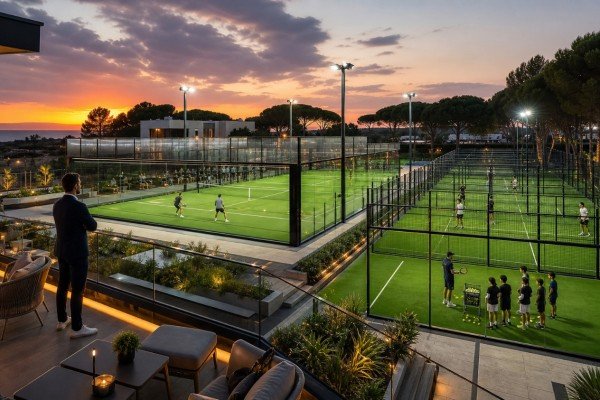

Many commercial real estate developers observe the exploding global popularity of racquet sports1 and immediately wonder: is a padel court profitable as a long-term investment? Unfortunately, buying the absolute cheapest equipment on the market often leads to a financial nightmare of structural failures, safety liabilities, and constant repairs. The true path to sustainable revenue requires understanding and controlling long-term lifecycle costs.
Yes, a padel court is highly profitable when investors focus on a 5-year Total Cost of Ownership (TCO) rather than just minimizing the initial purchase price. Long-term profitability is achieved by matching structural materials to the local climate, using certified safety glass to prevent business downtime, and selecting high-density turf to retain paying players.
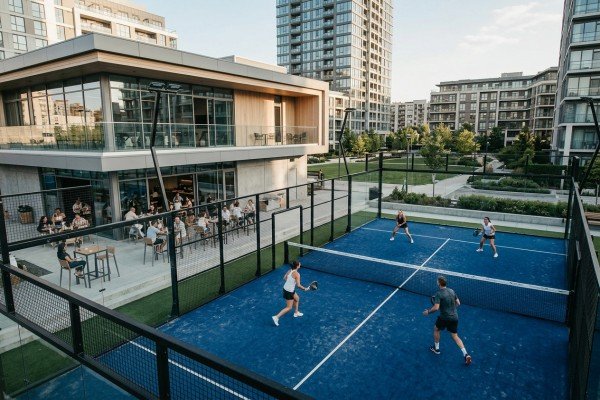
Wondering why initial manufacturing quotes vary so wildly across the industry? Let’s dive into the core engineering and procurement choices that will either protect your facility’s cash flow or drain your commercial business dry over the next five years.
Is a padel court profitable in coastal or harsh climates?
You have secured a premium piece of real estate, but unpredictable local weather severely threatens your new capital investment. High coastal winds and heavy humidity will quickly destroy a standard indoor-grade court, turning a revenue-generating asset into a rusted liability. The solution starts with climate-specific manufacturing.
The local climate dictates if a padel court is profitable because weather conditions determine the necessary structural materials. Coastal or high-wind environments require hot-dip galvanized steel, specialized zinc-rich primers, and hurricane-resistant frames. Ignoring these factors leads to rapid rusting, structural deformation, and total asset loss.
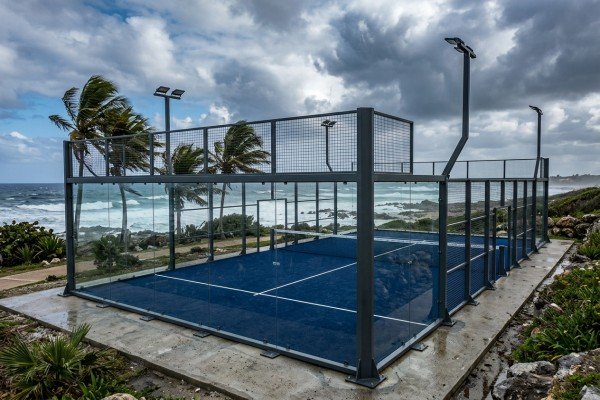
As a manufacturer with over a decade of production and export experience, my first reality check for any buyer asking about profitability is always: "Is your court going to be indoor or outdoor, and what exactly is your local climate?"
Far too often, new investors operating in coastal areas or tropical climates procure standard, minimally treated steel frames because the initial quote looks attractive. They fail to realize that salt-heavy sea air or monsoon-level rains will eat through standard powder coating in a matter of months.
To keep a padel court profitable, you must align the manufacturing specifications directly with the environmental stress the court will endure. We categorize these requirements strictly because the business value of weather resistance is absolute.
Environmental Risk Mitigation
| Environmental Factor | Recommended Manufacturing Spec | Direct Business Value (Financial Impact) |
|---|---|---|
| Coastal / High Humidity | Hot-dip galvanizing + Zinc-rich primer | Prevents aggressive rust-induced downtime; saves thousands in continuous repainting and sanding labor. |
| High Wind / Typhoon Zones | Thicker steel profiles (Hurricane-resistant courts) | Prevents complete structural frame collapse during severe storms; eliminates the risk of total rebuilds. |
| Extreme Sun / UV Exposure | Premium UV-resistant powder coating | Prevents paint chalking and peeling; maintains a premium aesthetic to justify high hourly booking rates. |
I once worked with an investor in Southeast Asia who initially bought low-cost courts from an unverified supplier. After just one heavy monsoon season, the metal frames were so dangerously rusted that structural integrity was compromised. They had to shut down their facility for over a month to tear everything down and replace the structures with our hurricane-resistant models. That month of zero cash flow, combined with the cost of buying the frames twice, completely wiped out their initial "savings."
Why is cheap glass the biggest threat to a padel court profitable business model?
Securing funding and a reliable civil contractor for a padel club is difficult, making the temptation to cut corners on bulk materials incredibly high. But installing cheap, uncertified glass puts players at severe physical risk and your business at massive legal risk. High-quality tempered glass is non-negotiable for protecting your venue’s operations.
Cheap glass threatens a padel court profitable business model by causing frequent shattering, severe safety liabilities, and extended business closures. Investing in CE or AS/NZS certified tempered glass eliminates these operational risks, ensuring continuous court availability and protecting the commercial investor from catastrophic injury lawsuits.
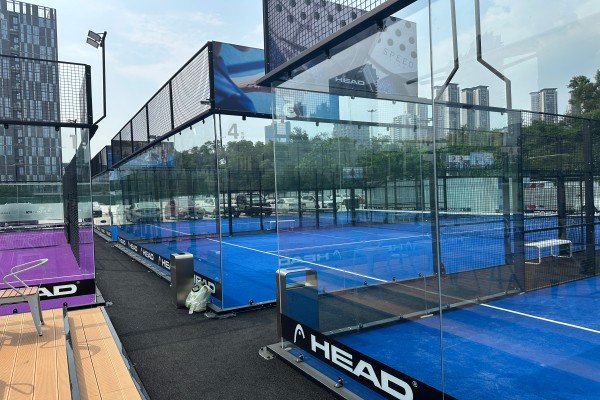
Glass is a massive structural component of any modern padel facility. In fact, Panoramic Courts (which rely heavily on large, uninterrupted glass panels) account for 50% of our global sales at QHPADEL, while Ultra Panoramic Courts make up another 40%. Because glass is so integral to the modern player experience, when a panel shatters, that specific court is completely closed. Zero play means zero revenue.
If you approve the procurement of low-quality glass without demanding proper international certifications, you are effectively playing Russian roulette with your financial projections.
The Financial Fallout of Sub-Standard Glass
- Catastrophic Revenue Loss: Sourcing a custom 10mm or 12mm tempered glass panel locally after a shatter event can take weeks, especially if your local market does not stock padel-specific dimensions. Those weeks of waiting equate to thousands of dollars in lost court rental fees.
- Severe Legal Liabilities: If a player crashes into uncertified glass and it breaks into dangerous, jagged shards rather than safe, blunt cubes, your business faces massive lawsuits that can bankrupt an operation overnight.
- Compound Replacement Costs: Continually replacing cheap glass panels over a 5-year span costs exponentially more than buying properly tested glass on day one.
I strictly advise all commercial buyers to demand legitimate test reports from their suppliers. Do not just look for a basic CE stamp on a brochure. Ask your manufacturer if their glass complies with AS/NZS 4666:2012 or AS/NZS 2208:1996, and whether they have passed a rigorous bulletproof test. These technical specifications are not just dry numbers; they act as the ultimate insurance policy that keeps your business open and generating revenue every single day.
Can low-quality turf destroy a padel court profitable investment?
Players expect a consistent, high-performing athletic surface every single time they book a match. Unfortunately, low-quality turf quickly develops bald spots, shedding yarns, and poor drainage, driving loyal players to competing venues. Premium artificial grass is essential for ensuring high customer retention.
Low-quality turf destroys a padel court profitable investment by ruining the playing experience and causing immediate customer churn. Fast-wearing, slippery, or poorly draining grass leads to cancelled matches. Utilizing turf with high Dtex and optimal density ensures long-term durability and keeps players returning.
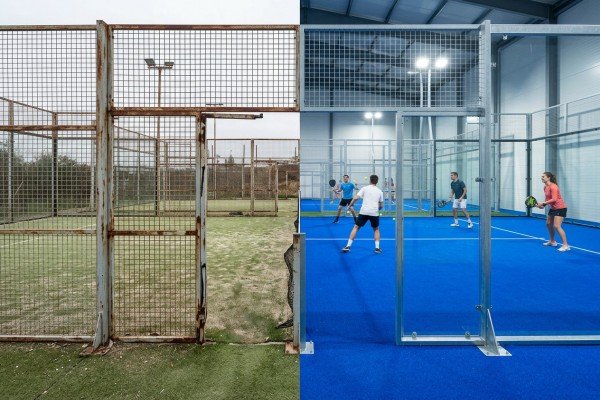
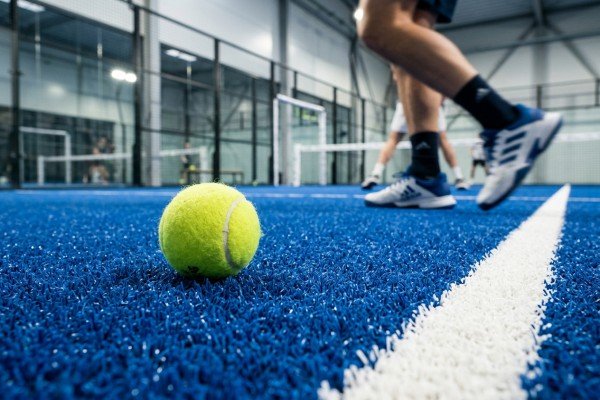
The artificial turf is the only component of the court that the player physically interacts with continuously throughout a match. If the surface is slippery, holds stagnant water after a rainstorm, or wears down to the backing within months, players will notice instantly. A highly profitable club model relies entirely on repeat bookings. You cannot sustain commercial success if players refuse to return because your turf ruined their game or caused joint pain.
Operating a factory with 10 production lines and a monthly output exceeding 1.5 million square meters of artificial turf, I constantly see new investors fixate on turf color while completely ignoring the structural specifications that dictate lifespan.
Translating Turf Specs into Business Value
You do not need to be a textile engineer, but you do need to understand how turf parameters directly impact your bottom line. At QHPADEL, we offer customization (with an MOQ of 6 courts, or 1254 sqm), but we always guide clients toward specific performance thresholds.
- Dtex (Yarn Weight/Thickness): A higher Dtex means thicker, more resilient blades of grass. High-Dtex turf resists flattening and shedding in high-traffic zones (such as the service line and net area). Less shedding means you do not have to endure the massive cost of replacing the entire turf roll every 12 to 18 months.
- Stitch Density: High density provides superior silica sand retention. This ensures a consistent, predictable ball bounce. If the ball bounce is dead, competitive players will immediately migrate to your competitors.
- Drainage Capacity: Proper backing allows rainwater to flow directly through the turf into the foundation. If your court holds water, you lose lucrative evening booking revenue after every afternoon storm.
Spending an extra fraction of your budget on ISO9001, CE, and RoHS certified artificial turf upfront can easily double the lifespan of your playing surface. This saves you thousands in premature material replacement costs and protects your primary source of income: the players.
It is thrilling to receive an initial supplier quote that comes in 30% lower than the rest of the market. Yet, that initial euphoria vanishes rapidly when structural components start failing just six months post-installation. The true hidden cost of a bad procurement decision is paying to rebuild your entire venue from scratch.
The hidden cost of buying cheap equipment is the reality of "buying twice." Investors who chase the lowest initial quote inevitably face catastrophic maintenance costs, extensive business downtime, and eventually pay a reliable manufacturer to completely tear down and rebuild their failing courts.
Over my years managing international exports—shipping over 600 containers annually—I have received countless panicked calls from civil contractors and real estate developers. They procured courts from a middleman broker based purely on the lowest price tag. Fast forward a year, their structures are warped, the foundation is mismatched, screws are snapping, and they are hemorrhaging cash.
Making a padel court profitable is not about finding the cheapest steel; it is strictly dictated by controlling your 5-Year Total Cost of Ownership (TCO)2.
The 5-Year TCO Breakdown
Let’s evaluate two distinct procurement scenarios over a five-year operational period:
Scenario A (The Cheap Trap): You choose the lowest initial bid. The supplier provides no foundation drawings, causing expensive delays with your local civil contractor. Within two years, uncertified screws rust and snap, glass panels shatter, and the thin turf requires full replacement. Add the cost of business closure during these extensive repairs, and your total cost skyrockets past your initial budget.
Scenario B (The Quality Investment): You partner with a factory that provides a complete Bill of Materials (BOM) with zero missing parts. The manufacturer holds AD 2000 WO and PED 2014/68/EU quality system approvals for all screws and accessories. The initial cost is higher, but structural failures are zero. The courts require only basic, routine maintenance, allowing for continuous daily revenue generation over the full five years.
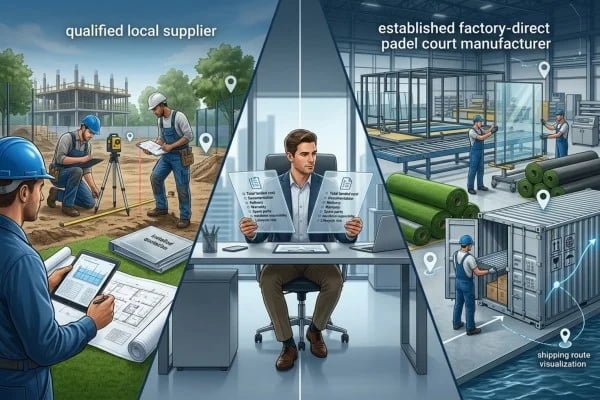
I recently worked with an investor in South America who literally had to demolish four low-quality courts entirely. He then hired us to manufacture and ship our premium panoramic systems. Buying the cheap courts first cost him hundreds of thousands of dollars in lost market momentum, wasted foundation work, and replacement fees. Always evaluate your supplier’s certifications, precise installation drawings, and packaging reliability before signing any contract.
Frequently Asked Questions
How long does it take to manufacture a commercial padel court?
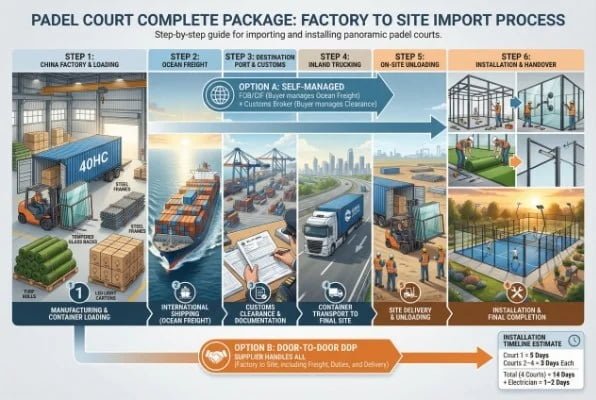
For standard models, a reliable factory with high capacity can produce two courts in roughly 20 days, and up to four courts in 20-25 days. Custom-designed styles usually take no more than 35 days, allowing local civil contractors to plan site preparation timelines accurately.
What is the most popular type of padel court for new clubs?
The Panoramic Court is the dominant choice globally, accounting for approximately 50% of our total sales. It offers excellent visibility for spectators, creates a premium aesthetic that helps justify higher booking fees, and is highly preferred by commercial club operators.
How do I know if my padel court structural frame is safe?
Always request CE certification and verify the factory uses high-quality fasteners with AD 2000 WO approval. The structural frame must be engineered with precise hole positions to ensure accurate, safe installation, and must be matched to your local wind and weather conditions.
Conclusion
To definitively answer the question—is a padel court profitable?—the answer is a resounding yes, but only when you protect your capital investment from catastrophic downtime and hidden maintenance traps. Commercial success requires treating the court as a resilient 5-year asset rather than a cheap, one-time purchase. By selecting climate-appropriate steel frames, internationally certified tempered glass, and high-density durable turf, you guarantee continuous play and strong, predictable cash flow.
At QHPADEL, we leverage over 10 years of manufacturing experience to produce fully certified, complete padel court systems built for maximum durability and long-term business success. Don’t risk your investment on sub-standard equipment. Reach out to Alice Chen today at alice@grass-supplier.com or via WhatsApp at +86 185 7566 0746, and visit www.qhpadel.com to discuss customized, risk-free court packages for your next commercial project.
-
"FIP World Padel Report 2025", https://www.padelfip.com/world-padel-report-2025/. According to the International Padel Federation (FIP), global participation in padel has grown exponentially, with millions of active players across over 90 countries. Evidence role: statistic; source type: institution. Supports: Provides statistics on the global growth rate and participation numbers for padel and other racquet sports.. Scope note: Participation metrics often rely on self-reported data from national federations and may vary by region. ↩
-
"Total cost of ownership – Wikipedia", https://en.wikipedia.org/wiki/Total_cost_of_ownership. Total Cost of Ownership (TCO) is a management accounting concept that evaluates the complete lifecycle cost of an asset, incorporating the initial purchase price alongside long-term maintenance, operational, and replacement expenses. Evidence role: definition; source type: encyclopedia. Supports: Defines Total Cost of Ownership (TCO) as a comprehensive financial estimate of direct and indirect costs over an asset’s lifecycle.. ↩